Confused - 6.5x55 showing pressure signs with low powder charges

Wessex4291

Well-Known Member
I am trying to load a round for my 20" Steyr Mannlicher Pro Hunter and am confused by what I am experiencing. I am trying to use the Yew Tree 6.5mm 112gr bullet with N150, CCI LR primers and new Lapua cases.

Starting advice was to use load data for 120gr Barnes TTSX and a jump of 50 thou, unfortunately after a few weeks searching I can't find any load data for Barnes TTSX that uses Vhit powders. So I started with Vhits data for N150 with 120gr Scenars which, gives a max load of 40.9gr, I originally started at 38.2gr and worked up in 0.3 gr steps. After seeing issues at 38.8gr, I stopped, pulled the rounds and started another ladder at 36.1gr, I am still seeing pressure signs at almost 5grs under the suggested max load. Using Gordon's Reloading Tool, as a guide, a 38.2gr load only produces peak pressure of 2722 bar, and a MV of 2541ft/s which gives a ME of 1606ftlb which is not enough to be deer legal.

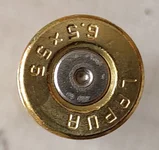
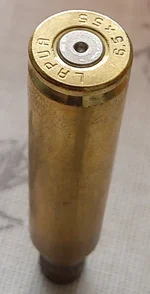
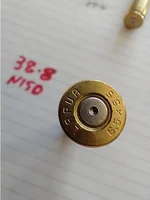
From 37.3grs I started to intermittently get very faint markings that look like ejector rings and swipe, the rings do not feel raised at all. I then saw primer cratering at 38.5 and 38.8gr. Pictures attached are of 38.2 gr and 38.8gr cases. The two without any writing in the background are both the same case that had a 38.2gr powder charge.

I have rechecked the point at which the bullets jam in the rifling 3 times now and have got the same readings of COAL of 3.047" which gives a COL of 2.548" at jam, which gives a COAL for 50 thou jump of 2.997". I weighed every charge using a new RCBS mechanical scale and a tickler, the scales give me reliable and repeatable readings when I weigh the bullets.

Comparing base to shoulder length using a hornady comparator shows that the once fired cases are 8 thou longer than the new cases, the fired cases still chamber without any additional force on the bolt, but will not chamber if I add 2 thou of masking tape to the base.

What confuses me is that these pressure signs seem to happen at such a low powder charge. Having scoured the internet there seems to be a suggestion that excessive headspace could cause this. Is it likely that by having 9thou of headspace that the case is being forced into the bolt face hard enough to generate pressure signs and that if I was to bump the fired case shoulders 2thou and reload that I wouldn't see the same pressure signs until a higher charge? Is there anything else that would be worthwhile checking or should I just try a different powder?

Thanks
 

Attachments

  • 20210624_123658.webp
    20210624_123658.webp
    110.1 KB · Views: 79
  • 20210624_123711.webp
    20210624_123711.webp
    77.5 KB · Views: 79
  • image.webp
    image.webp
    106.8 KB · Views: 80
YewTree is on this site and has been extremely helpful to many in the recent past - suggest you pm for his recs.
Good luck.
🦊🦊
 
New brass can give false indicators, so properly bumped back reloads are more likely to give more reliable results.
You may be better if you record bullet velocity. As pressure is what you're interested in and the two are linked.
The catering may be a function of bolt head and firing pin shape/clearance. Also have you changed to a different primer.
Chrony readings are truer than computer predictions any day.
Ian
 
I can see the extractor shadow but primer is still rounded in shoulder and I wouldn't call that cratered.
My suspicion is the shoulder has been oversized and the mark is from it being pushed back into the bolt face as the pressure goes up, so headspace as you say.
Try neck sizing and see what happens...
 
If you go into the bullet data section for the bullet in GRT, you will see a variable called "bullet resistance". In the free "nightly" version, this is set at "default" and you cannot change it, but in the paid-for Patreon version, I believe you can vary this. In the QuickLOAD manual, Hartmut Broemel says that the bullet resistance for monolithics is twice what it is for cup-and-core bullets in QL.

Running your load of 38.2 grains of N150 behind a 120 grain conventional "copper jacketed" bullet in P-Max (with 52 grains H2O powder space) I get 2533 ft/sec. for a peak pressure of 2841 bar, which is pretty good agreement with your GRT output. However, if I use the "monolithic" bullet option, the pressure jumps to 3338 bar, with a MV of 2607 ft/sec.

To get a pressure of 3338 bar with the "copper jacketed" bullet option in P-Max, I find I need another 2.1 grains of powder, bringing the load up to 40.3 grain. Vhitavuori quote 40.9 grains of N150 as a max load, behind a 120 Scenar, and you were seeing pressure signs pretty close to that, effectively, with 38.2 grains N150 behind a monolithic.

So, nothing to get confused about. Just a nice example of why you need to download when using monolithics.
 
My experience with 6.5x55

1. N150 worked well for 100gr but was too fast and somewhat unpredictable with 120s. I remember the charge weight for 120s was significantly lower and pressure seemed to ramp up quickly.
2. Scenar load data cannot be used as a base for anything. They’re VLDs
3. I don’t rate QL - a chrono is more useful.

The golden rule is pressure signs are pressure - discount at your peril. Headspace masks primer appearance, I don’t believe it makes much odds with ejector marks.
I think you have a poor powder choice, have the wrong start load base and are blind because no chrono.
I note many mono bullet makers recommend faster powders to help bullet start and engraving. If it’s not working for you try a more conventional powder such as N160
 
@Wessex4291
there is load data for the Barnes TSX, which isn't fundamentally different from the TTSX.
Pasted from Viht site.
Bullet7,8 g / 120 grBarnes, TSXC.O.L. 71,2 mm / 2.803 inch
PowderStarting loadMaximum load
TypeWeightVelocityWeightVelocity
[g][grs][m/s][fps][g][grs][m/s][fps]
N1602,7242.081526742,9946.18862907
N1653,2450.086228283,4052.59092982
N5603,0647.283827493,2550.29022959
 
@Wessex4291
there is load data for the Barnes TSX, which isn't fundamentally different from the TTSX.
Pasted from Viht site.
Bullet7,8 g / 120 grBarnes, TSXC.O.L. 71,2 mm / 2.803 inch
PowderStarting loadMaximum load
TypeWeightVelocityWeightVelocity
[g][grs][m/s][fps][g][grs][m/s][fps]
N1602,7242.081526742,9946.18862907
N1653,2450.086228283,4052.59092982
N5603,0647.283827493,2550.29022959
Thank you, I couldn't find it despite lots of googling!

Although, I've worked out why now. It's under the Swedish Mauser section not the SKAN. I was of the understanding that Swedish Mauser covered the older lower pressure actions.
 
I had the same with vhit n160 and 120 & TTSX, even with several grains below max. Reckon seating was still too deep @2.85 &2.95 in hindsight and compressing the load. Only occurred to be to sense check a bullet head next to a loaded round to see how far in the case it was…. Bloody frightened me! I’m at 3.05col now using peregrines and getting good accuracy and velocity with RS62 but with no pressure signs.
 
If you go into the bullet data section for the bullet in GRT, you will see a variable called "bullet resistance". In the free "nightly" version, this is set at "default" and you cannot change it, but in the paid-for Patreon version, I believe you can vary this. In the QuickLOAD manual, Hartmut Broemel says that the bullet resistance for monolithics is twice what it is for cup-and-core bullets in QL.

Running your load of 38.2 grains of N150 behind a 120 grain conventional "copper jacketed" bullet in P-Max (with 52 grains H2O powder space) I get 2533 ft/sec. for a peak pressure of 2841 bar, which is pretty good agreement with your GRT output. However, if I use the "monolithic" bullet option, the pressure jumps to 3338 bar, with a MV of 2607 ft/sec.

To get a pressure of 3338 bar with the "copper jacketed" bullet option in P-Max, I find I need another 2.1 grains of powder, bringing the load up to 40.3 grain. Vhitavuori quote 40.9 grains of N150 as a max load, behind a 120 Scenar, and you were seeing pressure signs pretty close to that, effectively, with 38.2 grains N150 behind a monolithic.

So, nothing to get confused about. Just a nice example of why you need to download when using monolithics.
Had to to read this more that once, 🤪 but I think I got there in the end.

Really helpful post.
 
Thank you for wading through my post and for your thoughts, chronographing is definitely in the near future!

I think the next step is to try N160 with the Barnes data from the Vhit site. I would like a load that works in new brass, otherwise I have 74 cases to fire form!
 
Can't see any excess pressure signs. If the the recess around the primer wasn't visible then yes.cant see a prominent extractor mark either.

My GP says I need glasses

Wot does she know 😳
 
I am trying to load a round for my 20" Steyr Mannlicher Pro Hunter and am confused by what I am experiencing. I am trying to use the Yew Tree 6.5mm 112gr bullet with N150, CCI LR primers and new Lapua cases.

Starting advice was to use load data for 120gr Barnes TTSX and a jump of 50 thou, unfortunately after a few weeks searching I can't find any load data for Barnes TTSX that uses Vhit powders. So I started with Vhits data for N150 with 120gr Scenars which, gives a max load of 40.9gr, I originally started at 38.2gr and worked up in 0.3 gr steps. After seeing issues at 38.8gr, I stopped, pulled the rounds and started another ladder at 36.1gr, I am still seeing pressure signs at almost 5grs under the suggested max load. Using Gordon's Reloading Tool, as a guide, a 38.2gr load only produces peak pressure of 2722 bar, and a MV of 2541ft/s which gives a ME of 1606ftlb which is not enough to be deer legal.

From 37.3grs I started to intermittently get very faint markings that look like ejector rings and swipe, the rings do not feel raised at all. I then saw primer cratering at 38.5 and 38.8gr. Pictures attached are of 38.2 gr and 38.8gr cases. The two without any writing in the background are both the same case that had a 38.2gr powder charge.

I have rechecked the point at which the bullets jam in the rifling 3 times now and have got the same readings of COAL of 3.047" which gives a COL of 2.548" at jam, which gives a COAL for 50 thou jump of 2.997". I weighed every charge using a new RCBS mechanical scale and a tickler, the scales give me reliable and repeatable readings when I weigh the bullets.

Comparing base to shoulder length using a hornady comparator shows that the once fired cases are 8 thou longer than the new cases, the fired cases still chamber without any additional force on the bolt, but will not chamber if I add 2 thou of masking tape to the base.

What confuses me is that these pressure signs seem to happen at such a low powder charge. Having scoured the internet there seems to be a suggestion that excessive headspace could cause this. Is it likely that by having 9thou of headspace that the case is being forced into the bolt face hard enough to generate pressure signs and that if I was to bump the fired case shoulders 2thou and reload that I wouldn't see the same pressure signs until a higher charge? Is there anything else that would be worthwhile checking or should I just try a different powder?

Thanks
Honestly those cases look fine to me?
 
I am trying to load a round for my 20" Steyr Mannlicher Pro Hunter and am confused by what I am experiencing. I am trying to use the Yew Tree 6.5mm 112gr bullet with N150, CCI LR primers and new Lapua cases.

Starting advice was to use load data for 120gr Barnes TTSX and a jump of 50 thou, unfortunately after a few weeks searching I can't find any load data for Barnes TTSX that uses Vhit powders. So I started with Vhits data for N150 with 120gr Scenars which, gives a max load of 40.9gr, I originally started at 38.2gr and worked up in 0.3 gr steps. After seeing issues at 38.8gr, I stopped, pulled the rounds and started another ladder at 36.1gr, I am still seeing pressure signs at almost 5grs under the suggested max load. Using Gordon's Reloading Tool, as a guide, a 38.2gr load only produces peak pressure of 2722 bar, and a MV of 2541ft/s which gives a ME of 1606ftlb which is not enough to be deer legal.

From 37.3grs I started to intermittently get very faint markings that look like ejector rings and swipe, the rings do not feel raised at all. I then saw primer cratering at 38.5 and 38.8gr. Pictures attached are of 38.2 gr and 38.8gr cases. The two without any writing in the background are both the same case that had a 38.2gr powder charge.

I have rechecked the point at which the bullets jam in the rifling 3 times now and have got the same readings of COAL of 3.047" which gives a COL of 2.548" at jam, which gives a COAL for 50 thou jump of 2.997". I weighed every charge using a new RCBS mechanical scale and a tickler, the scales give me reliable and repeatable readings when I weigh the bullets.

Comparing base to shoulder length using a hornady comparator shows that the once fired cases are 8 thou longer than the new cases, the fired cases still chamber without any additional force on the bolt, but will not chamber if I add 2 thou of masking tape to the base.

What confuses me is that these pressure signs seem to happen at such a low powder charge. Having scoured the internet there seems to be a suggestion that excessive headspace could cause this. Is it likely that by having 9thou of headspace that the case is being forced into the bolt face hard enough to generate pressure signs and that if I was to bump the fired case shoulders 2thou and reload that I wouldn't see the same pressure signs until a higher charge? Is there anything else that would be worthwhile checking or should I just try a different powder?

Thanks
I have worked up a load for a client rifle in 6.5x55 today with N150 and my bullets. I suggest you are low in your charge weights and the case is not obdurating properly in the chamber. Hence it’s pushing back into the bolt and giving pressure signs. I will post charge weight range tomorrow when I look it up in the morning.
I am here to help if you are struggling for whatever reason to get a load email me or pm me on here. I have fired more of them than anyone and want them to be a success(clearly).
Cheers
Rich
 
So by way of explanation in terms of my methodology in load development today.
Used quickload with my bullet for N150 then sense checked against data for the 120 barnes. Ended up with a charge weight range of 41-43.5 grains N150. Loaded this up in half grain increments. Fired groups at all these charge weights. Fired cases showed exactly what I expected with gradual flattening of the primer throughout the range. No stiff bolt lift or ejector marks on any of the loads. 41.5 grains showed excellent elevation and 42 was a lovely cloverleaf group although a bit too big 3/4 moa for my liking. Went back to armoury confident that somewhere between those charge weights would work to my satisfaction.
Having originally started at 70 thou off (due to the very long throat on the swede) loaded 41.6 at 10 thou increments from 70 thou to 110 thou off, Sweet spot turned out to be 90 thou off. shot that group 3 times all 1/2 MOA.
 
My experience with 6.5x55

1. N150 worked well for 100gr but was too fast and somewhat unpredictable with 120s. I remember the charge weight for 120s was significantly lower and pressure seemed to ramp up quickly.
2. Scenar load data cannot be used as a base for anything. They’re VLDs
3. I don’t rate QL - a chrono is more useful.

The golden rule is pressure signs are pressure - discount at your peril. Headspace masks primer appearance, I don’t believe it makes much odds with ejector marks.
I think you have a poor powder choice, have the wrong start load base and are blind because no chrono.
I note many mono bullet makers recommend faster powders to help bullet start and engraving. If it’s not working for you try a more conventional powder such as N160
1. I agree have always felt 150 'suddenly' shows pressure, doesn't mean it's a bad powder though.
2. Agree with respect to cross referencing for monos
3. to be fair QL is a good indicator of chamber pressures but also agree a chrono is a must have.

Thoroughly agree with your paragraph other than the powder choice bit, With the correct charge weight range it works very well.
Just my 2p
cheers
Rich
 
Back
Top