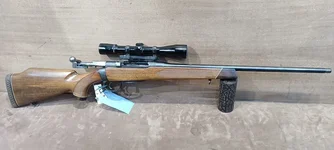
The Lee Enfield Rifle Association (LERA) LERA's aims are to promote the shooting, collection, and study of the Lee Enfield series of rifles. The majority of members shoot either the SMLE or the No 4, however many of the rarer marks are owned by members.

lee-enfield.org
The Zeroing Of Rifles (According to the REME)
(Taken from the Précis by the Technical Training School REME)
By the term "zeroing" we mean the adjustment of the sights of a weapon so as to give the correct position of the shots on the target in relation to the point of aim.
An Armourer is always concerned with the permanent zeroing of a Rifle, which is effected by the adjustment of, or the fitting of a new blade to the Foresight. In passing it is as well to remember that a temporary adjustment for errors in elevation, can be made by altering the Backsight, e.g. if the mean point of impact (MPI) of a group of shots is below the correct position it can be corrected by raising the Backsight, similarly if an error above the correct position is obtained it can be corrected by lowering the Backlight. If the Rifle is fitted with a Windgauge Backsight, errors of deflection can be adjusted in the same way. It will be seen that in each case the Backsight is moved AWAY from the error.
On the Mk1 leaf sight - 1 click = 1 minute = 1 inch at 100 yds (approx)
In adjusting the Foresight however, the opposite rule applies. If a Rifle is shooting low the Foresight must be moved down or TOWARDS the error (i.e. a lower blade must be fitted).
To enable Rifles to be zeroed, a moveable blade is fitted into a dovetail base, thereby allowing the blade to be moved from side to side to correct lateral errors.
The Foresight Blades are also made in varying heights so that the vertical errors can be corrected by the replacement of the existing blade by one of a different height.
There are varying sets of blades for the different types of Rifles, but on all those Rifles a blade marked "0" is provided, the tip of which when fitted to the Rifle is exactly one inch above the axis of the bore.
All other blades graduate from this "0" or zero blade either above or below it in constant increments. In the case of British Rifles this increment is .015". If a blade is lower than the zero blade it is referred to as a "minus" blade, and if it is above it becomes a "plus" blade.
All blades are marked so as to be easily recognised, those below the zero having as a prefix the minus sign e.g. —.015". The "plus" sign is not used; therefore a blade with only a figure, e.g. .015", is always a plus blade.
Sight Blades are always fitted from the Left side of the rifle and tapped out from the Right.
(Note: This was the accepted wisdom with regard to the SMLE that didn't have a split block or screw, but I have found no evidence to suggest that there is any practical reason for it other than the fact that it followed the same rule that applied to screws, which all go in from the left, and in theory it should make no difference. RW)
The Mean Sight Radius is the distance from the aperture or "U" of the Backsight to the tip of the Foresight, and this differs on the various Rifles.
Rifle No.1 | 19” |
Rifle No. 4 | 28.74” |
Rifle No. 5 | 23.25” |
It will be appreciated that the Sight Radius governs the amount of adjustment made on the target by the fitting of a different size of blade foresight. The longer the Sight Radius the smaller will be the angle made between a line from the Backsight to the old blade and a line from the Backsight to the new blade.
To assess the difference which will be made by a change of Foresight use the following formula:—
RANGE x DIFFERENCE IN HEIGHT OF BLADES =VARIATION ON TARGET
SIGHT RADIUS OF WEAPON
To give a simple example, assume that we are going to replace an "0" blade with a —.015" blade on a Rifle No. 4, the Sight Radius of which is 28.74" and our range is 100 yards. By fitting a LOWER blade the resultant MPI will be HIGHER by:—
100 X 36 X 0.015 = 1.87"
28.74
As we included the figure 36 in our top line, bringing our 100 yards to inches, our answer is in inches. So that by replacing an "0" blade with a —.015" on a Rifle No. 4 we would raise our MPI by 1.87" at 100 yards.
With a Leaf Backsight fitted to a Rifle, the aperture or slide should be set at the lowest graduation, namely 200 yards. It is not however satisfactory to zero a Rifle at this range, and the ranges used are 100 yards or 25 yards. It will be seen therefore, that for the resultant MPI. to be correct, it would have to be somewhere above the point of aim, so that when actually firing at 200 yards, or at other ranges with the correct reading on the sight the shots will group AT the point of aim.
In the case of Rifle No. 4 fitted with an Mk 2 Backsight, the apertures of which are sighted for 300 and 600 yards, the Rifle will be zeroed using the 300 yard aperture with a Bayonet fixed. Therefore the correct position of the MPI at 100 yards or 25 yards would be even higher than with a leaf sight.
The small aperture Battle Sight on some Leaf Backsights manufactured by Savage Rifles is sighted for 400 yds.
Rifle | No
of
Blades | Lowest
Blade | Highest
Blade | Range | Variation in MPI with one alteration of Blade | Correct Position of MPI in relation to Point of Aim |
No. 1 | 7 | -.06” | .03” | 100 yds
25 yds | 2.77”
0.69” | 3” above
¾” above |
No. 3 | 9 | -.015” | .135” | 100 yds
25 yds | 1.70”
0.50” | 3” above
¾” above |
No. 4 | 8 | -.03” | .075” | 100 yds
25 yds | 1.87”
0.475” | 3” above
¾” High |
No. 4
With
MK2
Back
Sight | 8 | -.03” | .075” | 100 yds
25 yds | 1.87”
0.475” | 6” above
1 ½” above |
No. 5 | 8 | -.03” | .075” | 100 yds
25 yds | 2.33”
0.582” | 3” above
¾” above |
Lateral adjustment will be made to the Foresight with the aid of a "Tools Foresight, Cramp." There are different patterns of these for the various Rifles, namely:—
Rifle | Cramp | One turn | One Width of Blade | | |
| | 25 yds | 100 yds | 25 yds | 100 yds |
| No. 1 | No. 1 Mk 1 | 1.6” | 7.4” | 2” | 8” |
| No. 1 | No. 1 Mk 2 | 2” | 8” | 2” | 8” |
| No. 3 | No. 2 | No Data available | | | |
| No. 4 | No. 3 | 1” | 5” | 1 ½” | 6” |
| No. 5 | No. 4 | 1 ½” | 6” | 2” | 8” |
1. 2. 3. 4.
On the Cramps Nos. 1 and 2 there is a deflection scale to guide adjustment.
Each division = 4” at 100 yds, otherwise each turn = 0.040”of movement.
One complete turn of the screw cramp X Range in inches.
Sighting Radius.
Example:
Weapon Rifle No. 4
Cramp No. 3. - 25 threads per inch (1/25th)
Range 100 yds. (3600”)
Sight Radius 28.74”
= .040" X 3600" = 5.010"
28.74"
= One complete turn of the screw cramp at 100 yds.