Steel pin tumbling vs ultrasound

zambezi

Well-Known Member
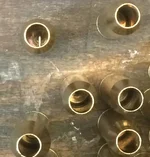
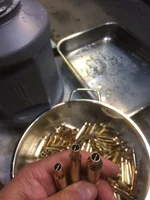
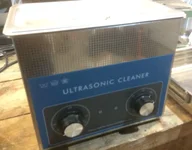
Until recently, I cleaned all of my cases using an ultrasound bath filled with 70℃ water, a squirt of Sunlight and teaspoon of citric monohydrate. IMG_6794.webp. I was always pretty happy with the cases which took perhaps 15 minutes to get 40 cases [cartridge size dependent] to reasonable cleanliness. Some primer pockets remained gummy and required additional mechanical abrading with a brush. Recently I bought a rotary tumbler with steel pin media Tumbler.webp. There are a number differences. First up, there can be no doubt that the steel media process yields a better overall finish [ultrasound cleaned shown on left in next image, steel pin tumbled cases on right] IMG_6790.webp. The steel pin media cleans the primer pockets too. Also, the rotary tumbler can process more cases in one go [up to 1000 x .223 cases] but takes 4 to 8 times as long to finish compared to the ultrasound bath. That is fine. You canjust go away and do something else. But the real issue is extracting all the steel pin media from the cases at the end IMG_6789.webp. It is a bit of a faff. The pins "stick" inside the wet cases IMG_6793.webp. I imagine that pins will fall out of a dried case in almost 100% of cleaning runs.
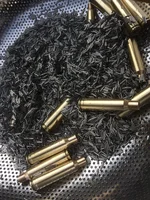
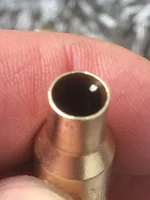

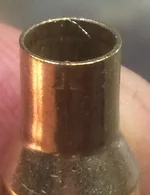
BUT...the pins are approx 6.5mm long...and in 4 cases of 6.5x55mm brass,pins were jammed horizontally in the neck of the case and had to be pinged out with a screwdriver. I cannot imagine not spotting that before reloading, but if you failed to remove...
 
Get a neodym magnet from a knackered old hard drive and it will pull the pins out (the pins are a magnetic form of stainless steel).

I already did that...not a perfect solution as tested:

Once cases were dry, I lined them up for a sweep IMG_6795.webp of the neodynium magnet [60mm diameter, claimed 150kg lifting force]. Even before I got magnet out, I spotted one more pin stuck in the neck of a case IMG_6796.webp. This would be useful in veryfying the magnet test capability and it did not disappoint as it lifted that case from the ranks IMG_6799.webp. But...I then dropped a loose pin into a clean case IMG_6798.webp and ran the magnet over the neck of that case.


The magnet failed to lift the pin from the bottom of the case! So unless I get a supersized magnet, I suspect the checking process will remain a laborious task utilising the mark 1 eyeball and a bright light
 
I pick the cases out of the drum individually and give each a shake whilst upside down and still in the water.
You soon learn if the case is empty or not.
That way the pins stay in the drum.
It has been suggested that small stainless balls work just as well and don't jam inside the case.

Cheers

Bruce

Just trying the 'balls' - but those buggers get stuck in the primer pocket!!. No free lunches!.
 
For the pins that get stuck, just throw them away. Eventually, the stuck pin in the neck problem goes away. I may try the spherical media when I go to recharge my stainless steel media though, as that is what jewelers have used for years.

As to getting the pins out of the case, I use a rotary device/separator (pour out most of the water first) to spin/tumble the cases so the pins fall out. (see link for a similar separator)

Media Separator

Makes separating the pins from the cases a simple task...

Also, the big problem a lot of people have (peened case necks) is due to people tumbling their cases far too long. 45 mins is all that is really needed, unless the brass is old range pick up brass that has turned brown. Cases that were cleaned when fired, don't require nearly that amount of time (3-4 hours).

One final thing. Instead of dish soap, try using a car wash soap that has a synthetic wax in it. This helps keep the cases from tarnishing once they're clean, and also helps lift/suspend the dirt and debris away from the case.

Carwash Soap with Synthetic Wax
 
Last edited:
pick up 2-3 cases, holding them upside down under the water, and give them a shake.

Pins drop straight out. Quick, and easy.

Adopted. 95% success. Still some clingers discovered post drying. The stuck pin event is recurrent. 6 on my next batch of brass IMG_6803.webp which was mixed 6.5x55mm and 6.5PRC. Removing the pins jammed horizontally in the case necks invariably scored the neck face IMG_6808.webp but probably not a significant issue. Agree with MarinePMI: chuck sticking pins. That said, I would have thought makers would select pin media length which avoided popular calibers. Any media sizes other than 6.5mm out there?

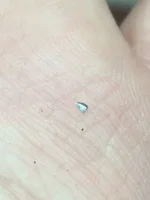
One serious concern: I found a tiny flake of steel IMG_6807.webp in one of the dried cases which must be the swarf off the end of a pin IMG_6806.webp. I did not see any steel swarf in sealed media bag, so guess this is the effect of pins striking each other?

I am definitely sticking with this method of cleaning brass. But I realise it will take greater care to ensure medi-free cases at the end of process.
 
Until recently, I cleaned all of my cases using an ultrasound bath filled with 70℃ water, a squirt of Sunlight and teaspoon of citric monohydrate. View attachment 225505. I was always pretty happy with the cases which took perhaps 15 minutes to get 40 cases [cartridge size dependent] to reasonable cleanliness. Some primer pockets remained gummy and required additional mechanical abrading with a brush. Recently I bought a rotary tumbler with steel pin media View attachment 225506. There are a number differences. First up, there can be no doubt that the steel media process yields a better overall finish [ultrasound cleaned shown on left in next image, steel pin tumbled cases on right] View attachment 225507. The steel pin media cleans the primer pockets too. Also, the rotary tumbler can process more cases in one go [up to 1000 x .223 cases] but takes 4 to 8 times as long to finish compared to the ultrasound bath. That is fine. You canjust go away and do something else. But the real issue is extracting all the steel pin media from the cases at the end View attachment 225509. It is a bit of a faff. The pins "stick" inside the wet cases View attachment 225510. I imagine that pins will fall out of a dried case in almost 100% of cleaning runs.


BUT...the pins are approx 6.5mm long...and in 4 cases of 6.5x55mm brass,pins were jammed horizontally in the neck of the case and had to be pinged out with a screwdriver. I cannot imagine not spotting that before reloading, but if you failed to remove...
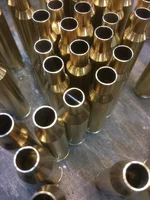
Keep them submerged and shake the pins out or get the 1/8th diamond pins which just fall out
 
Just trying the 'balls' - but those buggers get stuck in the primer pocket!!. No free lunches!.
Adopted. 95% success. Still some clingers discovered post drying. The stuck pin event is recurrent. 6 on my next batch of brass View attachment 225551 which was mixed 6.5x55mm and 6.5PRC. Removing the pins jammed horizontally in the case necks invariably scored the neck face View attachment 225552 but probably not a significant issue. Agree with MarinePMI: chuck sticking pins. That said, I would have thought makers would select pin media length which avoided popular calibers. Any media sizes other than 6.5mm out there?

One serious concern: I found a tiny flake of steel View attachment 225557 in one of the dried cases which must be the swarf off the end of a pin View attachment 225559. I did not see any steel swarf in sealed media bag, so guess this is the effect of pins striking each other?

I am definitely sticking with this method of cleaning brass. But I realise it will take greater care to ensure medi-free cases at the end of process.
These are the answer….


Don’t get stuck in the cases or in the primer pockets
 
Last edited:
Adopted. 95% success. Still some clingers discovered post drying. The stuck pin event is recurrent. 6 on my next batch of brass View attachment 225551 which was mixed 6.5x55mm and 6.5PRC. Removing the pins jammed horizontally in the case necks invariably scored the neck face View attachment 225552 but probably not a significant issue. Agree with MarinePMI: chuck sticking pins. That said, I would have thought makers would select pin media length which avoided popular calibers. Any media sizes other than 6.5mm out there?

One serious concern: I found a tiny flake of steel View attachment 225557 in one of the dried cases which must be the swarf off the end of a pin View attachment 225559. I did not see any steel swarf in sealed media bag, so guess this is the effect of pins striking each other?

I am definitely sticking with this method of cleaning brass. But I realise it will take greater care to ensure medi-free cases at the end of process.

It's clearly all in the wrist action. I can honestly say, I've never had an issue with the pins not dropping out of the case, but maybe I've had more practise :-|

One thing I do do, is once clean, I drain most of the dirty water, I then flush everything with clean water, until it runs clear. I then add a squirt of rinse aid, top up with water, and run it for 5-10mins, drain, quick flush. and dry.

It sounds like it's hassle, but it's quick, and easy.
 
My final check tonight was to see whether the rotary tumbler had changed any of the case dimensions. [I had already de-primed, ultrasound cleaned, annealed, sized and trimmed brass before rotary cleaning].

The results are a bit odd and I will sleep on it and review a.m. The 6.5x55mm cases remained absolutely unchanged. I.e. inside neck diameter, shoulder height, etc. What I expected.

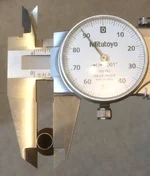
Not so with the Hornady 6.5PRC brass. That was also fully prepped by my usual regime prior to rotary cleaning and dimensions were 0.261" inside neck, 0.2898" outside neck IMG_6809.webp IMG_6810.webp
After rotary tumbling, that same batch of Hornady brass now measured 0.258" inside neck and 0.2895" outside IMG_6811.webp IMG_6812.webp


In short, even though the OD of the necks do not appear to have altered much/at all, the inside neck diameter on a sample of 10 cases [of each] has reduced by 0.003" . Baffled.


One YouTube resource suggested that protracted periods in a rotary tumbler can cause case mouth deformation. I wonder if I have turned the lip of the neck in a bit and that is what the vernier is measuring? i.e. the ID is actually still 0.261", but a rotary tumbler induced burr on the lip has given the neck a "collar".
 
It's clearly all in the wrist action. I can honestly say, I've never had an issue with the pins not dropping out of the case, but maybe I've had more practise :-|

One thing I do do, is once clean, I drain most of the dirty water, I then flush everything with clean water, until it runs clear. I then add a squirt of rinse aid, top up with water, and run it for 5-10mins, drain, quick flush. and dry.

It sounds like it's hassle, but it's quick, and easy.
It does depend on case and pin size.

.308 the pins @zambezi is using fall out fine, in a 6.5 / .25 they tend to get stuck in and across the case mouth and .22 cals they can clump up In the case mouth abs be hard to remove. They are also the perfect length to get completely wedged internally across the base of a .22 hornet case!
 
Last edited:
It does depend on case and pin size.

.308 the pins @zambezi is using fall out fine, in a 6.5 / .25 they tend to get stuck in and across the case mouth and .22 cals they can clump up In the case mouth abs be hard to remove. They are also the perfect length to get completely wedged internally across the base of a .22 hornet case!

Makes sense. My smallest case is a 223, but I haven't needed to tumble them yet, my other calibres are 6.5, 7, 30, & 9.3, and none of these have been an issue.

Do you think the rinse aid helps stopping the pins sticking, by reducing water tension, or something like that ?
 
When steel pin media is new it has sharp corners and these peen the case mouth. This can turn the edge over and cause the small diameter measurement.
When the pins are well used the sharp corners wear down and don't peen the case mouths as much.
Cure is to chamfer after cleaning.
Ian
 
Sorry, looks like the link didn’t post first time

Yep I can vouch for these and even clean small primer pockets with my 6.5x47L cases and will shake out of the cases.
 
Back
Top