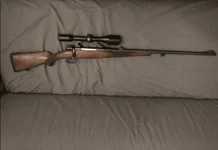
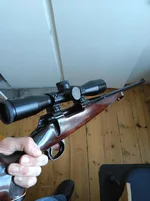
Mauser reintroducing the 7x57 in several of it's rifles for the 130th anniversary of the cartridge.

Scipio

Well-Known Member
Or so says this guy, anyways,

English subs are available.

Interesting. It's a fine cartridge for European game, and a Revival over some of its American cousins probably wouldn't be undeserved.

I Wonder if Mauser is going for the traditional Long throat of the 7x57 or if they have revised it. Given the emergence of long for weight non lead ammo, keeping it might be wise.
 
The 7x57 and it’s larger sister the 7x64 has always had a 1 in 8 and bit inch twist rate to stabilise long 173gn bullets. So did other early centrefire rifle calibres such as the 6.5 Mannlicher and even our own 303.
 
If you look at the CIP dimensions you will see that both the 7x57 and 7x64 are at 1 turn in 220mm, whereas the 7mm-08 is 1 in 240mm (9.5”) and the 280 Rem and 7mm Rem Mag are 1 in 250mm (about 10”).

So clever Mr Mauser when he designed the 7 x57 120 odd years ago got it spot on first time.

And a monolithic bullet will give all the penetration of an old solid bullet but with a much wider wound channel. I suspect Karamojo Bell would love these new monolithic bullets for shooting Elephants.
 
A copper friendly twist rate would be a nice change.
hello buddy :)

I think Heym has already answered you in full, and changing the already good and non lead suited twit rates (and long throats) of the the typical 7x57 surely would make little sense in this non lead dage of age.
In fact the only barrel maker i have seen who makes the 7x57 with a fairly slow twist rate is Schultz Larsen, who makes them as 1 in 10 for some odd reason, according to this link: Barrels | Schultz & Larsen
But yeah, i think my Mannlicher S is just around 9, so acceptable for even longer bullets, which as heym hinted too was probably also the intention from Mr.Mauser to start with. 👍


If Mauser wants to do this great cartridge a favor, and make it more marketable and easy to reload for, they should probably look to standardize the length of the throat instead, which it's my impression can vary alot between one 7x57 maker and another.
They might want to keep it fairly long though, as is tradition, but which might also provide more options with regards to seating depth, when seating the longer non lead bullets.
 
Last edited:
In my relatively poor opinion, throat length is really only important in that relatively elevated areas of target shooting, and moderate bullet jump is more a problem in peoples minds than their rifle's barrels.

Regards,

David.
Hello David, i fully agree if accuracy is the main concern, but if making sharing reloading data is your aim (as a maker) it is my understanding that it could hold some relevance, as the varying throat length of different 7x57s can make it a bit more tricky with regards to finding a recipe that works more easily across a different array of x57s.
But i am only about to start my reloading adventure now, so i guess i shall soon find out in practice. :p
 
It’s a fantastic cartridge and my 9 twist varberger shoots copper just fine and at speeds that expand well at ranges I’ll shoot at anyway. Good to see Mauser celebrating this fine cartridge.
Maybe a rebrand to 7x57 Creedmoor would see it fly off the shelves and fashionistas realise just how right they got it first time round?
 
It’s a fantastic cartridge and my 9 twist varberger shoots copper just fine and at speeds that expand well at ranges I’ll shoot at anyway. Good to see Mauser celebrating this fine cartridge.
Maybe a rebrand to 7x57 Creedmoor would see it fly off the shelves and fashionistas realise just how right they got it first time round?
7x57 creedmore !!!!!

Wash your mouth out!!
 
Hello David, i fully agree if accuracy is the main concern, but if making sharing reloading data is your aim (as a maker) it is my understanding that it could hold some relevance, as the varying throat length of different 7x57s can make it a bit more tricky with regards to finding a recipe that works more easily across a different array of x57s.
But i am only about to start my reloading adventure now, so i guess i shall soon find out in practice. :p
I really wouldn’t worry about various throat lengths when reloading.

When you work up a load you are working a load for a specific rifle, and part of the process is making sure the bullet is not being jammed into the lands.

Any factory made 7x57 will be made to SAAMI or CIP specifications. Custom rifles may not be, and this implies to lots of other calibres as well. The 7x57 and 7x64 both have long throats as many of the bullets used were more round nosed in shape.

There is the 275 Rigby HV, which has a separate Saami spec. It’s to all intense the same as the 7x57, only difference being the angle from the chamber to start of rifling. Same cartridge overall length though. Any 275 Rigby HV will be marked as such and was designed for a 140 grain bullet at 2800 fps loaded by Kynoch. But they still shoot the long round nosed bullet but sights may not be regulated to this bullet.

When reloading hunting ammunition I load to standard cartridge overall length and apply a crimp to the cartridge. Two reasons.

1) Hunting ammo goes in and out of the rifle, pockets and is bounced around etc. I do not want that bullet to move in the case.

2) A crimp gives very definite neck tension which I gives a lot of consistency and thus accuracy. And it covers a multitude of errors.

But I am expecting lots of incoming, and note I said “hunting” ammo. A lot of serious reloaders will spend a lot of time adjusting the length of the bullet in the case, applying different neck tensions etc etc. This may make the difference between winning a match and picking up silverware, or doing the clearing up whilst others celebrate.

For me, I want a load that puts the bullet through the vitals of any deer, boar or fox, that has a trajectory where I don’t have to worry about range or wind, or for that matter the exact angle that the deer presents.

Going back to the 7x57 Load data, and for that matter factory ammo, there are two schools of thought:

1) its a 130 year old cartridge that may be shot in a 130 year old rifle so its loaded, or the load data provided is to pretty low pressures and anaemic velocities. Think 140gn at 2500 fps - think Federal blue box, Remington green box.

2) or its loaded to full pressure for rifles in good order of more modern manufacture. The likes of Norma and RWS ammo are loaded as such. Indeed Rigby loaded their 275 HV 140 gr at 2,800 fps.

When loading for any rifle you do need to work up a load keeping in mind pressures etc and the vintage of the rifle. But no reason why a modern 7x57 shouldn’t be loaded to modern pressures, but don’t put that through an old 1893 Mauser!!!
 
I really wouldn’t worry about various throat lengths when reloading.

When you work up a load you are working a load for a specific rifle, and part of the process is making sure the bullet is not being jammed into the lands.

Any factory made 7x57 will be made to SAAMI or CIP specifications. Custom rifles may not be, and this implies to lots of other calibres as well. The 7x57 and 7x64 both have long throats as many of the bullets used were more round nosed in shape.

There is the 275 Rigby HV, which has a separate Saami spec. It’s to all intense the same as the 7x57, only difference being the angle from the chamber to start of rifling. Same cartridge overall length though. Any 275 Rigby HV will be marked as such and was designed for a 140 grain bullet at 2800 fps loaded by Kynoch. But they still shoot the long round nosed bullet but sights may not be regulated to this bullet.

When reloading hunting ammunition I load to standard cartridge overall length and apply a crimp to the cartridge. Two reasons.

1) Hunting ammo goes in and out of the rifle, pockets and is bounced around etc. I do not want that bullet to move in the case.

2) A crimp gives very definite neck tension which I gives a lot of consistency and thus accuracy. And it covers a multitude of errors.

But I am expecting lots of incoming, and note I said “hunting” ammo. A lot of serious reloaders will spend a lot of time adjusting the length of the bullet in the case, applying different neck tensions etc etc. This may make the difference between winning a match and picking up silverware, or doing the clearing up whilst others celebrate.

For me, I want a load that puts the bullet through the vitals of any deer, boar or fox, that has a trajectory where I don’t have to worry about range or wind, or for that matter the exact angle that the deer presents.

Going back to the 7x57 Load data, and for that matter factory ammo, there are two schools of thought:

1) its a 130 year old cartridge that may be shot in a 130 year old rifle so its loaded, or the load data provided is to pretty low pressures and anaemic velocities. Think 140gn at 2500 fps - think Federal blue box, Remington green box.

2) or its loaded to full pressure for rifles in good order of more modern manufacture. The likes of Norma and RWS ammo are loaded as such. Indeed Rigby loaded their 275 HV 140 gr at 2,800 fps.

When loading for any rifle you do need to work up a load keeping in mind pressures etc and the vintage of the rifle. But no reason why a modern 7x57 shouldn’t be loaded to modern pressures, but don’t put that through an old 1893 Mauser!!!
Hello Heym and thanks for all the input :)

The above is pretty much also how i planned to proceed, and my Mannlicher S is from the late 60ies, and is in good condition, so it should be alright for modern pressures i reckon. My initial plan was to lean a good bit on the norma data, as well as of course the bullet manufatorers own published data , but i will naturally follow the suggested protocal and build up from low, looking for pressure signs as i try to find a good working load. 👍 I must admit i hadnt planned on crimping, but i do have the die for it, and given that i prefer stalking/pursch vs stand hunting, maybe i should indeed do that as well.

Buy back to Mauser! :) will be interesting to see which chamber dimensions mauser they have decided to use, and if they have modified their 1893 blueprint at all.👍


PS. When do you reckon they started constructing actions strong enough to sustain "modern pressures"?
 
Hello Heym and thanks for all the input :)

The above is pretty much also how i planned to proceed, and my Mannlicher S is from the late 60ies, and is in good condition, so it should be alright for modern pressures i reckon. My initial plan was to lean a good bit on the norma data, as well as of course the bullet manufatorers own published data , but i will naturally follow the suggested protocal and build up from low, looking for pressure signs as i try to find a good working load. 👍 I must admit i hadnt planned on crimping, but i do have the die for it, and given that i prefer stalking/pursch vs stand hunting, maybe i should indeed do that as well.

Buy back to Mauser! :) will be interesting to see which chamber dimensions mauser they have decided to use, and if they have modified their 1893 blueprint at all.👍


PS. When do you reckon they started constructing actions strong enough to sustain "modern pressures"?
About 1896, 1898 etc. and if you think the 30-06 was in use by 1906 and that is a full pressure cartridge. 7x64, 220 Swift, 270 win etc were all early 1920’s.

I think the biggest concern was that there have been manufacturing runs during the war years when quality was somewhat dubious, especially when slave labour was involved.

Post the wars - both WW1 and WW2 there were large numbers of Mauser rifles - 7x57 of Spanish, Chilean etc as well as German etc all imported into the US and sold very cheaply as surplus and then subject to red neck type treatment and Gunsmithing. Those are the ones which US ammo surpliers are really concerned about.

In the UK / Europe there are all the proof houses which would prevent these from ever entering the market. Besides most of the cheap / poor quality ones have long gone.

If you are buying a 7x57 by a good well known maker, especially the more top end and its of good condition etc there shouldn’t be any issues.

Also look at other calibres in the same make / model. The Mannlicher S from the late 1960’s are nice rifles. And they were available in all manner of calibres including the likes of the 270 Win, 243, 30-06 etc.
 
Hello buddy, good advice but i am not buying more rifles at the moment and already have the Mannlicher S. It is a nice GK stutzen model in 7x57 , and i am very happy with it. :)
In the future i hope to use it as a iron sight only rifle, as i think that could be a pretty cool way of getting elements of bow hunting into rifle hunting instead.
Obviosuly this means shortening the shooting distances into what is well inside your given shooting capacity, but that is the whole point of it. And where i'll be hunting now it is often a mix of forrest, meadows and fields, so not the very long distances or stretches of very open land that one can run into in other countries, which creates a necessity for scopes.

The reason why i asked was about another rifle, a 6.5x57 which is built on a danish captured mauser 98 k ww2 action, but the action looks good, which makes sense, as Denmark was occupied early on in the war, when the production quality was still good, and it was quite probably put together by Schultz Larsen, as it has their barrel on it and they exactly did manufactor rifles using captured Mauser actions post ww2. It was sold to me by a german gun smith, listing it on a german gun site. So it should be fine i reckon, for doing normal modern loads as well. 👍 i've attached a photo :)
 

Attachments

  • Skærmbillede (179).webp
    Skærmbillede (179).webp
    36.4 KB · Views: 19
The 7x57 is a great high velocity cartridge. I have a 1955 BSA in 7x57 and it does well with quite beefy loadings. I usually run 139gr bullets in it with 49gr RS62 and get about 2875fps. This is still recoiling milder than my .308s and is below book max. Interestingly the old military loadings are not far below it: The 1913 Spanish Army loading was "a 9-gram (138.9 gr) spitzer bullet fired at a muzzle velocity of 850 m/s (2,789 ft/s) with 3,251 J (2,398 ft⋅lbf) muzzle energy from a 589 mm (23.2 in) long barrel. It had a maximum range of 3,700 m (4,046 yd)." 7×57mm Mauser - Wikipedia
 
The 7x57 is a great high velocity cartridge. I have a 1955 BSA in 7x57 and it does well with quite beefy loadings. I usually run 139gr bullets in it with 49gr RS62 and get about 2875fps. This is still recoiling milder than my .308s and is below book max. Interestingly the old military loadings are not far below it: The 1913 Spanish Army loading was "a 9-gram (138.9 gr) spitzer bullet fired at a muzzle velocity of 850 m/s (2,789 ft/s) with 3,251 J (2,398 ft⋅lbf) muzzle energy from a 589 mm (23.2 in) long barrel. It had a maximum range of 3,700 m (4,046 yd)." 7×57mm Mauser - Wikipedia
hello mate :)
Yes, that sounds much like what the american gun writer who also prefers the 7x57 says to expect when loading to modern pressures (in rifles that can take it of course!! as heym also mentioned). :)
He is called muledeer on 24hrcampfire site i believe, but i cant remember his civlilian name right now.

i use a stutzen with a 20,5 " barrel when i shoot the "old 7" though, so maybe 75-100 fps less than you would be my range. How long is the barrel on the bsa if i may ask? :)
 
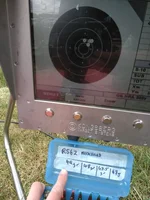
It is a 24 inch barrel. I have run it with 50gr of RS62 win no pressure signs, but accuracy starts to suffer from the increased blast and recoil. This group is at 300yds with 49gr of RS62.
 

Attachments

  • 7x57 49gr RS62 S&B FMJ 139gr 300yds.webp
    7x57 49gr RS62 S&B FMJ 139gr 300yds.webp
    195.4 KB · Views: 13
It is a 24 inch barrel. I have run it with 50gr of RS62 win no pressure signs, but accuracy starts to suffer from the increased blast and recoil. This group is at 300yds with 49gr of RS62.
Hello friend :)
Now THAT is a nice group indeed.🎯

I too, as you might also remember from an earlier thread on here about buying older vs newer rifles, am more into looking for craftsmanship, quality , beauty and practicality vs my purpose when buying rifles, rather than what is new or the current fashion. Imo that combination is often best found in rifles made a while back vs most current ones.
But that is just my preference and opinion of course, and i dont mind hunter preferring newer mass produced carbon and plastic rifles at all. And if you are a professional culler and game keeper i reckon some of the modern makes might be more practical indeed. So each to their own. 👍

The good news is that this 7x57 mauser news, will allow hunters in the later category to also now start to discover and enjoy this round and perhaps even seen 7x57 components become slightly easier to get and better priced too :cool:
 
Hello friend :)
Now THAT is a nice group indeed.🎯

I too, as you might also remember from an earlier thread on here about buying older vs newer rifles, am more into looking for craftsmanship, quality , beauty and practicality vs my purpose when buying rifles, rather than what is new or the current fashion. Imo that combination is often best found in rifles made a while back vs most current ones.
But that is just my preference and opinion of course, and i dont mind hunter preferring newer mass produced carbon and plastic rifles at all. And if you are a professional culler and game keeper i reckon some of the modern makes might be more practical indeed. So each to their own. 👍

The good news is that this 7x57 mauser news, will allow hunters in the later category to also now start to discover and enjoy this round and perhaps even seen 7x57 components become slightly easier to get and better priced too :cool:
I suggest looking for a 1950s era BSA in 7x57 as they have cut rifled hand-lapped barrels and are affordable. Mine cost less than £300 and was hardly used.
 

Attachments

  • S&B 7mm.webp
    S&B 7mm.webp
    36.4 KB · Views: 27
Saying all the above, whilst you can bullets at 2850 fps, it still performs very well at 2650 fps, and in truth doesn’t make a huge difference to point blank range. To some extent if you don’t need the extra horsepower why put the extra strain.

I like to treat mechanical machines with an element of sympathy - especially older machines.

And those Mannlicher GKs were expensive rifles when new. They were generally bought by gentlemen and ladies for sporting shooting, rather being a high volume deer control type rifle - that was the job of BSA’s, Parker Hales etc. So generally they will not have had a lot of ammo through them. I know of one that the lady bought new 50 years ago, she has shot a few bucks and stags every year with it, with a few test shots before going to the hill. Its probably fired 10, maybe 20 rounds a year.
 
Last edited:
Back
Top