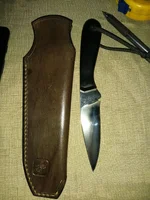
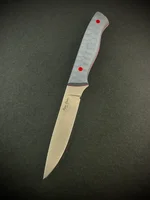
Stalking Knives, their metallurgy and use.

Bowland blades

Well-Known Member
For those who want the real facts , seek to enhance their knowledge of one of mans oldest tools and its use in the field . What factors to consider in use and selection of materials to give great " property balance" , its a risky thread for a maker to post tbf but reading through an existing one I though that an actual professional knife maker and long time stalkers take on things might be of use to those of the forum membership who seek the facts that should be foremost in a stalkers mind.

There is no perfect material as regards knife steels , what we have is a selection of different steels both High carbon and stainless steel . Be aware that both of these come in a massive range of enhanced features (Properties) and also to achieve high performance in one thing other things will need to reduce. Think this like a high performance super car , its fast, looks cool but also drinks petrol like there is a hole in the tank and is difficult to park and climb in and out of . No room to stuff a hind in either !

The main three properties of a knife steel are 1. Toughness . 2. Edge retention 3. Corrosion Resistance 4. Hardness
The variables in different steels play off these four factors and the reason i do not have sharpness in the above is the fact that its largely geometry

Personally speaking and this might change as new products are developed

It might be worth pointing out that there is a book written specifically on Knife steels the heat treating of them and their geometry. Knife Engineering by DR. Larrin Thomas a son of a knifemaker who has done much work in development of processes and steels and has actually compiled a table of knife steel ratings covering 1,2,3 above including and a max working hardness .

To compare two steels and explain selection of properties i will take three steels and explain why i personally choose which
AEB-L ( interchangeable with SF100 ) Stainless
Toughness rating 9.5
edge retention 3
corrosion resistance 7
Max 63-64

440 A
toughness rating 3.5
edge retention 3.5
corrosion resistance 8.5
max 60-61 Rc

Elmax

toughness rating 4
edge retention 5.5
corrosion resistace 8
63-64 Rc

now for something different

Rex 121
toughness 1
edge retention 10
corrosion resistance 3.5
70-71 Rc

The last just to show the price paid for enhancing one thing and remember very high edge retention makes the sharpening job a harder , no free rides !
In practice during tests AEB-L / SF100 in the hands of a truly competent user will last 100 large species deer without begging for the stone, toughness means no missing tips so removing heads or dropping your knife onto a hard surface is a lot safer and i have yet to mistreat and neglect cleaning my knife and i do not use my knives in saltwater spearfishing so i am all good .
 
For those who want the real facts , seek to enhance their knowledge of one of mans oldest tools and its use in the field . What factors to consider in use and selection of materials to give great " property balance" , its a risky thread for a maker to post tbf but reading through an existing one I though that an actual professional knife maker and long time stalkers take on things might be of use to those of the forum membership who seek the facts that should be foremost in a stalkers mind.

There is no perfect material as regards knife steels , what we have is a selection of different steels both High carbon and stainless steel . Be aware that both of these come in a massive range of enhanced features (Properties) and also to achieve high performance in one thing other things will need to reduce. Think this like a high performance super car , its fast, looks cool but also drinks petrol like there is a hole in the tank and is difficult to park and climb in and out of . No room to stuff a hind in either !

The main three properties of a knife steel are 1. Toughness . 2. Edge retention 3. Corrosion Resistance 4. Hardness
The variables in different steels play off these four factors and the reason i do not have sharpness in the above is the fact that its largely geometry

Personally speaking and this might change as new products are developed

It might be worth pointing out that there is a book written specifically on Knife steels the heat treating of them and their geometry. Knife Engineering by DR. Larrin Thomas a son of a knifemaker who has done much work in development of processes and steels and has actually compiled a table of knife steel ratings covering 1,2,3 above including and a max working hardness .

To compare two steels and explain selection of properties i will take three steels and explain why i personally choose which
AEB-L ( interchangeable with SF100 ) Stainless
Toughness rating 9.5
edge retention 3
corrosion resistance 7
Max 63-64

440 A
toughness rating 3.5
edge retention 3.5
corrosion resistance 8.5
max 60-61 Rc

Elmax

toughness rating 4
edge retention 5.5
corrosion resistace 8
63-64 Rc

now for something different

Rex 121
toughness 1
edge retention 10
corrosion resistance 3.5
70-71 Rc

The last just to show the price paid for enhancing one thing and remember very high edge retention makes the sharpening job a harder , no free rides !
In practice during tests AEB-L / SF100 in the hands of a truly competent user will last 100 large species deer without begging for the stone, toughness means no missing tips so removing heads or dropping your knife onto a hard surface is a lot safer and i have yet to mistreat and neglect cleaning my knife and i do not use my knives in saltwater spearfishing so i am all good .
Thanks for that.

Could you explain what each of the variables means? In simple terms.

For instance, I don’t really understand the difference between toughness and hardness.
 
Thanks for that.

Could you explain what each of the variables means? In simple terms.

For instance, I don’t really understand the difference between toughness and hardness.

Rc . Is the hardness level in Rockwell , it can also be measured in Brinell . Its measured by a carbide point force making a divot in the steel post hardening and temper after removing all scale . the higher the number the higher the hardness a Stalking knife should ideally be 58-64 Rc but its the balance required for task 64 would be too high for a machete or combat knife 58 is imo and not as hard as we might desire in a deer knife
Toughness is resistance to chipping, breaking and abuse . In our terms its " legging , heading and general abuse " An axe would sacrifice the edge sharpness and hardness to gain more "toughness" for instance, . We can temper back a really hard knife , in extreme cases like in a massive Bowie or survival knife we might actually Blue back the back of the knife after regular heat treatment as we do when we make gun springs or a gate closer . In a way much of this is do we need a 223 for the job or a 30-06 ? We know what we are going to carry on Driven boar but also what is appropriate for a fox that's been visiting the hens in the barn
 
just to say to much info for this ole brain to take in, ive seen your knives and they are fantastic, im sure any of your great knives would do for me:old: cheers bs.
 
just to say to much info for this ole brain to take in, ive seen your knives and they are fantastic, im sure any of your great knives would do for me:old: cheers bs.
I realise its a complicated thing for those who are not in the trade or have a solid Engineering background . Its actually better having the "dont really understand that bit" mind set and ask than disappear up the wrong path , will try and answer anyone with specific questions anytime when i can Thanks for the compliment
 
Is toughness related to how brittle the steel is? I guess a hard steel which is brittle wouldn't be tough?

Also would Elmax need sharpening less often than AEB-L, but take longer to sharpen when it did need it?

Sorry if these are daft questions but I don't know much about this stuff.

Very interesting post, thanks for putting this up.
 
Is toughness related to how brittle the steel is? I guess a hard steel which is brittle wouldn't be tough?

Also would Elmax need sharpening less often than AEB-L, but take longer to sharpen when it did need it?

Sorry if these are daft questions but I don't know much about this stuff.

Very interesting post, thanks for putting this up.
Toughness and hardness are different things . i think i am answering this question as you intend when i say AEB-L has a very high toughness at 9.5 and Elmax just 4 and they both have the same Rc Hardness when correctly heat treated
Edge retention is 3 on AEB-L and 5.5 on Elmax but there are a few that go into double figures so yes in theory Elmax has a slight advantage but i dont think it would be noticeable in sharpening or on the deer , geometry of the edge would be far more the factor . To illustrate why personally choose AEB-L and SF100 over Elmax is AEB-L and SF Have a toughness of 9.5 and Elmax is at just 4 , are you going to prefer keeping the tip of your knife ? or Having just a little tiny amount of extra edge retention ?
All of these factors can of course be manipulated some during the Hardening and tempering and hence you can "tweak" things, shifting one number to gain something else . The Numbers shown give Dr Thomas Larins recommendation for HT but take some out of the toughness of the AEB-L that has a very large advantage over Elmax and there is more to be had on the edge retention no doubt . High edge retention tends to sacrifice toughness
A good example is REX 121 toughness 1 edge retention 10 ! remember AEB-L is 9.5 in toughness - so that's a heck of a lot of wiggle room availability in messing with the heat treatment Elmax meanwhile sitting at just 4 !
I can tell you ( real world terms ) its not required for stalking! From testing on up to and exceeding 100 deer Field grallochs with an AEB-L knife without it needing visiting a stone ! But if i was cutting rope in a factory all week , every week straight line cuts on a fixture REX might be top of the list.
Hope that clarifies things , without getting too deep . Got to be careful here we dont try and make a rally car out of a ride on mower mind
 
@Bowland blades if I don’t mind (and possibly quite enjoy) maintaining my kit and equipment, is there any reason not to go with a simple carbon steel blade?
None at all! Indeed i like a good bit of 1095 and o1 tool etc Our most used knife in the house is a little Kirishashi hung up on the key rack and the large chef knife in our kitchen is 1095 HC . As a blacksmith i still like to forge and very few stainless knife steels cope well with forging , indeed on of my favourites is a little Pukko type blade i Forged from a Subaru Coil spring its my favourite for a spot of bunny bashing . I also have some customers who appreciate HC and i do a few in 1095 water quenched with the Hamon line .
Today few take the time to maintain their kit and stainless is more forgiving as regards corrosion but its a mistake to think its totally rust less (hence they never called it rust-less) ( if a magnet sticks it needs care to prevent corrosion )

I am looking at building a rolling mill so i can start into stainless clad 1095 core especially for the Chef knives but also in the stalking range
 
For those who want the real facts , seek to enhance their knowledge of one of mans oldest tools and its use in the field . What factors to consider in use and selection of materials to give great " property balance" , its a risky thread for a maker to post tbf but reading through an existing one I though that an actual professional knife maker and long time stalkers take on things might be of use to those of the forum membership who seek the facts that should be foremost in a stalkers mind.

There is no perfect material as regards knife steels , what we have is a selection of different steels both High carbon and stainless steel . Be aware that both of these come in a massive range of enhanced features (Properties) and also to achieve high performance in one thing other things will need to reduce. Think this like a high performance super car , its fast, looks cool but also drinks petrol like there is a hole in the tank and is difficult to park and climb in and out of . No room to stuff a hind in either !

The main three properties of a knife steel are 1. Toughness . 2. Edge retention 3. Corrosion Resistance 4. Hardness
The variables in different steels play off these four factors and the reason i do not have sharpness in the above is the fact that its largely geometry

Personally speaking and this might change as new products are developed

It might be worth pointing out that there is a book written specifically on Knife steels the heat treating of them and their geometry. Knife Engineering by DR. Larrin Thomas a son of a knifemaker who has done much work in development of processes and steels and has actually compiled a table of knife steel ratings covering 1,2,3 above including and a max working hardness .

To compare two steels and explain selection of properties i will take three steels and explain why i personally choose which
AEB-L ( interchangeable with SF100 ) Stainless
Toughness rating 9.5
edge retention 3
corrosion resistance 7
Max 63-64

440 A
toughness rating 3.5
edge retention 3.5
corrosion resistance 8.5
max 60-61 Rc

Elmax

toughness rating 4
edge retention 5.5
corrosion resistace 8
63-64 Rc

now for something different

Rex 121
toughness 1
edge retention 10
corrosion resistance 3.5
70-71 Rc

The last just to show the price paid for enhancing one thing and remember very high edge retention makes the sharpening job a harder , no free rides !
In practice during tests AEB-L / SF100 in the hands of a truly competent user will last 100 large species deer without begging for the stone, toughness means no missing tips so removing heads or dropping your knife onto a hard surface is a lot safer and i have yet to mistreat and neglect cleaning my knife and i do not use my knives in saltwater spearfishing so i am all good .
Great post.
One of my future goals is to make my own stalking knife, so this post is of great interest.
 
great post! thanks.

I literally have the Mauser page open as we speak, looking at their new hunting knife and if it's any good or not...I'm undecided!
Have you looked at the fallkniven ones?
Not dissing Bowlands which are beautiful custom made ones, but the fallkniven knives are what I see as the mid ground between basic factory and full custom.
All horses for courses.
 
Have you looked at the fallkniven ones?
Not dissing Bowlands which are beautiful custom made ones, but the fallkniven knives are what I see as the mid ground between basic factory and full custom.
All horses for courses.
I have, but never was convinced based on online reviews...these days I'm in between full custom such as Bowlands (and others), and the likes of Mora / Mora Garberg for slightly upscale low-end.
 
I have, but never was convinced based on online reviews...these days I'm in between full custom such as Bowlands (and others), and the likes of Mora / Mora Garberg for slightly upscale low-end.
Well, I have a phk and it’s a bloody great knife.
Its 3G blade is great - sharpen to a point you can shave with it and it holds well.
Thick blade means taking heads / limbs off is a cinch and size wise it’s bang on for me.

I have had mine for 5 years and still looks brand new. Only thing I changed was the kydex sheath, because I don’t like them! Bought a leather one from fallkniven site, so all happy.
 
With those modern steels are you still forging, shaping, hardening and finally tempering the steel knife, or is now a question of cutting put a blank and then grinding in the bevels, with no heat treatment required?

Would be wonderful if we could follow one of your knives being made.
 
Very informative post - thanks for posting. Like SSN100 I actually enjoy sharpening my knives but......I get caught out when a dusk stalk in spring/summer rolls into a 5am start at work.......that's when my carbon blades can suffer.
 
With those modern steels are you still forging, shaping, hardening and finally tempering the steel knife, or is now a question of cutting put a blank and then grinding in the bevels, with no heat treatment required?

Would be wonderful if we could follow one of your knives being made.
Only a few stainless cutlery steels can be forged without adversely effecting them. All stainless and high carbon steels from flat stock need heat treatment and the heat treatment can be tuned to the job to which the knife is intended to be used on .
There is a plan that's been in the bag for a long time now with a well known field sports journalist to produce said video, we both seem to have a lot of other commitments clashing. It will happen though and hopefully soon
 
Very informative post - thanks for posting. Like SSN100 I actually enjoy sharpening my knives but......I get caught out when a dusk stalk in spring/summer rolls into a 5am start at work.......that's when my carbon blades can suffer.
yeah , many of us are in that same boat. I have two good mates one of them keeps his knives like new via disciplined maintenance and the other is the total opposite. Both have a massive annual cull , so things show up fast and someplace in the middle is likely where the average stalker is ( only i get the results in months not decades ) .
I would say if your looking at a cheaper stainless factory knife and the high carbon the HC would perform better in all aspects but staining and corrosion Below a picture from one of my clients HC knives , it recently came back for service ( i do this for the first owner free of labour on all my knives ) it needed a go on the buffer to remove blood induced patination and a few stokes across a stone ! 1095 differential hardening with Hamon line The dark section being extra hard and the siler behind it tough but not truly hard supporting it ( a difficult photo to take these )IMG_20211213_122807.webp
 
Back
Top