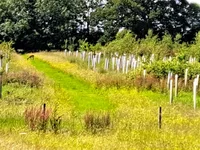
New planting and brambles

Thanks the objective was to plant native species for wildlife long term, and although they're planted for coppicing, truth is i doubt by the time they're large enough ill be doing that (or if i do wont be much of it).
Planting “ native “ trees only leaves you a very restricted palette, both ash and larch are no longer viable due disease.
Spanish chestnut, beech, walnut, all non native may be worth considering
 
Points noted. There are areas we have left as grass around the place, although we have used weed killers in some areas of our plot, the field is untouched by us in this respect.

Our back garden is c.half an acre of which we leave about a half of it unmown until the buttercups cease flowering, primarily because where we sit and eat looks out over this and its lovely to see a sea of yellow flowers gently swaying in the breeze (that happens between the strong gusting winds and heavy rain of the past week or two).

We also have small area c.100m2 we call the orchard, where my wife has spent countless hours trying to get wild flowers to grown and seed. Not to mention the cost of wild flower seed to start with. That's v.much WIP but lots of ox eye daises, yellow rattle, goats beard, along with a few others.
Sounds great.
They do say not to sow too many wildflower seeds after a couple of years snd let it balance. If you have yellow rattle then half the battle is won as this will reduce the grass. Cutting and removing cut is important rather than mulching as this reduces nitrogen which wildflowers want.
We are trying the same with 3 acres of meadow. We cut three times a year at the moment all by hand with a scythe which is better than a strimmer.
The hay is then removed and stored or used to mulch the willow trees we have planted to provide early pollen and nectar.
Like you I love sitting watching the wind blow through field and how it changes colour through the day as well as seasons.
 
Thanks, our planting list was provided by the Woodland Trust when we agreed neither larch or ash were in our species list, Crab apples, field maple, Hornbeam, Oak, silver birch and wild cherry, plus we have added some sweet chestnuts too.

Shrubs were blackthorn, dog rose, hazel, holly, spindle, guelder rose, dogwood, although the spirals provided by the woodland trust, along with the plants they were supposed to protect have largely been removed by the resident fallow. I think that the spirals were provided to give the Fallow something to play with and the shrubs as a result were snacks for them to enjoy while they played.

As complete novices at this kind of thing, engaging with the WT seemed like a good thing to do, their rep visited the site, saw Fallow Deer and specified accordingly. Have to say that had we known how much maintenance we have had to do, we may have done things differently but we are where we are.
 
Thanks the objective was to plant native species for wildlife long term, and although they're planted for coppicing, truth is i doubt by the time they're large enough ill be doing that (or if i do wont be much of it).
Its about 5 years ago since planted a new little wood with the guidance of the woodland trust - our have really got going this year and some are now maybe 10 ft tall
 
Planting “ native “ trees only leaves you a very restricted palette, both ash and larch are no longer viable due disease.
Spanish chestnut, beech, walnut, all non native may be worth considering

It reall doesnt
Dont plant anything non native Glenn
 
In the photos it doesnae look too 'brairy' ive cut a lot worse.
Its a bloody horrible job esp in commercial restock sites, brambles up to ur tits and dolp ditches everywhere waiting to swallow u up to ur baws with strimmer round ur neck.:doh:

If the brabmbles are taller thanvthe trees they could shade it out.
The best thing is a heavy duty strimmer with a shredder blade, those 3 legged oregon 1s with the ends turned over are a game changer for brairs.
With big clumps do a few vertical pats down it really opens the clumps up.
It is a lot easier if u can wait till back end when the vegetation dies down, mibbee not so important with a flat field as ur not going to fall into an unseen ditch.
Possibly long term u could strim the brambles in a rotation so always rough patches all throu site but also newly strimmed and stuff mid way. Basically same isea as a grouse moor
The deer will appreciate fresh bramble shoots too, more tasty than old growth.

The circular saw blades are very handy too but more for cutting down trees, seen my taking trees up to 6" down with my strimmer althou that was pushing it.


Wots ur plans with the coppicing?
With the commercial SRC willow for biomass theyd top it after 1st year to get the stem to start coppicing.
Otherwise theyd just have a single stem to harvest.

Never had much to do with coppicing newly planted trees so not sure when ur best to cut them for 1st time.
Esp 1st time coppiced trees/stools will be vulnerable to both deer and shading by brambles.
Just be tricky getting enough brairs to hide stools without over shading them.
In old days ud wigwam ur brash over the stool for deer protection but u wont have much brash 1st time throu.
 
It reall doesnt
Dont plant anything non native Glenn
Ok, list your native trees.
You should be able to find one handy enough.
Then compare the list of natives with what you can see out the window.
The list of native trees is based on what grew in the immediate post glacial periods, when it was cold, if the climate warming scenario is correct, then post glacial polar optimised species may not be the best option , hedge your bets , whatever you plant is going to have to survive for at least a century.
 
Ok, list your native trees.
You should be able to find one handy enough.
Then compare the list of natives with what you can see out the window.
The list of native trees is based on what grew in the immediate post glacial periods, when it was cold, if the climate warming scenario is correct, then post glacial polar optimised species may not be the best option , hedge your bets , whatever you plant is going to have to survive for at least a century.

There is loads of natives Dunwater - dont you agree ?

The thing with non natives - think of naturalised sycamore - just as an example - They cause so much shading so early in the season - things like oak and beech allow so many of the flowers to have their life cycles before they leaf

I have half a clue what im on about - had a count up the other day and i have planted over 45,000 trees and shrubs on our land these last 5 years - not a bad effort really - with a lot of help from our shoot
 
Last edited:
I have planted

Oak
Alder
Aspen
Lime
Maple
Holly
Rowan
Hornbeam
Beech
Downy Birch
Silver Birch
Willow
Field Maple
Crab apple
Blackthorne
Box
Hawthorne
Guelder Rose
Wild Privet
Box
Bird Cherry
Wild Cherry
Dog wood
Wych elm
Hazel
Various old varieties of domestic fruit trees - plum apple gauge pear
Spindle
Whitebeam

Might have missed a few but you get the gist
 
There is loads of natives Dunwater - dont you agree ?
No, a lot of the so called trees listed are shrubs, hawthorn, hazel and spindle to name a few, alder is a waste of space and a few are non viable nowadays because of disease or pests.
Examples, elm, larch, ash. All no longer viable and all were once valuable sources of timber that need replacing.
Spruce beetle is a matter of when, not if, it’s coming and when it does it’s going to have a huge impact.
We need to make thinking about viable alternatives that are both future climate and pest proof.
No doubt we’ll pick a few wrong ones out of the available options, but we need to try.

The thing with non natives - think of naturalised sycamore - just as an example - They cause so much shading so early in the season - things like oak and beech allow so many of the flowers to have their life cycles before they leaf
I’m not going to argue that all trees are suitable or desirable , but some definitely are, walnut and Spanish chestnut are worth a punt in my book.
They’re happy in a warmer climate, they produce both food and timber, the chestnut coppices well and is resistant to rot, the walnut provides high grade timber.
Even the sycamore is worth something, the timber is decent but very plain and it self seeds almost as well as birch does, which fits neatly into the new continuous cover forest management model.
An acre of live sycamore is better than an acre of of dead ash.
I have half a clue what im on about - had a count up the other day and i have planted over 45,000 trees and shrubs on our land these last 5 years - not a bad effort really - with a lot of help from our shoot
Well done, and long may both you and your trees prosper.
The list seems to me to be very restrictive, if we are truly planting for the future, we need to plant for what the future may bring, and that seems to be a warmer, wetter climate which may not suit our traditional cold weather natives.
 
No, a lot of the so called trees listed are shrubs, hawthorn, hazel and spindle to name a few, alder is a waste of space and a few are non viable nowadays because of disease or pests.
Examples, elm, larch, ash. All no longer viable and all were once valuable sources of timber that need replacing.
Spruce beetle is a matter of when, not if, it’s coming and when it does it’s going to have a huge impact.
We need to make thinking about viable alternatives that are both future climate and pest proof.
No doubt we’ll pick a few wrong ones out of the available options, but we need to try.


I’m not going to argue that all trees are suitable or desirable , but some definitely are, walnut and Spanish chestnut are worth a punt in my book.
They’re happy in a warmer climate, they produce both food and timber, the chestnut coppices well and is resistant to rot, the walnut provides high grade timber.
Even the sycamore is worth something, the timber is decent but very plain and it self seeds almost as well as birch does, which fits neatly into the new continuous cover forest management model.
An acre of live sycamore is better than an acre of of dead ash.

Well done, and long may both you and your trees prosper.
The list seems to me to be very restrictive, if we are truly planting for the future, we need to plant for what the future may bring, and that seems to be a warmer, wetter climate which may not suit our traditional cold weather natives.

I dont think so and neither does the throngs on birds and insects mate

Sycamore is awful stuff and is suffering from sooty bark anyway - it takes over - shades out - supports hordes of aphids but nothing like the bio diversity an oak supports

An acre of dead ash - within a managed woodland - would actually be quite beneficial - We have become far too tidy in our woodland management
 
No, a lot of the so called trees listed are shrubs, hawthorn, hazel and spindle to name a few, alder is a waste of space and a few are non viable nowadays because of disease or pests.


Why dont you like Alder ?
I always find it great for wildlife
 
I dont think so and neither does the throngs on birds and insects mate

Sycamore is awful stuff and is suffering from sooty bark anyway - it takes over - shades out - supports hordes of aphids but nothing like the bio diversity an oak supports

An acre of dead ash - within a managed woodland - would actually be quite beneficial - We have become far too tidy in our woodland management
A good few years ago, someone contacted a TV garden expert by letter( yes that long ago) asking about the best place to plant a Sycamore tree. Answer, about 25 miles from your house.
 
I dont think so and neither does the throngs on birds and insects mate

Sycamore is awful stuff and is suffering from sooty bark anyway - it takes over - shades out - supports hordes of aphids but nothing like the bio diversity an oak supports

An acre of dead ash - within a managed woodland - would actually be quite beneficial - We have become far too tidy in our woodland management
An acre of dead anything is a hazard, a no go area. As for sycamore, as always, your land your choice, if you don’t like it don’t plant it. It’ll likely sneak in all on its own anyway.
My opinion is that confining yourself to planting only native species is restrictive, they evolved to thrive in far colder conditions than we currently enjoy and are due to experience in the future, so planting a variety of species seems like a sensible way to hedge your bets against both climate change and new pests and diseases.
I’m not keen on alder, I’d sooner have birch. I love their light open foliage and silver stems, however both alder and birch are very good at colonising open areas, which should provide a bit of competition for the sycamore..
 
An acre of dead anything is a hazard, a no go area. As for sycamore, as always, your land your choice, if you don’t like it don’t plant it. It’ll likely sneak in all on its own anyway.
My opinion is that confining yourself to planting only native species is restrictive, they evolved to thrive in far colder conditions than we currently enjoy and are due to experience in the future, so planting a variety of species seems like a sensible way to hedge your bets against both climate change and new pests and diseases.
I’m not keen on alder, I’d sooner have birch. I love their light open foliage and silver stems, however both alder and birch are very good at colonising open areas, which should provide a bit of competition for the sycamore..

You need birch for the ground as a copper fixer really

i love dead wood and have ring barked a good number - i also felled some massive sycamore to get the light in
Im look at things a bit the other way and see so many of these non natives bringing in the diseases that do our trees in
 
Back
Top