18 year old daughter showing interest - where/how to begin

Membership of BASC or the NGO would seem a good first step (not least because of the public liability insurance). Are you near any ranges that offer training? BASC may be able to help, if not. Then a couple of paid stalks for does / cull animals. If she then wants to progress, apply for an FAC and enrol for DSC1.
 
Last edited:
Dont over complicate things, get her own FAC, (even if its for fox only at this stage) do a dsc1 course and book a few paid stalks.
That would be a good starting point.
The rest will happen in due course..
 
Well I still think you're making it more complicated than needs be.

Fox & AOLQ for the estate rifle would enable her to get started, and take advantage of any deer permission that the OP might be able to secure.
Bookings for forthcoming paid stalks is sufficient supporting evidence for a FAC application.

And no-one's yet mentioned DSC1. That would also be a good starting point, and shows commitment. She should do that as soon as possible.
This is it, there are always workarounds with people still wanting to follow the exact parts of the post, some of it comes from the lack of detail from the original posts, some of it comes from "not looking at the wider picture.
 
I agree with Tim 243.
DSC 1 is the gateway to respectability in deer stalking. Police forces nationwide use it as a benchmark to measure commitment, some degree of knowledge of deer stalking and firearms handling ability
of the applicant for a FAC.
In my humble opinion it should be a requirement before an FAC for a deer rifle is granted.
I admire your desire to get your daughter on the correct path. No one knows everthing and there is more than one way to do the job properly.

Best Wishes
 
Thanks to everyone for taking the time to offer input, and especially to those who very kindly contacted me by private message with advice and support.

I talked to Northumbria FA this afternoon, who suggested various methods of achieving the outcome of a .243 for my daughter's stalking, either on my FAC for my daughter's use, or for her to apply for her own (taking the current 12 month wait into account). I've ordered a second cabinet for her use and we will start the process. Meanwhile, keep doing what we are doing and practice patience.

Thanks again.
 
Do you have an example of a permission that states that the holder can loan a rifle?

I’ve never seen or heard of that requirement. I suppose any lease could have any clause like that added, but the estate rifle clause itself doesn’t require it.
Firearms act was updated a couple of years ago to specifically say written permission required for the estate rifle rule.

My permissions now state I can take an armed guest and including loaning of a firearm.
 
Why don't you get the variation and have a .243 and your daughter put in for a FAC with the .243 on it. Other than the cost of her FAC she could go on own guided stalks without you if needed, it would only require you get the .243 out of the cabinet so she wouldn't have access to the other firearms not on her FAC.
 
Firearms act was updated a couple of years ago to specifically say written permission required for the estate rifle rule.

My permissions now state I can take an armed guest and including loaning of a firearm.
It was updated to say that written permission is now needed with regards to the authority to use firearms on the premises, where verbal permission is no longer sufficient:

 
It was updated to say that written permission is now needed with regards to the authority to use firearms on the premises, where verbal permission is no longer sufficient:

No, it was amended to say written authority to lend a rifle is required.

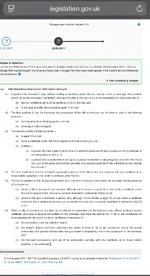
See 11A, in particular (3) (C) ii

IMG_8661.jpeg

 
No, it was amended to say written authority to lend a rifle is required.

See 11A, in particular (3) (C) ii

View attachment 436650

Having just read the section you mentioned, I think you're wrong.
You have misread 11A (3) (c) i, and failed to notice that it ends in the word "or".
 
No, it was amended to say written authority to lend a rifle is required.

See 11A, in particular (3) (C) ii

View attachment 436650


IIRC para (ii) was added to stop the situation where someone with a SGC would turn up, say, on a bought day’s shooting and lend a shotgun to a fellow gun who did not hold a SGC. The same could be true with a rifle - e.g. a visitor without a FAC is a member of a party staying on an estate in Scotland, he and another member (holding a FAC and who has bought his rifle along for the trip) go out with the guide to stalk deer, and both share and use the same rifle.

In each of the above examples both the lender and the borrower would be breaking the law, as the estate rifle exemption only applies if the lender holds the shooting and/or stalking rights, or has written authorisation from the person who does hold those rights.

Therefore to avoid breaking the law para (ii) was added so that the holder of those rights could issue permission to the lender to loan the rifle/shotgun.

This is why “or” sits between para (i) and para (ii).

If you are a lawful sporting tenant, or have written permission from the landowner to shoot on the premises, then you are deemed to be the occupier and you are already covered for the estate rifle exemption by para (i).

It is nicely explained here:

 
  • Like
Reactions: VSS
IIRC para (ii) was added to stop the situation where someone with a SGC would turn up, say, on a bought day’s shooting and lend a shotgun to a fellow gun who did not hold a SGC. The same could be true with a rifle - e.g. a visitor without a FAC is a member of a party staying on an estate in Scotland, he and another member (holding a FAC and who has bought his rifle along for the trip) go out with the guide to stalk deer, and both share and use the same rifle.

In each of the above examples both the lender and the borrower would be breaking the law, as the estate rifle exemption only applies if the lender holds the shooting and/or stalking rights, or has written authorisation from the person who does hold those rights.

Therefore to avoid breaking the law para (ii) was added so that the holder of those rights could issue permission to the lender to loan the rifle/shotgun.

This is why “or” sits between para (i) and para (ii).

If you are a lawful sporting tenant, or have written permission from the landowner to shoot on the premises, then you are deemed to be the occupier and you are already covered for the estate rifle exemption by para (i).

It is nicely explained here:

Exactly this ^^^
 
IIRC para (ii) was added to stop the situation where someone with a SGC would turn up, say, on a bought day’s shooting and lend a shotgun to a fellow gun who did not hold a SGC. The same could be true with a rifle - e.g. a visitor without a FAC is a member of a party staying on an estate in Scotland, he and another member (holding a FAC and who has bought his rifle along for the trip) go out with the guide to stalk deer, and both share and use the same rifle.

In each of the above examples both the lender and the borrower would be breaking the law, as the estate rifle exemption only applies if the lender holds the shooting and/or stalking rights, or has written authorisation from the person who does hold those rights.

Therefore to avoid breaking the law para (ii) was added so that the holder of those rights could issue permission to the lender to loan the rifle/shotgun.

This is why “or” sits between para (i) and para (ii).

If you are a lawful sporting tenant, or have written permission from the landowner to shoot on the premises, then you are deemed to be the occupier and you are already covered for the estate rifle exemption by para (i).

It is nicely explained here:

Having just read the section you mentioned, I think you're wrong.
You have misread 11A (3) (c) i, and failed to notice that it ends in the word "or".
No, I don’t believe so.

11A (3)(c) i, does not state the occupier or someone that has authority or permission, it specifically states a “person who has the right to allow others to enter the premises for the purposes of hunting” .

This cannot refer to someone who has authority or permission to enter the premises for hunting, as if they had the right to do so they would not need authority or permission. This section therefore can only refer to controller of the shooting rights, so the owner of the shooting rights or someone who has leased them.

The subsequent section refers to someone with authority (permission) from the controller of the shooting rights.

So section i refers to the controller of the shooting rights, section ii refers to anyone who only has permission to be there.
 
IIRC para (ii) was added to stop the situation where someone with a SGC would turn up, say, on a bought day’s shooting and lend a shotgun to a fellow gun who did not hold a SGC. The same could be true with a rifle - e.g. a visitor without a FAC is a member of a party staying on an estate in Scotland, he and another member (holding a FAC and who has bought his rifle along for the trip) go out with the guide to stalk deer, and both share and use the same rifle.

In each of the above examples both the lender and the borrower would be breaking the law, as the estate rifle exemption only applies if the lender holds the shooting and/or stalking rights, or has written authorisation from the person who does hold those rights.

Therefore to avoid breaking the law para (ii) was added so that the holder of those rights could issue permission to the lender to loan the rifle/shotgun.

This is why “or” sits between para (i) and para (ii).

If you are a lawful sporting tenant, or have written permission from the landowner to shoot on the premises, then you are deemed to be the occupier and you are already covered for the estate rifle exemption by para (i).

It is nicely explained here:

The article you posted is incorrect as it quotes the legislation as saying “someone who has the right to enter the premises” when the current legislation states “someone who has the right to allow others to enter the premises”.

They are 2 very different things, so forgive me if I don’t hold much faith in their interpretation.

The legislation states “a person who is authorised in writing by a person mentioned in sub-paragraph (i) to lend the rifle or shotgun” It is specifically saying written permission is required to lend the gun, not that they only need written permission to be there, its there in black and white!
 
Last edited:
No, I don’t believe so.

11A (3)(c) i, does not state the occupier or someone that has authority or permission, it specifically states a “person who has the right to allow others to enter the premises for the purposes of hunting” .

This cannot refer to someone who has authority or permission to enter the premises for hunting, as if they had the right to do so they would not need authority or permission. This section therefore can only refer to controller of the shooting rights, so the owner of the shooting rights or someone who has leased them.

The subsequent section refers to someone with authority (permission) from the controller of the shooting rights.

So section i refers to the controller of the shooting rights, section ii refers to anyone who only has permission to be there.
If you hold a sporting lease or otherwise have permission then you are deemed to be an occupier of the land, and by virtue of your lease (or "permission") you have the rights to enter the land for hunting purposes, and to lend an estate rifle to another person for the purpose of hunting, as per the conditions of the estate rifle clause, without any specific written authority to lend a rifle. It doesn't have to be written into the lease or "permission".
However, if you (ie, the person described above) were to invite two guests to shoot, with one of them owning a rifle that both intended to use, you (the leaseholder, "permission" holder, or owner) would need to provide written authority permitting guest 1 to lend his rifle to guest 2 while on the land which you are legally an occupier of by virtue of your lease, "permission" or ownership.
 
If you hold a sporting lease or otherwise have permission then you are deemed to be an occupier of the land, and by virtue of your lease (or "permission") you have the rights to enter the land for hunting purposes, and to lend an estate rifle to another person for the purpose of hunting, as per the conditions of the estate rifle clause, without any specific written authority to lend a rifle. It doesn't have to be written into the lease or "permission".
However, if you (ie, the person described above) were to invite two guests to shoot, with one of them owning a rifle that both intended to use, you (the leaseholder, "permission" holder, or owner) would need to provide written authority permitting guest 1 to lend his rifle to guest 2 while on the land which you are legally an occupier of by virtue of your lease, "permission" or ownership.
“Occupier” is no longer at all relevant, it is not contained in the legislation.

With a sporting lease you lease all or part of the sporting rights, so you are the controller of all or part of the sporting rights, you do not have permission or authority.

If someone has permission to do something they do not have the right to do it, they have permission to do it which is not the same thing.

Think we’ll have to agree to disagree!

@Conor O'Gorman any clarification from BASC on this? Does loaning of a rifle for a permission (sorry @VSS 😂) holder / someone not controlling the sporting rights require specific written permission?
 
Last edited:
Back
Top