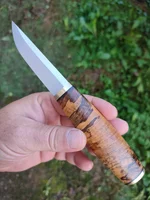
What’s your favourite grind on a knife for rabbit and deer?

Sniper308

Well-Known Member
For years I have always gone for a flat grind with small bevel, however after using this on a few rabbits I was genuinely blown away with its capabilities to slice away the skin! I don’t know what the grind is classed as, high scandi? I had been using it as small bushcraft knife, but I think the purpose will now be changing!

Out of interest what is your preferred grind
 

Attachments

  • d3c023d4-7c35-41c3-b11f-a29e69e10b77.webp
    d3c023d4-7c35-41c3-b11f-a29e69e10b77.webp
    121.2 KB · Views: 128
  • IMG-89eee8d9fb23a30e7e21b12f61e8681d-V.webp
    IMG-89eee8d9fb23a30e7e21b12f61e8681d-V.webp
    121 KB · Views: 128
Yes I think it’s referred to as a high Scandi grind, or saber or Nordic grind and typical for a knife like your puukko. Looks a lovely knife and ideal for skinning.
 
The grind on that knife looks asymmetrical like a Yakutian knife but without the groove on the chisel ground side.

Very nice knife 👌🏻
 
For years I have always gone for a flat grind with small bevel, however after using this on a few rabbits I was genuinely blown away with its capabilities to slice away the skin! I don’t know what the grind is classed as, high scandi? I had been using it as small bushcraft knife, but I think the purpose will now be changing!

Out of interest what is your preferred grind
Any one of those 🙏

 
Not overly bothered or even thought about the grind tbh &, I’m guessing the same as most on the SD, have many of variations amongst the countless knives that I’ve accumulated over the years. Biggest factor for me is blade/overall size compared to the task at hand & whether it holds a good edge😃👍
 
Here we go ....

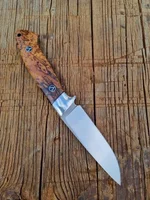
The OP's first picture shows a blade with as good as a full flat grind (which will have a secondary bevel). The second is of a high sabre grind, probably with a micro secondary bevel. To make a blade like this with no secondary bevel at all (a 'Zero' grind) would make for an outstanding slicing tool for very light work, but the edge would be very weak and would damage quickly and easily, either rolling or chipping out whatever steel it was made from especially if it hit hard wood or bone. The balance is to get a nice fine edge that is properly supported from behind. Scandi grinds do this by getting thick very quickly as you go from edge towards spine. Full flats and Sabres do so by having some 'edge thickness' immediately behind the secondary bevel.
Many knives are not ground thin enough at the edge (prior to adding the secondary), resulting in a 'thick' edge that requires a deeper (wider) secondary to obtain a sensible edge angle. Grind the blade too thinly and you leave it weak .... It's a balancing act that is up to the maker to achieve.
With the right tools and knowledge either can be rectified to some extent by sharpening correctly. 'Thick' edges can be given a deeper secondary to compensate whilst edges that are ground too thinly can be honed back to get a little more 'meat' behind the secondary although this does alter the blade profile to either a small, or a noticeable degree.
The skill of sharpening is not only to make the blade sharp, but to understand the edge geometry and tailor it towards the intended usage of the blade. It's no good putting a super fine, thin edge on an axe or other chopping blade and it's no good putting a good strong relatively obtuse edge on a gralloching knife. The first would be destroyed quickly in use and the second would not cut as well as that knife could cut if sharpened correctly.

Give me a thin enough blade with a thin enough edge and I can guarantee that I can sharpen it to a point sharper than any commercial razor blade (as long as it's heat treated properly) I've done it, and seen the results under very high magnification that made the polished edge of a brand new Wilkinson Sword razor blade look like a rip saw. A blade and edge of this sort is only really of any use for the experiment as it is so weak and prone to damage that it becomes useless with almost no work.

A well heat treated piece of steel can easily be made to put deep notches in angle iron, or chop through a nail with no visible damage. All it takes is a well supported edge ground at a suitable angle for the job. A cold-chisel will do the job nicely but you wouldn't want to be using the same edge profile on a blade for slicing deeply into anything.

My axes are as sharp as my knives but the edge profiles and geometry are obviously very different, although they are both convexed edges. Slicing blades need a finer edge angle and choppers need a more obtuse edge angle. They can easily be as sharp as one-another, but the more obtuse the angle the less well it makes penatrative cuts, but it's stronger and less likely to damage during use. Again ... the skill is in hitting the 'happy medium'.

My own preference for a gralloching blade is a full flat grind with a convexed secondary that I can then maintain with no more than a loaded strop. Scandi grinds are great for making feather sticks and the like, but they are simply the wrong tool for cutting flesh. They become thick quickly behind the edge, making the blade far more likely to stick in the cut. They are, quite frankly, a piece of p1ss to grind from a knife-makers point of view, (I have frequently claimed that I could train a pigeon to do Scandi grinds :lol: ) hence they are promoted by a great number of makers both 'hobbiest' and professionals alike, many of whom have never gralloched and butchered anything in their lives. If a Scandi ground knife is the right tool for cutting meat why is it that you've never seen one in use at a butchers or an abattoir ?

Here endeth todays rant :) Go in peace and MIND YOUR FINGERS ! :lol:
:lol:
 
Last edited:
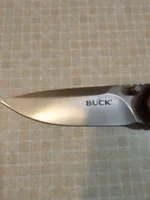
As someone who knows nothing about knives, could someone tell me which grind this is, please?
Ken.
Ps. The lower part of the blade feels to be concave.
 

Attachments

  • IMG_20251118_183859603_MFNR.webp
    IMG_20251118_183859603_MFNR.webp
    72 KB · Views: 35
I'm definitely not going to disagree with @Longstrider that a Skandi is not really the right tool for deer BUT that grind is perfectly workable as a gralloching knife with the major advantage that it requires little skill to resharpen. My backup knife is a cheap scandi-ground mora. It's easy to keep extremely sharp and honestly I don't think that my very lovely Stuart Mitchell best knife really does a noticeably easier or better job, despite it having a more suitable grind (full flat with bevel).

Scandi knives make terrible food-prep knives though. Have you ever tried sliding a carrot with a scandi grind? Just doesn't work.
 
As someone who knows nothing about knives, could someone tell me which grind this is, please?
Ken.
Ps. The lower part of the blade feels to be concave.
That will be a 'hollow grind' fella. Done on the outer edge of a large grinding wheel to make a concave grind on the blade. Buck usually make a good blade ;)
 
Not for deer, I know, but years ago, when ferreting, we would sharpen our lamb's foot penknives on a stone we picked up in the field. Paunched thousands with that grind!

Whilst on the subject, could people stop posting videos of legs and Co, and Pans People, please. I find them far too unsettling for an old man!
 
Not for deer, I know, but years ago, when ferreting, we would sharpen our lamb's foot penknives on a stone we picked up in the field. Paunched thousands with that grind!

Whilst on the subject, could people stop posting videos of legs and Co, and Pans People, please. I find them far too unsettling for an old man!
We would do exactly the same with our pen knives whilst ferreting, Even sharpening them by rubbing them down old steel type fence posts to give them an edge, It worked and we never had a blunt knife when we were kids.
As to the OP and following a recent post where Stuart Mitchell helped me out the flat grind is my favourite, I have got Skandi grind knives but only because we used to get them issued at work In my rigging days.
 
Your old lambsfoot blades were full flat grinds ;) You put a sharpened secondary bevel on with the stones. Hell .... we all did the same back then, although I favoured the single bladed 'jack knife' by Richardsons of Sheffield :lol:
 
Back
Top