pressure bedding

why would i buy a such a flawed rifle. ? it is in mint condition and its all i can afford. .....
its easy to reject a rifle as not good enough just because its not the same as modern rifle

I own Sauers, one a 200, the other an 1937 Mauser sporting rifle. I love them both.
I own Steyrs, Pro Hunters, Model M Professional, Model M Stutzen, and older MCA, a 1950, and have owned a 1952, and an SSG 69. I love them all.

A hunting rifle does not need to shoot sub-MOA every time to be usable. You, the shooter, need to be able to hold sub MOA with any rifle. If you can hold 1/2 MOA and you and your rifle can shoot 2 inches at 100 yards, and 4 at 200, maybe with open iron sights, you can confidently fire and know you can take deer at 200 and 250 yards.

Spend the money on ammunition, and your time getting familiar with your rifle, and increase your absolute sure range for taking field shots.

And you can make it all-weather, and maybe shoot really well, with a cheap, injection molded plastic stock like a Butler Creek. You might be shocked.

PS: My 1950 Steyr Mannlicher Express .30-06 is fully bedded in a walnut stock, and overlaps 5 shots of all my loads.
 
Last edited:
And here's another couple of articles

http://www.rifleshootermag.com/2010/09/23/gunsmithing_bedding_0304/

http://www.larrywillis.com/tip021.html

I'm not saying that floating doesn't usually deliver the best accuracy with a modern rifle but it may well not be the best or only solution with some rifles. Modern rifles tend to have shorter stiffer barrels that respond well to good pillar or action bedding. For light weight sporters with long barrels such as the Parker-Hales this might not always be the case.
 
OK, so you use the given method to set the Barrel to a given pressure, say 6lb.
Now the problems start:
How do you zero the rifle how? Rest in the mag area or at the forend?
Resting at the tip of the forend you'll increase the barrel upward pressure to whatever the rifle weighs at that spot...just rest the forend tip on scales, read the amount and that is the amount you have just increased the barrel upward pressure with. Any change in position will change the pressure exerted on the barrel. One can easily increase the upward pressure on the
barrel to 10 -15lbs maybe even way more when loading a bipod. That is why I say it is flawed.
Won't happen to a free floated barrel, if properly free floated.
Next problem is that a piece of wood is not exactly a good spring, wood will relax or the young's modulus will change with moisture or temperature leading to a different pressure exerted on the barrel. Why would one choose these handicaps?

I understand if one wants to stalk with a rifle that has been built in this manner however one must be aware of how one should handle the rifle and it's limits.
edi
 
As long as the forend is stiff, you are not going to increase the pressure on that point whether you hold it at the magazine, in front of the magazine, at the end, or lay the entire forend in a cradle of sandbags. If you get to twisting around on a bipod you can leverage some pressure on it.

I have several 1903 Springfield sporters, Mausers and Mannlichers fully bedded, and they all shoot the same no matter how I hold them, and offhand, sitting, kneeling and prone all have different hold.
 
As long as the forend is stiff, you are not going to increase the pressure on that point whether you hold it at the magazine, in front of the magazine, at the end, or lay the entire forend in a cradle of sandbags. If you get to twisting around on a bipod you can leverage some pressure on it.

I have several 1903 Springfield sporters, Mausers and Mannlichers fully bedded, and they all shoot the same no matter how I hold them, and offhand, sitting, kneeling and prone all have different hold.

Sorry wrong, 101 physics. A downwards bent forend will 1:1 transfer any load from the bottom directly onto the barrel.
No wonder you did not understand.
edi
 
No offense, ejg, but I may have to draw a diagram to demonstrate the elementary physics.
The force on the barrel is no different whether you rest the forend on a sand bag or your hand, or a brick.
It will jump move differently upon firing.
 
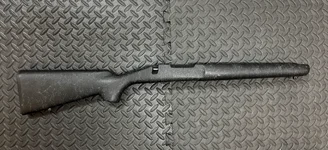
some pictures of the bedding and coincidently the front screw could be tightened just a bit more. there is still a little movement between barrel and fore end

View attachment 42338View attachment 42339View attachment 42340View attachment 42341View attachment 42342

I think that's where your inconsistency is. Either float or don't float, you don't want to nearly float. If you intend to float a thin barrel then you will need a fair amount of clearance, being able to slip a fiver under the barrel won't be nearly enough. Just look a some of the slo-mo videos of barrel flexing to see how much every thing shakes about.

Packing a couple of strips of card under the barrel at the pressure point is very quick and easy, it can be tried/changed in the field, will give instant results and can easily be undone. If there is no improvement then you can explore other avenues but packing the fore-end here is the first thing that should be tried. A few thou of clearance is neither one thing or the other.
 
No offense, ejg, but I may have to draw a diagram to demonstrate the elementary physics.
The force on the barrel is no different whether you rest the forend on a sand bag or your hand, or a brick.
It will jump move differently upon firing.

You said: As long as the forend is stiff, you are not going to increase the pressure on that point whether you hold it at the magazine, in front of the magazine, at the end, or lay the entire forend in a cradle of sandbags.
and this is plain wrong. If you have pressure on the forend between barrel and stock every bit of pressure that is exerted from the bottom of the forend will be relayed 1:1 to the barrel. The pressure on the barrel will increase when laying the forend on any kind of a rest, even holding. It does not matter if you have a plastic stock or a steel stock.
If you do not understand this then it is clear why you are in favour of pressure bedding.
edi
 
I neither favor nor disfavor pressure bedding nor free floated barrels, having shot both for over 40 years.

I am speaking here as a mechanical engineer, a designer of firearms and accessories for them, automobile components, aircraft frames and wind tunnel testing, missile engines, hand power tools, buildings up to 20 stories, etc. Vibration analysis, damping and absorbing were are part of all these.

I have owned over 100 rifles, probably shot three times that many, designed and built wood and composite stocks, and experimented with adjustable pressure point bedding. The fact that there are many rifles with point or full forend bedding which shoot 1/2 MOA is evidence enough that it works for those rifles. There is no "best for all" rule, just as the strings on one guitar sound worse on another guitar, and the suspension for Porsche will not work for a Ford truck.

I thought of another example of barrel vibration due to the firing forces, irrespective of the movement of the gun, which is AFTER the projectile leaves the barrel: an Army tank. The cannon barrel is "free floated", purely a cantilever beam, which can vibrate in Mode 1 and Mode 2 ( Mode 3 unlikely), as it fires various ammunition.

An important fact I forgot to add earlier, which may help with the visualization:
A free floating rifle barrel in mode 1 will typically vibrate at about 80 Hz.
A free floating rifle barrel in mode 2 will typically vibrate at about 400 Hz, but with less amplitude.
 
Last edited:
This has gone way too technical for me but I have shot both free floated rifles and rifles with upward pressure on the barrel from the fore end and have found that provided the fore end is stiff enough and the bedding is good, that repeatable hold and good shooting technique will allow the bedded barrel rifle to shoot well from various positions. A bit like the difference between shooting a pcp air rifle and a springer.
 
Glad im not the only one finding it to technical. Just want to get my rifle consistent.
 
Glad im not the only one finding it to technical. Just want to get my rifle consistent.

The problem is it seems that even technical well educated people get physical facts wrong... intentionally or unintentionally. If one wants a hunting rifle that can and will be shot from several positions then the pressure bedding route will not be as consistent as the free floated version. No matter how strong or stiff your stock is, once you have put pressure on the barrel via pressure point it means you are bending the forend downwards and the barrel upwards. If one lays up the rifle on the forend every ounce of weight will be added to the upward pressure on the barrel as the downward bent forend will not counter pressure going upwards.
We all know that changing pressure on a barrel can and will change POI. The 1/2" group shot off a consistent position in bench-rest conditions is not much use to anyone in the field as one can hardly replicate it.
If one wants consistency then free floating is the only way forward, like all modern precision rifles. Thin or thick barrel.
Some rifles are just a pain in the arse to get to shoot properly, often one hears the reason is lack of pressure bedding and that one might get a lucky group when the wind moon etc. falls into place.....in my experience it is often down to a lousy barrel would the rifle receive a new quality barrel of exactly the same weight all problems seem to disappear, seen it many times.

I believe initially pressure bedding had nothing to do with improving shot to shot consistency it was a feature to ensure that the gap between stock and barrel is consistent. Looks quality on the gun rack in the shop.
Even say plastic Remington SPS or T3 lite need a "pressure bed" only to centre the barrel in the stock as injection moulded stocks are quite difficult to manufacture straight.

Biggest problem with pressure bedded rifles, as mentioned before, is that they will shoot well off the bench but can and will fail in the field.
edi
 
The oscillation of the barrel originates with the expansion of the chamber creating a pressure wave which moves to the muzzle and back to the reciever, like sloshing water in a bathtub. Putting some mass or damper at the end of the barrel or in the middle can dampen this resultant barrel displacement.

The Simms appliance, of a soft gel ring which you slide onto a spot on a rifle barrel to dampen vibration - works - reduces group size.

The Browning BOSS appliance on the muzzle, a weight which you dial to reduce vibration, works - reduces group size.

A pressure point at the right position and pressure somewhere along a rifle barrel can also dampen vibration and reduce group size.

But a stout barrel, fully floating, and anchored in firmly bedded receiver, can oscillate very little, and be very consistent.

If I did not understand the mechanics, I would not have been able to develop software which predicted the modes of vibration, frequency, and deflection, as I did in the late 1970s. So have other people. And now there is commercial software which lets a gun designer interactively adjust the shape of a cannon barrel, or a gun barrel, or to locate a pressure point, or an increased diameter and mass in the middle of the barrel, to tune it.

An unsupported barrel may give you consistently large groups, or small groups with only a few loads.

PS: I personally think a load which produces a single peak bore gas pressure, and steadily declines as the bullet approaches the muzzle, is perhaps most important. Improper loads can produce a secondary peak at the muzzle, which can widely change the exit velocity, and the muzzle movement ( as well as damaging the bore, even being dangerous).
 
Last edited:
Southern, if you would have understood the mechanics you would have not written this sentence;

"As long as the forend is stiff, you are not going to increase the pressure on that point whether you hold it at the magazine, in front of the magazine, at the end, or lay the entire forend in a cradle of sandbags"

and that is exactly the flaw of pressure bedding the way it is done.
Pressure bedded via hydraulic or pneumatic ensuring a consistent pressure would be a technical solution, however maybe cumbersome to achieve on a small forend.
I have also seen rubber blocks as in old Steyr rifle. (that one also didn't shoot well)
By the way I have also several patents and designs, built many things from Automotive, microsurgery. electronics etc. Nothing to do with this.
edi
 
The wood warping with moisture is more of a reason to free float the barrel or change to a synthetic stock with aluminum bedding.

My direct experience developing software to model the interior ballistics and vibration of small arms is relevant to this discussion. My experience in chemical process control or medical devices may not be. I am only trying to relate my hands-on experience building, tuning and shooting rifles, and the science and engineering principles.

A friend had a sporterized 1903 Springfield which shot 1.5 groups with good loads. We swapped out the stock to a cheap, $65.00 synthetic stock with a pressure point at the forend, and it immediately shot 5 rounds into 0,75 inches. We put it into a stock from another 1903 with a heavier barrel, so it was floated the whole way, and it shot the same 165-gr Nosler into 0.8 inches. So he put it back into his cheap stock and went hunting. The stock is still on, 15 years later, and the rifle continues to shoot very well. That is why they call it "tuning".

A rifle that is difficult to make accurate may have a lot more going on with it than barrel bedding, and bedding or floating will not fix it.

If I am building or buying a handsome rifle with a nice walnut stock, I would rather have no gaps between wood and metal, visible or hidden. It may shoot better with an unsightly gap along the barrel, and it may not. I just don't have the experience of not being able to get one to shoot better than 98% of hunters can use.
 
Part of the perceived problem seems to be that modern shooters and hunters cannot cope with out a Bi-pod.

Stick a bi-pod on and you have just added a whole barrel of problems IMHO. They won't admit this is the problem so go blaming everything else and it cannot be them the shooter ............................ oh no.

I am no mechanical engineer nor scientist just a gun hobbyist and collector who does not think that the modern world and it's advances are as good as they are hyped up to be..
 
That was one of my points of agreement with you, Brithunter: a lot of what is sold to us "New, improved, a breakthrough", is actually a less expensive way to manufacture something, with fewer parts, looser fit, and less need for skilled workers - like front wheel drive cars.

Being old school myself, and a former competitive shooter, I think more hunters need to practice shooting with a hasty rest against a tree, over a log, sitting, kneeling, and yes ... offhand. It does no take that much practice to consistently hit a clay pigeon standing on edge 200 yards away with iron sights from offhand.

I only have two rifles with bipods - an HK 91 and an FAL. Mostly they are left off.
I actually have a front bipod on the triangular handguard for the HK 91, and a rear bipod which fits just ahead of the magazine with the slim hand guard. This rear bipod puts no stress on the barrel at all, and sits at the balance point of the weapon, so it works better.
 
Tried a bipod on it just to use for zeroing. I couldnt shoot it for toffee. It just jumped all over the place. Im much better off of a bag or sticks sitting with my back against a tree.

Out of interest brit. Does the bedding material around the recoil lig etc look original. And does the witness mark from where barrel and fore end meet look right. ( should the wood show a bigger area ok contact)
 
Back
Top