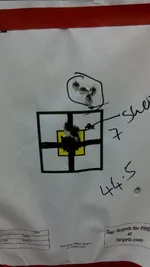
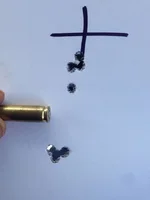
help loading 308

Wisdom.
Forget the lands. Why is this such a stumbling block for reloaders?? Does the factory come out and measure your throat with a comparator?? No. Seat the bullet with the parallel sides of the bullet to the base of the neck and crimp it there if you have a Lee FCD. (otherwise, forget the crimp) Mr Southern has it right: The Tikka will shoot a 'deep' seated load very well.~Muir

At last. Someone with a pragmatic approach. Perfection just doesn't exist and life's too short to go chasing it. I seat my bullets so they look about right in the case. Always have and it's worked well so far. Maybe target shooters aspire to hole on hole but I'm sure that live quarry couldn't care less if they die within 1" or 4".

And the only rounds I've felt the need to crimp are C/F pistol and .22 hornet.

Just forget utopia and enjoy your shooting.
 
At last. Someone with a pragmatic approach. Perfection just doesn't exist and life's too short to go chasing it. I seat my bullets so they look about right in the case. Always have and it's worked well so far. Maybe target shooters aspire to hole on hole but I'm sure that live quarry couldn't care less if they die within 1" or 4".

And the only rounds I've felt the need to crimp are C/F pistol and .22 hornet.

Just forget utopia and enjoy your shooting.

Excellent! Just the way I do it! I'll hold a bullet up along side the one I'm seating in the case and when it looks like the parallel sides are at the base of the neck I call it "Good!" I have seen froth and spittle fly from 'experienced' handloaders who are appalled at this technique and let me know it. Seems a very unsophisticated method to them but it works for establishing a starting point. I seldom need to make any adjustments.

I crimp everything.~Muir
 
Ok. I will try again! Being serious here. Don't understand the crimping thing. Lots of differing opinions. Was just interested in your thoughts on the subject.
 
Ok. I will try again! Being serious here. Don't understand the crimping thing. Lots of differing opinions. Was just interested in your thoughts on the subject.

Crimping helps to maintain consistency of pressure which can help with accuracy and grouping but does it really matter to the shooting of live quarry at the short to medium distances generally shot in the UK? Again, we don't need same hole groups.

It's also used in some hunting rounds to negate the possibility of the bullet becoming separated from the case. The only bullet I ever had separate from the case was seated too shallow and stuck in the lands. MY fault. And re my previous post, I'm not even sure that I need to crimp the hornet but it seems to be standard practice so rightly or wrongly I do.
 
Thanks for the reply. However I still struggle to balance the pressure generated by the ignition of the powder with the friction caused by neck tension/crimping? Seems to be orders of magnitude difference to me?
 
Thanks for the reply. However I still struggle to balance the pressure generated by the ignition of the powder with the friction caused by neck tension/crimping? Seems to be orders of magnitude difference to me?

Well, it matters. As DaveK said, it makes for uniform pressures and velocities. In my own experiments I have seen less extreme spread and lower standard deviation man timers over, with different cartridges. Chronograph strips of 20 shot strings are pretty convincing evidence. Results from pressure gun data evidence a greater uniformity in pressures as well, I have seen that as well. ~Muir
 
Neck tension may seem insignificant in relation to the peak pressure experienced behind the bullet, but it is not insignificant in relation to the force in the first few microseconds, at the bottom of that pressure curve. Let's say it delays the bullet exit from the muzzle by 1/1000 of a second at 3,000 fps. That is 1.5 times the length of the rifling, which means a huge potential variance in where the bullets exit in the oscillation of the barrel, due to the differences in exit speed. The force may be 1,000 or 2,000 PSI, at a stage when the gas pressure is only 5,000 PSI.

Consistency is the factor.

If you size the necks of your brass so that the inside is just perfect, in a set of brass with the same volume, crimping is irrelevant. But how many of us do that? Crimping compensates for differences in neck tension which can make quite a bit of difference in powder burning, as some loosely seated bullets would jump out of the case and increase the volume in those first microseconds.

At 100, 200, or 300 yards, it makes little difference. At a 1,000 yards, it may mean another 10 or 12 inches variance.
 
Neck tension may seem insignificant in relation to the peak pressure experienced behind the bullet, but it is not insignificant in relation to the force in the first few microseconds, at the bottom of that pressure curve.

Well said.~Muir
 
Thanks chaps. Very useful input. There is so much to learn! Looks like a trip to the shops for some neck crimping dies. Lee perhaps?
 
2p
worth
I use 150 pro-hunters with a charge of 45gr = h4895 at 2.300 oal @ OG , Out of my sako 85 shoots bug holes at 100 yrd without any crimp gives 2720 ish fps might be 2715 don't have my data to hand, anyway there is't any black soot line and very nice to shoot, happy happy :cool:
 
I don't crimp everything, but if the COAL falls on the cannelure, why not crimp? It works for me.

If you stand up several brands of 150-gr .30 caliber bullets side by side, you will see that some have the cannelure in different places, so the COAL varies a lot for those. But I think getting a few 1/1000s just right to the lands is over rated. The important thing is bore alignment. Look at how well the RN bullets, with lots of free bore, shoot ...
175 and 154 RN in the 7x57, .280, 7x64
150 and 180 RM in the .308 and .30-06
150 RN in the .270 win
117 RN in the .257 Roberts
140 RN in the 6.5mm
180 RN in the .303
270 RN in the .375
 
You did not say what brass or primers, or where you had started.
From scratch, I would start with 42.5 gr of IMR-4895 and load up sets of 5, in increments of 0.5 grains of powder, at 42.5, 43.0, 43.5, 44.0 and 44.5 in Remington brass and Rem 9.5 primers.

Since you got a really good group with 44.0, you could drop back to 43 and load up in increments of 0.2.

But right now, I would just keep it at 44.0, check the velocity, and shoot it a while to see if it keeps shooting good groups at 100, 200 and 300 yards. You might try different primers, like Remington, Federal, CCI 200, and Federal Gold Medal 210 match, if you have them, for sets of 5 rounds to shoot on the same range session.
Cci primers Geco case's ,thank for all the replays lots off helpful advice .
 
I don't crimp everything, but if the COAL falls on the cannelure, why not crimp? It works for me.

If you stand up several brands of 150-gr .30 caliber bullets side by side, you will see that some have the cannelure in different places, so the COAL varies a lot for those. But I think getting a few 1/1000s just right to the lands is over rated. The important thing is bore alignment. Look at how well the RN bullets, with lots of free bore, shoot ...
175 and 154 RN in the 7x57, .280, 7x64
150 and 180 RM in the .308 and .30-06
150 RN in the .270 win
117 RN in the .257 Roberts
140 RN in the 6.5mm
180 RN in the .303
270 RN in the .375

Neck (bore) alignment. Funny how people spend all that money on 'precision' dies and they do their best not to utilize the nice, concentric neck these dies provided by seating the bullets out as far of the neck as possible. I think that unless a rifle is chambered for this arrangement, seating the bullets to the lands as an essential part of the quest for accuracy falls into the same category as "boat tails are more accurate than flat based bullets". Generally speaking, it's just not true.~Muir
 
Back
Top