Aging deer by teeth

shbangsteve

Well-Known Member
Just wondering if you can age deer by the number of incisor teeth they are showing ?
You can age sheep and cattle, although they are slighty different.
Do deer follow similar rules and are all species the same ?
 
The incisors do not follow the same rules as other traditional livestock for aging purposes and each species have different eruption times too which doesn't help either.

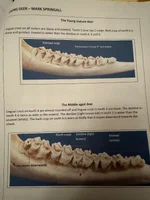
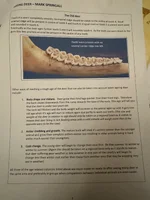
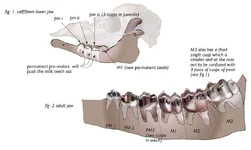
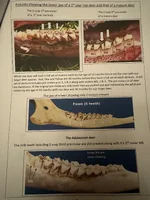
Aging is done from the lower jaw only, looking at pmi/PM1, pmii/PM2 and pmiii/PM3 and M1, M2 and M3. A combination or eruption and wear is used to identify age.

The incisors will give you a very rough and quick indication of mature/older animals by height above gum line but not much else.

If anyone is really interested I can put more info and pictures up
 
The incisors do not follow the same rules as other traditional livestock for aging purposes and each species have different eruption times too which doesn't help either.

Aging is done from the lower jaw only, looking at pmi/PM1, pmii/PM2 and pmiii/PM3 and M1, M2 and M3. A combination or eruption and wear is used to identify age.

The incisors will give you a very rough and quick indication of mature/older animals by height above gum line but not much else.

If anyone is really interested I can put more info and pictures up
Yes please
 
Franz Albert in Germany has done a lot of work on this on Roe. Tagging a lot of fawns over the years so know definitely how old they are and then comparing to teeth. He has done a number of videos, but not sure if its in published written work.

Teeth are a guide. A lot does depend on diet and to some extent soil type - both for minerals that promote good bone growth and strong teeth as well as being an abrasive.
 
Heym, you are correct soil type and vegetation has a massive impact on tooth wear which is why you cannot compare two jaws from two different geographical areas and age the deer in the same way.

Different soil types , eg sand, chalk, clay all have various levels of abrasiveness and a certain amount of soil will be ingested with any green matter through the deer's life, so it will affect tooth wear.

Soil type also dictates plant species present, to an extent too so the two go hand in hand.

A deer feeding on woody old Heather all it's life in in Scotland on a granite based gritty type soil is going to have significantly more tooth wear than its soft southern cousin feeding on soft lush agricultural green growth on some soft clay. Despite being potentially the same age...

This is why you need to get to know your deer on your own area...knowing what someone is doing in the next door county or Austria isn't super helpful for precise aging, other than to demonstrate key principles and science based facts.
 
This is why you need to get to know your deer on your own area...knowing what someone is doing in the next door county or Austria isn't super helpful for precise aging, other than to demonstrate key principles and science based facts.
Whilst fully agreeing with your point about knowing your own area etc - the work on aging done in Germany has been very helpful generally because as well as showing the typical trend as regards tooth wear/age on (tagged) deer of known age it's also highlighted the degree of variation in wear that can exist for deer of the same age living in the same area.
 
Webley, you.are right, there is masses of useful stuff that has come out of Europe, mostly in roe as you say. I'm not saying the research isn't helpful as it has shown trends and patterns, you just need to be aware that everywhere is different and huge variation within individual animals as you say but the principles that have been learnt are still useful.
 
Back
Top