


My club has embraced the 22NLR competition format with zeal in the last 9 months so I dusted off my little used Anschutz .22LR and checked zero.
First outing: Rubbish group. Tried 5 different ammos . Just degrees of poor grouping. So I asked a competent shot in our club to see if he could produce a decent group with the best ammo. Nope.
Checked scope mounts, action screws, cleaned barrel, fouled barrel, moderator on, moderator off...usual sequence and still no joy.
One seemingly repeatable symptom was that any change in windage was attended by a simultaneous change in elevation. So...had the scope's internals let go?
Per another thread's scope levelling method, I knew I could set up a crude test rig to find out whether the reticle was being governed appropriately by the dials. Simply: with the rifle held horizontally, a light shone into the objective lens will produce a silhouette of the reticle on a distant surface: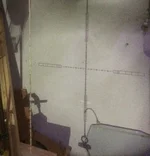 Once satisfied that the rifle was level and that the plumbline shadow was perfectly in sync with the scope reticle's vertical axis, I began to twiddle the windage.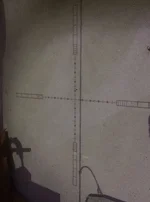
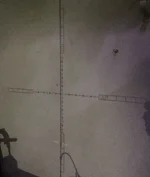 It tracked straight and true. No deviation in elevation. Testing the elevation achieved same.
At various points in the process, I applied a black sharpie dot on the wall and recorded the values on the elevation and windage turrets. I then wound the adjusters to their extreme limits and then back to recorded settings. Crosshairs came back to rest on dot.
I realise that this test is imprecise. A mechanical error causing a 4cm group at 100m may not be detectable over the 4m range of this photo-optical test. But equally there was no evidence of gross malfunction.
More web searching and I may have found a potential answer. Certainly it will be the basis of the next round of testing. What the YT pundit suggested is that the parallax adjustment on any given scope may be imperfect and described the way to test that by holding scope steady on target and moving eye. If reticle shifts wrt target, parallax is off. Nothing new. Pretty sure I did that sequence, but maybe imperfectly?
But...what the vid added looks to be a gem worth testing and sharing. Once you have set parallax as best as your eyes can determine [ignore distance values on scope dial, trust your eyes], then pull eye slightly back from ocular lens until shadow just starts forming evenly around whole scope image. Whenever shadow is a perfect doughnut, your eye is aligned to the reticle+target axis. Comments?
First outing: Rubbish group. Tried 5 different ammos . Just degrees of poor grouping. So I asked a competent shot in our club to see if he could produce a decent group with the best ammo. Nope.
Checked scope mounts, action screws, cleaned barrel, fouled barrel, moderator on, moderator off...usual sequence and still no joy.
One seemingly repeatable symptom was that any change in windage was attended by a simultaneous change in elevation. So...had the scope's internals let go?
Per another thread's scope levelling method, I knew I could set up a crude test rig to find out whether the reticle was being governed appropriately by the dials. Simply: with the rifle held horizontally, a light shone into the objective lens will produce a silhouette of the reticle on a distant surface:
Once satisfied that the rifle was level and that the plumbline shadow was perfectly in sync with the scope reticle's vertical axis, I began to twiddle the windage. It tracked straight and true. No deviation in elevation. Testing the elevation achieved same.At various points in the process, I applied a black sharpie dot on the wall and recorded the values on the elevation and windage turrets. I then wound the adjusters to their extreme limits and then back to recorded settings. Crosshairs came back to rest on dot.
I realise that this test is imprecise. A mechanical error causing a 4cm group at 100m may not be detectable over the 4m range of this photo-optical test. But equally there was no evidence of gross malfunction.
More web searching and I may have found a potential answer. Certainly it will be the basis of the next round of testing. What the YT pundit suggested is that the parallax adjustment on any given scope may be imperfect and described the way to test that by holding scope steady on target and moving eye. If reticle shifts wrt target, parallax is off. Nothing new. Pretty sure I did that sequence, but maybe imperfectly?
But...what the vid added looks to be a gem worth testing and sharing. Once you have set parallax as best as your eyes can determine [ignore distance values on scope dial, trust your eyes], then pull eye slightly back from ocular lens until shadow just starts forming evenly around whole scope image. Whenever shadow is a perfect doughnut, your eye is aligned to the reticle+target axis. Comments?


