Ensuring scope reticle is perpendicular to action [avoids cant POI error at extended ranges]

zambezi

Well-Known Member
I watched a Randy Newberg YT clip last night in which he explains how a non-verticle reticle causes cant related POI shift at distances other than the zero'd range. His tutorial has easy to follow graphics and he shows how he achieves action-to-scope truing using some clever optical device. But I got to thinking I could probably MacGyver a way to achieve the same outcome...


As it happens, the scope on my 30.06 was slightly off and needed fettling so I had a candidate for the project.

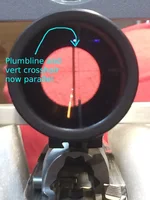
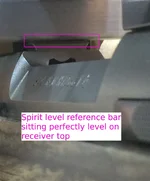
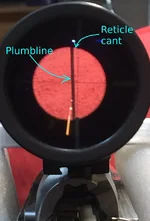
First up I lashed a visually straight bar onto the flat top edge of of the receiver action and ensured that there were no slivers of light where the action and reference bar married spirit_level_reference_bar_married_to_receiver.webp. Next I suspended a plumbline 2m in front of the rifle and manouvered the rifle bench to face that. Scope was set on lowest zoom, reticle and plumbline almost overlapping in sight picture. Then I canted the stock until declared level rifle_action_spirit_level.webp. Reviewing the sight image now, the plumbline and reticle were not in lockstep [see next post for before and after sight pics] and a spirit level placed on the top turret further confirmed cant scope_originally_canted_3deg_clockwise1.webp. So I loosened scope clamping screws and rotated scope perhaps 3 degrees anti-clockwise. I double checked that rifle action was still level and checked both spirit level and plumbline sight picture before tightening scope screws. One more final check after that scope_spirit_level_matches_plumbline.webp.
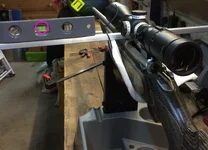
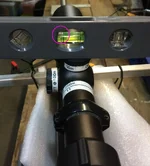
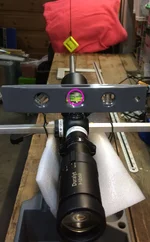

So the before and after sight images looked like...
 
Good a way as any. I do something similar by hanging a plumb line from a pin in a wall approx. a meter behind the gun. Then with the gun stable and level in the rest I simply shine a torch into the objective and the crosshair is projected perfectly over the plumb line on the wall. The advantage is that the project image of the crosshair is fine and sharp and can be aligned exactly with the plumbline without having to look through the scope whilst making any adjustment.
 
This is the flashlight method I use.


1. Position a vice with padded jaws on a sturdy table near a wall.
2. Clamp the rifle in the vice level both ways and with the breech pointing at the wall (bolt removed).
3. Shine a small flashlight down the muzzle towards the wall and place a vertical strip of masking tape about two feet long where the dot of light lands.
4. Using a large spirit level and black marker draw a true vertical line on the masking tape that passes through the dot of light (mark that dot on the tape with a cross in biro).
5. Centre the reticule in the scope by using the mirror method (press the objective lens to a mirror in a brightly lit room and adjust cross hair so it overlays its shadow).
6. Clamp the scope in the rings with a small spirit level balanced on the top of the elevation turret to ensure it is horizontal left to right.
7. Shine a powerful flashlight through the front of the scope and turn the focus ring until the reticule is in focus projected on the masking tape.
8. If the scope is aligned with the bore in the left to right axis you should see the crosshair intersect with the vertical line on the tape.
9. If the cross hair is on or below the biro mark then the mounting rail has useful tilt built into it.
10. If it is above the biro mark by the distance in which the scope centreline is above the bore then the mounting rail has no tilt.
11. If it is above the biro mark by more than the distance in which the scope centreline is above the bore then the mounting rail has the wrong kind of tilt.
 
I was having a problem with this issue earlier this week when fixing a scope to a Zastava CZ99 Precision in .22LR that I got as a plinker. There is actually no fixed feature on the action that enables one to determine if the action is actually level. It then became apparent that the quality of the milling of the dovetail did not quite match the rifle's name, when the scope mounts were clearly not horizontal to each other let alone the action. After some head scratching I gave up and just got scope as good as I could by eye. I'll see what it's like when I zero it and fiddle some more.
 
2 small spirit levels for me. One on the action and one on the turret cap.

How sensitive are your small levels? Do you calibrate them?

The plastic bodied magnetic levels that @zambezi showed in his post are notoriously bad...I have had a few which if you swap them end to end and they can be almost a millimetre out (@200mm that is 5mm per metre...awful)...I had to trim one with layers of masking tape around one end to get it to read true.

I think trying to set both the action and scope reticule to an arbitrary level is doubling your chances of inaccuracy, especially if you are not using the same level.

It is the relationship of scope reticule to bore which is the operative thing, so even setting the reticule to perfectly bisect the bore and then altering the windage turret to zero it you are going to be consistently offset...so it should be realigned after zeroing.

Unless you are deliberately setting up an offset sight like on some military rifles, I would rather just use my eye to align the vertical reticule line with the bore centre...If you need a guide you can just use two torches...one in the muzzle and one in the objective lens of the scope, which projects both the cross hairs and the bore onto the wall and it can be readily seen if they are out of kilter with one another.

Alan
 
Last edited:
How sensitive are your small levels? Do you calibrate them?

The plastic bodied magnetic levels that @zambezi showed in his post are notoriously bad...I have had a few which if you swap them end to end and they can be almost a millimetre out (@200mm that is 5mm per metre...awful)...I had to trim one with layers of masking tape around one end to get it to read true.

I think trying to set both the action and scope reticule to an arbitrary level is doubling your chances of inaccuracy, especially if you are not using the same level.

It is the relationship of scope reticule to bore which is the operative thing, so even setting the reticule to perfectly bisect the bore and then altering the windage turret to zero it you are going to be consistently offset...so it should be realigned after zeroing.

Unless you are deliberately setting up an offset sight like on some military rifles, I would rather just use my eye to align the vertical reticule line with the bore centre...If you need a guide you can just use two torches...one in the muzzle and one in the objective lens of the scope, which projects both the cross hairs and the bore onto the wall and it can be readily seen if they are out of kilter with one another.

Alan

I use a spirit level app on my phone and a normal domestic 9" real world level I found in my shed. Clamp gun firmly in the bipod with clutch nice and tight and level the receiver, then mount the scope and twiddle about. Perfect every time when checked against a plumb line.
 
What a performance for what could essentially be wasted when you zero the rifle as I doubt it is bang on plumb....I eyeball it...and call it good. Job jobbed! I could understand it on long range benchrest but otherwise will a 1/2 inch matter out to 300 yards?
 
Back
Top