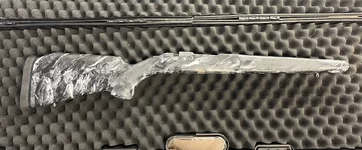
.270 factory loads for woodland work

As pert title, the .270 variation should be through this week i expect so a little information on what chaps and /or chapettes feel best suits the .270 at closer ranges in woodlands (100 yards or less)would be handy indeed. I do enjoy using my .243 and it has never let me down but trying the .270 should afford me a few more shots at the roe deer i would normally leave alone due to them being stood in clear felled strips at the edges of some denser woodland i have no permission to be rummaging through. Any round in the right place etc etc indeed but the .270 should tilt the balance just that little bit more .Thanks in advance for any constructive input.
Burst you bubble here but tests have shown that calibre - until you get the the extreame or below all legal deer (uk) doesn't shorten a run . What shortens a run is placement and how aware / alert to danger that deer is at the time .
Its a very good choice in a deer rifle though and pretty good with copper . Placement is by far the way to create a dead right there (DRT) Not forgetting the bullet and how it performs. choose the bullet with the greatest of care to purpose
 
150 grain in .270 WCF for all deer in every circumstance in the UK. We do not need "beanfield" rifle performance when most of the time in woodland or on the hill the shot should be 100 yards or less. Foxes then maybe even the seldom seen 100 grain loading may have some merit (I've an old box or two of Eley-Kynoch 100 grain .270 WCF) but for British deer in the most usual circumstances then 150 grain is all you need in .270 WCF.
They’re a bit thumpy and a lot of 150gr loads feature round noses and loopy trajectories.
I love the set zero 2” above point of aim and just shoot out to 200whatevers
 
They’re a bit thumpy and a lot of 150gr loads feature round noses and loopy trajectories.
I love the set zero 2” above point of aim and just shoot out to 200whatevers
Seria Game King boat tail (150's) have a decent point mine are close to 2750fps. The difference in cost against 130's is next to nothing...
The deer can't tell, the game dealer just weigh's and pays.
 
Seria Game King boat tail (150's) have a decent point mine are close to 2750fps. The difference in cost against 130's is next to nothing...
The deer can't tell, the game dealer just weigh's and pays.
I wont argue too much, but the BC of a 150gr .270 is around the same as a 180GR .300.
They’re very manageable, but Im sticking with what Ive settled on, 130 copper, 140, traditional.
Deds ded.
 
As pert title, the .270 variation should be through this week i expect so a little information on what chaps and /or chapettes feel best suits the .270 at closer ranges in woodlands (100 yards or less)would be handy indeed. I do enjoy using my .243 and it has never let me down but trying the .270 should afford me a few more shots at the roe deer i would normally leave alone due to them being stood in clear felled strips at the edges of some denser woodland i have no permission to be rummaging through. Any round in the right place etc etc indeed but the .270 should tilt the balance just that little bit more .Thanks in advance for any constructive input.
Front of leg top shoulder they will drop on the spot whatever caliber.
 
Burst you bubble here but tests have shown that calibre - until you get the the extreame or below all legal deer (uk) doesn't shorten a run . What shortens a run is placement and how aware / alert to danger that deer is at the time .
I call BS on that - common sense on it's own says that cannot be true. Putting a larger hole in something and imparting more energy is only going to kill it quicker.


I do also have the data to back this up, having personally tested a good variety of calibres against each other, using similar construction bullets (Mainly Barnes TTSX initially) and found a significantly varying result by calibre.

The overview of what I saw was average run distance from a chest shot nearly halved on average going from a 6.5x47L to a .308, and then more than halved again going to a .300WSM.
There's a reason I have three rifles and I choose each one depending on the job.


If you can produce any of said 'tests' which back up your statement I would be very interested to read them, however I'll be honest I don't think they exist...
 
Burst you bubble here but tests have shown that calibre - until you get the the extreame or below all legal deer (uk) doesn't shorten a run . What shortens a run is placement and how aware / alert to danger that deer is at the time .
Its a very good choice in a deer rifle though and pretty good with copper . Placement is by far the way to create a dead right there (DRT) Not forgetting the bullet and how it performs. choose the bullet with the greatest of care to purpose
You do talk a load of 5h1te sometimes ! If you look at the study by Andrew Yool who recorded over a 1000 deer reactions in Deer magazine the larger calibres clearly reduced the run distance compared to the smaller .222 and .243. From memory the .270 came out the best with negligible run distance. On red deer the .300s have a markedly reduced run distance compared to the 7mm and 6.5mm calibres
 
Burst you bubble here but tests have shown that calibre - until you get the the extreame or below all legal deer (uk) doesn't shorten a run . What shortens a run is placement and how aware / alert to danger that deer is at the time .
Its a very good choice in a deer rifle though and pretty good with copper . Placement is by far the way to create a dead right there (DRT) Not forgetting the bullet and how it performs. choose the bullet with the greatest of care to purpose

You do talk a load of 5h1te sometimes ! If you look at the study by Andrew Yool who recorded over a 1000 deer reactions in Deer magazine the larger calibres clearly reduced the run distance compared to the smaller .222 and .243. From memory the .270 came out the best with negligible run distance. On red deer the .300s have a markedly reduced run distance compared to the 7mm and 6.5mm calibres
Agreed, It is common sense that a larger caliber will drop deer more often on the spot when placement is accurate and the deer is unstressed but as usual i knew i would come up against some wafflers. I appreciate their input but oh dear do they lack some common sense sometimes. Anyways thank you all it is appreciated even though opinions may vary everyone has something worthwhile to contribute -- thats why i joined this place.
 
Last edited:
You do talk a load of 5h1te sometimes ! If you look at the study by Andrew Yool who recorded over a 1000 deer reactions in Deer magazine the larger calibres clearly reduced the run distance compared to the smaller .222 and .243. From memory the .270 came out the best with negligible run distance. On red deer the .300s have a markedly reduced run distance compared to the 7mm and 6.5mm calibres
hence why i thought it prudent to pick up a .270.I done the research and decided that although i have faith in my .243 ,and its been superb thus far,a wee upgrade to the .270 will limit the risk of a runner just that bit more making it a no brainer for shots round the edges of dense woodland.
 
hence why i thought it prudent to pick up a .270.I done the research and decided that although i have faith in my .243 ,and its been superb thus far,a wee upgrade to the .270 will limit the risk of a runner just that bit more making it a no brainer for shots round the edges of dense woodland.

270 is the go to calibre of the professional highland stalker for a reason. Several mates use them to great effect up north. It just works.

A big hole and lots of ft lbs is simply bound to put animals down faster, as has been stated, on 2 provisos. Bullet type/construction and placement. The former is academic, the latter subjective, if a person is recoil sensitive it’s better to use less and place better. I would think a lot of folks fall into that group.

There isn’t much between my 6.5 and 308 but that is owing to the girt long barrel on the former, and the fact it’s loaded hotter with similar ft lbs, my old 7mm RM put deer down with more authority than either.
 
hence why i thought it prudent to pick up a .270.I done the research and decided that although i have faith in my .243 ,and its been superb thus far,a wee upgrade to the .270 will limit the risk of a runner just that bit more making it a no brainer for shots round the edges of dense woodland.
Precisely the reason why I picked up a 270 after stalking for a few years with a 243.
But to be honest, I think it was largely a confidence thing. After having a couple of runners I was losing faith in the 243, and switching to a slightly bigger calibre rebooted my confidence. But at the bottom of my heart I know that the real reason those deer ran after being hit with the 243 was poor shot placement.
However, that's by-the-by. An early run of successes with 270 lifted my confidence no end, so much so that I now enjoy using my 243 again.
The 270 has also given me the confidence to stretch the distance a bit, to the extent that I'm happy taking deer up to around 230 yards with it. Previously, I'd have let anything over 100 yds walk on by if I couldn't get closer.
 
Agreed, It is common sense that a larger caliber will drop deer more often on the spot when placement is accurate and the deer is unstressed but as usual i knew i would come up against some wafflers. I appreciate their input but oh dear do they lack some common sense sometimes. Anyways thank you all it is appreciated even though opinions may vary everyone has something worthwhile to contribute -- thats why i joined this place.
I remember his findings from the time , i was pretty sure that Run distances where pretty much the same . Now we are looking at at 15 years or so on now
I really cant say when it comes from distance run regards caliber and having shot a heck of a lot in the time passed from the mans reports , that i remember different than presented here today . placement and awareness of the individual beast are the only predominant factor ( oh and the fact we cannot shoot big stags etc with 22 cf in the UK and can only shoot Roe with 222 up if we are in Scotland
More Nations allow 223 than dont and Alaska allows it for moose
 
100 grn super performance SP .243

140 grn super performance 6.5 x 55

123 grn. Sako .308

These are the best grouping rounds for my rifles including knockdown in any areas of woodland or clearfell
And I get the odd runner not because of a wrong shot placement because they can and will do so
 
100 grn super performance SP .243

140 grn super performance 6.5 x 55

123 grn. Sako .308

These are the best grouping rounds for my rifles including knockdown in any areas of woodland or clearfell
And I get the odd runner not because of a wrong shot placement because they can and will do so
We all get the " How the heck did that take a step ?" Deer . My freakiest was the third of three stags culling - it ran and ran , my mate a very experienced head stalker told me to let it go but i knew it was a good hit . It then fell down , opened it up and the hart was totally ripped appart wide open no function at all , indeed you couldn't see a more messed up organ if you smashed it up with a two handed sledge hammer! " it could and it did !" As you describe
 
What kills an animal dead is loss of oxygenated blood to the brain and major organs.

Drop on spot = put bullet where it impacts major sets of nerves thus rendering the animal instantly unconscious. A bullet and its shock wave through the shoulders impacting the big bundles of nerves in the armpits and front of thoracic cavity ( The HILAR) or impact the spine or brain will cause this. If the bullet also takes out major blood vessels the animal will bleed out before it regains consciousness.

If bullet and its shockwave only connects with major blood bearing organs - ie heart, lungs, liver and major blood vessels the animal will either stand and stagger or run until there is a major loss of blood pressure thus depriving critical organs of oxygen.

Some bullets will cause a bigger wound channel and this more damage to blood vessels so a quicker loss of blood. A bigger is not necessarily how wide the the channel is but its length and volume.

Put a bullet where there is little blood flow, animal will die from infection or may recover.

Bullet, cartridge and how much power doesn’t really matter, shot placement does. If power was critical then why do we use a 1,000 ftlb min cartridge on Roe which way 40kg on the hoof, yet a min of 375h&h with 4,000 ft lbs plus on Buffalo (1,000 kg) and Elephant (7,000 kg). Even the really powerful cartridges such as the 600 NE are only producing 8,000 ft lbs.

An elephant is 175 times the weight of Roe deer, but we don’t use, or gor that matter need a rifle producing 175,000 ft lbs - recoil would be a touch high. Instead many many buffalo and elephant are shot with 375s. Indeed plenty have been shot with 6.5x54s and 7x57s with about 2,500 ft lbs. Put their bullets in the correct place and tye drop on the spot.
 
We all get the " How the heck did that take a step ?" Deer . My freakiest was the third of three stags culling - it ran and ran , my mate a very experienced head stalker told me to let it go but i knew it was a good hit . It then fell down , opened it up and the hart was totally ripped appart wide open no function at all , indeed you couldn't see a more messed up organ if you smashed it up with a two handed sledge hammer! " it could and it did !" As you describe

Yep one of lifes learning mystery curves
I’ve never seen a point your finger reason to a deer running on, one deer 150 yds H&L drops like a stone, another 35 yds runs 40 yds both identical shot placements, same weight of round and caliber both in a relaxed didn’t know I was there scenario
No Rhyme or reason they just do it when and whenever it suits
 
Back
Top