4wd snorkels

All the swamp hunting good ole boys in North Carolina snorkel their quads. That said, never buy a snorkeled quad, as you can count on it having been “rode hard and put up wet”.
 
I have often wondered about these. They are regular additions to trucks here that will never see water deeper than puddles in the driveway. I have two concerns about them. First, what kind of air flow restriction do they create? At my altitude, we are already down iirc about 30 percent on available power due to low oxygen resulting in a lean condition if tuned correctly. Second, these new trucks would be totalled by the insurance company if they were ever in water deeper than the tires, so what kind of damage is done submerging a modern vehicle.

And no, I didn't read the article because.....facebook!

Scott
 
Principal reason for most “snorkels“ is that they are not so much snorkels but high level primary air cleaners.

When driving in dusty conditions, the cleanest air is up near the roof. They then have separators that remove the large particles before the air goes through the air filters.

Many are not really good enough to keep put serious water - a bit of a splash perhaps. Besides in most vehicles there are things like fuse boxes, oil breathers on gear boxes and axles , even just dipstick pipes all which are very susceptible to water ingress.

Its also worth noting that the air intake on many vehicles is really quite low. Certainly in my old A4 Allroad the intake level was well below the top of the wheels. If you are going to ford water in such a vehicle - be very aware of this, make damn sure you keep up a good bow wave and do not stop and when put the other side make sure the filter is not full of water, and no water has gotten into engine oil etc.

Snorkels do restrict airflow but not a huge amount if well designed. It’s a trade off between keeping engine free from dust vs engine performance. Besides most engines now have turbos. These are set to provide a certain level of boost. If there is not enough boost then the waste gate closes sucking more air in, till boost pressure is achieved. This both compensates for altitude, so a turboed engine doesn’t loose power like a naturally aspirated engine dose and will to some extent minimise the effect of big air cleaners etc.

But in bush type conditions reliability is somewhat secondary to power and fuel efficiency. Beauty of the Series landrovers is that they could be made to run even if half the bits were missing - not fuel efficient, but they run. Ditto with the old landcruiser straight 6s. 4,5 litres to produce 120 odd hp. But they would do this for half a million miles on a mix of diesel and whatever else is mixed into bush diesel.
 
Last edited:
oil breathers on gear boxes and axles
A lot of blokes here have breather valve extensions finishing off up inside the chassis.
Snorkels do restrict airflow but not a huge amount if well designed.
They do have another bonus besides the water and dust factors as that on the highway the air is 'rammed' into them ...or so its said.

One thing here is "dont cross unknown depth without a snorkel fitted."

I must admit that crossing the Goulburn one time with the water halfway up the windscreen was a little shaky..Hilux.
 
A lot of blokes here have breather valve extensions finishing off up inside the chassis.

They do have another bonus besides the water and dust factors as that on the highway the air is 'rammed' into them ...or so its said.

One thing here is "dont cross unknown depth without a snorkel fitted."

I must admit that crossing the Goulburn one time with the water halfway up the windscreen was a little shaky..Hilux.
If you are going to be crossing deep water and you don’t have high level breathers on axles, stop the car and let everything cool down. If you plunge into water and the diffs are hot the cooling effect of the water can make them suck in air and water.

Also worth checking and if necessary changing the oils in the diffs and gearboxes regularly if you are in and out of water. Water in oil seriously degrades the oils ability to lubricate things which leads to expensive failures.
 
Water in oil seriously degrades the oils ability to lubricate things which leads to expensive failures.
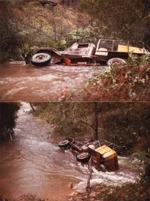
Nelsons Creek,Buckland Valley circa `85. Landcruiser with a 351 ci Cleveland v8 in her. Photos taken the next day after we three climbed out of the passenger window through the torrent coming in. Lots of Sambar hunters have lots of tales re creek/river crossings. There has been and always will be losses.

toyota truck drowned.webp
 
Nelsons Creek,Buckland Valley circa `85. Landcruiser with a 351 ci Cleveland v8 in her. Photos taken the next day after we three climbed out of the passenger window through the torrent coming in. Lots of Sambar hunters have lots of tales re creek/river crossings. There has been and always will be losses.

View attachment 370644
On a vehicle of that vintage. First light a fire and put the kettle on.

Drag it out, let it dry for an hour or two, whilst having a cup of tea and cleaning the rifles and other gear. Drain and refresh the oils and the fuel. Replace the filters. Remove battery, pour out the acid - replace with fresh. Or pinch one from another vehicle.

Pull the spark plugs and rotor head and turn the engine over checking no hydraulic locks etc, or that nothing is bent. Put them back, start up the engine and carry on with the trip.

Modern vehicle with ECUs etc. leave it there, it’s completely buggered as the electrics will all be fried. You have a long walk home.

With diesels of that vintage you don’t need electrics. In Zambia a friend with older cruiser than one above put a branch through the radiator. We were a long way into the bush and days when mobile phones did not exist. We limped the truck onto an anthill ( a Rhodesian starter motor). Lit a fire, pulled out the radiator and the battery. Carefully poured off the battery acid in a beer mug. Took out lead plates. Heated up a tire leaver in the fire, and using battery acid as a flux and battery lead as solder, plugged up holes on the radiator good enough so it would retain water. Put radiator back in and put last of our water into radiator. Pushed the truck down the anthill and old diesel spluttered into life and got us back to civilisation.
 
Last edited:
Principal reason for most “snorkels“ is that they are not so much snorkels but high level primary air cleaners.

When driving in dusty conditions, the cleanest air is up near the roof. They then have separators that remove the large particles before the air goes through the air filters.

Many are not really good enough to keep put serious water - a bit of a splash perhaps. Besides in most vehicles there are things like fuse boxes, oil breathers on gear boxes and axles , even just dipstick pipes all which are very susceptible to water ingress.

Its also worth noting that the air intake on many vehicles is really quite low. Certainly in my old A4 Allroad the intake level was well below the top of the wheels. If you are going to ford water in such a vehicle - be very aware of this, make damn sure you keep up a good bow wave and do not stop and when put the other side make sure the filter is not full of water, and no water has gotten into engine oil etc.

Snorkels do restrict airflow but not a huge amount if well designed. It’s a trade off between keeping engine free from dust vs engine performance. Besides most engines now have turbos. These are set to provide a certain level of boost. If there is not enough boost then the waste gate closes sucking more air in, till boost pressure is achieved. This both compensates for altitude, so a turboed engine doesn’t loose power like a naturally aspirated engine dose and will to some extent minimise the effect of big air cleaners etc.

But in bush type conditions reliability is somewhat secondary to power and fuel efficiency. Beauty of the Series landrovers is that they could be made to run even if half the bits were missing - not fuel efficient, but they run. Ditto with the old landcruiser straight 6s. 4,5 litres to produce 120 odd hp. But they would do this for half a million miles on a mix of diesel and whatever else is mixed into bush diesel
Thank you for the explanation. Use as an air breather extension makes more sense than believing you can use your new truck as a boat. Although, we have many 4x4 shops that are likely upselling this as necessary "truck bling".

Scott
 
I've not had mine deeper than the top of the wheel arches, but when you are crossing a river and a wheel "dips" into a hole it seems to take forever for the tyre to find bottom...

Viva la 80 series!!!!!
 
My air vents are on the side of my Freelander. It starts to float before the water goes in to the intake. On the flat and excluding holes to float over of course. 2 foot 2 inches in old money. I was a bit twitchy I can tell you.
 
The carpets in my old 90 CSW were always sodden and rotten from "wading". Breathers were extended but I didn't push it depth-wise so no snorkel. With my Freelander and now dS, my deep wading days are over as the damage risk is too high. In the 80's, I remember driving a 110 from Goose Green to Stanley (pre MPA road) across the bondu with no alternator. Jump started it at Goose Green and prayed I didn't stall it in any of the bog holes en route. Sadly those days are long behind us and all diesels now have so much electronics without which they will not run - progress :rolleyes:
 
Back
Top