

Dubla mangi.
Harsh words in Afrikaans spoken to the two black guys hanging around the garage doors had the rapid effect of a wooden seat being brought out and lashed to the back of the bakkie. It being hardly four in the afternoon we were undeniably excited if not actually a touch delirious, having stepped off an aeroplane four hours earlier, at the prospect of going out hunting straight away. However were we to understand that we would be shooting off the back of a bakkie? Not to start the week off with a bout of snobbery but surely this wasn't the African adventure we had quite envisaged.
As it turned out, if it is the case that danger lends the aspect of the sporting to methods otherwise mundane and, ah, perhaps mainly biltong-orientated then driving around on the back of S.'s bakkie in pursuit of anything game shaped was the wounded-leopard-following-up-in-thick-bush of plainsgame hunting……
Even the ride to the range (a Swiss-cheese sculptured oil drum, full of rocks, in front of a three foot earth, and rock, berm.) was death defying enough, In fact S.'s driving was only bested by the special looking gentleman and the Chase of Willy's Wounded Wildebeest but more on that anon.
We checked our rifles' zeros to a soundtrack of whizzing cowboy-movie ricochets (see description of zero range above.) and roaring from this little moggie…
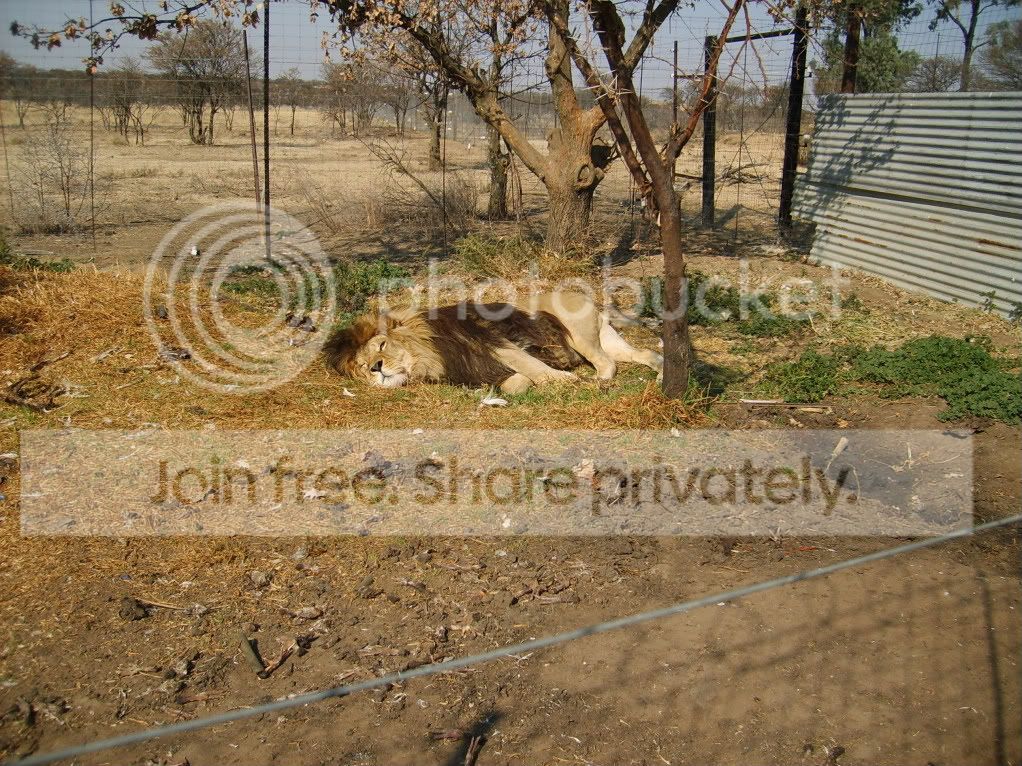
Quite the soundtrack and one, unfortunately minus the ricochets, that by various strokes of fortune became rather pleasingly normal during our stay in Africa. The roaring of the lion cemented for me a feeling of otherness I had felt since we landed. More specifically I am talking about the feeling one gets when it is apparent that one is very far from home. Africa is a place very much of itself and was quite alien for those first few days. I suppose what I'm trying to get across is that to be cruising around with intent and a loaded rifle, listening to lions roar and watching the wildebeest running around on the plain made Africa "real" at that moment.
A. and I tossed a coin to see who would open the African account, A. winning the toss and seating himself on the left of the bakkie so as to be as naturally comfortable as possible at the time of the shot. It did occur to me that this seemed a nice way to ease into the first afternoon and settle the nerves with a good look at a few different species of game and try and translate the diagrams and landmarks of the shot placement guides onto the new animals, but upon reflection have come to feel properly contrite at having taken this view. As it turned out the antelope are engineered much the same as our comparably sized deer, perhaps with the heart a touch lower and further forward.
We saw quite some number of species on this ranch, which was big enough to house several different habitats and a corresponding variety of species.
Soon enough a Springbok presented itself, trailing a herd at about 150 metres (my apologies to our imperial readers all shooting distances in this report will be given in metres as the range finder of our excellent PH, Dennie, read in metres). S. swung the bakkie out to the right as A. took aim and the double thud of a moderated rifle followed by the impact on the animal sounded in our trip in assured style. Despite visibly scoring a solid heart lung shot the springbok took off like a shot, running 150 metres into the veld directly away from the bakkie before turning around and running all the way back again. I confess that despite Dennie's assurances that it was dead on its feet it seemed awfully sprightly for having had a .270 through the boiler room. To my delight it dropped as it crossed the track in front of us.
We piled out the bakkie and surrounded the springbok. A. was grinning like a madman and the South African boys were saying all the right things. Eventually amid the handshaking and back-clapping we took a closer look at the thing. There is a curious phenomenon in recently deceased Springbok whereby the patch white hairs running along the back on to the rump stand as if by static for a few minutes after death. A further, and if anything even more curious, phenomenon is that these rump hairs smell like candyfloss.
Now I don't know about you gentle reader but A. and I suspected that the two suddenly very serious Afrikaans gentlemen in front of us may have been planning to have just a bit of sport with the two greenhorns….
The events following that standoff are probably best illustrated by the series of photographs I reproduce here:
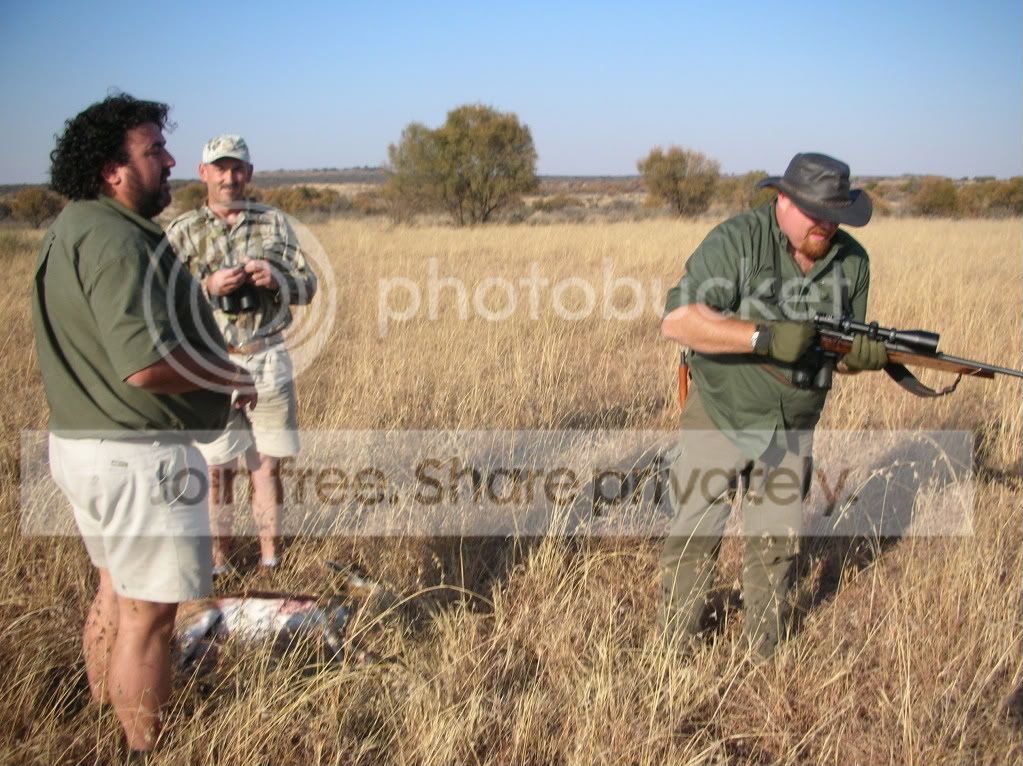
(The stand-off ends with A. abruptly clearing his rifle in preparation of sniffing the springbok's bottom, note the stony serious demeanour of Dennie and S.)
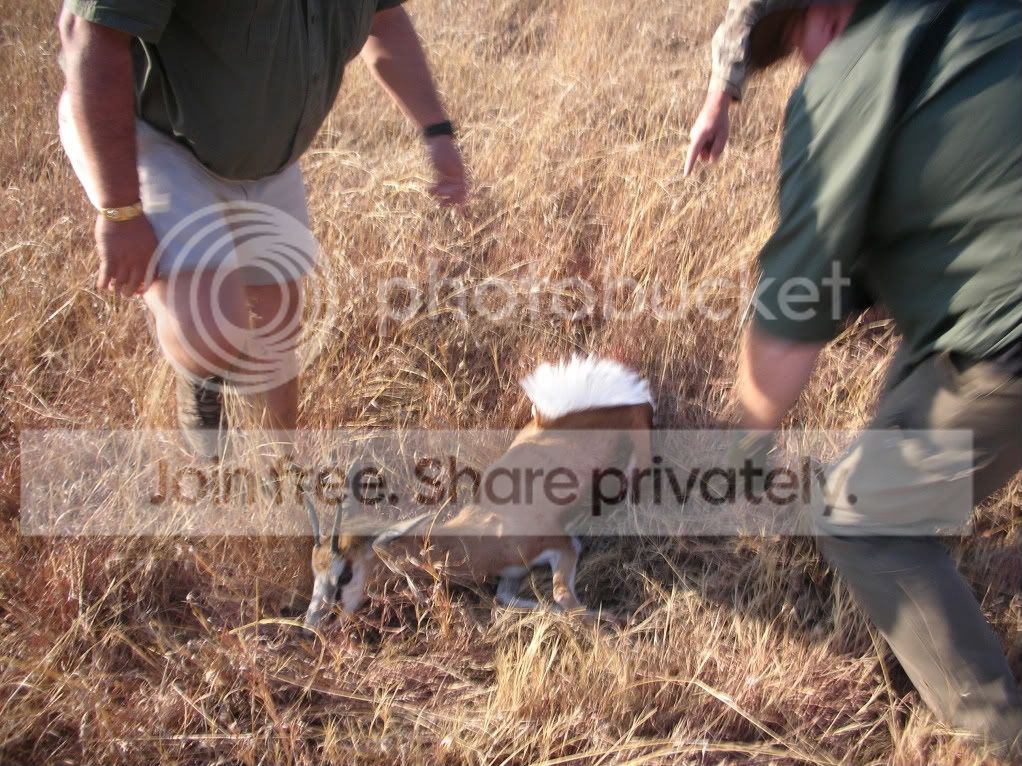
(As if by the report of a starter's gun three men pounce on the springbok to arrange for photography. And also to sniff it's bottom of course. )
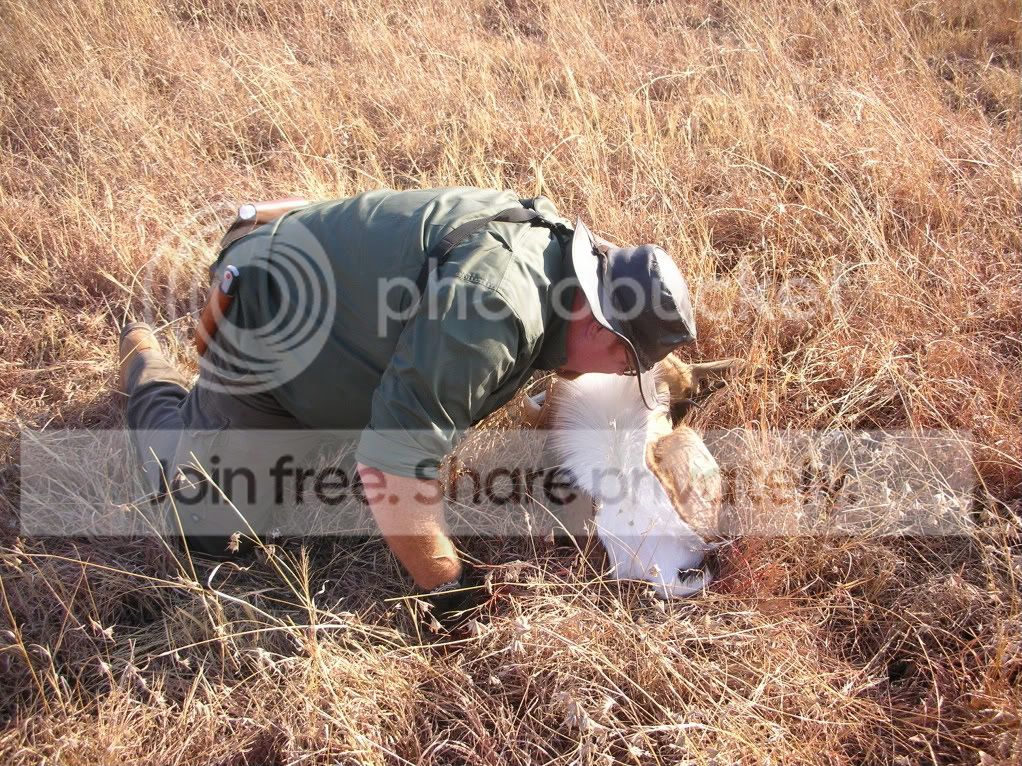
(This photograph illustrates the first phenomenon mentioned above very well. I am not sure what the purpose of this adaptation would be for in nature and so far my admittedly cursory researches have not turned up any information on it. If any one has any more information on this phenomenon I would be very interested to hear it. There is also a man rather self-consciously sniffing a springbok's bottom. )
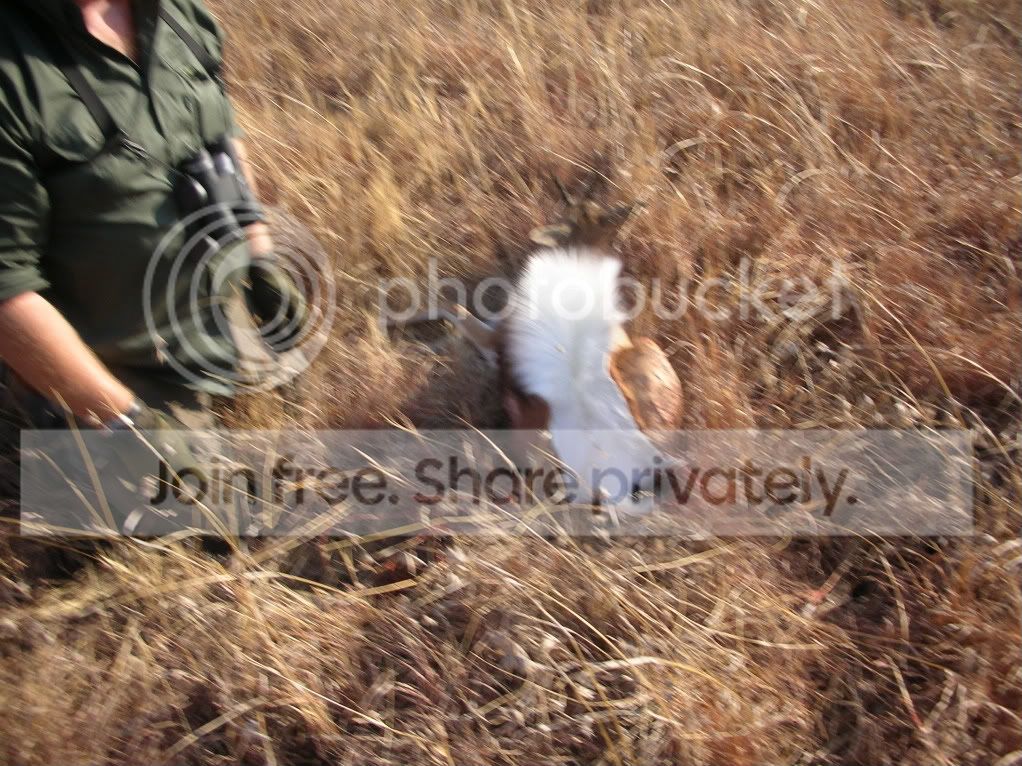
(Candyfloss!)
(In addition please excuse the particularly poor quality of this photograph, as apposed to the merely shabby quality of the others, I was practically micurating with mirth by this point m'lud…..)
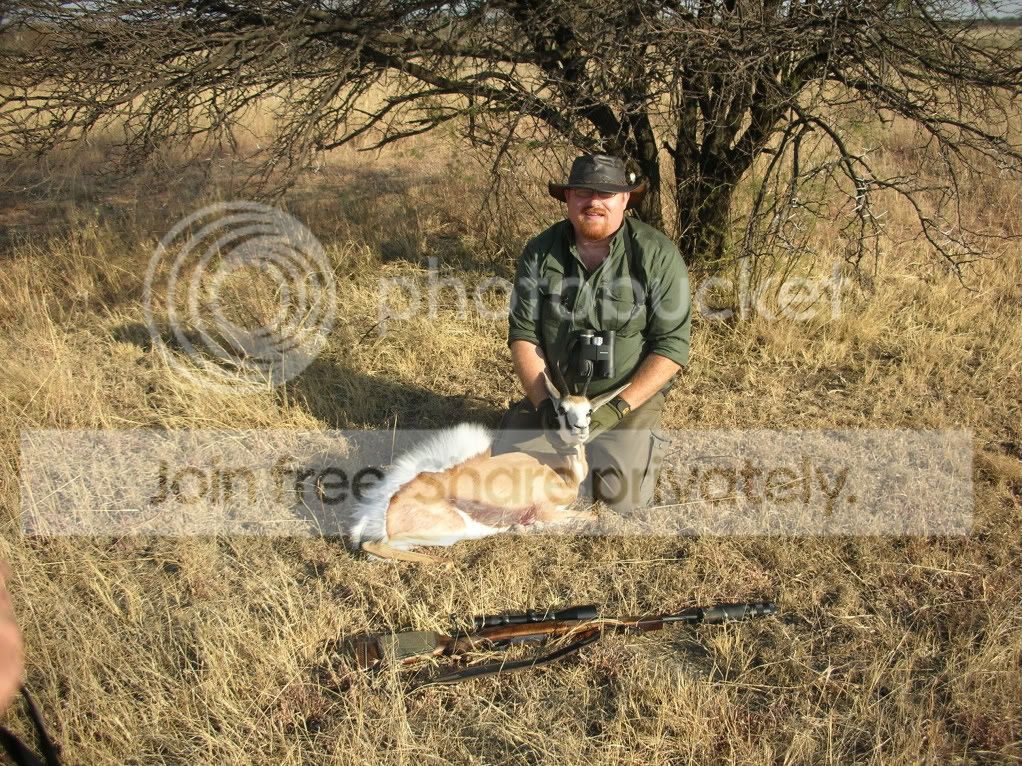
(A wonderful first African trophy!)
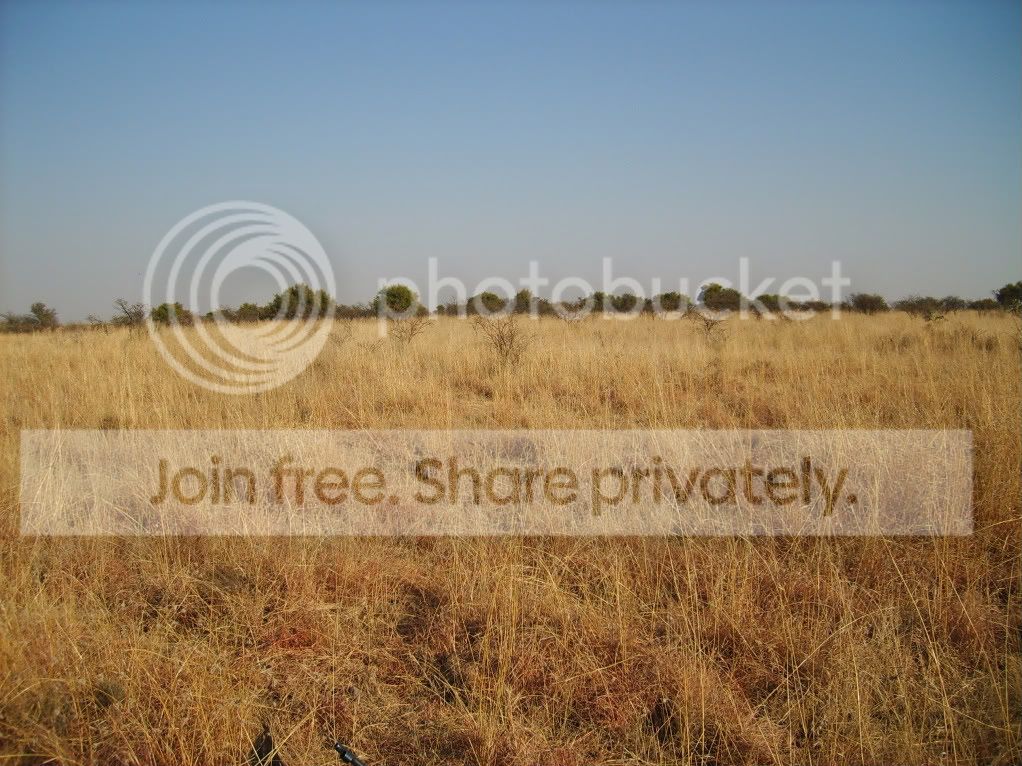
The shadows were lengthening however, so we loaded the springbok on the bakkie and drove on from the relatively open grassland into progressively thicker bush. The terrain of the place roughly divided into three main habitats:
Open scrub and grasslands
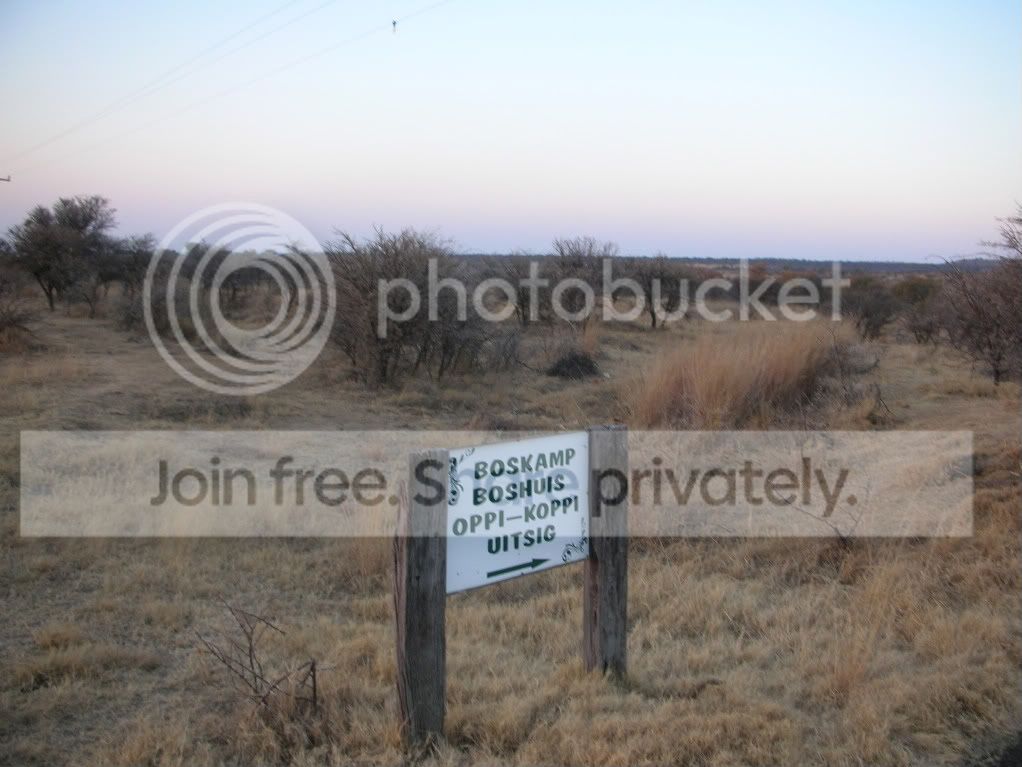
Thicker, low bushveld
The third being burnt plains. The blackened remnants of the first two habitats where according to age and rainfall the only areas where green shoots of new growth could be observed the ranch. This was probably led to it being the favoured habitat of the black Wildebeest, Blesbok, Springbok and Ostrich who seemed to come out on to the plain to feed, heading back to the cover of the veld to rest up in cover. I think that their behaviour is different on the plain than in the veld, but I would like to spend more time observing them before drawing any concrete conclusions.
Such soul-satisfying amateur ecology was all well and good, but it was time to set off and see if I could bag anything before the end of the first day. As we drove into thicker bush, Dennie leant over to the back window of the bakkie and told me be ready with the sticks as would probably be stalking anything we spotted in this bush.
Spotting game was the hardest aspect of the hunting over there for me. The eye takes a while in getting accustomed to looking for the subtly different silhouette of backs, flicking of ears and upright legs spotted in gaps in the bush in different terrain. It is also fair to say that I found a lot in the African bush to become accustomed to. Red lumps that would at home frequently resolve in to deer would turn out to be ant hills and termite mounds; the preponderance of woody undergrowth both screening the smaller species very effectively and the taller bush providing effective cover for beasts as large as hartebeest.
Dennie's game spotting abilities seem to verge on the supernatural to this rather awestruck and humbled hunter. There was also a small issue in that moving through the African bush quietly is rather difficult. I found that if it wasn't the grass rustling as you moved through or the thorns scraping on your gaiters, it was the "go-away" bird squawking or an amazing noisy and belligerent species of ground squirrel chattering that just occasionally bumped a carefully stalked animal on from ahead of you…..
About the only thing a neophyte can effectively manage is being careful not to break any of the abundant supply of dry twigs lying around. I eventually took some consolation in the fact that despite it all, as long as one didn't break any of those accursed twigs the rest was fairly manageable as long as I carefully mirrored the PH's pace.
Visibility depended on the exact terrain generally varying from thirty to one hundred and fifty metres. It must however be admitted that from the top of a bakkie one could see out a little further. Nevertheless it was Dennie who first spotted the herd of Impala, with a nice cull ram in it, from his position two feet below us.
He quietly got out of the bakkie, motioned me down off the back, bad puns involving the back of bakkies - the hanging out whereof et al - becoming a perennially popular theme over the two weeks by the way, and extended the sticks.
"We'll stalk that ram."
Splendid.
"Remember, when the sticks go up get behind me quick and get on them. When I say "shoot now!" you shoot ok? They won't hang around these animals!"
There was a ride leading to a dam, Afrikaans for anything from a rough borehole to a full on lake, about five hundred metres away with its nearest point being about thirty metres to the right through some low bush. The Impala were meandering across this ride from the patches of feed and cover on the verges of the ride, tending generally towards the water but far enough ahead of us that they had not appeared to have noticed the bakkie. The wind being just about perfect, I judged that we had thirty metres to stalk to get on to the ride and then perhaps another two hundred to get within comfortable shooting range.
More by luck than judgement I managed to arrive behind Dennie at the edge of the ride without scaring the herd off and got the binos up for a first proper look at the African Impala.
An elegant and fairly alert antelope, the Impala is great fun to hunt, especially the smaller herds of females with one or two rams attached. This sort of hunting was relatively familiar to me as similar to stalking small groups of our woodland Fallow deer. The main aim of the game is to manoeuvre into a position where you can take a shot a particular animal from the group without being busted by the constantly wary females. It's fun and addictive stalking and after a scant ten minutes of the usual stalking shenanigans we managed to get within about one hundred metres of the herd.
There is a particularly exciting moment when hunting with a guide the world over, the moment when the guide suddenly stiffens and begins deploying the sticks. It reaches the point where one is getting buckfever even before seeing the beast, never mind getting the bloody rifle up and the crosshairs on it!
Aptly enough then when Dennie froze and began to slowly put out the sticks my treacherous pulse started playing silly buggers before I even knew exactly where the ram was. We were in the shade of some trees just inside the bush, about a hundred yards away from the majority of the herd. The herd were now alert if not actually suspicious. Getting on the sticks I saw what precipitated the sudden freeze on the part of my PH, the ram was behind some light bush a hundred and twenty metres in front of us but a ewe at only about seventy metres appeared to be looking directly in our direction. Fortunately the movements I had made in getting behind Dennie and getting the rifle onto the sticks had been hidden from her by Dennie's bulk so whilst she was undeniably suspicious she wasn't outright spooked. I suspected that she would err on the side of caution and move off, probably taking the rest of the herd with her. Keeping my eye on the ram I placed the crosshairs of the scope on a gap in the bush in the direction I thought he might go. Sure enough the ewe decided that the area was perhaps not as safe as she had first thought and turned off towards the rest of the herd. This had the predicted effect the rest of the herd, who trusting their matriarch's judgment instinctively began to depart the scene in an approximation of single file into the wind and towards the water.
I had been on sticks for a couple of minutes watching the herd, specifically the ram to be fair, when the ewe started moving. The effect on the herd was interesting, the members perhaps paying as much attention to each other as their surroundings, the effect very much reminiscent of our herding species in the UK. It was interesting to compare and contrast the behaviour of the game animals with those of roughly the equivalent seral niche with those of places I am already familiar with. Geeky I realise, but part of the fun as far as I'm concerned!
Forcing myself to calm down, planning the shot had helped, I watched in the periphery of the scope for the ram to come clear of the scrub, it looked as if he was going to go in the direction of the gap so easing off the safety I checked Dennie's position with my left eye. I had told him earlier that for some reason the only word I can reliably use to warn others of an impending shot in these circumstances is "ears!". He was looking intently at the herd through his binoculars so when I saw that my whispered "ears!" had no apparent effect I resolved to give the poor guy one more warning, In truth I have had a few complaints about detonating an short barrelled 30.06 next to friends' ears before, and so whispered "ears!" a little more loudly.
Just then the ram stepped into the clear.
"Sorry old boy, Dubla mangi." I thought, closing my left eye again and focussing all my attention on the by now one step way from clear Impala; if Dennie hadn't heard my warning he would certainly be left in no doubt in a moment.
The ram took one step and stopped to look around presenting an almost perfectly broadside aspect, right in the middle of the gap. This was all the invitation I needed and following the front leg a third of the way up, where the cream of the belly hair meets the reddish hair of the back, squeezed that wonderfully, comfortingly familiar trigger on the trusty Tikka.
The rifle kicked the sight picture out of view but remembering the advice of a stalking mentor whose advice has yet to fail me I made sure to regain the sight picture before reloading the rifle. At the risk of subsequently labouring the point I was glad I did as I saw the somewhat shocked looking ram at the apogee of a jump that upon landing from which threw its head forward and set off in a blind dash. "Heart shot?" I thought, once again this antelope behaving perhaps surprisingly similarly to our deer.
The herd took off at a run at the report, though we had stayed almost perfectly still since that ewe spotted us, away from the water, across the wind into what must have been thicker bush. The ram ran with them across us mostly hidden by bush and long grass. We could see some of their backs just above the grass and the tips of some of their horns just above the bushes and that was it. Despite my earlier confidence and Dennie's assurances I was immensely relieved when one of the pairs of horn-tips wavered as the rest ran by and started tottering sideways behind the bush rather than determinedly departing towards the horizon.
The relief gave way to adrenaline when the horn tips gave one last waver and dropped out of view. My ears ringing and mind spinning I was shaking Dennie's hand and at the same time bizarrely fixated on trying to fix in my mind the position that the ram had dropped. What a first animal! The whole thing from spot to shot couldn't have taken more than ten minutes but the stalk was honestly one of the most exciting I have experienced. We walked over to where the ram had dropped to arrange it for the obligatory photograph.
It was as elegant as life, when we found it.
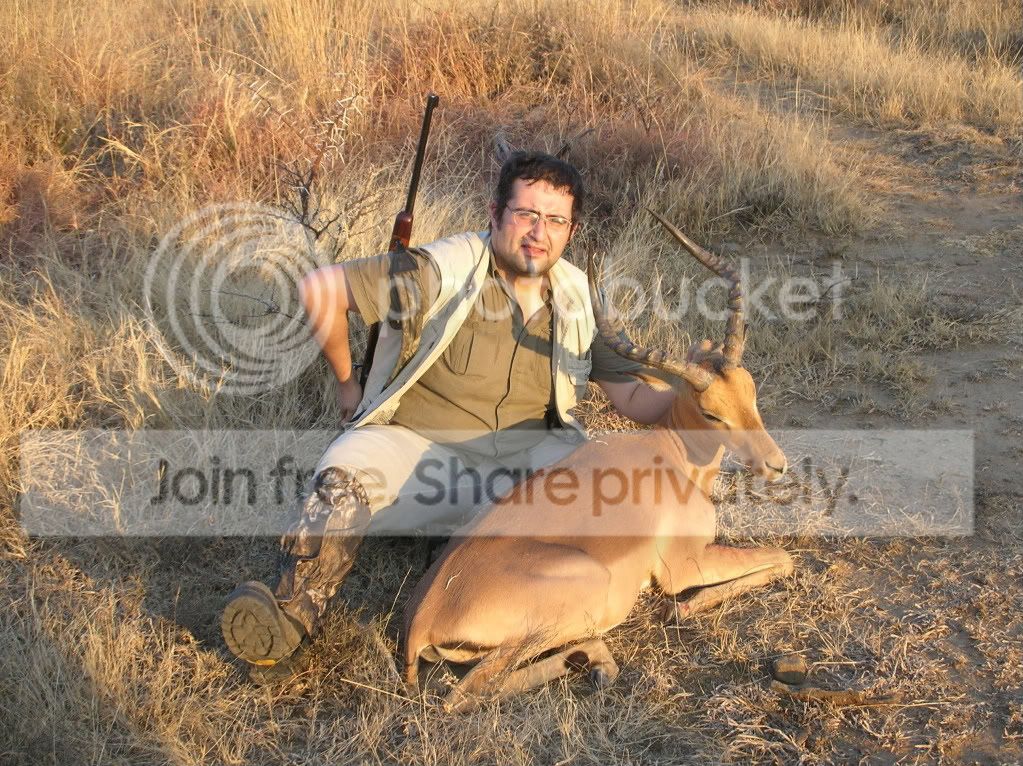
It is therefore entirely fitting that the only photo I should have is the one where I slipped on to my arse trying to get into position.
We dragged the Impala to the ride and waiting for the bakkie to pick us up. It had been quite the conclusion to my first day in Africa. As we drove back to the lodge, A. and I riding on the top of bakkie like self-styled rancheros, the sun set. It has become a bit of a cliché in these hunt reports to talk about African sunsets, I fully understand why. The views from our chalet-like rooms in the bush camp were not exactly scintillating in terms of dramatic geology or even in terms of the flora and fauna; At sunrise and sunset however it took some beating.

After an excellent dinner of steak we felt suddenly very tired, a few Castles later in the bar and we were finished. Heading back to my room I showered and went to bed with the intention of writing some sort of journal entry on that rather interesting day; however sleep was not far in coming.
Is it safe?
We were staying at something called a "Bush camp" which consisted of a cluster of individual chalets, basically individual rooms with en-suite showers, set about five hundred metres away as the crow flies from the main camp buildings across a large dam.
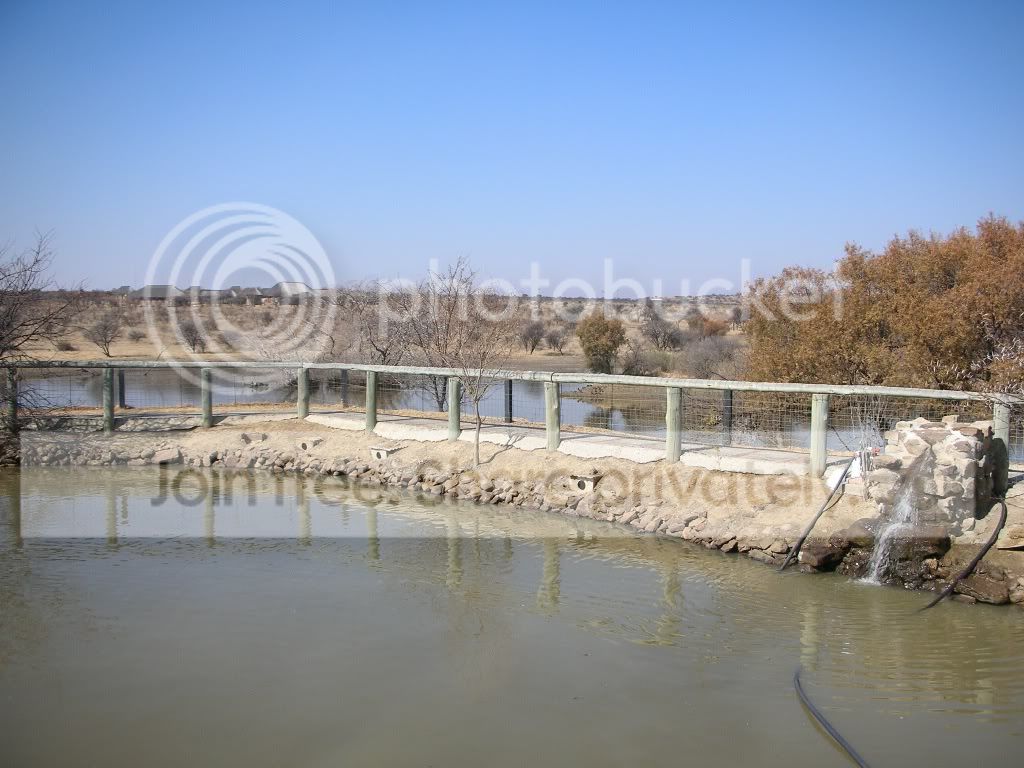
(The bush camp buildings are on the horizon on the left hand side of the picture above. The picture itself was taken from the veranda of the bar of the main camp building.)
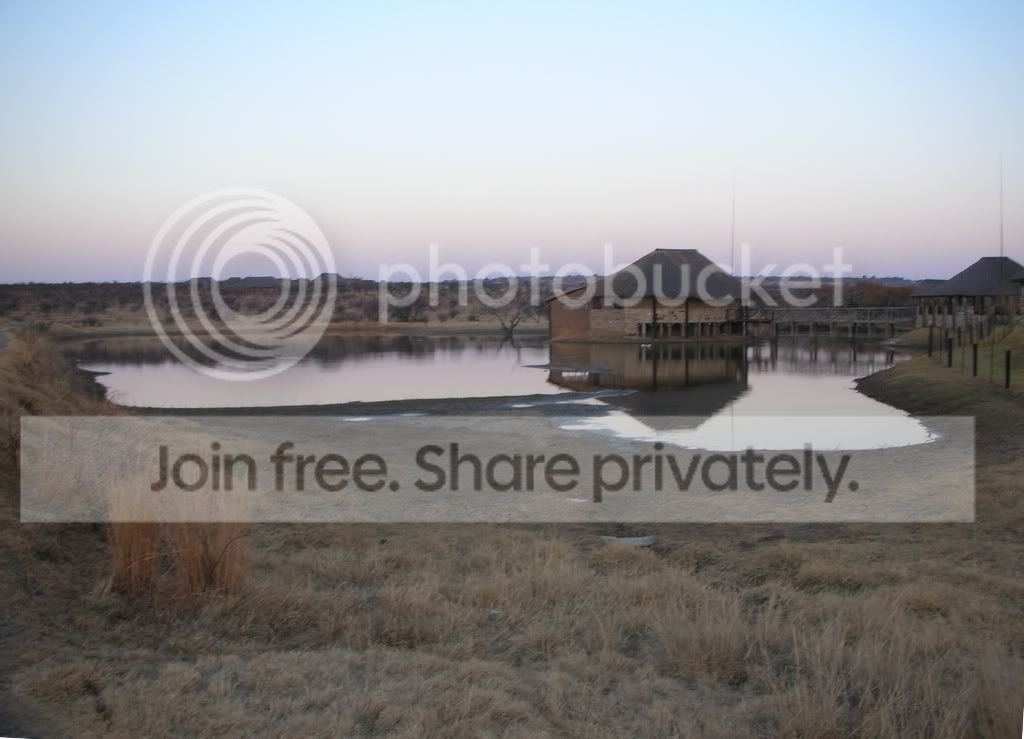
(The corresponding view from the bush camp, towards the restaurant built over the dam)
The main camp consisted of a wonderfully rustic lodge, built with roughly trimmed logs as main beams, stone block walls and thatched roofs in what we would come to recognise as a distinctly African style. The lodge had a large hall, increasingly rented out to conferencing groups these days apparently, together with a restaurant and bar built out over the water on slits.
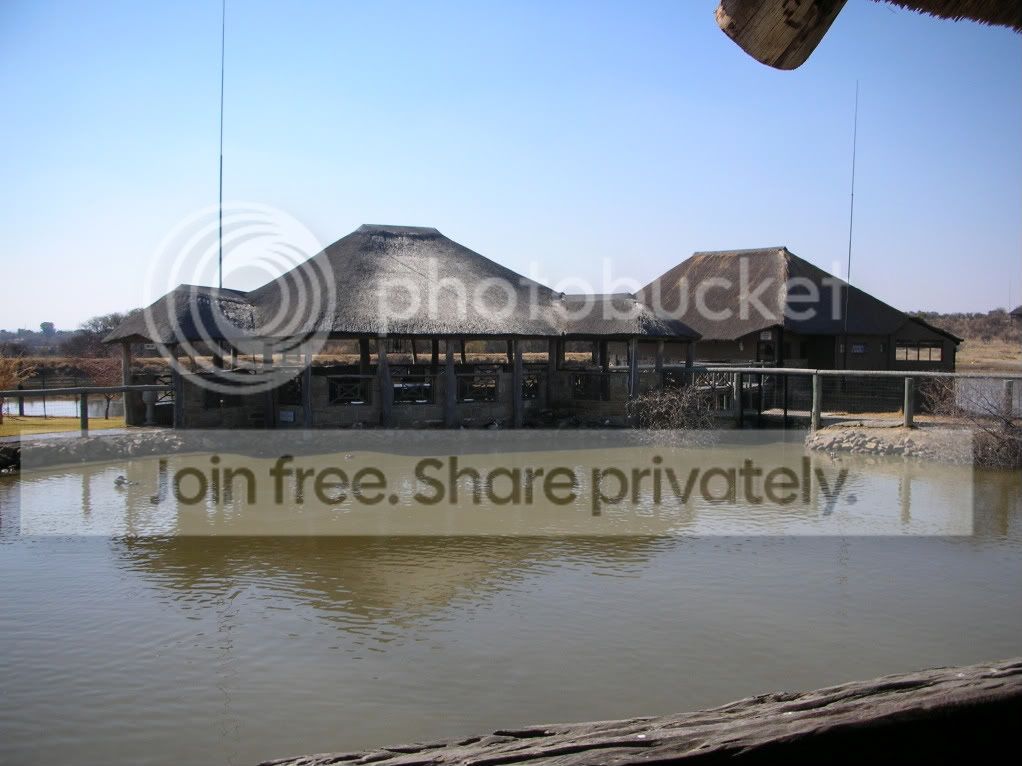
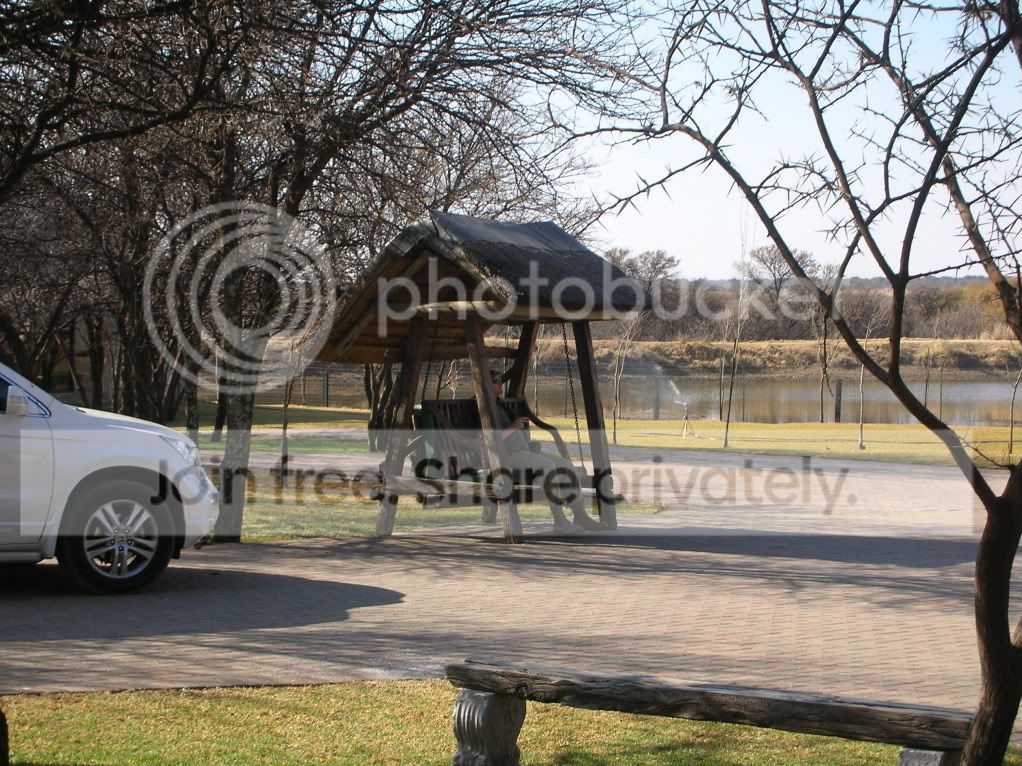
(Diggory enjoying some quiet time on the first afternoon)
It was a very picturesque place to spend a week and set a high standard for the rest of the trip.
As Adam has hinted the owner S. was quite a character; a man of many talents, of which game farming and game capture were merely two, he seldom suffered for want of a suitable anecdote during one of our many drinking/talking session. Having so many fingers in so many pies, just the stories of his daily trials and tribulations kept us entertained whilst his excellent camp manager and cook Peter kept us very well fed and watered.
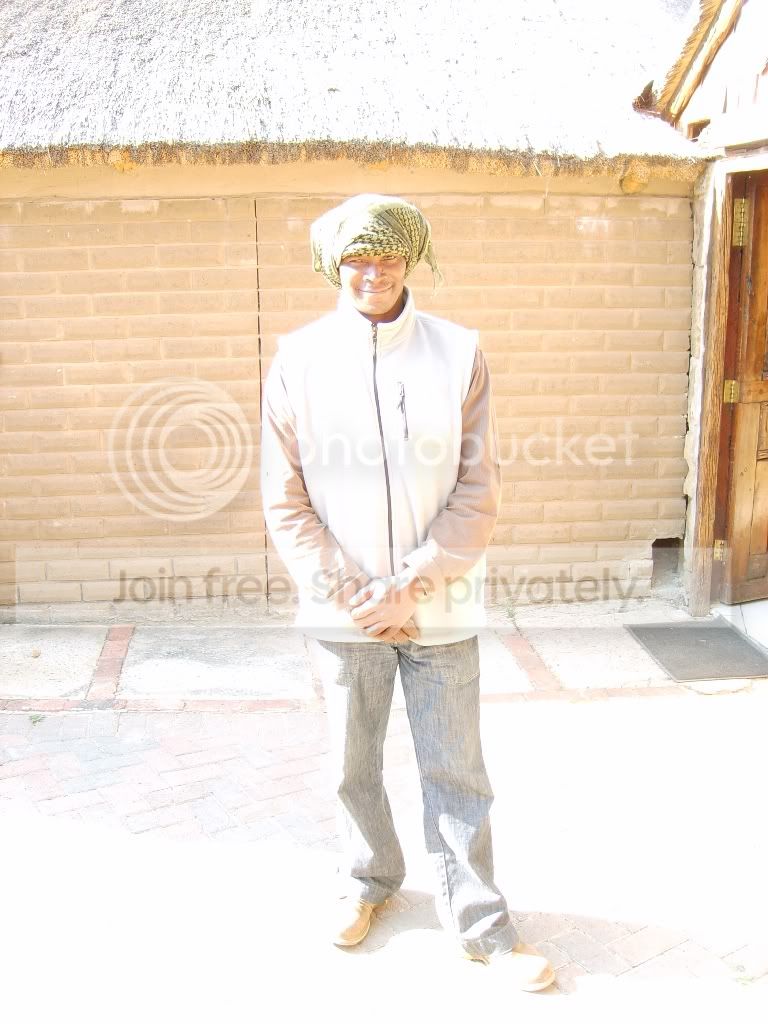
This is Zambian Peter, a man who speaks thirteen languages, cooks a hundred different cuisines and cuts a quite a dash in a dish-dash…… His story is not really for here, but was a rather eye opening introduction into the politics of Southern Africa of the last 30 years for me. I got to know him a little over the next week and I am glad I did. Without wishing to give the impression that I interacted with everybody I met in South Africa on the basis of an anthropological experiment, I was almost as interested in the people as the hunting. To a child of the nineteen eighties South Africa has, ah, a certain image in the preconceptions of us products of later-day urbananised society. On the other hand I have always believed in travel as the antidote to preconception and also that only a fool would rock up to another man's country and assume he could know the score better than the locals on the ground. Zambian Pete's was one of the more important stories I heard in this regard.
The owner's brother lived on the ranch, for some reason near the skinning shed, and in the middle of several lion enclosures.
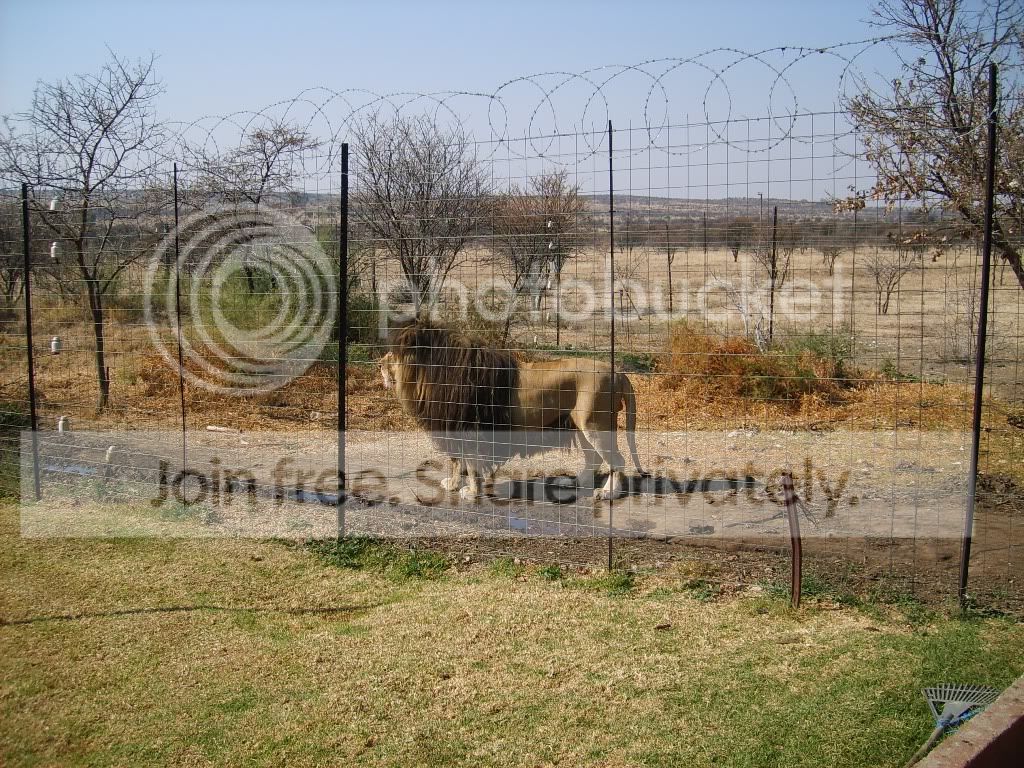
(Another photo of the big boy with quite exceptional genetics above)
A breeding population of white lions surrounded his home in perhaps what was the apogee of home security we were to see in our stay in South Africa. I did actually get to go into an enclosure with a male and female hand reared white lions of only about 100 kgs each with S.'s gigantic younger brother and found out the frightening way that lions don't like the smell of tobacco…..
(A. and I drive past the white lion enclosure to see that a enormous South African gentleman is standing in it playing with the lions.)
(We stop and make polite conversation about the ranch, rugby and his current choice of leisure time pursuit activity)
"Is it safe?" I ask.
"Sure it's safe china, you want to come in?"
(Caution sounds a note of it's namesake in the back of mind only to be is immediately double clotheslined by Bravado and Recklessness, bundled off the scene by Curiosity and quietly buried in a shallow grave by Watch-This)
"Yeah!"
(We go around to the gate to find the gentleman has now nonchalantly armed himself with a three foot length of plastic piping and oddly seems more nervous at having company in the enclosure than at being alone)
"They can sense fear so don't show them any fear and you'll be fine"
(Ok.)
"They won't bite unless your down and they've worn you down a bit with their claws so don't worry about being bitten, it's not going to happen. The main thing is not to let them up on to you so they push you over"
(F&%k me….)
"If they get aggressive slap them hard on the nose"
(F&%k you….)
"Other than that no problems! Come and rub his side"
Seeing no honourable option but to join him in cooing the lions' names and rubbing their sides like overgrown Labradors, I did my best to look utterly nonchalant. The male was the first to overcome his suspicion of the strangers and came towards me with his head held low. It is a very impressive feeling, being that close to the king of the jungle, the power and sinuous grace evidenced by every ripple of their musculature certainly might look impressive but I can assure you that they do feel at least as powerful as they look.
Enthusiastically whacking away at the lion's shoulders and flanks it didn't occur to me that there would be the remotest possibility of lions really not liking the smell of tobacco. You see gentle reader I am a man of many bad habits, most minor and I like to thing of as possibly endearing, but I will admit that my smoking is a terrible habit and the one of which I'm least proud. My girlfriend always says smoking would kill me and on that day she was almost vindicated in truly spectacular style. S.'s brother was the second to notice the growing animosity the lion appeared to be displaying towards me. It might have been the growling that gave it away but it's also possible that he saw the slobber on my right arm from a particularly animated lick the lion had just given me.
"Hit him on the nose the b%&$£d!"
(F%&k me I briefly thought before the good bit's of my life flashed before my eyes, kiss your fundament goodbye Amir - you're about to belt an irate lion)
"Ha Ha" I mirthlessly vocalised as I backhanded the lion on the nose with more force than I had initially thought I had put into the blow, just as S.'s brother started towards the lion cursing in Afrikaans. The lion sort of yelped and slunk back to the giant Afrikaaner, rubbing against his legs like a giant kitten.
A. has some video footage I believe, entitled "Dances with lions" he might post.
I shan't bore you gentle reader…..
Looking back at the four and half thousand-odd word introduction to the camp and account of the first afternoon's hunting I feel that some brevity might be a good idea at this point.
Despite our tiredness A. and I convened over a cup of coffee in my room before going to bed on that first night. We had been welcomed to Africa, literally with a bang and needed to discuss and digest the day's goings on.
The game was so plentiful and riding around on the bakkie so likely to put one on them that some discernment, a few rules of engagement if you like, was going to be necessary. We were there to hunt, rather than shoot, after all.
The first order of business would be to refuse the bakkie if at all possible and stalk for the rest of the week. We also needed all the experience we could get, considering we had a competition hunt to look forward to embarrassing ourselves in the next week. We also decided that despite notionally cull hunting, we would make an effort to be more selective in our shooting, the farm owner having a number of animals that actually needed shooting, heterozygous white blesbok and springbok in pure herds especially, as well as one of each of the species of our wish lists. Wanting to warm up on some antelope the next day A. and I set our sights on an Impala and Springbok respectively in addition to a Blesbok apiece before deciding what else to shoot.
Fortunately for us Dennie is a sportsman of the first order and turned out not only to be naturally sympathetic to the above points of view but also a competitive (ultra)marathon runner more than willing to march overweight tourists in to submission under the African sun. The winter sun admittedly, but sun nevertheless.
I felt oddly restless just after A. left, not quite sure what to make of it all. I think Africa is a sort of dream for hunters, a place the hunter reads about in his escapist equivalent to the commuting salary man's thriller or, god forbid, the bored housewife's romance novels. As such one tends to construct a kind of mythology about the place in one's head, I defy the first-time reader of Capstick not to romanticize the adventure aspect of African hunting for example, and so when the anticipation meets the reality a certain amount of reflection is necessary.
As I mulled it all over, a new and in the circumstances more useful line of reasoning struck me. "Bugger" I thought, "I'll be knackered tomorrow unless I get to bed". The wisdom in this, hard won from previous expeditions, seemed to be unassailable as I was possibly asleep before my head touched the pillow.
After about three days with literally no sleep I had expected to need extracting from bed with explosives, scorpions and dancing girls but experienced a slightly strange, for this bon viveur, inability to stay in bed. However the next morning I was awake wide awake, at something like half past four! I could hear something, something at first alien and I must admit slightly menacing, seemingly not too far away from our camp. It was a guttural roaring with a deep bass finish that I didn't immediately recognize as a belonging to a lion.
In retrospect, the old boy made quite the alarm clock.
Throwing some clothes on, the morning being bloody cold, I am slightly embarrassed to confess that I stuck a full magazine into my otherwise empty rifle and cautiously stuck my head out of the door to see if I could get a fix on the source of the roaring. I was fairly sure the lion would be in its own enclosure rather than munching it's way through S.'s breeding stock in the main farm but I'll hope you'll forgive as inexperience my retrospectively comic caution.
It was however pitch black outside and the source of the roaring, which seemed a scant couple hundred metres away, at least appeared to be getting no closer. I eventually felt slightly silly standing on the porch in flip-flops, dressing gown and rifle and so went back inside to put the kettle on.
I came to discover a morning ritual, uniquely and wonderfully African, of emptying my kettle of a small, particularly aggressive sort of red ant before putting it to boil. The little blighters were getting in through a crack in the window sill, and for some reason known only to them, trying to set up a forward observation post in my kettle. They would defend the kettle, and the corner of the room with the kettle and dresser more generally, with an enthusiasm and valour that would have been movingly noble had it but involved somebody else's domestic arrangements instead of mine. They would form into phalanxes at the first sign of trouble (me) and come in waves arching their abdomens above their heads like scorpions. The main issue I had with them though, my bed being apparently considered neutral territory, was that, boiled, they somehow managed to unpleasantly taint an already struggling Ricoffey™ brand instant coffee that the South Africans try and convince people is drinkable.
Therefore the second cup of Ricoffey™ was the one taken out on to the veranda to accompany the sun rise that first morning. Folk stirred in their rooms as I sat there drinking coffee, smoking a cigarette, watching the first blush of dawn tint the wide, wide horizon. Things were Ok, I concluded.
Harsh words in Afrikaans spoken to the two black guys hanging around the garage doors had the rapid effect of a wooden seat being brought out and lashed to the back of the bakkie. It being hardly four in the afternoon we were undeniably excited if not actually a touch delirious, having stepped off an aeroplane four hours earlier, at the prospect of going out hunting straight away. However were we to understand that we would be shooting off the back of a bakkie? Not to start the week off with a bout of snobbery but surely this wasn't the African adventure we had quite envisaged.
As it turned out, if it is the case that danger lends the aspect of the sporting to methods otherwise mundane and, ah, perhaps mainly biltong-orientated then driving around on the back of S.'s bakkie in pursuit of anything game shaped was the wounded-leopard-following-up-in-thick-bush of plainsgame hunting……
Even the ride to the range (a Swiss-cheese sculptured oil drum, full of rocks, in front of a three foot earth, and rock, berm.) was death defying enough, In fact S.'s driving was only bested by the special looking gentleman and the Chase of Willy's Wounded Wildebeest but more on that anon.
We checked our rifles' zeros to a soundtrack of whizzing cowboy-movie ricochets (see description of zero range above.) and roaring from this little moggie…
Quite the soundtrack and one, unfortunately minus the ricochets, that by various strokes of fortune became rather pleasingly normal during our stay in Africa. The roaring of the lion cemented for me a feeling of otherness I had felt since we landed. More specifically I am talking about the feeling one gets when it is apparent that one is very far from home. Africa is a place very much of itself and was quite alien for those first few days. I suppose what I'm trying to get across is that to be cruising around with intent and a loaded rifle, listening to lions roar and watching the wildebeest running around on the plain made Africa "real" at that moment.
A. and I tossed a coin to see who would open the African account, A. winning the toss and seating himself on the left of the bakkie so as to be as naturally comfortable as possible at the time of the shot. It did occur to me that this seemed a nice way to ease into the first afternoon and settle the nerves with a good look at a few different species of game and try and translate the diagrams and landmarks of the shot placement guides onto the new animals, but upon reflection have come to feel properly contrite at having taken this view. As it turned out the antelope are engineered much the same as our comparably sized deer, perhaps with the heart a touch lower and further forward.
We saw quite some number of species on this ranch, which was big enough to house several different habitats and a corresponding variety of species.
Soon enough a Springbok presented itself, trailing a herd at about 150 metres (my apologies to our imperial readers all shooting distances in this report will be given in metres as the range finder of our excellent PH, Dennie, read in metres). S. swung the bakkie out to the right as A. took aim and the double thud of a moderated rifle followed by the impact on the animal sounded in our trip in assured style. Despite visibly scoring a solid heart lung shot the springbok took off like a shot, running 150 metres into the veld directly away from the bakkie before turning around and running all the way back again. I confess that despite Dennie's assurances that it was dead on its feet it seemed awfully sprightly for having had a .270 through the boiler room. To my delight it dropped as it crossed the track in front of us.
We piled out the bakkie and surrounded the springbok. A. was grinning like a madman and the South African boys were saying all the right things. Eventually amid the handshaking and back-clapping we took a closer look at the thing. There is a curious phenomenon in recently deceased Springbok whereby the patch white hairs running along the back on to the rump stand as if by static for a few minutes after death. A further, and if anything even more curious, phenomenon is that these rump hairs smell like candyfloss.
Now I don't know about you gentle reader but A. and I suspected that the two suddenly very serious Afrikaans gentlemen in front of us may have been planning to have just a bit of sport with the two greenhorns….
The events following that standoff are probably best illustrated by the series of photographs I reproduce here:
(The stand-off ends with A. abruptly clearing his rifle in preparation of sniffing the springbok's bottom, note the stony serious demeanour of Dennie and S.)
(As if by the report of a starter's gun three men pounce on the springbok to arrange for photography. And also to sniff it's bottom of course. )
(This photograph illustrates the first phenomenon mentioned above very well. I am not sure what the purpose of this adaptation would be for in nature and so far my admittedly cursory researches have not turned up any information on it. If any one has any more information on this phenomenon I would be very interested to hear it. There is also a man rather self-consciously sniffing a springbok's bottom. )
(Candyfloss!)
(In addition please excuse the particularly poor quality of this photograph, as apposed to the merely shabby quality of the others, I was practically micurating with mirth by this point m'lud…..)
(A wonderful first African trophy!)
The shadows were lengthening however, so we loaded the springbok on the bakkie and drove on from the relatively open grassland into progressively thicker bush. The terrain of the place roughly divided into three main habitats:
Open scrub and grasslands
Thicker, low bushveld
The third being burnt plains. The blackened remnants of the first two habitats where according to age and rainfall the only areas where green shoots of new growth could be observed the ranch. This was probably led to it being the favoured habitat of the black Wildebeest, Blesbok, Springbok and Ostrich who seemed to come out on to the plain to feed, heading back to the cover of the veld to rest up in cover. I think that their behaviour is different on the plain than in the veld, but I would like to spend more time observing them before drawing any concrete conclusions.
Such soul-satisfying amateur ecology was all well and good, but it was time to set off and see if I could bag anything before the end of the first day. As we drove into thicker bush, Dennie leant over to the back window of the bakkie and told me be ready with the sticks as would probably be stalking anything we spotted in this bush.
Spotting game was the hardest aspect of the hunting over there for me. The eye takes a while in getting accustomed to looking for the subtly different silhouette of backs, flicking of ears and upright legs spotted in gaps in the bush in different terrain. It is also fair to say that I found a lot in the African bush to become accustomed to. Red lumps that would at home frequently resolve in to deer would turn out to be ant hills and termite mounds; the preponderance of woody undergrowth both screening the smaller species very effectively and the taller bush providing effective cover for beasts as large as hartebeest.
Dennie's game spotting abilities seem to verge on the supernatural to this rather awestruck and humbled hunter. There was also a small issue in that moving through the African bush quietly is rather difficult. I found that if it wasn't the grass rustling as you moved through or the thorns scraping on your gaiters, it was the "go-away" bird squawking or an amazing noisy and belligerent species of ground squirrel chattering that just occasionally bumped a carefully stalked animal on from ahead of you…..
About the only thing a neophyte can effectively manage is being careful not to break any of the abundant supply of dry twigs lying around. I eventually took some consolation in the fact that despite it all, as long as one didn't break any of those accursed twigs the rest was fairly manageable as long as I carefully mirrored the PH's pace.
Visibility depended on the exact terrain generally varying from thirty to one hundred and fifty metres. It must however be admitted that from the top of a bakkie one could see out a little further. Nevertheless it was Dennie who first spotted the herd of Impala, with a nice cull ram in it, from his position two feet below us.
He quietly got out of the bakkie, motioned me down off the back, bad puns involving the back of bakkies - the hanging out whereof et al - becoming a perennially popular theme over the two weeks by the way, and extended the sticks.
"We'll stalk that ram."
Splendid.
"Remember, when the sticks go up get behind me quick and get on them. When I say "shoot now!" you shoot ok? They won't hang around these animals!"
There was a ride leading to a dam, Afrikaans for anything from a rough borehole to a full on lake, about five hundred metres away with its nearest point being about thirty metres to the right through some low bush. The Impala were meandering across this ride from the patches of feed and cover on the verges of the ride, tending generally towards the water but far enough ahead of us that they had not appeared to have noticed the bakkie. The wind being just about perfect, I judged that we had thirty metres to stalk to get on to the ride and then perhaps another two hundred to get within comfortable shooting range.
More by luck than judgement I managed to arrive behind Dennie at the edge of the ride without scaring the herd off and got the binos up for a first proper look at the African Impala.
An elegant and fairly alert antelope, the Impala is great fun to hunt, especially the smaller herds of females with one or two rams attached. This sort of hunting was relatively familiar to me as similar to stalking small groups of our woodland Fallow deer. The main aim of the game is to manoeuvre into a position where you can take a shot a particular animal from the group without being busted by the constantly wary females. It's fun and addictive stalking and after a scant ten minutes of the usual stalking shenanigans we managed to get within about one hundred metres of the herd.
There is a particularly exciting moment when hunting with a guide the world over, the moment when the guide suddenly stiffens and begins deploying the sticks. It reaches the point where one is getting buckfever even before seeing the beast, never mind getting the bloody rifle up and the crosshairs on it!
Aptly enough then when Dennie froze and began to slowly put out the sticks my treacherous pulse started playing silly buggers before I even knew exactly where the ram was. We were in the shade of some trees just inside the bush, about a hundred yards away from the majority of the herd. The herd were now alert if not actually suspicious. Getting on the sticks I saw what precipitated the sudden freeze on the part of my PH, the ram was behind some light bush a hundred and twenty metres in front of us but a ewe at only about seventy metres appeared to be looking directly in our direction. Fortunately the movements I had made in getting behind Dennie and getting the rifle onto the sticks had been hidden from her by Dennie's bulk so whilst she was undeniably suspicious she wasn't outright spooked. I suspected that she would err on the side of caution and move off, probably taking the rest of the herd with her. Keeping my eye on the ram I placed the crosshairs of the scope on a gap in the bush in the direction I thought he might go. Sure enough the ewe decided that the area was perhaps not as safe as she had first thought and turned off towards the rest of the herd. This had the predicted effect the rest of the herd, who trusting their matriarch's judgment instinctively began to depart the scene in an approximation of single file into the wind and towards the water.
I had been on sticks for a couple of minutes watching the herd, specifically the ram to be fair, when the ewe started moving. The effect on the herd was interesting, the members perhaps paying as much attention to each other as their surroundings, the effect very much reminiscent of our herding species in the UK. It was interesting to compare and contrast the behaviour of the game animals with those of roughly the equivalent seral niche with those of places I am already familiar with. Geeky I realise, but part of the fun as far as I'm concerned!
Forcing myself to calm down, planning the shot had helped, I watched in the periphery of the scope for the ram to come clear of the scrub, it looked as if he was going to go in the direction of the gap so easing off the safety I checked Dennie's position with my left eye. I had told him earlier that for some reason the only word I can reliably use to warn others of an impending shot in these circumstances is "ears!". He was looking intently at the herd through his binoculars so when I saw that my whispered "ears!" had no apparent effect I resolved to give the poor guy one more warning, In truth I have had a few complaints about detonating an short barrelled 30.06 next to friends' ears before, and so whispered "ears!" a little more loudly.
Just then the ram stepped into the clear.
"Sorry old boy, Dubla mangi." I thought, closing my left eye again and focussing all my attention on the by now one step way from clear Impala; if Dennie hadn't heard my warning he would certainly be left in no doubt in a moment.
The ram took one step and stopped to look around presenting an almost perfectly broadside aspect, right in the middle of the gap. This was all the invitation I needed and following the front leg a third of the way up, where the cream of the belly hair meets the reddish hair of the back, squeezed that wonderfully, comfortingly familiar trigger on the trusty Tikka.
The rifle kicked the sight picture out of view but remembering the advice of a stalking mentor whose advice has yet to fail me I made sure to regain the sight picture before reloading the rifle. At the risk of subsequently labouring the point I was glad I did as I saw the somewhat shocked looking ram at the apogee of a jump that upon landing from which threw its head forward and set off in a blind dash. "Heart shot?" I thought, once again this antelope behaving perhaps surprisingly similarly to our deer.
The herd took off at a run at the report, though we had stayed almost perfectly still since that ewe spotted us, away from the water, across the wind into what must have been thicker bush. The ram ran with them across us mostly hidden by bush and long grass. We could see some of their backs just above the grass and the tips of some of their horns just above the bushes and that was it. Despite my earlier confidence and Dennie's assurances I was immensely relieved when one of the pairs of horn-tips wavered as the rest ran by and started tottering sideways behind the bush rather than determinedly departing towards the horizon.
The relief gave way to adrenaline when the horn tips gave one last waver and dropped out of view. My ears ringing and mind spinning I was shaking Dennie's hand and at the same time bizarrely fixated on trying to fix in my mind the position that the ram had dropped. What a first animal! The whole thing from spot to shot couldn't have taken more than ten minutes but the stalk was honestly one of the most exciting I have experienced. We walked over to where the ram had dropped to arrange it for the obligatory photograph.
It was as elegant as life, when we found it.
It is therefore entirely fitting that the only photo I should have is the one where I slipped on to my arse trying to get into position.
We dragged the Impala to the ride and waiting for the bakkie to pick us up. It had been quite the conclusion to my first day in Africa. As we drove back to the lodge, A. and I riding on the top of bakkie like self-styled rancheros, the sun set. It has become a bit of a cliché in these hunt reports to talk about African sunsets, I fully understand why. The views from our chalet-like rooms in the bush camp were not exactly scintillating in terms of dramatic geology or even in terms of the flora and fauna; At sunrise and sunset however it took some beating.
After an excellent dinner of steak we felt suddenly very tired, a few Castles later in the bar and we were finished. Heading back to my room I showered and went to bed with the intention of writing some sort of journal entry on that rather interesting day; however sleep was not far in coming.
Is it safe?
We were staying at something called a "Bush camp" which consisted of a cluster of individual chalets, basically individual rooms with en-suite showers, set about five hundred metres away as the crow flies from the main camp buildings across a large dam.
(The bush camp buildings are on the horizon on the left hand side of the picture above. The picture itself was taken from the veranda of the bar of the main camp building.)
(The corresponding view from the bush camp, towards the restaurant built over the dam)
The main camp consisted of a wonderfully rustic lodge, built with roughly trimmed logs as main beams, stone block walls and thatched roofs in what we would come to recognise as a distinctly African style. The lodge had a large hall, increasingly rented out to conferencing groups these days apparently, together with a restaurant and bar built out over the water on slits.
(Diggory enjoying some quiet time on the first afternoon)
It was a very picturesque place to spend a week and set a high standard for the rest of the trip.
As Adam has hinted the owner S. was quite a character; a man of many talents, of which game farming and game capture were merely two, he seldom suffered for want of a suitable anecdote during one of our many drinking/talking session. Having so many fingers in so many pies, just the stories of his daily trials and tribulations kept us entertained whilst his excellent camp manager and cook Peter kept us very well fed and watered.
This is Zambian Peter, a man who speaks thirteen languages, cooks a hundred different cuisines and cuts a quite a dash in a dish-dash…… His story is not really for here, but was a rather eye opening introduction into the politics of Southern Africa of the last 30 years for me. I got to know him a little over the next week and I am glad I did. Without wishing to give the impression that I interacted with everybody I met in South Africa on the basis of an anthropological experiment, I was almost as interested in the people as the hunting. To a child of the nineteen eighties South Africa has, ah, a certain image in the preconceptions of us products of later-day urbananised society. On the other hand I have always believed in travel as the antidote to preconception and also that only a fool would rock up to another man's country and assume he could know the score better than the locals on the ground. Zambian Pete's was one of the more important stories I heard in this regard.
The owner's brother lived on the ranch, for some reason near the skinning shed, and in the middle of several lion enclosures.
(Another photo of the big boy with quite exceptional genetics above)
A breeding population of white lions surrounded his home in perhaps what was the apogee of home security we were to see in our stay in South Africa. I did actually get to go into an enclosure with a male and female hand reared white lions of only about 100 kgs each with S.'s gigantic younger brother and found out the frightening way that lions don't like the smell of tobacco…..
(A. and I drive past the white lion enclosure to see that a enormous South African gentleman is standing in it playing with the lions.)
(We stop and make polite conversation about the ranch, rugby and his current choice of leisure time pursuit activity)
"Is it safe?" I ask.
"Sure it's safe china, you want to come in?"
(Caution sounds a note of it's namesake in the back of mind only to be is immediately double clotheslined by Bravado and Recklessness, bundled off the scene by Curiosity and quietly buried in a shallow grave by Watch-This)
"Yeah!"
(We go around to the gate to find the gentleman has now nonchalantly armed himself with a three foot length of plastic piping and oddly seems more nervous at having company in the enclosure than at being alone)
"They can sense fear so don't show them any fear and you'll be fine"
(Ok.)
"They won't bite unless your down and they've worn you down a bit with their claws so don't worry about being bitten, it's not going to happen. The main thing is not to let them up on to you so they push you over"
(F&%k me….)
"If they get aggressive slap them hard on the nose"
(F&%k you….)
"Other than that no problems! Come and rub his side"
Seeing no honourable option but to join him in cooing the lions' names and rubbing their sides like overgrown Labradors, I did my best to look utterly nonchalant. The male was the first to overcome his suspicion of the strangers and came towards me with his head held low. It is a very impressive feeling, being that close to the king of the jungle, the power and sinuous grace evidenced by every ripple of their musculature certainly might look impressive but I can assure you that they do feel at least as powerful as they look.
Enthusiastically whacking away at the lion's shoulders and flanks it didn't occur to me that there would be the remotest possibility of lions really not liking the smell of tobacco. You see gentle reader I am a man of many bad habits, most minor and I like to thing of as possibly endearing, but I will admit that my smoking is a terrible habit and the one of which I'm least proud. My girlfriend always says smoking would kill me and on that day she was almost vindicated in truly spectacular style. S.'s brother was the second to notice the growing animosity the lion appeared to be displaying towards me. It might have been the growling that gave it away but it's also possible that he saw the slobber on my right arm from a particularly animated lick the lion had just given me.
"Hit him on the nose the b%&$£d!"
(F%&k me I briefly thought before the good bit's of my life flashed before my eyes, kiss your fundament goodbye Amir - you're about to belt an irate lion)
"Ha Ha" I mirthlessly vocalised as I backhanded the lion on the nose with more force than I had initially thought I had put into the blow, just as S.'s brother started towards the lion cursing in Afrikaans. The lion sort of yelped and slunk back to the giant Afrikaaner, rubbing against his legs like a giant kitten.
A. has some video footage I believe, entitled "Dances with lions" he might post.
I shan't bore you gentle reader…..
Looking back at the four and half thousand-odd word introduction to the camp and account of the first afternoon's hunting I feel that some brevity might be a good idea at this point.
Despite our tiredness A. and I convened over a cup of coffee in my room before going to bed on that first night. We had been welcomed to Africa, literally with a bang and needed to discuss and digest the day's goings on.
The game was so plentiful and riding around on the bakkie so likely to put one on them that some discernment, a few rules of engagement if you like, was going to be necessary. We were there to hunt, rather than shoot, after all.
The first order of business would be to refuse the bakkie if at all possible and stalk for the rest of the week. We also needed all the experience we could get, considering we had a competition hunt to look forward to embarrassing ourselves in the next week. We also decided that despite notionally cull hunting, we would make an effort to be more selective in our shooting, the farm owner having a number of animals that actually needed shooting, heterozygous white blesbok and springbok in pure herds especially, as well as one of each of the species of our wish lists. Wanting to warm up on some antelope the next day A. and I set our sights on an Impala and Springbok respectively in addition to a Blesbok apiece before deciding what else to shoot.
Fortunately for us Dennie is a sportsman of the first order and turned out not only to be naturally sympathetic to the above points of view but also a competitive (ultra)marathon runner more than willing to march overweight tourists in to submission under the African sun. The winter sun admittedly, but sun nevertheless.
I felt oddly restless just after A. left, not quite sure what to make of it all. I think Africa is a sort of dream for hunters, a place the hunter reads about in his escapist equivalent to the commuting salary man's thriller or, god forbid, the bored housewife's romance novels. As such one tends to construct a kind of mythology about the place in one's head, I defy the first-time reader of Capstick not to romanticize the adventure aspect of African hunting for example, and so when the anticipation meets the reality a certain amount of reflection is necessary.
As I mulled it all over, a new and in the circumstances more useful line of reasoning struck me. "Bugger" I thought, "I'll be knackered tomorrow unless I get to bed". The wisdom in this, hard won from previous expeditions, seemed to be unassailable as I was possibly asleep before my head touched the pillow.
After about three days with literally no sleep I had expected to need extracting from bed with explosives, scorpions and dancing girls but experienced a slightly strange, for this bon viveur, inability to stay in bed. However the next morning I was awake wide awake, at something like half past four! I could hear something, something at first alien and I must admit slightly menacing, seemingly not too far away from our camp. It was a guttural roaring with a deep bass finish that I didn't immediately recognize as a belonging to a lion.
In retrospect, the old boy made quite the alarm clock.
Throwing some clothes on, the morning being bloody cold, I am slightly embarrassed to confess that I stuck a full magazine into my otherwise empty rifle and cautiously stuck my head out of the door to see if I could get a fix on the source of the roaring. I was fairly sure the lion would be in its own enclosure rather than munching it's way through S.'s breeding stock in the main farm but I'll hope you'll forgive as inexperience my retrospectively comic caution.
It was however pitch black outside and the source of the roaring, which seemed a scant couple hundred metres away, at least appeared to be getting no closer. I eventually felt slightly silly standing on the porch in flip-flops, dressing gown and rifle and so went back inside to put the kettle on.
I came to discover a morning ritual, uniquely and wonderfully African, of emptying my kettle of a small, particularly aggressive sort of red ant before putting it to boil. The little blighters were getting in through a crack in the window sill, and for some reason known only to them, trying to set up a forward observation post in my kettle. They would defend the kettle, and the corner of the room with the kettle and dresser more generally, with an enthusiasm and valour that would have been movingly noble had it but involved somebody else's domestic arrangements instead of mine. They would form into phalanxes at the first sign of trouble (me) and come in waves arching their abdomens above their heads like scorpions. The main issue I had with them though, my bed being apparently considered neutral territory, was that, boiled, they somehow managed to unpleasantly taint an already struggling Ricoffey™ brand instant coffee that the South Africans try and convince people is drinkable.
Therefore the second cup of Ricoffey™ was the one taken out on to the veranda to accompany the sun rise that first morning. Folk stirred in their rooms as I sat there drinking coffee, smoking a cigarette, watching the first blush of dawn tint the wide, wide horizon. Things were Ok, I concluded.


