
You are using an out of date browser. It may not display this or other websites correctly.
You should upgrade or use an alternative browser.
You should upgrade or use an alternative browser.
Annealing brass
- Thread starter DS Mad
- Start date


Steff
Well-Known Member
I'm aware that I will be stepping on most people's toes here as annealing is currently very much en vogue.I am looking for information on annealing brass 6.5x55 Lapua. how many firings before its needed.
Ideas on the best way of doing it with out a Annealing machine or is it best to send it away and have it done.
Cheers.
Before you get into it you should first try and see how many (accurate) reloads you can get from your brass without annealing. I use my .308, .270 and .222 brass for 8 to 10 reloads without annealing and cannot detect deteriorating accuracy, nor do I have case failures.
This is for readily available brass. Only if I was shooting some very rare calibre with cases worth their weight in gold I would rethink.
Besides the fact that my bullets seat very consistently even on the 9th reload the influence of neck tension on precision is widely exaggerated.
Last edited:
I'm aware that I will be stepping on most people's toes here as annealing is currently very much en vogue.
Before you get into it you should first try and see how many (accurate) reloads you can get from your brass without annealing. I use my .308, .270 and .222 brass for 8 to 10 reloads without annealing and cannot detect deteriorating accuracy, nor do I have case failures.
This is for readily available brass. If I was shooting some very rare calibre with cases worth their weight in gold I would rethink.
For me it's about consistency , mainly during the sizing process as I find my shoulder bumping more repeatable and easier to maintain.
Simple method is a blow torch , a socket mounted in a cordless drill as a holder and a traditional bar of soap as an indicator media.
I'll leave the discussion as to whether this is annealing on a molecular level or simply stress relieving for the more analytical on here .
The subject is always divisive .
Hmm. For field shooting forget it. Been reloading for 30 plus years and never annealed (pause for collective gasp) I cannot think of any circumstances where I missed or had a poor result which I couldblameattribute to not annealing.


Jamsie
Well-Known Member
My reloads produce the same results each time. I do not anneal my cases and they get binned eventually subject to their condition / primer pocket tension.
All of my shooting is at targets from 100 - 1000 yards (308Win using Lapua and RWS brass). My present batch of cases have been fired 6 times and at the last outing produced a figure of .44 MOA average with two of the three shot groups going through the same hole. This was at Diggle on the 100 yard range, nil wind and with the stock rested on my range bag. I don't hotrod my loads.
Jamsie
All of my shooting is at targets from 100 - 1000 yards (308Win using Lapua and RWS brass). My present batch of cases have been fired 6 times and at the last outing produced a figure of .44 MOA average with two of the three shot groups going through the same hole. This was at Diggle on the 100 yard range, nil wind and with the stock rested on my range bag. I don't hotrod my loads.
Jamsie
I think it really depends on a lot of things whether you want to or not. Are your loads hot or mild, do you shoot lots and therefore reload the same brass lots, how accurate and consistent do you want/need them to be? The list goes on.
Middle of the road, cheapish brass in .243win, I have seen split necks in less than 3-4 firings which you simply will not get with stress relieved brass. But then like @Foxyboy43 I have previously had in to double figures of reloading .222rem brass which showed no signs of necks splitting and accuracy remained fine for field use up to a point. When you anneal brass, you can 100% feel the consistency of seating bullets. They all go in the same whereas without annealing, you can feel some feel graunchy and need a little extra ram effort with others just slipping in easily. Clearly this is a difference in brass hardness and therefore neck tension. How much does this affect accuracy? I mean if you are shooting out to 150yds with a mild load in a mild cartridge like the .222rem, I would suggest you are losing little if any performance. Certainly not enough to warrant annealing which involves getting some sort of kit and spending some sort of time doing it. If you are shooting that rifle out to 300-400yds on small targets then yeah, you will notice a difference if shooting from a solid rest with a sound technique.
So assuming you have identified that you want/need to anneal, then I really think there is a point of diminishing returns when it comes to how you go about doing it, assuming that whatever method you are using, you are doing it correctly. I have seen no difference in the feel of seating bullets and how cartridges shoot out to extended ranges whether I have annealed my own way or by using brass annealed more professionally by others with their costly machines. You are looking to stress relieve and from my research, there is a point at which this happens but it is not some tiny microscopic point in time that has to be down to a milisecond. It should be fairly precise in that you want to stress relieve enough and you also don't want to soften the brass down in to the body and web of the case. But there is a time inbetween which is pretty easy to identify and replicate with decent precison. Certainly enough precision for our needs.
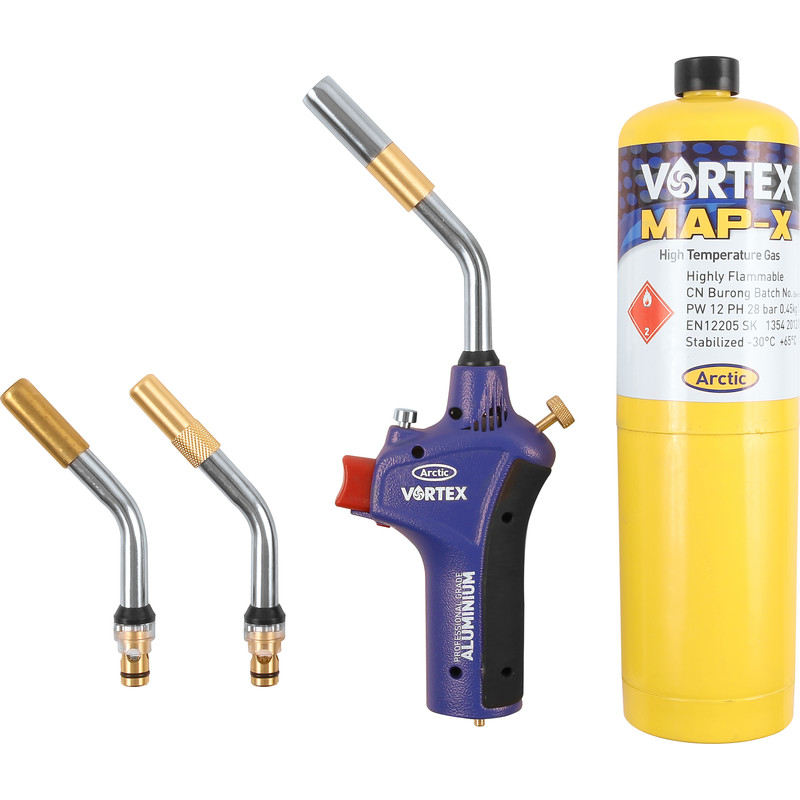
I personally use a torch and MAP gas. What is useful is using a torch head with a small, precise flame. This is what I use and it comes with three different torch attachments which are useful for other things in life but the small intense detailed flame is what I use for annealing brass. You can concentrate the hot part of the flame on the junction between neck and shoulder and keep it there consistently as long as you are fairly good dexterity wise.
 www.toolstation.com
I then use a drill, a sparkplug socket and spin the case in the drill while the point between neck and shoulder is in the hot part of the flame. I do this in a dark room and you are looking to remove the brass case immediately (literally immediately) as soon as you see the tiniest colour change in the flame. To begin with, it is worth using some old brass to do it a few times until you get it via trial and error. The learning curve is rapid and easy. The MAP bottle stands on its own and the angled torch attachment means you can just concentrate on holding the drill and removing the brass without worrying about the flame.
As soon as the colour change hits (with a powerful gas torch, somewhere in the region of 3-4 seconds but let the flame colour change dictate when to remove brass from flame) I just chuck them in a tray and do the next one. You can do 50-100 cases in minutes with no serious outlay. Gas lasts forever.
Or you could spend well north of a grand to do the same thing. I think if I was shooting out to 1000yds+ and my life depended on it, then there is milage in going the full hog. I think for most people's needs, you can get away without doing it all or doing it more on a budget. Quality of brass also plays a part. Lapua goes ages both primer pocket wise and neck quality wise whereas some factory brass I have reloaded has been crap. Buy good brass and if you shoot lots and push the range of the cartridge, then I would say anneal as well.

Middle of the road, cheapish brass in .243win, I have seen split necks in less than 3-4 firings which you simply will not get with stress relieved brass. But then like @Foxyboy43 I have previously had in to double figures of reloading .222rem brass which showed no signs of necks splitting and accuracy remained fine for field use up to a point. When you anneal brass, you can 100% feel the consistency of seating bullets. They all go in the same whereas without annealing, you can feel some feel graunchy and need a little extra ram effort with others just slipping in easily. Clearly this is a difference in brass hardness and therefore neck tension. How much does this affect accuracy? I mean if you are shooting out to 150yds with a mild load in a mild cartridge like the .222rem, I would suggest you are losing little if any performance. Certainly not enough to warrant annealing which involves getting some sort of kit and spending some sort of time doing it. If you are shooting that rifle out to 300-400yds on small targets then yeah, you will notice a difference if shooting from a solid rest with a sound technique.
So assuming you have identified that you want/need to anneal, then I really think there is a point of diminishing returns when it comes to how you go about doing it, assuming that whatever method you are using, you are doing it correctly. I have seen no difference in the feel of seating bullets and how cartridges shoot out to extended ranges whether I have annealed my own way or by using brass annealed more professionally by others with their costly machines. You are looking to stress relieve and from my research, there is a point at which this happens but it is not some tiny microscopic point in time that has to be down to a milisecond. It should be fairly precise in that you want to stress relieve enough and you also don't want to soften the brass down in to the body and web of the case. But there is a time inbetween which is pretty easy to identify and replicate with decent precison. Certainly enough precision for our needs.
I personally use a torch and MAP gas. What is useful is using a torch head with a small, precise flame. This is what I use and it comes with three different torch attachments which are useful for other things in life but the small intense detailed flame is what I use for annealing brass. You can concentrate the hot part of the flame on the junction between neck and shoulder and keep it there consistently as long as you are fairly good dexterity wise.
Vortex MAP Torch Pack | Toolstation
Fully adjustable torch with a highly concentrated, anti-flare flame. Compatible with most gas cylinders. Lightweight, tough magnesium alloy body. Stainless steel burner head with swivel adjuster collar. Flame lock, flame regulator and safety lock. Instant piezo ignition. Standard CGA600 thread...
www.toolstation.com
I then use a drill, a sparkplug socket and spin the case in the drill while the point between neck and shoulder is in the hot part of the flame. I do this in a dark room and you are looking to remove the brass case immediately (literally immediately) as soon as you see the tiniest colour change in the flame. To begin with, it is worth using some old brass to do it a few times until you get it via trial and error. The learning curve is rapid and easy. The MAP bottle stands on its own and the angled torch attachment means you can just concentrate on holding the drill and removing the brass without worrying about the flame.
As soon as the colour change hits (with a powerful gas torch, somewhere in the region of 3-4 seconds but let the flame colour change dictate when to remove brass from flame) I just chuck them in a tray and do the next one. You can do 50-100 cases in minutes with no serious outlay. Gas lasts forever.
Or you could spend well north of a grand to do the same thing. I think if I was shooting out to 1000yds+ and my life depended on it, then there is milage in going the full hog. I think for most people's needs, you can get away without doing it all or doing it more on a budget. Quality of brass also plays a part. Lapua goes ages both primer pocket wise and neck quality wise whereas some factory brass I have reloaded has been crap. Buy good brass and if you shoot lots and push the range of the cartridge, then I would say anneal as well.

trickie
Well-Known Member
Some brass won’t size reliably after 1 firing unless annealed, 6.5 cm Sellior and Beloit for one. I’ve a friend who bought 100 hoping to get 4/5 reloads out of them. Almost impossible to size down 2 thou. Annealing every time and some of these are on their 4th reload, meanwhile he’s now able to purchase Hornady new cases.
Besides the fact that my bullets seat very consistently even on the 9th reload the influence of neck tension on precision is widely exaggerated.
I think it very much depends on the type of brass, the calibre, how hot the load is, and maybe even the chamber ?
I very much doubt it will make the blindest bit of difference on the average hunting rifle, but setting the neck tension, made an enormous difference on my 300 Norma Magnum, and required annealing the cases to achieve this.
And dare I say, unless you have a bushing die, so that you can adjust the neck tension, people are unlikely to know if it would make any difference ?
I only anneal the brass from my hunting rifles, when I resize, and and or seat, and can tell the cases have work hardened.
There are plenty of people who don't even clean the cases before reloading, because it doesn't affect accuracy, so we each decide what works for us. !
Steff
Well-Known Member
A lot of truth is this.I think it very much depends on the type of brass, the calibre, how hot the load is, and maybe even the chamber ?
I very much doubt it will make the blindest bit of difference on the average hunting rifle, but setting the neck tension, made an enormous difference on my 300 Norma Magnum, and required annealing the cases to achieve this.
And dare I say, unless you have a bushing die, so that you can adjust the neck tension, people are unlikely to know if it would make any difference ?
I only anneal the brass from my hunting rifles, when I resize, and and or seat, and can tell the cases have work hardened.
There are plenty of people who don't even clean the cases before reloading, because it doesn't affect accuracy, so we each decide what works for us. !
And indeed, bushing dies do make a difference. Both in realizing whats going on and in minimizing the work hardening.

DS Mad
Well-Known Member
On average how many bangs do you get out of a cartridge before you A: start to see stress signs on the brass or B: You stop using a piece of brass.Hmm. For field shooting forget it. Been reloading for 30 plus years and never annealed (pause for collective gasp) I cannot think of any circumstances where I missed or had a poor result which I couldblameattribute to not annealing.
Cheers
Steff
Well-Known Member
If I may … usually the web section gives up first on my brass. Annealing wouldn‘t help anything with that.On average how many bangs do you get out of a cartridge before you A: start to see stress signs on the brass or B: You stop using a piece of brass.
Cheers
Jamsie
Well-Known Member
That rather depends on the quality of the brass and the actual load that you are using. It's a kind of ' how long is a piece of string' question. Good quality components and medium loads will see your brass lasting longer before you toss it.On average how many bangs do you get out of a cartridge before you A: start to see stress signs on the brass or B: You stop using a piece of brass.
Cheers
Sorry ... but can't be more specific.
Jamsie
There' no definitive answer regarding the number of firings before annealing might be worthwhileI am looking for information on annealing brass 6.5x55 Lapua. how many firings before its needed.
Ideas on the best way of doing it with out a Annealing machine or is it best to send it away and have it done.
Cheers.
It principally depends on the make of brass and the load you are using.
If you decide that annealing is required, I would recommend induction annealing as it is a much more controlled process than the blowtorch or molten salt methods.
Cheers
Bruce

Foxyboy43
Well-Known Member
Depends on manufacturer, chamberings, loads and purpose. Seeing “A” stress signs is a red flag to me and invariably ends up in the same bin as “B”.On average how many bangs do you get out of a cartridge before you A: start to see stress signs on the brass or B: You stop using a piece of brass.
Cheers
In my experience my mild treble two loaded cases go on forever with usually the primer pocket letting them down or very occasionally a split neck - probably well into the high teens of reloading - at least.
Mild 6.5x55SE loads will give 8-10 reloads and again usually fail at the primer pocket.
Stouter (but not hot) .308 loads will go for perhaps 5-8 reloads with primer pocket dominating over split neck failures.
As will be noted I do not load hot in any chamberings - I do not shoot long distance targets so never really saw the need to be honest. I imagine that all other things being equal this will have a direct impact on barrel life and as mentioned before my triple deuce has many thousands of rounds through it and still shoots better than I ever have or ever will.
Be interesting to learn what the average life expectancy of annealed cases works out at and have an honest opinion on whether it is really worth the expense/bother?

ParsnipPappy
Member
While I use a similar method, my cases look almost identical to Cottis'. Using a lock stud and shell holder in a cordless drill and a hand held butane micro torch, I aim the flame at the junction of the neck and shoulder (90* to shoulder) and do a 20 second count. It's not a $1000 dollar method, but it works.
Annealing Machine
The machine is made of stainless steel. It is very simple to operate and performs very well. The disc plates holding the cases are interchangeable for the different calibers and are replaced by removing couple of thumb screws on top. The annealing time could be set simply by turning a potentiomet...
ukvarminting.com

it might make a difference in a match , but then there was plenty great scores before folks got into annealing. Never done it but good brass pushed hard is still good for ten or more firings without . Shooting deer you will inevitably loose brass abd might end up mixing 4x fired with 2x fired and i know plenty who mix across brands ( i would not personally) , if you not shooting matches IMHO forget spending time and money on it
I used to anneal every fifth load, now that I'm using more non-lead bullets -higher mv- I do it every third load. Lapua 6.5x55 brass, neck sized with a bushing die and mandrel.
Annealing in batches 50, with a Raptor Calls unit is not a chore.
In 12 years I've only had 1 split neck -which split whilst resizing-, shooting 25+ per week. I have some that are still useable after 18 reloads, most common reason for rejection is loose primer pockets, which can occur anytime after 10+ reloads. As @Bowland blades says the highest rate of loss occurs when stalking in overgrown woodland and long grass.
Let's be honest after 10 reloads it owes you less than a penny. However most of the American brands are kaput after 2/3 reloads.
Annealing in batches 50, with a Raptor Calls unit is not a chore.
In 12 years I've only had 1 split neck -which split whilst resizing-, shooting 25+ per week. I have some that are still useable after 18 reloads, most common reason for rejection is loose primer pockets, which can occur anytime after 10+ reloads. As @Bowland blades says the highest rate of loss occurs when stalking in overgrown woodland and long grass.
Let's be honest after 10 reloads it owes you less than a penny. However most of the American brands are kaput after 2/3 reloads.
Similar threads


- Replies
- 10
- Views
- 472


- Replies
- 9
- Views
- 552

