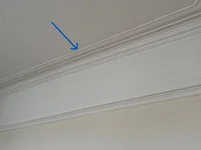
From relatively recent experience (along with a lifetime of construction related jobs) I would ask a few questions.
What is the reasoning for the bare brick below the coving? Rewire? Loose existing, cracks?
Why do you want to keep the ceiling and just over board?
I have recently worked on two early 1900"s houses one we under boarded the ceilings stripped back some walls. Others were chased out for wiring. But one thing was common the plaster coving was almost impossible to save without cutting back the lath and plaster of the ceiling. then boarding skimming to replace. We had taken out the hall wall to make a larger front room. The coving was replaced in the areas where the wall had been by taking a template and filling/shaping to make a modern undersized piece up to the original shape.
I found on the bits that came out the technique seemed to be to mould the plaster coving onto the wall/ceiling so it came away in lumps bringing bits of both with it. The original lime/horse hair plaster being prone to crack away easily. Basically it's not stuck on as well as it once was.
You might need to consider what is more cost effective. Taking out all the old, and starting from a blank canvas. As it might be easier to board/plaster from scratch and replace the coving with new (of the same pattern). Which might be more cost effective than trying to save the existing and marry up to it. There's the risk of cracking along the joint, you lose other benefits like the wall usually holds up the edges of the ceiling boards.
If rewiring how do you propose to get past the coving with your cables?
I would also mention that you need to be sure where any existing cables are if you go ahead with the plan to cut under the coving with a grinder. A wall chaser with just one blade fitted might work better. you have the advantages of depth control and dust extraction in one.
Everything pretty much covered in this reply.
I'll add a few more thoughts.
The problem of overboarding a ceiling and trying to marry up to the edge of an existing cornice is never easy. I have seen as previously mentioned a "shadow moulding" being made around the edge, but this way creates another problem as how are you going to secure the edge of the plasterboard ?
There will no doubt "not" be a joist in the ceiling suitable to screw the edge of the sheet to and the old imperial joist spacings will not work out for sheeting without a lot of cutting and buggering about.
Are the existing walls plastered on the hard or are they plastered on laths on straps dooked in to the walls?
In the past when tackling jobs like these (I am a joiner to trade) when helping an old plasterer chap that stayed nearby, he would take the lot off and down but prior to stripping he would get me to make a template of the profile of the existing cornice or take a section he had cut out to me.
(I'd be in the kitchen usually on a Friday night having a cup of tea and he would appear at the window (fag in mouth) with a big box or bucket and look in at me and give a wink) Id go out and see him and it was always the same conversation. " could you make a mould/ template for me for Monday/" (he was a hardy soul and I miss his craic, old school and a grafter.
Back to the subject.
Up here plastering on the hard on walls is not common and there would generally be laths on staps.
If the laths and straps were good and the customer wanted them left they would be boarded over and the ceiling brandered to modern centres 400mm/600mm with 2"x1", Straightened and then boarded.
Then we would fit timber beads to the walls and he would start running the cornice in situ. If the cornice was big 12"/14"/or bigger we would cut additional plasterboard strips and screw in place to bulk out the sections before he started to run them.
Alternatively I would make a box mould and he would run these on the bench in lengths and affix/bed to the wall/ceiling (after running all the sections required) with temporary supports.
Then he would plaster the walls and ceilings as normal.
Alternatively if the lath and straps were knackered, the wall would be framed out at modern centres and insulation could be fitted (something else to consider in this day and age).
Plastering a tight skim coat on a ceiling can and does save a lot of time but if there are areas of the ceiling that are bossed then that is not going to improve the situation and it will just come back to bite you.
Something else to consider is that most old houses with 9'-11' high ceilings usually have big skirtings and timber mouldings around window and door openings and you need to factor that in to what you are doing so that they look ok when you are done and not half buried in new plaster.
To remove the cornice completely and not replace would spoil the room and take away for the character of the house.
Anyway, just a few thoughts.
Cheers