Any Plasterers Among Us? Ceiling Advice Please

Stuart Mitchell

Well-Known Member
The time has come for me to refurbish my dining room at home 😬

The house is 1901 and pretty standard I think for that era, skirting board, wall, picture rail, frieze and coving. Everything below the coving is coming off, back to brick, the plan to run a grinder disc around just beneath the coving and strip all below.

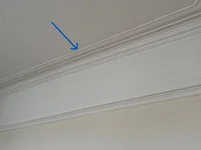
I hope to leave the original ceiling in place and overboard, so not to disturb the coving too much, thing is though that the edge of the coving where it meets the ceiling (blue arrow) is only around 5mm high so not deep/high enough to cover the edge of the plasterboards.

My question is if I proceed as planned, how can I finish the edges of the new ceiling plasterboards?


IMG_1892.jpg
 
Last edited:
I had the same problem , my plasterer put up 9mm board to the edge of the coving then skimmed the board , not touching the coving and it came out really nice,
a nice little feature around the edge, maybe put a small section of 9mm up to the edge of the coving and see what you think .
 
I wouldn’t try to save the coving. If you’re taking the walls back to brick then take the ceiling and coving down lathes and all.
If you are particularly wanting to have the identical coving then get a coving specialist to take a moulding of the existing before works begin. They can then make a form and produce and fit new coving after you’ve boarded the ceiling and plastered both ceilings and walls. This way you won’t have any trouble with either the walls or ceiling marrying up with the old coving. You’ll end up with a perfect finish.
 
I screwed external grade 3mm ply sheets on to a ceiling that had been previously covered with expanded polystyrene tiles. (1936 house)
These had been removed, but the adhesive left the otherwise sound plaster covered with patches of slightly raised yellow adhesive.
I'm not a plasterer, and I had to sit down for a minute after getting a quote from one, so I DIY'd it.
I located the rafters and used c/sunk torx screws at 20cm intervals, paying particular care along the rafter where two sheets were butted together.
Then filled, lightly sanded and three coats of kitchen grade emulsion......still looks as new 3 years on.

D.
 
The time has come for me to refurbish my dining room at home 😬

The house is 1901 and pretty standard I think for that era, skirting board, wall, picture rail, frieze and coving. Everything below the coving is coming off, back to brick, the plan to run a grinder disc around just beneath the coving and strip all below.

I hope to leave the original ceiling in place and overboard, so not to disturb the coving too much, thing is though that the edge of the coving where it meets the ceiling (blue arrow) is only around 5mm high so not deep/high enough to cover the edge of the plasterboards.

My question is if I proceed as planned, how can I finish the edges of the new ceiling plasterboards?


View attachment 407596
From relatively recent experience (along with a lifetime of construction related jobs) I would ask a few questions.
What is the reasoning for the bare brick below the coving? Rewire? Loose existing, cracks?
Why do you want to keep the ceiling and just over board?

I have recently worked on two early 1900"s houses one we under boarded the ceilings stripped back some walls. Others were chased out for wiring. But one thing was common the plaster coving was almost impossible to save without cutting back the lath and plaster of the ceiling. then boarding skimming to replace. We had taken out the hall wall to make a larger front room. The coving was replaced in the areas where the wall had been by taking a template and filling/shaping to make a modern undersized piece up to the original shape.
I found on the bits that came out the technique seemed to be to mould the plaster coving onto the wall/ceiling so it came away in lumps bringing bits of both with it. The original lime/horse hair plaster being prone to crack away easily. Basically it's not stuck on as well as it once was.

You might need to consider what is more cost effective. Taking out all the old, and starting from a blank canvas. As it might be easier to board/plaster from scratch and replace the coving with new (of the same pattern). Which might be more cost effective than trying to save the existing and marry up to it. There's the risk of cracking along the joint, you lose other benefits like the wall usually holds up the edges of the ceiling boards.
If rewiring how do you propose to get past the coving with your cables?

I would also mention that you need to be sure where any existing cables are if you go ahead with the plan to cut under the coving with a grinder. A wall chaser with just one blade fitted might work better. you have the advantages of depth control and dust extraction in one.
 
From relatively recent experience (along with a lifetime of construction related jobs) I would ask a few questions.
What is the reasoning for the bare brick below the coving? Rewire? Loose existing, cracks?
Why do you want to keep the ceiling and just over board?

I have recently worked on two early 1900"s houses one we under boarded the ceilings stripped back some walls. Others were chased out for wiring. But one thing was common the plaster coving was almost impossible to save without cutting back the lath and plaster of the ceiling. then boarding skimming to replace. We had taken out the hall wall to make a larger front room. The coving was replaced in the areas where the wall had been by taking a template and filling/shaping to make a modern undersized piece up to the original shape.
I found on the bits that came out the technique seemed to be to mould the plaster coving onto the wall/ceiling so it came away in lumps bringing bits of both with it. The original lime/horse hair plaster being prone to crack away easily. Basically it's not stuck on as well as it once was.

You might need to consider what is more cost effective. Taking out all the old, and starting from a blank canvas. As it might be easier to board/plaster from scratch and replace the coving with new (of the same pattern). Which might be more cost effective than trying to save the existing and marry up to it. There's the risk of cracking along the joint, you lose other benefits like the wall usually holds up the edges of the ceiling boards.
If rewiring how do you propose to get past the coving with your cables?

I would also mention that you need to be sure where any existing cables are if you go ahead with the plan to cut under the coving with a grinder. A wall chaser with just one blade fitted might work better. you have the advantages of depth control and dust extraction in one.
Everything pretty much covered in this reply.

I'll add a few more thoughts.

The problem of overboarding a ceiling and trying to marry up to the edge of an existing cornice is never easy. I have seen as previously mentioned a "shadow moulding" being made around the edge, but this way creates another problem as how are you going to secure the edge of the plasterboard ?
There will no doubt "not" be a joist in the ceiling suitable to screw the edge of the sheet to and the old imperial joist spacings will not work out for sheeting without a lot of cutting and buggering about.

Are the existing walls plastered on the hard or are they plastered on laths on straps dooked in to the walls?

In the past when tackling jobs like these (I am a joiner to trade) when helping an old plasterer chap that stayed nearby, he would take the lot off and down but prior to stripping he would get me to make a template of the profile of the existing cornice or take a section he had cut out to me.

(I'd be in the kitchen usually on a Friday night having a cup of tea and he would appear at the window (fag in mouth) with a big box or bucket and look in at me and give a wink) Id go out and see him and it was always the same conversation. " could you make a mould/ template for me for Monday/" (he was a hardy soul and I miss his craic, old school and a grafter.

Back to the subject.

Up here plastering on the hard on walls is not common and there would generally be laths on staps.
If the laths and straps were good and the customer wanted them left they would be boarded over and the ceiling brandered to modern centres 400mm/600mm with 2"x1", Straightened and then boarded.

Then we would fit timber beads to the walls and he would start running the cornice in situ. If the cornice was big 12"/14"/or bigger we would cut additional plasterboard strips and screw in place to bulk out the sections before he started to run them.
Alternatively I would make a box mould and he would run these on the bench in lengths and affix/bed to the wall/ceiling (after running all the sections required) with temporary supports.
Then he would plaster the walls and ceilings as normal.
Alternatively if the lath and straps were knackered, the wall would be framed out at modern centres and insulation could be fitted (something else to consider in this day and age).

Plastering a tight skim coat on a ceiling can and does save a lot of time but if there are areas of the ceiling that are bossed then that is not going to improve the situation and it will just come back to bite you.

Something else to consider is that most old houses with 9'-11' high ceilings usually have big skirtings and timber mouldings around window and door openings and you need to factor that in to what you are doing so that they look ok when you are done and not half buried in new plaster.

To remove the cornice completely and not replace would spoil the room and take away for the character of the house.

Anyway, just a few thoughts.

Cheers
 
Last edited:
Iv just done with my hall way/stairs landing absolutely sht of a job.

Pulled all the coving down knocked off any loose plaster which made some massive holes. Filled it with bonding.

Over boarded ceiling again pig of a job unless you got the right kit and someone to help.

Skimmed walls and ceiling.

Put up new supercove because it’s easier to manage than the plaster. It’s not as nice as the original coving but like for like replacement was insanely expensive.

Having done it and done an ok job it’s something that I would probably get a plasterer to do but a spread round here is like hens teeth and boy do they know how to charge.
 
Hello, Sounds very nice Stewart, For me i would leave as it was like 1901 and just repaint, My first family home was built around 1900 and still like that now
 
I wouldn’t try to save the coving. If you’re taking the walls back to brick then take the ceiling and coving down lathes and all.
If you are particularly wanting to have the identical coving then get a coving specialist to take a moulding of the existing before works begin. They can then make a form and produce and fit new coving after you’ve boarded the ceiling and plastered both ceilings and walls. This way you won’t have any trouble with either the walls or ceiling marrying up with the old coving. You’ll end up with a perfect finish.
This would be extraordinarily expensive.
 
This would be extraordinarily expensive.
Not really. It all depends if the OP wants a proper professional job or just wants to make a horlicks of it. Having a moulding taken of the existing cornice, to be accurate, and having lengths formed is from experience not cheap but also not prohibitively expensive. With the amount of hardwall or bonding that will be needed to build out the crappy edwardian brickwork (OP has stated he intends to take the walls back to brick) to marry up the new wall finishes to the retained cornice will go some way to paying for the new replacement cornice. Another contributory factor is the time wasted trying to board over crappy lathe and lime plaster on the ceiling trying to find the ceiling joists to properly fix the new boards which, hopefully won’t fall down in great chunks whilst overboarding. This all to achieve what?…..a seriously mediocre outcome.
 
Not really. It all depends if the OP wants a proper professional job or just wants to make a horlicks of it. Having a moulding taken of the existing cornice, to be accurate, and having lengths formed is from experience not cheap but also not prohibitively expensive. With the amount of hardwall or bonding that will be needed to build out the crappy edwardian brickwork (OP has stated he intends to take the walls back to brick) to marry up the new wall finishes to the retained cornice will go some way to paying for the new replacement cornice. Another contributory factor is the time wasted trying to board over crappy lathe and lime plaster on the ceiling trying to find the ceiling joists to properly fix the new boards which, hopefully won’t fall down in great chunks whilst overboarding. This all to achieve what?…..a seriously mediocre outcome.
IMG_1908.webp
 
Back
Top