
You are using an out of date browser. It may not display this or other websites correctly.
You should upgrade or use an alternative browser.
You should upgrade or use an alternative browser.
BASC chairman delivers New Year message
- Thread starter DebbieBASC
- Start date


CarlW
Well-Known Member
Kes, your analysis of the Charge of the Light Brigade is a tad off beam, 632 men took part in the Charge and 110 were killed in action, so 82 per cent survived, it was also more to do with poor communication , a lack battlefield intelligence and a clash of personalities that led to the Charge not being properly supported by the Heavy Brigade and infantry. Never the less the Charge put the wind up the Russians to such an extent that they refused to engage the British cavalry for the rest of the war, some my see this as a strategic victory.
We will post an update on the JD on the Welsh issue when we have more news and similarly an update on the medical fees issue when there is more news
Dear David,
I do greatly admire the way you indefatigably and good-humouredly continue to engage with us on the Stalking Directory, despite occasionally getting a little bit of rough treatment.
You represent BASC well here. May I ask that you do the same in the opposite direction? It would give many of us on here great heart to know that you are giving a voice to our concerns as stalkers when you return to the corridors of Marford Mill.
The relationship between BASC and its membership can be rebuilt, but that will require that the organisation listens to people like Kes, and Walshie, and you, and me, and everyone else on here. BASC belongs to its members; not the other way around.
Again, we're lucky to have you as our representative!
Kindest regards,
Carl
CarlW
Well-Known Member
Trust me, I do feedback comments and have members interests at heart, and you are correct, BASC is run by members, it always has been , and the Constitution clearly confirms this
Thank you, David. That is good to know.
Kind regards,
Carl
Kes, your analysis of the Charge of the Light Brigade is a tad off beam, 632 men took part in the Charge and 110 were killed in action, so 82 per cent survived, it was also more to do with poor communication , a lack battlefield intelligence and a clash of personalities that led to the Charge not being properly supported by the Heavy Brigade and infantry. Never the less the Charge put the wind up the Russians to such an extent that they refused to engage the British cavalry for the rest of the war, some my see this as a strategic victory.
We will post an update on the JD on the Welsh issue when we have more news and similarly an update on the medical fees issue when there is more news
In 1854 the 17th Lancers were ordered abroad as part of an Anglo-French expeditionary forces to help Turkey who had been invaded by Russia. Upon arrival the force discovered that the Turkish Army had repulsed the Russian invasion. It was then decided to capture the Czars' intended fleet base at Sebastopol. In order to achieve this, the force passed to the South of the town to the small fishing village of the new famous Balaklava.
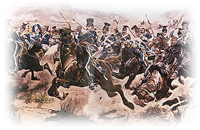
The battle of Balaklava consisted of three distinct actions. In the first, the 93rd Regiment of Foot (now the Argyll and Sutherland Highlanders), withstood and repulsed an attack by a vastly superior force of Russians. The second is remembered as "The Charge of the Heavy Brigade", in which a number of Dragoon Regiments routed a force of Russians ten times their strength. The third and final action in which the 17th Lancers were involved and which is still celebrated every year on 25th October, was "The Charge of the Light Brigade", immortilized in the poem by Alfred, Lord Tennyson. This famous charge only took place as a result of misinterpreted orders issued by the Command in Chief, General Lord Raglan, to General Lord Lucan the Commander of the Cavalry Division. Lord Lucan ordered Major General Lord Cardigan, who commanded the Light Brigade, to lead a force consisting of five Cavalry Regiments, of which the 17th were one, against a line of Russian guns which were sighted at the far end of a long valley. With the 17th as left forward Regiment the advance began. Those watching expected the Brigade to wheel and attack the intended target, but to their amazement the advance continued at the trot and in perfect formation towards the Russian guns.
The first salvo was fired at about 500 yards and took a heavy toll. Such was the discipline standard of training and courage of the Light Brigade, however, that the advance continued unabated with the gaps created by the enemy fire quickly being filled by other Cavalry men. At last with only a few hundred yards remaining, Lord Cardigan have the order to charge, and the 17th Lancers led by their Commanding Officer, Captain William Morris, swept down on the enemy. The final Russian salvo caused untold injury to the attacking force but despite this, the gun lines were over-run.
The battle continued until finally the order to withdraw was given. The 17th Lancers had paid a high price for this victory. Of the 145 who set out only about 38 all ranks could be accounted for at the final roll call. By their actions however, the Regiment earned 3 Victoria Crosses that day.
The 17th played a minor role in the battle of Inkerman but continued to suffer daily from the privations of maladministration and the weather in the area. It was with some relief that the unit was reposted to Ireland in 1855. Although, it barely had time to make itself comfortable there when a new crisis rose to threaten the stability of the Empire.
I must have the wrong reference. Happy New Year David.
tikka_madras
Well-Known Member
Has the full truth of what happened with Ali ever come out? Or is BASC still hiding behind “employee confidentiality“?

Think I left out the word Officer's, before mess 
I understand your figures re the 17th are correct, but they ware only part of the total, ( that was my point and probably not very well made!) agreed they took a heavy loss and made up a large number of those killed, but their bravery has never and will never be in doubt.
However, in by view, the battle of Balaclava would never have happened if the Allied Army had pushed onwards at the battle of Alma, with the Russian forces so weak (admittedly unknown to the Allies) they could have taken Sebastopol and advanced through the city, but I guess hindsight is a wonderful thing
Happy New Year to you too!
David
However, in by view, the battle of Balaclava would never have happened if the Allied Army had pushed onwards at the battle of Alma, with the Russian forces so weak (admittedly unknown to the Allies) they could have taken Sebastopol and advanced through the city, but I guess hindsight is a wonderful thing
Happy New Year to you too!
David
Just re filled my sand table, Looking through my lead soldiers I have rooted out the Cheshire regiment's 22nd Foot, I will have them represent the B.A.S.C. membership in their struggle to push forwards with sensible legislation on sporting shooting, Now lets see, I need a few mounted chappies, ......... ?
David, I'm sure you will recall I mentioned the bravery and suggested being led by buffoons i.e. Lord Raglan and Cardigan, who's personal animosity rendered the most dangerous event in military history - luckily they mysteriously derived a victory and are remembered as a result - a failure would have been recognised for what it was.
A parrallel might be considered to be BASC's approach to challenging police motivated medical changes - it should have been nipped in the bud but has flowered, set seed and is almost established. I am not sure apolitical approach was the right way, ok I think it was benighted in the truest sense of the word.
Were BASC a Member-led, Member -driven organisation it would have challenged the decision as it appears it has done with CA over the Welsh issue. It could never have been credibly argued that members did not want confrontation over the issue of medicals - BASC even called for examples topursue at one stage but, as usual lost its nerve or became mired in insecurity. When BAC does its duty to its members I will rejoin, always provided it does not again betray the trust of its members which, truth to tell has been a feature of the last 10 years. The long grass at BASC is an untended meadow of neglected issues.
A parrallel might be considered to be BASC's approach to challenging police motivated medical changes - it should have been nipped in the bud but has flowered, set seed and is almost established. I am not sure apolitical approach was the right way, ok I think it was benighted in the truest sense of the word.
Were BASC a Member-led, Member -driven organisation it would have challenged the decision as it appears it has done with CA over the Welsh issue. It could never have been credibly argued that members did not want confrontation over the issue of medicals - BASC even called for examples topursue at one stage but, as usual lost its nerve or became mired in insecurity. When BAC does its duty to its members I will rejoin, always provided it does not again betray the trust of its members which, truth to tell has been a feature of the last 10 years. The long grass at BASC is an untended meadow of neglected issues.
I would argue that Balaclava was probably not the greatest muck up in English Military history, I would put forward the Battle of Bannockburn (Edward II) as a potential leading contender...
You may recall that the key issue is not putting a marker on a persons records or having a GP alerting the police if someone presents with certain conditions its the random nature of fees charged, in some cases, and remember fees are not set by the police but by GP's.
You will find that the Welsh issue / JD is a joint effort by BASC, CA and NGO.
You may recall that the key issue is not putting a marker on a persons records or having a GP alerting the police if someone presents with certain conditions its the random nature of fees charged, in some cases, and remember fees are not set by the police but by GP's.
You will find that the Welsh issue / JD is a joint effort by BASC, CA and NGO.

Currently re examining my sand table, .... HHmn, Greatest Muck up?, I'll offer Winston's Gallipoli for that as a campaign,

Kes, your analysis of the Charge of the Light Brigade is a tad off beam, 632 men took part in the Charge and 110 were killed in action, so 82 per cent survived, it was also more to do with poor communication , a lack battlefield intelligence and a clash of personalities that led to the Charge not being properly supported by the Heavy Brigade and infantry. Never the less the Charge put the wind up the Russians to such an extent that they refused to engage the British cavalry for the rest of the war, some my see this as a strategic victory.
We will post an update on the JD on the Welsh issue when we have more news and similarly an update on the medical fees issue when there is more news
I had imagined that Debbie was now the voice of BASC after David had a wobbly when losing a heated debate and refused to further engage.
Here
As it happens I think what the Chairman reports as big wins is very very small beer. It was David who stated that as the BASC were fully engaged at the top table that they did not need to lobby to be listed as an entity to be fully consulted by statute. The BASC then failed to progress a judicial review on the medical issue preferring to use a softer approach, and political skills. So the JR was abandoned. But to claim any credit for the JR being considered for the Welsh shooting ban simply lacks credibility on BASC's part. I tend to believe it is the CA and the NGA who are leading BASC kicking and screaming down the JR option. BASC are too pally with the constabularies and NPCC (ex ACPO) (not surprising given the number of retired ex-plod on the books), and were truly naïve over the BMA/HO negotiations. It was bound to fail.
The Light Brigade is a poor analogy. I regard the BASC's negotiating capability more akin to the buffoonery of supplicant May in her £39bn good faith blunder over Brexit.
Last edited:
Some just cant casting daft accusations at BASC even when the evidence to the contrary is in the public domain! BASC, CA and NGO are working together on the Welsh issue, its on our web site here: Rural groups take next step in legal challenge to shooting ban - and if you could be bothered to check your facts its on the other web sites too...honestly this constant attacking of shooting originations is doing no good at all is it? The organisations rise above this petty bickering and work together on a range of issues to try and help shooters, regardless of what you spout on here!
David, it would be worth recognising that BASC members do feel let down by the police expedition into medicals.
There was an agreement with the HO that the fee was part of the firearms fee. That is what has been lost in flawed discussions over a much vaunted 10 year cert. There is concern over 'think of a number charges for medicals' but the greater harm was not challenging the Police over ANY CHARGE BEING JUSTIFIED in the first place and JR was the way to do that. At the time you agreed and asked for examples. How can you now suggest it was merely the uniformity of fees charged that is the issue ?
Getting back to topic, despite the Chairman's words, I decided BASC was anyway a lost cause and vowed not to be drawn in again to pointing out the truth when faced with 'fake news'.
I never want to hear anymore about BASC because its doing its job and doing it well. We are some way from that and banning adverse comment as e.g. on Pigeon Watch is malign and trying to manipulate the truth - the reason I complained and was banned from PW to 'wash upon this shore' as Zapp put it.
My choice is this site, truth is neither compromised nor a bystander here.
There was an agreement with the HO that the fee was part of the firearms fee. That is what has been lost in flawed discussions over a much vaunted 10 year cert. There is concern over 'think of a number charges for medicals' but the greater harm was not challenging the Police over ANY CHARGE BEING JUSTIFIED in the first place and JR was the way to do that. At the time you agreed and asked for examples. How can you now suggest it was merely the uniformity of fees charged that is the issue ?
Getting back to topic, despite the Chairman's words, I decided BASC was anyway a lost cause and vowed not to be drawn in again to pointing out the truth when faced with 'fake news'.
I never want to hear anymore about BASC because its doing its job and doing it well. We are some way from that and banning adverse comment as e.g. on Pigeon Watch is malign and trying to manipulate the truth - the reason I complained and was banned from PW to 'wash upon this shore' as Zapp put it.
My choice is this site, truth is neither compromised nor a bystander here.
CarlW
Well-Known Member
David, it would be worth recognising that BASC members do feel let down by the police expedition into medicals.
There was an agreement with the HO that the fee was part of the firearms fee. That is what has been lost in flawed discussions over a much vaunted 10 year cert. There is concern over 'think of a number charges for medicals' but the greater harm was not challenging the Police over ANY CHARGE BEING JUSTIFIED in the first place and JR was the way to do that. At the time you agreed and asked for examples. How can you now suggest it was merely the uniformity of fees charged that is the issue ?
Getting back to topic, despite the Chairman's words, I decided BASC was anyway a lost cause and vowed not to be drawn in again to pointing out the truth when faced with 'fake news'.
I never want to hear anymore about BASC because its doing its job and doing it well. We are some way from that and banning adverse comment as e.g. on Pigeon Watch is malign and trying to manipulate the truth - the reason I complained and was banned from PW to 'wash upon this shore' as Zapp put it.
My choice is this site, truth is neither compromised nor a bystander here.
Kes: would you be willing to address BASC's board, if they would let you?
David: how about it? Dissent generally precedes innovation.
Kind regards,
Carl
Carl, yes, I would, willingly and tomorrow -
but its not going to happen - snowball and hell i'm afraid - not one of the most radical organisations is BASC.
Anyway David is now on the Management Team after the latest re-shuffle so he has the ability to influence the officer side.
Maybe they should carry out a poll and see what are the issues in priority order that the Membership want actioned - perhaps that would open eyes. They could then take 2 a year and get the CEO on one and the Chairman on the other.
It simply isnt going to happen until Membership slumps and then its the likes of me will be blamed - until the pheonix rises that is.
but its not going to happen - snowball and hell i'm afraid - not one of the most radical organisations is BASC.
Anyway David is now on the Management Team after the latest re-shuffle so he has the ability to influence the officer side.
Maybe they should carry out a poll and see what are the issues in priority order that the Membership want actioned - perhaps that would open eyes. They could then take 2 a year and get the CEO on one and the Chairman on the other.
It simply isnt going to happen until Membership slumps and then its the likes of me will be blamed - until the pheonix rises that is.
CarlW
Well-Known Member
Fantastic!Carl, yes, I would, willingly and tomorrow -
but its not going to happen - snowball and hell i'm afraid - not one of the most radical organisations is BASC.
Anyway David is now on the Management Team after the latest re-shuffle so he has the ability to influence the officer side.
Maybe they should carry out a poll and see what are the issues in priority order that the Membership want actioned - perhaps that would open eyes. They could then take 2 a year and get the CEO on one and the Chairman on the other.
It simply isnt going to happen until Membership slumps and then its the likes of me will be blamed - until the pheonix rises that is.
I think it's great that you are up for it, Kes. And, David has never shown an unwillingness to engage with this forum on the difficult issues. He is a risk-taker.
So, David, fancy inviting Kes over to meet you and your colleagues and present his view of the world?
Kind regards,
Carl
Similar threads
- Replies
- 30
- Views
- 2K


- Replies
- 85
- Views
- 4K

