EKA Swingblade not holding edge

Rasputin

Well-Known Member
Morning all. Got an EKA swing blade G4 for xmas and it just won't hold an edge. Have I got a dud or does it need reprofiling as the latter is above my pay grade? Have to say compared to my other EKA which is the fish one its really not that great especially for the money.
 
Morning all. Got an EKA swing blade G4 for xmas and it just won't hold an edge. Have I got a dud or does it need reprofiling as the latter is above my pay grade? Have to say compared to my other EKA which is the fish one its really not that great especially for the money.

EKA make good kit, and I'm doubtful that a duff heat treat would get through their QC. Is it just that the edge angle is too fine for the way you use knives?

Invest in a simple-to-use Lansky set and reprofile to a "coarser" - maybe 25°? - edge for greater longevity.

maximus otter
 
I have one and thought similar, sent it off to @Longstrider who returned it scary sharp ( with a free plaster 😉) he also informed me they have a double edge therefore harder to sharpen for us mere mortals .
My go to is a cheap n cheerful Mora which is easy to keep and edge on using the Lansky set 👍.
 
The Lansky system is good I use it on the others but this is dull after only two deer so thought it seemed a bit odd. Will give Longstrider a nudge as I have another blade that’s in need as well.

Cheers
 
I have one and thought similar, sent it off to @Longstrider who returned it scary sharp ( with a free plaster 😉) he also informed me they have a double edge therefore harder to sharpen for us mere mortals .
My go to is a cheap n cheerful Mora which is easy to keep and edge on using the Lansky set 👍.

The main blade actually has a secondary bevel (a narrow strip along the edge that you work on when you sharpen it) and as such should actually be easier for most folks to get to grips with than, say, a true Scandi grind. It's the concave curve of that silly belly-blade that makes life difficult unless you have the right kit. If you use a flat hone on it the hone will only touch at the edges (of the hone) NOT across the entire flat of the hone. It 'bridges' across the curve.
I use a very very small round diamond hone on them then a slightly dome-topped strop to polish and finish the edge.
I'm yet to come across a Swingblade that I'd suggest the heat treat was dodgy on (and I've seen a good few ;) ) ... unlike some of the supposed 'Custom' knives I've handled over the years.

With about 40 years of practice with the diamond hones I can usually tell within a point or so the hardness (Rc) of a blade just by sharpening it. There was even once a rumour that I could tell the steel type just by licking the hone halfway through, but I'll let you decide if that's true ! :lol:
 
I had the same problem with the swingblade when using a lansky system. Then I read a thread on SD where sharpening with wet/dry sandpaper from Halfords was better. Put the sandpaper on a mouse mat or similar and sharpen with that working your way from coarse to fine grits. This worked really well. I think it’s something to do with the concave curve of the blade as oppose to the usual scandi grind blades.
 
I’ve not found a knife yet I can’t get sharp with a warthog v2 finished with a lansky mini sharpener. I’m pretty good with the old whetstone but this is so much quicker and results it shaving quality edge with the right steel
 
The main blade actually has a secondary bevel (a narrow strip along the edge that you work on when you sharpen it) and as such should actually be easier for most folks to get to grips with than, say, a true Scandi grind. It's the concave curve of that silly belly-blade that makes life difficult unless you have the right kit. If you use a flat hone on it the hone will only touch at the edges (of the hone) NOT across the entire flat of the hone. It 'bridges' across the curve.
I use a very very small round diamond hone on them then a slightly dome-topped strop to polish and finish the edge.
I'm yet to come across a Swingblade that I'd suggest the heat treat was dodgy on (and I've seen a good few ;) ) ... unlike some of the supposed 'Custom' knives I've handled over the years.

With about 40 years of practice with the diamond hones I can usually tell within a point or so the hardness (Rc) of a blade just by sharpening it. There was even once a rumour that I could tell the steel type just by licking the hone halfway through, but I'll let you decide if that's true ! :lol:
Why do manufacturers put such difficult to sharpen edges on working knives?
 
Why do manufacturers put such difficult to sharpen edges on working knives?

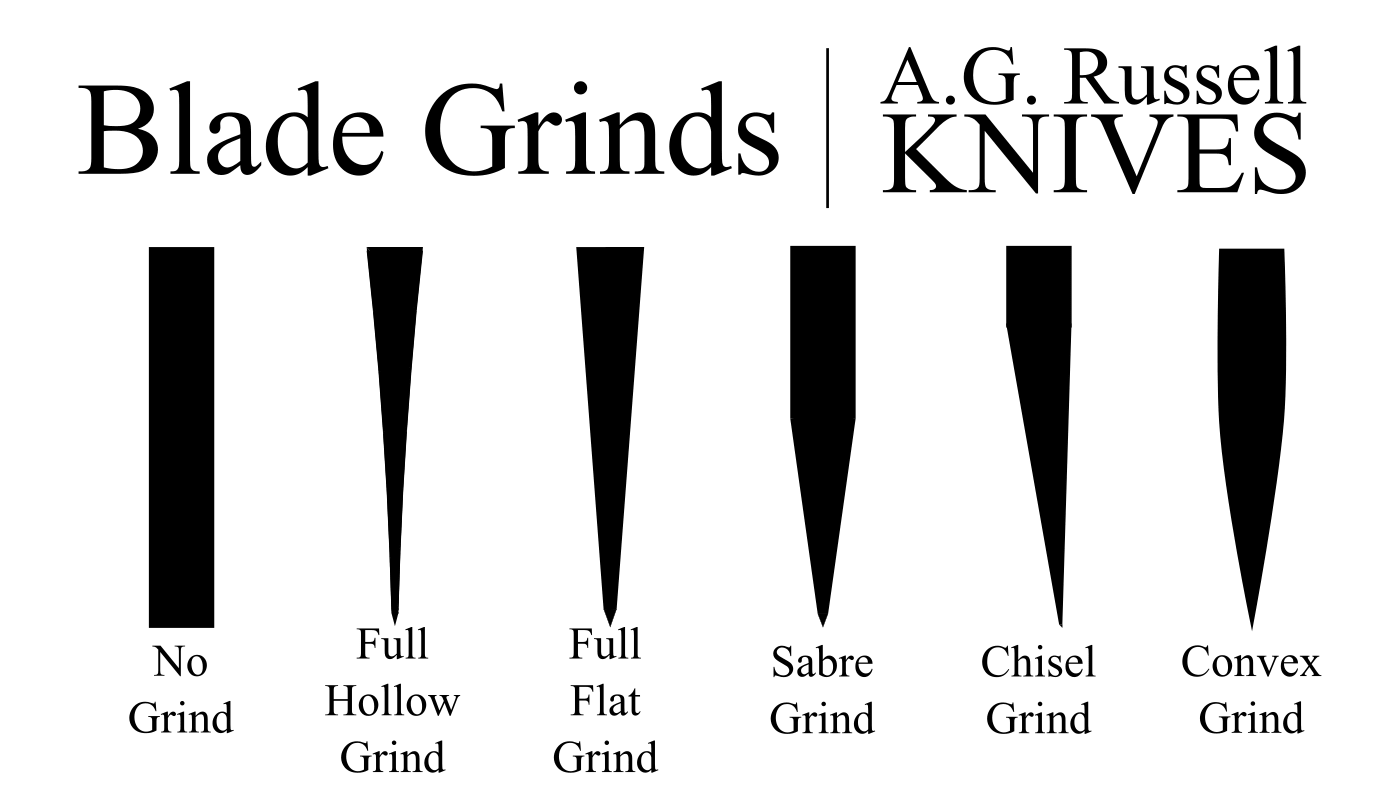
Blades with a secondary bevel are the commonest type of knife. They are the easiest to work on as you only have a narrow strip of steel to work along the edge. In order for the edge geometry to be right you need a relatively shallow angle grind on the blade (primary grind) in order to leave a thin edge, onto which you put a secondary bevel at a slightly more obtuse angle. Grinds such as a Sabre, Full Flat, and Hollow Grind allow for this. A Scandi grind generally does not. To sharpen a Scandi correctly you need to remove steel from the entire flat surface of the ground angle, keeping it flat, and keeping it even. Easy enough in the workshop where everything is stable but not as easy to deal with in the field. Certainly not as easy to deal with in the field as a secondary bevel.

But .... In order to put an even, neat, Sabre grind on a blade takes more work as you are actually removing more steel from the blade blank. If you go for a Full Flat grind you actually remove almost 1/2 the steel from the blank, and then you have to get it dead right or it looks a mess.
A Scandi grind is a very simple affair to achieve in comparison ... Relatively little steel needs to be removed and it's also far easier to keep neat and even when grinding.

Manufacturers like quick, easy and simple. Let the user find the difficulties and drawbacks later ;)

A maker who can produce good quality Sabre grinds and Full Flat grinds can make knives. Too many people "master" putting a Scandi grind onto a piece of steel and think they are the next best thing in cutlery.

This shows knife grinds better than I can explain...
 
Last edited:
Back
Top