Lapua .223 brass: is match different from standard?

Cyres

Well-Known Member
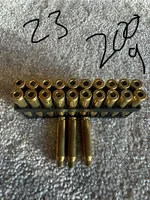
I have two brand new boxs of .223 Lapua brass,

One is .223 rem match lapua 4PH5003

Other is .223 rem (5.56x45mm) 4PH5003

The cases appear identical bar the match has match on the head stamp.

Can anybody shed any light on why they have the same product no but are labelled and head stamped differently?

Thanks

D
 
I have considered this issue before and researched it online and IIRC found the consensus was that the Match version was thicker, and therefore different. However no one mentioned that the part numbers were one and the same.
 
I have two brand new boxs of .223 Lapua brass,

One is .223 rem match lapua 4PH5003

Other is .223 rem (5.56x45mm) 4PH5003

The cases appear identical bar the match has match on the head stamp.

Can anybody shed any light on why they have the same product no but are labelled and head stamped differently?

Thanks

D
I recently bought a box of .223 Lapua from Spud, advertised as .223 Rem Match. I received a box labelled .223 Rem (5.56x45) Part No 4PH003. However the headstamp says MATCH.
 
Compare the weight of the two types of cases, if they are the same you should be fine.
I'd run up some identical loads with both & chronograph / drop test fire them to make sure.
Ian
 
Lapua 223 used to be very heavy and had amongst the lowest internal capacity of any commercial case on the market. This made it unattractive to most match shooters and 10, maybe 12 years ago the company changed its specs to a new lighter / higher capacity 'match' grade. For the first few years, the word 'Match' only appeared on the carton (back in the brown/gold cardboard days), then, presumably to avoid confusion, the word was introduced in the case headstamp.

See here:

223 Rem + 223 AI Cartridge Guide within AccurateShooter.com

and scroll down to a table called 223 Rem Case Weight v Capacity. There is a 10gn weight and 2gn internal water capacity difference between 'new' and 'old' Lapua, what was then called 'new' being the current 'Match' model. AFAIK, only this version is available for handloading to the retail gun trade - whether the company still makes a heavier version for military specification ammunition I couldn't say. So, nowadays, the only way you should ever get a lower capacity lot would be if you came across a very old gold box lot where neither carton or cases had the word match. If buying old used or new loose brass, a simple weight check tells you what you have. If just over 90gn, it's 'Match'; if just over 100gn it's the old heavy variety.
 
Laurie,

I was hoping you would reply as I thought if anybody knew you would.

I do still have a partially used Lapua cardboard box of .223 cases and it looks like I have mainly reloaded most of these and the non match stamped cases.

Currently I have a very accurate load using N140 and 69 TMK'S so I will need to check the cases to ensure I reload the correct ones.

I will do some weighing when i get a chance.

D
 
Thanks for explaining Laurie.
The advice I had found online had got it backwards and said the Match brass was older and heavier.
I have been unwittingly using the old heavy stuff for years.
 
Lapua 223 used to be very heavy and had amongst the lowest internal capacity of any commercial case on the market. This made it unattractive to most match shooters and 10, maybe 12 years ago the company changed its specs to a new lighter / higher capacity 'match' grade. For the first few years, the word 'Match' only appeared on the carton (back in the brown/gold cardboard days), then, presumably to avoid confusion, the word was introduced in the case headstamp.

See here:

223 Rem + 223 AI Cartridge Guide within AccurateShooter.com

and scroll down to a table called 223 Rem Case Weight v Capacity. There is a 10gn weight and 2gn internal water capacity difference between 'new' and 'old' Lapua, what was then called 'new' being the current 'Match' model. AFAIK, only this version is available for handloading to the retail gun trade - whether the company still makes a heavier version for military specification ammunition I couldn't say. So, nowadays, the only way you should ever get a lower capacity lot would be if you came across a very old gold box lot where neither carton or cases had the word match. If buying old used or new loose brass, a simple weight check tells you what you have. If just over 90gn, it's 'Match'; if just over 100gn it's the old heavy variety.
Thanks for that info. I assume the older cases may have a longer life, given a not too hot load?
 
I have some Lapua match. 223 brass which has smaller flash holes than normal. I had to turn down the pin in my decapping die to suit.
 
Thanks for that info. I assume the older cases may have a longer life, given a not too hot load?

That's a difficult question to answer. If shot in an AR-15 or similar, almost certainly yes as they'll stand up to rough physical handling better. In a bolt-action, they will if the heavier case has a thicker and stronger case-head / web section as this end of the case will resist pressures longer before expanding such that primers become a loose fit in their pockets. Sectioning different makes of case has shown that whilst there often is a correlation between overall weight and web thickness, it's by no means guaranteed and some heavy military 7.62/308 brass was actually weaker in this key area than lighter commercial equivalents.

The real determinant of case-life with modest pressure loads though in bolt-actions is usually the case to chamber fit, hence how much brass expansion takes place and also how much subsequent reduction occurs in sizing. The type of die used, especially the amount of neck diameter reduction followed by expansion often determines case life with neck splits being the weak point. So, a 'minimum SAAMI' chamber with lower clearances around the case and employing match bushing dies with mandrel type neck expansion which between them incur minimum brass movement may do much more for brass life than slightly thicker brass.

Run pressures though right on the red line or sneaking past it usually sees case-head / primer pocket expansion kill the case off before anything else and a stronger case-head is a great help. If you take 308 Win loaded 'hot' for F/TR and similar Lapua large primer brass was usually retired in four or five firings thanks to loose pockets. The change to the small primer 'Palma' case with more metal in the case-head / web has seen the back end of the case have a near indefinite life despite some competitors using yet higher pressure loads. The focus has instead switched up front to the neck / shoulder as with this very strong case, work hardening in this area becomes the weak point both for case life and also to avoid changing / variable neck tensions. So everybody now is into DIY annealing or paying somebody with an expensive AMP to do it for them.
 
Thanks Laurie, very interesting. I've only necked sized my brass, so should be good for many more loads yet then.
 
This thread got me thinking, so I took a look at the Lapua brass I have here. I was wrong, it is not marked as "match" but it is in the old black & gold boxes, with a part number of 4PH5009. I weighed a case, at about 95/96 grains. I knew at the time I was buying some older stock.

For me the only thing that "caught me out" was that smaller flash hole. I have an accurate 69 grain SMK load, so if I get a good few reloads from these I will be happy enough.
 
My pet load using "match" cases with 69 TMK is N140 25.8 grns col 2.417 and is v accurate out of my 26' 1:8 barrel. Use remmy 7 1/2 primers

D
 
Mine is the old 104ish grain stuff, and still going strong at 10 reloads so far of 24.5gr N133 under a 53 grain bullet.
 
Back
Top