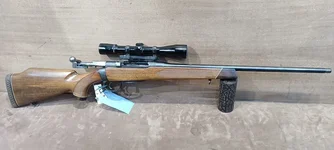
When it comes to Lee Enfields its concerning when all the serials match without prior provence being proven, 100's-1000's of fakes have been made up with serials matching among other indicatorsDo all the serial numbers match?
I suppose it depends on what you want to know. Most of what's there is fairly self-explanatory. It's obviously an SMLE (short magazine Lee Enfield the short referring to the length of the barrel compared to previous models) It's a MkIII and the * indicates it's been back to the factory, as I think the Z34 indicates in 1934 and upgraded (or arguably downgraded with no magazine cut off). During wartime, churning out or refurbing rifles quickly took precedence over having more features.
Assuming you are going to fire it, they perform well with home loads. The best factory ammo (in my experience anyway) that's fairly available at present is PPU. S&B do .303 too although their brass isn't as good if you want to reload. How well it'll shoot is really down to the condition of the barrel. A good one won't be too far off modern rifle accuracy, given the relatively primitive iron sights (No4 sights were a big improvement IMHO). I'm not sure of the availability of replacement barrels these days if you wanted/need to go down that road.
They are fun to shoot, compared to a modern rifle with a great big zoom scope and bipod. More room to improve! And even if it, or you aren't performing well, it makes a big old noise and usually is a talking point at the range. What's not to like?
I was under the impression that III* were factory standard for the latter part of the Great War and not a post war "upgrade"?
If a rifle went through this process at the hands of a military armourer then procedures would have been followed and parts numbered accordingly, however if through civilian hands, anybody's guess.Insofar as serial numbers go, yes, it's ideal if they match (and of course they're genuine). But at the end of WWII (or WWI, or both, memory going) there was a great surplus of rifles and so a great deal of them went through a procedure whereby they were inspected and obviously worn out models were discarded and others were kept, but any worn/faulty parts were replaced either with new parts or from the saved good bits from discarded rifles. So having a rifle with differing numbers doesn't necessarily mean it's wrong, but simply an indication it went through that process, that being part of it's history.
So although rifles without matching serial numbers tend to be cheaper to buy, they aren't any less genuine. Probably...
There are ways, though not foolproof of course, of detecting changes to serial numbers. Provenance on such grand old rifles is somewhat difficult at best.When it comes to Lee Enfields its concerning when all the serials match without prior provence being proven, 100's-1000's of fakes have been made up with serials matching among other indicators
www.forgottenweapons.com