Lee Loader stiff chambering and withdrawal

As caberslash eludes too-make sure it’s not a metal hammer creating sparks.

More about not pounding the living daylights out of your dies and case heads with a steel hammer...

A plastic faced dead-blow hammer works well. Thor make a very good one here in the UK! Dead Blow - Thor Hammer Company Limited

Anyone doing saw work should have one of these anyway unless you want to change wedges on a regular basis!
 
@caberslash - thanks for the feedback/suggestions. I did read the leaflet that came with the kit, along with the how to guides in the hornady 10th and sierra 5th manuals. At no stage did the brass exceed the stated max case size there, or in the saami specs (as I said in my original post: apologies if it was too long). Therefore, I didn't consider trimming. Had it exceeded, I definitely wouldn't have proceeded without and made arrangements. Safety is my priority, again as I said originally. The hammer is a nylon (white plastic head) flat faced thor with some heft to it. I have big rubber mallets but wanted impact and it looked most like the lee video you posted (and countless others I've watched).

@martin_b - thats a kind offer. I do go up to bisley once a month, perhaps next month again. I'll PM you closer to the time and see what we can come up with. More than happy to make a donation for unused kit that still works.

In the meantime, will follow-up on @rwade545 's suggestions and watch this thread closely.

Thanks all,
BRP
 
Demo by the late, great, Richard Lee himself:


The Lee Loader is what was once called a 'hand die', and for anyone thinking it's rubbish, I hope you don't own any fancy L.E Wilson in-line seaters and arbour press :stir:

A Lee Loader is an excellent tool, especially for loads which are not on the hot side. One should bear in mind that Lee Loaders differ between rifle, pistol and shotgun models but work on the same priciple.

@Stalker1962 can relate the peril of not reading the Lee Loader instructions/data sheet :thumb:

That striking tool is/was made by Snap-On/Blue-Point.

K
 
Take all the guess work out reloading with one of these:
 
I have the Lee Loader dies in .303, .308 and .223, I found all my problems went away once I started annealing with the Case Life annealer, which costs about £250. My original plan was to anneal every 3 or 4 firings but it's so quick and simple to use I run all the cases through it after every firing. Someone else can explain the technical detail but I believe it softens the brass back to its original form. Prior to annealing, I found I had loose neck tension with the Lee Loader, I could slide the bullets up and down a few mm when loaded, after annealing this went away.

I also use CBC/Magtech cases to reload, originally from their Tactical 55gn FMJ ammunition bought from the Range Office at Bisley. I've reloaded with 63gn, 69gn and 75gn on both the Lee Loader and the Lee neck sizing collet die, both work well. With the Lee Loader, I use a dead blow mallet from B&Q, their own Magnessun brand costs about £9, you have to make sure the case goes all the way into the die. I am also shooting the .223's through a Howa 1500 SA and am up to my fifth reload on some brass and I've had no issues with any of the 300 cases I have. I think the cases are fine, not Lapua quality but certainly up to PPU quality.

If cleaning your chamber doesn't work, then try annealing. Before buying a machine, you can do a dozen cases using a drill with a 12/13mm socket and a handheld blowtorch. For .223, I found about 6/7 seconds worked, then size the case and seat the bullets with no primer or powder and check. I assume you have a handheld inertia bullet puller, if not they are a good investment?

I use the Lee Loader if I want to run up a small number of rounds quickly, up to 50 or so, at my desk without setting up the press. The things I do differently to the video are that I deprime and clean the cases before resizing and I weigh or throw every charge, I don't use the scoop, I did try but I found I was +/- 0.5gn which is a little too much for me, it's probably better with ball powder but I use Viht, which is stick. I do have a press and full-length dies and the plan for .223 was to use them once the rounds became difficult to chamber but it has not happened yet. **EDIT** Forgot to mention that after depriming and cleaning I trim using the Lee system.

I got some arbour facings to be able to use my Lee Loader on the press but quickly realised that if I was doing that, I might as well just use the dies. A full set of Lee dies costs about £56 and a press can be had for £100 so it's not expensive, as long as you have the room for it. The great thing about the Lee Loader is you need nothing else apart from the mallet, I just use an old wood chopping board I had lying around.

Originally, I got the Lee Loader to have a go at reloading .303, it worked well and I have kept using it for the reasons outlined above. My problem up to now has been space and I haven't been able to leave the press set up, however, I have a Lee Reloading stand arriving today from Kranks and I've cleared space in the spare room for it so will soon have a permanent set up. After that, it remains to be seen if I will continue to use the Lee Loader.
 
Last edited:
Thanks for the time and effort in your writeup @nCognitos , really appreciate it. Seems like I can take CBC/Magtech brass off my list of potential culprits for the time being.

Hopefully tonight I'll be able to seat a few heads into cleaned unprimed cases (that chamber nicely without bullet seating) and see if I can narrow down the issue further, or perhaps my chamber and lug rail cleaning has sorted whatever the issue was....fingers-crossed!

Might...(big pause)...might give annealing a go later down the line. Pretty sure we have one of those chef blowtorch things somewhere in the garage!

All the best, BRP
 
@bakereloadprune , there is a slim chance that you have an oversize chamber, if this is the case, you'll be needing either a small base die or a vise die like I linked to earlier.

@griff made a good suggestion of getting a case gauge, would be good to have one as reference for your unfired vs. fired cases.

Either way, I've never had a reloaded round from 1st to 2nd firing not chamber with a Lee Loader. It's usually the 3rd firing where the lack of shoulder sizing starts to show, but this depends on your rifle's chamber and how hot you are loading.
 
There's a >90% chance that the condition is caused by the case-shoulder needing 'bumped' back a thou' or two. Neck-only sizing (which the Lee Loader does) won't cure it. A good pointer as to whether this is the cause is whether the bolt face leaves witness marks / circular scoring on the case-head face as the bolt is opened due the case's tight longitudinal (actually crush) fit in the chamber. (This is frequently misdiagnosed as an over-pressure sign.) High-pressure factory ammo can leave some cases with this form and chamber-fit in a reasonably tight chamber on the initial firing. If so, it is quite normal for only a percentage of cases to be so affected on their second loading as both peak pressure characteristics and shoulder behaviour vary across individual cartridges.

Once this condition applies, subsequent light loads won't help any afflicted case, only suitable sizing. It can steadily become worse however in both individual case fit and in previously unaffected cases becoming 'infected' with subsequent full or high-pressure loadings / firings. Starting with new brass and using light to moderate loads throughout will usually see neck-only sizing cause no case to chamber fit problems at all over long strings of loadings and firings.
 
Thanks for the time and effort in your writeup @nCognitos , really appreciate it. Seems like I can take CBC/Magtech brass off my list of potential culprits for the time being.

Hopefully tonight I'll be able to seat a few heads into cleaned unprimed cases (that chamber nicely without bullet seating) and see if I can narrow down the issue further, or perhaps my chamber and lug rail cleaning has sorted whatever the issue was....fingers-crossed!

Might...(big pause)...might give annealing a go later down the line. Pretty sure we have one of those chef blowtorch things somewhere in the garage!

All the best, BRP
You could first try chambering an empty resized case or two….
🦊🦊
 
If you want to try another Lee loader to rule it out let me know - happy to post you one that you can post back afterwards. As for what’s happening when closing the bolt - how many rounds are doing this and how many have you reloaded with this in the past?

Regards,
Gixer
 
Quick update from yesterday evening - I took a batch of clean (once fired magtech factory rounds) brass. These were in spec for length and neck diameter. No way I can check if there was a bumped shoulder. But hurrah, they chambered really nicely. Next I seated 5 bullets into the unprimed cases. They fed and extracted silky smooth without resistance.

@gixer1 thank you for the kind offer. Will keep it in mind.

Perhaps the cleaning of the action and chamber was the culprit. My assumption now being that if I have feeding issues moving forward (all things being equal) it would be related to the priming. I hope that's correct!

I won't try chambering live rounds until I'm at the range (even with the pin out) so it will be a few weeks until I find out for sure. All signs so far point to potential resolution. I have a good stash of magtech brass which will keep me going (especially as I've put in for a variation this week) but investing in a trimmer setup for the future is definitely on the next to-do.

Many thanks to everyone's considerable input and kind offers so far, greatly appreciated from me: a forum newbie. I'll post an update in the near future once I test out the next batch.

BRP
 
In a nutshell I have a Howa 1500: I've reloaded .223 magtech once-fired brass which was originally off-the-shelf magtech 55gr FMJ (which chambered smoothly in my Howa without problem). I took 30 of these once-fired cases. I prepped the brass by depriming, ultrasonic cleaning and neck resizing with the lee loader. The length of the brass (only full case) was checked against the factory with calipers, the sierra manual and saami. Then on to priming (flush), charging and seating a 53gr sierra matching HP with flat base, matching the overall length of the factory magetch ammo.
I would not suggest simply copying the COAL of the Magtech factory ammo loaded with an FMJ. You are using a different bullet. I would instead suggest that you seat the Sierra Match King to a COAL recommended in reputable reload data for that specific model. Since you have a Sierra manual I would look to that for load data for that specific bullet and use the COAL which they state. Generally this will give you a suitable "jump to the lands" to use as a starting point.

Copying a factory round is often a good starting point, but only as long as you are using the same, or a very similarly profiled, bullet.
At the range, about 30% of these reloads had stiff bolt opening and/or closing (none that were fine closing the bolt had issues opening & extracting, if that makes sense). By stiff, the bolt went down a small fraction and then I needed to give it a way more force forward to close it. Similar to opening - something I've not experienced before and I don't think acceptable (even grazed my thumb on the scope rings trying to open the bolt a few times).
I don't think you should have even attempted to shoot the ones where you had difficulty closing the bolt on them. That should have immediately told you to stop, unload them, and set them aside as suspect. Given that you did, then struggled to open the bolt afterwards, you should have stopped immediately, not carried on regardless and discovered that 30% of them were obviously not right.

(but I'm unable to measure shoulders and necks consistenly with just a caliper (right?).
You can measure neck diameter well enough with just callipers, though a micrometer is better. It is quite a useful measurement to do, particularly with this type of sizing. Measure outer diameter of sized neck before seating bullet. Seat bullet. Measure again. It will be larger. The difference is the "neck tension" 2-3 thousands of an inch is OK. Much more than that and you are essentially using the bullet as a neck expander. Not good for the bullet, and maybe undue force down on the shoulder, particularly if trying to force in a flat based bullet, as you are using. Easily detectable if seating on a press, once you have a feel for what's right, but of course with the Lee Loader you don't have any of that, just whack them in with the hammer.

There is every chance of this happening with a Lee Loader, (or even insufficient neck tension, say anything below 1/1000" If so, try the simple bullet push test). it is a one-size-fits all compromise device, The results it gives are largely determined by the neck thickness of your particular brass. Unlike a bushing die, where you select a specific bushing diameter to suit the brass that you are using.

To measure shoulder position you need a comparator. But realise that a comparator only gives a comparison measurement, not an absolute one, used to compare with a fireformed (in your rifle) case. So keep a few of these as reference pieces, maybe three or so.

I consider a body/headspace comparator to be an essential tool for reloaders, unless they are content to just set up their sizing dies in the simplest way, assuming that they will produce brass somewhere inside the SAAMI tolerance band, rather than best fit in a particular rifle. Which is quite an assumption to make.
- My rifle chamber is dirty and needs a good clean. Honestly, I've just been running VFG felts and nylon brushes down the bore and giving the action area a bush and a wipe, not realizing the chamber gets dirty. A flashlight down there shows some waxy like deposits where the shoulder of the round sits. But I look back at all the factory ammo that is chambered without issue. Is it really the chamber? [I plan to do this]
I suggest you buck up your ideas about cleaning. Aren't you using any solvents ? Surely you knew that the chamber needs cleaning as well ? The fact that factory ammo chambered OK in a dirty chamber is unsurprising, it is made to SAAMI tolerances which mean that even the longest (shoulder, i.e headspace) cartridge will fit the shortest chamber. Or the other way around there can be (typically) up to 0.010" of headspace allowed, which is far too much for best accuracy, but deemed safe, and should fit any correctly chambered rifle.

BTW, keep your bolt lugs and the receiver recesses clean and greased too.

Once you have shot the factory ammo it will have fireformed to your chamber, so become a snug fit. if not an almost interference fit. This rather depends on the stiffness of your action, as it fireforms under the peak pressure, when the bolt thrust is at its highest, which is not the situation when you rechamber a fireformed case that has only been neck sized. It usually works because the brass springs back a little after the first fireforming, but less and less so on subsequent firings, where it is starting off much more closely conforming to the chamber.

Usually you can get away with only neck sizing for several reloadings, particularly if you only use mild to moderate loads.

My only experience with a Lee Loader was when I got my first centrefire, a Lee Enfield No.4 in 303. The club reloading guru kindly lent me a Lee Loader, which worked nicely for cast lead bullets downloaded for the indoor 25 yard range. reloaded cases many times over with never a problem. But as soon as I tried using it for proper loads with FMJs on the outdoor ranges it failed. Neck sizing only worked maybe once, or twice, before the bolt became stiff to close. The Enfield action is not particularly stiff, the bolt lugs are at the rear, and the receiver flexes a little when under the force during firing. So the cases fireformed slightly longer than the chamber actually was.

Which is why I then bought a Lee hand press, and a set of three dies, full length, Lee collet neck, and seater. Learned how to set the FL die for minimal shoulder bump for the full power loads, and used the neck die only for the downloads.

No further interest in the Lee Loader after that.

Your Howa action should be far stiffer, but nevertheless, if you are using anything more than mild to moderate loads, expect to have to bump the shoulder back a little at some point.

Simple test, after you have shot a round, re chamber the empty case in your rifle. If it is already beginning to show any signs of stiffness in closing the bolt, then it's pointless simply trying to neck size it again. Time to either bin it, or FL size it.

- If I were to reload the same way again but try to chamber each round directly after cleaning (unprimed/charged/bullet-seating), that would be able to identify the outliers. Could I then colour in the ill-fitting cases with a permanent marker and then see where the issue is after chambering>extracting? This is diagnosis, but not fix! [I plan to do this, unless feedback suggests not to]
Yes of course you should test fit each resized case (but otherwise empty of primer, powder and bullet) in your rifle until you are confident of your technique.
- Neck sizing is insufficient and I should FL resize. I don't want to believe this! Perhaps my chamber is close to the margin and not liking the rounds the loader is delivering? Is the "hammering" of the bullet seater changing the shoulder or neck that much?
Neck sizing could work for several, if not many, reloads. Particularly if you only use moderate loads, though you might find that limiting as you progress. But sooner or later the shoulder will need to be bumped back, unless the brass has otherwise become worn out before then.
 
Thanks @Sharpie - very valuable advice and suggestions, thanks for taking the time. I'll definitely be staying on top of the action from now, perhaps I wasn't clear that I was wiping it down after each outing (and post solvent) but likely not giving it and the lugs/recesses the dedicated attention they deserved. Hopefully you'll appreciate I'm on a learning journey here and greatly appreciate yours (and other contributing) to help me (and perhaps subsequent readers) continue to progress.

BRP
 
Glad it worked out for you, by pure coincidence I can across the video on annealing vs not annealing, just adding it for interest, the guy uses the drill and blowtorch method.

The very basic Lee trimmer will cost you £12 + postage and I would suggest it's a good next step to go with the Lee Loader. If you are loading in small lots, I don't think you need anything else.

 
Hello forum and potentially kind people that responded to my plea for guidance in this thread - I wanted to say a big (belated) thank you!

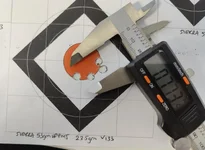
A couple of months later than I expected I finally went to the range and managed to confirm smooth and seamless operation from my handloads. I'm quite certain that the culprit was a unnecessarily grubby chamber. It was unbearably hot without cover at Bisley and i couldn't read too much in terms of accuracy (sans chrono) from the targets themselves, given the Howa sporter barrel (and me) was feeling the heat of 5 shot-strings of 50 rounds over the course of the afternoon. I'm well under the max charge in the Sierra manual and even middway through the set of loads I was getting sub-inch groups at 100 yards, as I still settle into my new-ish rifle and differences vs rimfire.

I'm doing this not to become a supreme F-class shooter, more so just because I like it and enjoy learning a new skill. Thanks again to everyone - I'll be trying out different heads and perhaps even chrono later in the year, and pushing this (and other calibers) out further distances.

Needless to say, my Lee Loader is firmly staying on the bench along with some additional case-prep/trim stuff. Surprisingly, this hasn't stopped me buying a Lee single-stage & dies and a hand primer...the rabbit hole deepens...

IMG20220810093854.webp


BRP
 
Your rounds may, of MANY times loaded, with full power loads have developed a "donut" (as the Americans call it). That is to say the brass has flowed up into the bottom of the case neck making it thicker. My advice is use your loader to assemble a round with neither power nor primer then use a candle to lampblack the neck and shoulder. Carefully chamber the round and see where the lampblack has been removed.
 
Shell holder! I had the same problem with a 708, tight bolt on loaded rounds, v tight on fired; i was using hornady dies but a lee shellholder.
The shell holder was bottoming the die so nothing more there so i concluded it was the rifle which had recently been rechambered (another story)
The smith took the rifle back and showed me everything was in tolerance and told me to buy some new dies.
Completely incidently someone told me to try a new shell holder, i got a hornady one.
The lee die was junk and not forcing the case into the die far enough even though it was hard against the die.
For the cost of a new shell holder it seems the cheapest place to start! 👍
 
To measure the point at the bottom of the neck where it flares out into the shoulder I put a 6.5 or .270 case upside down over the neck of .224 brass then measure with calipers which gets kinda 4 inches long. Compare this to a new factory round measured in the same way that fits well in your rifle, this is how I discovered that my dies were not bumping the shoulder back far enough on full contact with the shellholder. In the end I took 15 thou off of the bottom of the die (RCBS 7.65x53 Argentine dies). I now check all my cases using a pistol case of a suitable diameter to just slip over the necks, Use wikipedia to get the info as to which pistol onease would work. Surprisingly accurate.
 
Hello forum and potentially kind people that responded to my plea for guidance in this thread - I wanted to say a big (belated) thank you!

A couple of months later than I expected I finally went to the range and managed to confirm smooth and seamless operation from my handloads. I'm quite certain that the culprit was a unnecessarily grubby chamber. It was unbearably hot without cover at Bisley and i couldn't read too much in terms of accuracy (sans chrono) from the targets themselves, given the Howa sporter barrel (and me) was feeling the heat of 5 shot-strings of 50 rounds over the course of the afternoon. I'm well under the max charge in the Sierra manual and even middway through the set of loads I was getting sub-inch groups at 100 yards, as I still settle into my new-ish rifle and differences vs rimfire.

I'm doing this not to become a supreme F-class shooter, more so just because I like it and enjoy learning a new skill. Thanks again to everyone - I'll be trying out different heads and perhaps even chrono later in the year, and pushing this (and other calibers) out further distances.

Needless to say, my Lee Loader is firmly staying on the bench along with some additional case-prep/trim stuff. Surprisingly, this hasn't stopped me buying a Lee single-stage & dies and a hand primer...the rabbit hole deepens...

View attachment 268371


BRP
Keep the Lee Loader close by, with fire formed brass they can produce very consistent ammunition with very little effort.
If I found a Zero tolerance one in one of my chamberings I would probably buy it...
 
Back
Top