Neck tension - A different view

I would suggest that as with all aspects of reloading, we try to create a consistency of each part of the case on every step we do.
There are steps not required if shooting deer etc, but if chasing the 0.1's on paper, then you go to the next level of consistency.

Neck tension is an easy one to achieve, and again if typical stalking distances are considered, it not something to be overly concerned about. Inevitably your rifle will still shoot 1" groups, whish at even 250 yards is still within your 4" area.
 
I use RCBS dies, the standard full length with expander ball type.
I could feel I had different neck tensions (when seating) and noticed that sometimes I had an unusual vertical spread.
I think it was a thread on here that made me think about it and it becomes apparent that a tighter neck will give a different harmonic 'kick' to the barrel and that the MV will be different.
A consistent tension should give me consistent pressure's/speeds etc (I reasoned).
I bought a LEE crimp die and evey round is put through it.
I don't have that 3" vertical spread anymore, now the bullets are more randomly distributed around the PoA :rolleyes:
 
Neck tension isnt just a function of pre seating internal neck diameter.
It is a function of the elasticity of the material and the whether the neck thickness is uniform all the way round and/or central to the bore.

Your expander ball is doing the same job as the bullet itself when seating!
Expanding the neck to the nominal diameter.
The only difference is that you may be adding some concentricity and standardisation of ID with the die that you cant get by stuffing an unsupported bullet in.

Work hardened brass of differing elasticity constants will produce differing results on neck tension and accuracy.

Annealling is by far the best way to ensure the elasticity of your brass is constant.

Watch the AMP videos of the bench rest shooters annealing every firing
 
Neck tension isnt just a function of pre seating internal neck diameter.
It is a function of the elasticity of the material and the whether the neck thickness is uniform all the way round and/or central to the bore.

Your expander ball is doing the same job as the bullet itself when seating!
Expanding the neck to the nominal diameter.
The only difference is that you may be adding some concentricity and standardisation of ID with the die that you cant get by stuffing an unsupported bullet in.

Work hardened brass of differing elasticity constants will produce differing results on neck tension and accuracy.

Annealling is by far the best way to ensure the elasticity of your brass is constant.

Watch the AMP videos of the bench rest shooters annealing every firing
What you‘re saying sounds very logical and I have tried all of it, except annealing.

However my experience is exactly the opposite.
I have omitted the expander and only sized via fitting bushings. Bullet seating was done with a Redding Competition die, best there is in my eyes as it supports the case during seating and the seating stem is also fully guided and supported.. The results were very noticeably worse (on target) than doing exactly the same but with the expander installed.

Brass on its 8th and more reloading(s) which had never been annealed and on which you could feel the work hardening during sizing and bullet seating (less elasticity) rendered top results, repeatedly over many lots of cases and in various calibres.

Above experience and what I have seen as described in the opening post leads me to believe that low neck tension levels are considerably more forgiving with regard to moderate variances than higher levels.
 
What you‘re saying sounds very logical and I have tried all of it, except annealing.

However my experience is exactly the opposite.
I have omitted the expander and only sized via fitting bushings. Bullet seating was done with a Redding Competition die, best there is in my eyes as it supports the case during seating and the seating stem is also fully guided and supported.. The results were very noticeably worse (on target) than doing exactly the same but with the expander installed.

Brass on its 8th and more reloading(s) which had never been annealed and on which you could feel the work hardening during sizing and bullet seating (less elasticity) rendered top results, repeatedly over many lots of cases and in various calibres.

Above experience and what I have seen as described in the opening post leads me to believe that low neck tension levels are considerably more forgiving with regard to moderate variances than higher levels.
That follows
When you run a bushing die without the expander you are “outside” neck sizing.
The variance in the neck thickeness of unturned brass creates multiple different internal dimensions both in overall size and also its concentricity. Thicker neck on one side than other.

Agree on low neck tension being less significant than wider variance in higher neck tension …to a degree
Run rock hard necks with no tension and the results can be terrible
Often due to lack of obturation and gas seeping past the neck

When I went full nerd i :
Deprimed on universal die (no sizing)
Annealled.
sized with bushing die (no pin of any kind)
Expanded using a mandrel
Outside neck turned to knock the high spots off the neck thickness and standardise them
Trim and deburr

Pain in the ass to do but I felt I had followed all logical steps to get me the most uniform neck size, concentricity and tension

Results on paper were good but if I am completely honest I didnt do any comparison testing against a non nerd batch!!
 
That follows
When you run a bushing die without the expander you are “outside” neck sizing.
The variance in the neck thickeness of unturned brass creates multiple different internal dimensions both in overall size and also its concentricity. Thicker neck on one side than other.
This was related to your previous statement that the bullet would do the same job as the expander. I was thinking the same but was proven wrong as you now also conclude.
 
Did you chamfer your case necks?

Not enough neck tension causes ignition issues.

US DoD spent a lot of time and money researching and developing ammunition for their sniper rifle systems. Their findings were that a slight crimp was beneficial across the board.
DoD and most ammunition makers. The real benefit to neck tension -whether it be a tight neck, a mechanical crimp, or a chemical crimp- is that it establishes the burn rate for that particular cartridge. All things being otherwise equal, a uniform neck tension (pull weight) on a LOT of cartridges will make for uniform performance. Not necessarily more accurate, but more uniform in a ballistic sense. ~Muir
 
I agree with most of the above ..
I've found that with standard dies , do your normal case preparation and sizing.
When you seat your bullet...you will fee if l a bullet is Soft , Normal or Tight to seat.
You can measure the difference in COL with calipers.
Then group accordingly...shoot to check differences.
Polishing the expanded can ease things too.
I'd bear in mind that Lapua brass is normally thicker at the neck than other brass too.
 
That follows
When you run a bushing die without the expander you are “outside” neck sizing.
The variance in the neck thickeness of unturned brass creates multiple different internal dimensions both in overall size and also its concentricity. Thicker neck on one side than other.

Agree on low neck tension being less significant than wider variance in higher neck tension …to a degree
Run rock hard necks with no tension and the results can be terrible
Often due to lack of obturation and gas seeping past the neck

When I went full nerd i :
Deprimed on universal die (no sizing)
Annealled.
sized with bushing die (no pin of any kind)
Expanded using a mandrel
Outside neck turned to knock the high spots off the neck thickness and standardise them
Trim and deburr

Pain in the ass to do but I felt I had followed all logical steps to get me the most uniform neck size, concentricity and tension

Results on paper were good but if I am completely honest I didnt do any comparison testing against a non nerd batch!!

I completely agree with @Edinburgh Rifles If we are looking for consistency in neck tension on brass that is going to be loaded multiple times we should be looking at annealing the brass.

It’s all good and well staying what the DoD do when manufacturing rounds but they aren’t reloading the brass.

We are looking for uniform neck tension which in most reloading techniques is determined by the expander ball in the sizing die stem pushing the resized neck back. So in reality neck tension isn’t determined by the size of the hole in the die. But when you have outside neck turned the brass won’t be squashed as much and you have to factor in spring back. So bushing dies are really a must even if only skimming high spots.

Personally a standard set of dies and lapua brass does me just fine. But if you have a troublesome rifle crimping sounds like a great way of ensuring consistent tension as well.
 
There are tools that measure the Newtons required to push things into a fixture, the tools head is like a DTI gauge/gage but the needle will stay at the highest pressure recorded when the pressure is removed.
So who wants to be the first in the world develop a tool that can measure the pressure required to seat the bullet that would need to be incorporated into the seating die threaded insert? Then you have the readout data for neck tension sorted. It must be doable.
My career was mainly hearing from others of a problem then figuring out how to solve it in a cost efficient way.
I often wondered if the shoulder angle is say 40 degrees Saami then is fired in a Saami correct chamber then put into a Saami correct resizing die and squeezed down to Saami dimensions, then the expander pin pulls up through the neck thereby changing the shoulder angle a smidgeon (maybe)?
 
Last edited:
I agree with most of the above ..
I've found that with standard dies , do your normal case preparation and sizing.
When you seat your bullet...you will fee if l a bullet is Soft , Normal or Tight to seat.
You can measure the difference in COL with calipers.
Then group accordingly...shoot to check differences.
Polishing the expanded can ease things too.
I'd bear in mind that Lapua brass is normally thicker at the neck than other brass too.

Neck tension shouldn’t be affecting Cartridge overall length.
 
There are tools that measure the Newtons required to push things into a fixture, the tools head is like a DTI gauge/gage but the needle will stay at the highest pressure recorded when the pressure is removed.
So who wants to be the first in the world develop a tool that can measure the pressure required to seat the bullet that would need to be incorporated into the seating die threaded insert? Then you have the readout data for neck tension sorted. It must be doable.
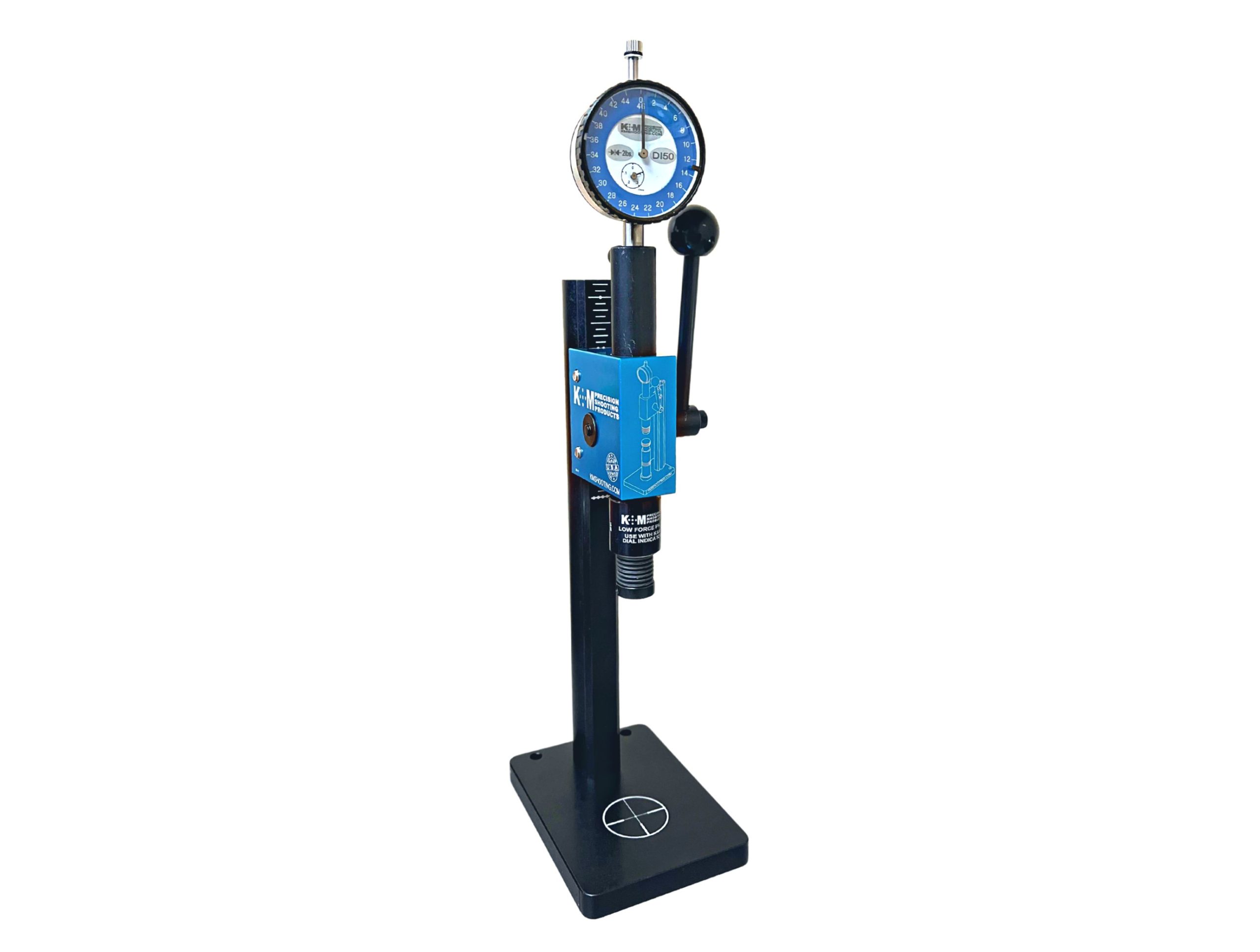
Has that not already been done with the 'force indicator' kit on the K&M Arbor press?

I've got one for seating bullets into my .20Prac and although the basic dial indicator doesn't stop at the highest pressure point, the force required is pretty much consistent bullet to bullet... I anneal my cases every time, probably unnecessary but hey, that's what I do.

Or there's this from Dogtra....

Cheers

Fizz
 
Has that not already been done with the 'force indicator' kit on the K&M Arbor press?

I've got one for seating bullets into my .20Prac and although the basic dial indicator doesn't stop at the highest pressure point, the force required is pretty much consistent bullet to bullet... I anneal my cases every time, probably unnecessary but hey, that's what I do.

Or there's this from Dogtra....

Cheers

Fizz
I did not know about that tool but having one for normal in press dies would be on my wish list, not for benchrest type tooling.
 
Neck tension shouldn’t be affecting Cartridge overall length.
From 30 years of reloading , using standard dies through to competition bushing dies and a multitude of calibres and brass.
I neck turn to eliminate this.
I've personally found that neck tension can change COL.
Using the same force to seat the bullet in different neck tensions will change COL.
Albeit only a few thou.
Try it and see yourself.
 
I did not know about that tool but having one for normal in press dies would be on my wish list, not for benchrest type tooling.
In talking with guys that use these...they're nice, but not that helpful. Especially if your using a neck expanding mandrel.

I suspect when factory cases are formed, that before the final trim, and in the last drawing process, that's exactly what they do; expand the neck with a mandrel. I suspect this, because after working the last few months for a brass processor, we have found the most consistent way to make the brass uniform (neck tension wise) is the size the case without an expander ball, and then size the neck with a mandrel in the next station. This is done also, because when you're running 1500-3000 cases an hour, if FL sizing and neck sizing are done in the same step, it wears on the tooling more than if you do it in separate steps. Less heat/friction in each stage as well.

Again, I don't know this empirically (haven't seen it first hand in a factory), but for what I have been doing lately (processing brass in volume, at fairly high speeds), it just works better. Plus, mandrels can be easily replaced as they wear out, without having to replace the FL sizing die.

JMTCW...
 
Back
Top