Prices of pups abroad and at home

The differences in tests are as I stated down to the traditional use of the dog.
There are positives and minuses within both clubs tests.
Verein Hirschmann-doing a Natural track on an unwounded animal for the tracking part of test......before firearms,HS were used to find the animals for the other hounds/hunters on horseback so they were used just to find the unwounded game,thus the name “leithund” or lead hound.
With firearms their job has evolved.
Within the Verein Hirschmann there are 3 ways to test tracking.
1.The natural track as explained-an unwounded animal is watched in the morning or evening and the track is noted.
The track is then followed by the team.
Personally,I don’t like this method but it’s the traditional Jagerhof method.
2.A live animal,normally a boar,sometimes a mouflon is led by the leash and track is marked then aged,then followed.
3.Scent shoe track,24 hours old over a kilometre.

As I have stated I have favourites for testing purposes.The scent shoe gives you the better reading of a team as you 100% know the dog is on/off the track.
The natural track can lead to confusion sometimes.
 
The KBGS tradition within the test is that the dog has to protect the carcass at the end of a track.
Protection of the carcass I don’t like and is all about tradition.
However,99% of Teams don’t care about getting an 8 in this part of test.
8 being highest mark,although 9 is available a 9 is only given when the dog should have failed and it excelled.....so 9’s are rarely given.
The track is always conducted in the KBGS with scent shoe-slight differences from Verein Hirschmann scent shoe as well in that the KBGS use blood,the VH never use blood,unless for verweisen(indication purposes).....
At the end of the KBGS track there will be a dead animal-boar or red.
The dog is laid down within chewing distance of the carcass-if the dog has a chew-fail the test.
The dog must sit next to the carcass for 10 minutes,no chewing.
A judge will then approach and the dog must protect the carcass by growling and showing its teeth with a bark as well=8 points,especially if it’s a bit aggressive but controlled-eg the dog doesn’t bite but in no uncertain terms tells the “poacher” it’s the dogs carcass.......
This is pure tradition,in the mountains where BGS originate from,the forester would shoot an animal and leave the dog to protect the carcass from people who heard the rifle shot and then went looking for the carcass whilst Mr forester went looking for the game cart.
So pure tradition that is not required nowadays.
The Verein Hirschmann took in Social tests of dogs so instead of growling,snarling dogs we have nice dogs towards people and other dogs.
To be fair,99% of this part of the test is marked as a 4,as long as the dog doesn’t back off and shows no fear the dog will pass the test.
This part is not considered for breeding purposes.
 
I hadn't realised you were adding new bloodlines. I thought it was closed within the club. It makes perfect sense that bloodlines from outside the ISHV can be added provided that they are of sufficient quality, both genetically and also the conformation/ability of the actual dogs. Previously it had read like it was a closed gene pool.
Not adding as outwith the ISHV but making new bloodlines from different countries that all work the same way.
 
Last edited:
Must admit it does seem a decent set up.
Esp now as I like others thought it was a closed shop for breeding.

Wot is the inbreeding co efficient of ur average IsHv hound?
And is there a top limit to the ammount of times even a top dog can sire?

That's half the problem in UK to few dogs used as studs, don't get my wrong some very good healthy dogs used but when there during literally hundreds of litters a year is it really healthy for the breeds genetics on the whole?

Also was there not an early imported IsHv hound that had health problems and died young? ( Possibly not genetic, only vaguely mind it)
It is the best set up there is.
Inbreeding coefficient is always less than 1%.
So very low,this is why the ISHV was formed in the first place.
A dog is only bred once normally,no popular dog syndrome allowed.
If a line comes down with anything it is removed,on the other hand,this can lead to loss of genetic diversity,it is a fine balancing act.
100% correct,the lines become too top heavy in the UK.
Think about this......

People are saying we are breeding from a closed gene pool.
We have access to 13 different countries with the best dogs for breeding in regard to work performance,health and conformation to breed standard.
Over 300 stud dogs to choose from for HS.
Double that for BGS.
Now please consider how many are in the UK from unrecognised sources and we include unrecognised dogs as dogs that are recognised by our UK Kennel club,so that includes any dogs that have papers unrecognised by the ISHV......this includes dogs from the FCI only.
So please answer me.....

Who has the smaller gene pool ?
People in the UK who are breeding with no knowledge of these breeds or the clubs with over 100 years of experience ?

The ISHV does things correctly and seriously with these dogs.
NO ISHV HOLOGRAM=RUSSIAN ROULLETTE.

THERE HAS BEEN NO ISHV HOUND WITH HEALTH PROBLEMS IMPORTED INTO UK.

I do know of plenty of issues with dogs bred from UK dogs and also know of dogs having to be put down under 4 years old from FCI lines,none from ISHV lines.
 
Last edited:
Thanks for the information really good post and very informative. When I finally get round to buying one I may drop you a line for some advice.
You will not get a Verein Hirschmann dog.
There is only one way people in the UK can get one.
You need to be a member of UKSHA.Thats the only way.This is fact.
 
Just one thing to add when watching the Verein Hirschmann video that the pendelsau part is used for the purpose of testing after the dog has been fully trained, it’s purpose is to see how the dog will react to game after being used in a saugatter.
If you listen it’s not used constantly, it’s for reaction, and importantly to show the dog your there, the release
Of the dog is the point it looks back for help then you go forward to support the dog.
If you use this method for training it becomes a game and will end in a dog getting hurt in a real situation.
It’s an assessment of the dog not a training tool, there were videos some time back of people using this method for young dogs not ready and this can ruin the dog, or get it hurt.
People often say how do you know the dogs will work a single animal or do what it’s supposed to do but with the training in stages then working a saugatter and testing shows what will be, putting a dog in harms way before it’s ready on a real wounded animal will not be good.
We in the uksha are lucky to be able to work in a saugatter in the latter stages for us to see reactions and how we need to work on areas or if they are truly ready and this with the testing I believe is important, the final outcome when you release the dog is knowing your dog can hold/bay and control a situation for a swift end of that animal or be able to bay till you can dispatch, no point in release if the dog cannot do this as you then creat more suffering, regards Wayne
 
So roughly how many IsHv dogs/bitches are there in total in the breeding program for the 2 breeds?

Did 1 of the early HS not die quite young, I thought it was owned by a regular poster on here in the past and thought it came from the right lines?
 
Each country has different numbers of dogs available for breeding but there are plenty from completely different lines.
No,none of the early HS that have came in from ISHV lines have died.
i will re-iterate again-no ISHV dog-BGS or HS has had ANY issues with health at all.
There was a dog that came in via FCI lines that died before it was 4.
Non-ISHV lines,on the papers of that particular dog it stated......the requirements for the parents have not been met to be bred from......or words to that effect.
It was bought by a regular poster on here but not from ISHV lines.
No ISHV stamp on papers.(Was a stamp that was used at that time,now it’s a hologram)
All the best
George
 
It is the best set up there is.
Inbreeding coefficient is always less than 1%.


Firstly, thanks for all the information, very interesting and, as I have always said, the dedication is without question and hugely admirable.

How many generations is that Inbreeding Coefficient based on? It is a very strict limit. What is the rationale of having a 1% limit? It seems to go against the grain of trying to produce predictable litters.
 
The papers have 4 generations in them if memory serves correctly.
The coefficient is around a 1%,sometimes slightly over,very very rare for a mating to be over 1.5%
Most often it is below the 1% mark.
The predictability of litters comes with the detail that the dogs have on their papers.
Not just in Germany either.
It is across the board in the ISHV.
You have a lot of detail on every dog within the papers......every dog.
Colour,height,mask,test results,conformation results,what scores the tests were,what barking scores the dogs have,whether the dogs have good scores in chasing and baying......
All the detail is there for the Breedmasters to look at and 9/10 the dogs will have been seen working by the judges giving them these marks.
So the predictability is there.
The predictability of epilepsy Is even within the papers.
It is very interesting and it is a science.
An exact science when a gene pool is small but expanding.
That’s why I said Keith in the beginning of this thread that people here in the UK have no clue with what they are doing in regard to breeding these dogs.
This all backs up that statement as well as people here play at it and the dogs are suffering as a result.
As the 1st Chairman of the ISHV stated to the 1st Chairman of the BMHS of GB in the letter in response to them.
We will look after the Bayerischer Gebirgsschweißhund and you can look after the Bavarian Mountain Hound.
In effect,2 different dogs.One of those reasons is health.
All the best
George
 
The papers have 4 generations in them if memory serves correctly.
The coefficient is around a 1%,sometimes slightly over,very very rare for a mating to be over 1.5%
Most often it is below the 1% mark.
The predictability of litters comes with the detail that the dogs have on their papers.
Not just in Germany either.
It is across the board in the ISHV.
You have a lot of detail on every dog within the papers......every dog.
Colour,height,mask,test results,conformation results,what scores the tests were,what barking scores the dogs have,whether the dogs have good scores in chasing and baying......
All the detail is there for the Breedmasters to look at and 9/10 the dogs will have been seen working by the judges giving them these marks.
So the predictability is there.
The predictability of epilepsy Is even within the papers.
It is very interesting and it is a science.
An exact science when a gene pool is small but expanding.
That’s why I said Keith in the beginning of this thread that people here in the UK have no clue with what they are doing in regard to breeding these dogs.
This all backs up that statement as well as people here play at it and the dogs are suffering as a result.
As the 1st Chairman of the ISHV stated to the 1st Chairman of the BMHS of GB in the letter in response to them.
We will look after the Bayerischer Gebirgsschweißhund and you can look after the Bavarian Mountain Hound.
In effect,2 different dogs.One of those reasons is health.
All the best
George


It would be interesting to know the inbreeding coefficient over more generations. I've known unions of other breeds that come out very low over four and then rocket when you go further back. Personally, I have nothing against line/close breeding as long as you not doubling up on known faults and are doubling up on all of the correct attributes. The Plummer Terrier clubs base their inbreeding coefficient on ten generations and often come out at 15% plus sometimes over 20% but wind that down to four generations and it drops to normally accepted levels of below 5%.

The attention to detail of the ISHV is superb and how it should be. It is clear to see how the two separate variations of the breed are forming. I will always find it sad that top genes cannot be shared for the good of entire breeds and the same said for the knowledge.
 
Keith it’s not sad at all, the Uk breeders have screwed up the Bmh here so why add good stock to people that would only exploit them for more money, they are now cross breeding them with poodles ffs, the ishv take great care to preserve the correct lines with the people that put back to caring for the breeds full stop, once the Hs gets recognised it will be fubar within less time than the Bavarian, the ishv/ Verein/ KBGS are strict for a reason, the damage that’s been done here will never be undone only get worse, oh and by the way my thoughts are why put good to s-h-I-t all you do is ruin the good that’s not doing anything for a breed but add to the problem regards Wayne
 
Last edited:
The ISHV will not dilute lines with lines (unknown,untested)that will mean playing Russian roulette with our breeds.
The gene pool within the ISHV will expand but only in the correct way with the correct dogs.
There are reasons the BMHS of GB and other organisations are not recognised by the Breed societies that matter and there are reasons why UKSHA are.
That reasons are that we abide by rules and science that have worked for both breeds for over 100 years.
Why would you add something completely unknown into that ?
You dont.
Best way to ruin something is to do exactly that.Introducing lines that are not of the same or better quality is the best way to ruin lines.
Exactly the way the UK KC have ruined numerous breeds.
The damage that has been done with these breeds will continue and get worse.
The horse has bolted and the HS will be next.
What we will continue to attempt to do is protect both breeds and attempt to ensure the heritage and tradition of both HS and BGS.
As stated earlier in this thread.
We will continue to look after the original dogs and others can please themselves with whatever they want to do with whichever dog they want.
Quality always shows through.
No different with your teckels Keith.
All the best
George
 
Last edited:
The ISHV will not dilute lines with lines (unknown,untested)that will mean playing Russian roulette with our breeds.
The gene pool within the ISHV will expand but only in the correct way with the correct dogs.
There are reasons the BMHS of GB and other organisations are not recognised by the Breed societies that matter and there are reasons why UKSHA are.
That reasons are that we abide by rules and science that have worked for both breeds for over 100 years.
Why would you add something completely unknown into that ?
You dont.
Best way to ruin something is to do exactly that.Introducing lines that are not of the same or better quality is the best way to ruin lines.
Exactly the way the UK KC have ruined numerous breeds.
The damage that has been done with these breeds will continue and get worse.
The horse has bolted and the HS will be next.
What we will continue to attempt to do is protect both breeds and attempt to ensure the heritage and tradition of both HS and BGS.
As stated earlier in this thread.
We will continue to look after the original dogs and others can please themselves with whatever they want to do with whichever dog they want.
Quality always shows through.
No different with your teckels Keith.
All the best
George

You see we are back at my sticking point...I am not referring to uknown or untested lines, I am not referring to Sh1t quality. I am referring to physically sound, capable hounds that have proven their ability but just don't sit within ISHV control. It is now my understanding that top quality dogs currently not within the ISHV register can gain entry once proven? That makes perfect sense. So it must be the case that quality specimens do indeed sit outside of the ISHV otherwise it would be a closed gene pool.

With respect, it is not the same with teckels. There is not an overarching umbrella organisation that is seen as the zenith of the dachshund world. The DTK is respected but there certainly isn't a global opinion that the best dachshunds are registered with the DTK. There are some truly excellent German breeders who not only want to achieve the minimum 'good' result in conformation but strive for National and International show champion status and combine this with exam passes in tracking exams, water retrieving, wild boar pen, earth dog - both natural and artificial, steady to shot and obedience tests.

However, this dedication is not limited to Germany but is apparent across the globe. French, Dutch, Nordic, Italian, Austrian, Polish, Hungarian, the list goes on, top quality breeders producing International show and international work champions. Many top drawer, well established German kennels are more than happy to use blood from around the globe and regularly do. They may see a conformation need within their line to address and outsource blood to improve this. Or they may see a working attribute (willingness to naturally go to ground or strong voice on trail) and again outsource blood to improve that. In recent times the best German kennels have outsourced bloodlines to make improvements or maintain quality.

To your point George "Introducing lines that are not of the same or better quality is the best way to ruin lines" you have hit the nail on the head, if you are introducing 'better' quality as you suggest - you can only introduce 'better' to 'inferior' otherwise it would not be 'better' would it. This is the basics of stock breeding, striving to continually improve.

As said continually, I have the utmost respect for the work that UKSHA and ISHV do to maintain/improve quality. I just have a natural desire to continue to ask questions if I do not completely understand something, probably from my autistic tendencies or perhaps it goes back to my punk background of always questioning authority :) Personally I think it makes for good debate and that's what forums are here for.
 
This is what you’re not understanding Keith.
The ISHV dogs are dogs that are ISHV dogs,not just German dogs.
Dogs that meet the required standards from Germany,Austria,Switzerland,Hungary,France,Italy,Belgium,UK,Poland,Slovakia,Slovenia,Czech Republic,Norway and Sweden.
These dogs are all ISHV Quality before being bred.
Dogs which are not ISHV cannot be made ISHV.
Every country within the ISHV mates with dogs from the other countries.
No AI is allowed.
No problem asking questions at all Keith,if we can help you understand we will.
All the best
George
Punk background-LMAO......too much glue back in the day perhaps?
 
Dogs which are not ISHV cannot be made ISHV.

This is it George, this is the question. Are you stating that an A1 top notch, superb conformation, top grade worker passing all the equivalent tests cannot become registered with the ISHV? Are you also saying that the only dogs that can be registered are those from ISHV parents. If yes to both ........That sounds like a closed gene pool.
 
There's a guy local to me who is selling BMH pups. £900 a pop. In the BMH club and advertised on their website. Still too much for me, so will keep looking.
 
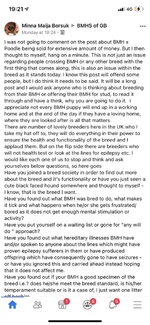
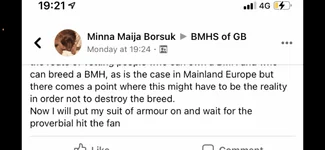
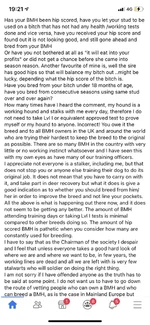
Please read the attached screenshots I have received from a member of the BMHS of GB society.
This is from the Chairwoman of the society.She is correct as well.
The light seems to have finally switched on as we have been saying this all the way from the start.
The problem the BMHS of GB have is that they have already done the damage to their breed here in the UK.
Meanwhile,we will continue doing what we are doing.
All the best
George
 

Attachments

  • 7074B1FA-8F25-4861-A3AB-1C7A09B064F6.webp
    7074B1FA-8F25-4861-A3AB-1C7A09B064F6.webp
    196.4 KB · Views: 31
  • E2AA1573-AA5B-46D0-BFCC-4945CC8CE5C4.webp
    E2AA1573-AA5B-46D0-BFCC-4945CC8CE5C4.webp
    180.6 KB · Views: 32
  • D2B5011E-9C90-4872-BDCF-BA0780582CCB.webp
    D2B5011E-9C90-4872-BDCF-BA0780582CCB.webp
    51.4 KB · Views: 28
Please read the attached screenshots I have received from a member of the BMHS of GB society.
This is from the Chairwoman of the society.She is correct as well.
The light seems to have finally switched on as we have been saying this all the way from the start.
The problem the BMHS of GB have is that they have already done the damage to their breed here in the UK.
Meanwhile,we will continue doing what we are doing.
All the best
George

The points made in the posts are rather concerning. The fact that there are many in the UK with little or no working instinct is shocking - that doesn't happen in one or two generations - that is a result over time. Perhaps buyer/importers haven't paid attention or even understood the exam passes on pedigrees. That does sound a bit of a mess.
 
Back
Top