
Resizing as last step undoes benefits of annealing?

zambezi

Well-Known Member
Reece on the Range posted an interesting series of tests in which he measured case hardness after greater or lesser periods of annealing.

But the truly interesting measurement he made was that if you resize at the end of your case prep sequence, that work hardening takes the case back to or beyond its pre-annealed hardness.

I have usually completed case prep in the following order: de-prime, anneal, ultrasound, fan-dry, re-size, trim.

My ammunition in all calibers for which I load is accurate, so no reason to alter method on that account. But perhaps the case-longevity benefit of annealing is void if it is not the last process? Anyone have a view on this?
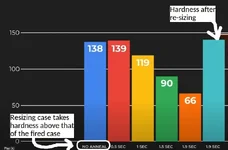


Sizing_after_annealing_restores_hardness.webp
 
Interesting that the case, after resizing, was back up to the start point. I always thjought it was the sudden expansion that hardened it not so much a gentle shove up a die.
What about 'new' brass too (I don't mean new as in not fired or only fired once, but brass made in 2000 v brass made in 2020) - I guess that's mute as it all gets used/changed out after a 4 or 5 years max.

From the results above it looks like we could/should anneal lower down the case as the case body does 'work' when fired, if it didn't it wouldn't fit in the chamber at all.

@mealiejimmy has a hardness tester ..... ??? 😎
 
The basic issue is annealing allows a return to malleability and thus easier resize, less spring back. Worry about the hardness of the brass after resize is pure folly. What is to gain if you anneal after resize?
 
It would have been interesting if he had tested resizing without annealing and the hardness of the case neck then?
 
Miki,
What are you linking to?

Morning Bruce
I was refering to the OP's video where the presenter showed that annealing was effectively cancelled out after a single resizing operation.
I wondered if there was merit in less frequently (home) annealing further down the case as this would allow the brass to 'flow' better in both the resizing and firing stages.
Would brass benefit from a single (1 time) annealing to achieve a better case/chamber seal ?

Does brass get more and more brittle as it's worked or does it only go so far and then (because it's brass) reaches a state of hardness over which it never steps ?

Can you test a (several times) fired case and then anneal it to within 10mm of its head, test again, resize, fire and test again well into the body ?
Is it worth it ?
Am I talking pish (again) ?
 
Last edited:
The basic issue is annealing allows a return to malleability and thus easier resize, less spring back. Worry about the hardness of the brass after resize is pure folly. What is to gain if you anneal after resize?
If you look at videos of cartridge case manufacture, annealing is the final step in the process, happening after the final dimensions of the case have been achieved.
Buy new Lapua brass and the colour change from the annealing process is easily visible - I don't think it would be as visible (if at all) if the cases were re-sized after annealing
I've re-sized fired Lapua brass before and after annealing and haven't noticed any significant difference in the accuracy of the ammunition manufactured from those cases

Cheers

Bruce
 
In the world of precision (i'm not) I can see why neck tension is important.
When the powder deflagrates the pressure buildup moves the bullet out of the neck and into the lands and it pushes it up the barrel.
That initial build up of pressure takes a moment as does the jump and the consequent rise again as the bullet accellerates.

I can visualise a hill with a sharp rise, followed by a dip and then a speed hump and the gradient gently rising up a tapering slope until it get over the brow and drops like a lead balloon.
That intial rise, humps and dips create a shockwave which flexes the barrel.
If that flex was consistent then the shooter could regulate it so that the barrel was pointing at the target when the bullet exited.
If the resonant wave forces the barrel to be 'up' when the bullet exits then seating deeper (increasing the jump) will time that movement to match the exit moment.
He/She/They could compensate for this energy reflection and would then only have the atmospheric conditions between the barrel and the target to worry about ('only' haha).

Annealing allows you to maintain an equal clamping force on the bullet helping to get that nirvana of consistency.
It also allows the brass to lose it's 'memory'/hardness so that it can be resized fitting a set of standards that your chamber has also been machined to meet.

Should I anneal the case down towards the head occasionally (say 1:20) to keep the brass flexibe ?
Can this be measured with your measuring tool @Bruce ?
How hard is a new case (in the body) and is it any harder after a number of firings/resizing cycles ?
 
Annealing has become a sub culture of reloading.
I anneal after cleaning and before every loading. This annealing allows me to actually get the case back into the form I want. I guess I could anneal it again afterwards but I can't see the point. My brass remains ductile enough to give uniform neck tension and the process begins again at the next loading.
I have no plans on changing what works.

And for what it's worth, I hope that little sample of cases wasn't his entire data collection source.~Muir
 
In the world of precision (i'm not) I can see why neck tension is important.
When the powder deflagrates the pressure buildup moves the bullet out of the neck and into the lands and it pushes it up the barrel.
That initial build up of pressure takes a moment as does the jump and the consequent rise again as the bullet accellerates.

I can visualise a hill with a sharp rise, followed by a dip and then a speed hump and the gradient gently rising up a tapering slope until it get over the brow and drops like a lead balloon.
That intial rise, humps and dips create a shockwave which flexes the barrel.
If that flex was consistent then the shooter could regulate it so that the barrel was pointing at the target when the bullet exited.
If the resonant wave forces the barrel to be 'up' when the bullet exits then seating deeper (increasing the jump) will time that movement to match the exit moment.
He/She/They could compensate for this energy reflection and would then only have the atmospheric conditions between the barrel and the target to worry about ('only' haha).

Annealing allows you to maintain an equal clamping force on the bullet helping to get that nirvana of consistency.
It also allows the brass to lose it's 'memory'/hardness so that it can be resized fitting a set of standards that your chamber has also been machined to meet.

Should I anneal the case down towards the head occasionally (say 1:20) to keep the brass flexibe ?
Can this be measured with your measuring tool @Bruce ?
How hard is a new case (in the body) and is it any harder after a number of firings/resizing cycles ?
Miki,
My hardness tester can only measure the hardness at the neck of the case.
To measure the hardness further down the body would need to case to be cut open, so it then becomes a destructive test rather than a non destructive test

Cheers

Bruce
 
I hope that little sample of cases wasn't his entire data collection source.

Sample looked small, so hardly definitive. But...assuming the hardness tester was accurate, then the scale of the hardening at the neck imposed by sizing is significant.

I.e. this does not seem a statistically large batch, but sizing was measured to reverse the softening that annealing is intended to confer.

Setting aside accuracy or other reasons for adjusting your reloading regime... if case life is extended by having annealed brass at point of firing...perhaps this should come last?
 
Sample looked small, so hardly definitive. But...assuming the hardness tester was accurate, then the scale of the hardening at the neck imposed by sizing is significant.

I.e. this does not seem a statistically large batch, but sizing was measured to reverse the softening that annealing is intended to confer.

Setting aside accuracy or other reasons for adjusting your reloading regime... if case life is extended by having annealed brass at point of firing...perhaps this should come last?
i doubt I'd see any difference in case life or performance. I think a lot depends on the composition of the brass and what the actual hardnesses mean in real world practical application. Are we splitting hairs? Like having a scale that meters to .02 grains when there is largely no difference in results with ten times that deviation; are we just playing with numbers? And coming up with a new religion in the process?? People seldom think new, once fired brass NEEDS annealing, right? It usually works fine. As the presenter alluded to, consistency is far better than a 'number" representing hardness. I agree. ~Muir
 
Annealing has become a sub culture of reloading.
I anneal after cleaning and before every loading. This annealing allows me to actually get the case back into the form I want. I guess I could anneal it again afterwards but I can't see the point. My brass remains ductile enough to give uniform neck tension and the process begins again at the next loading.
I have no plans on changing what works.

And for what it's worth, I hope that little sample of cases wasn't his entire data collection source.~Muir

A little off topic, do you clean re-sizing lube off the case? If so how?
 
I haven’t yet got into annealing, but I’m sure I will at some point. Can’t justify an AMP annealer though!

I’ve stopped FL resizing my 6.5 Creed Lapua brass and instead neck size with a Lee collet die.

It’s actually made things much simpler, no lube and I’m sure must increase the longevity of the brass. Groups have been decent with 140gr Sierras so I’m going to stick with it.

Of course I’ll have to FL resize at some point but perhaps that’s be the optimum combination when annealing?
 
I dont anneal cheap 308w, 6,5*55, 300blk cases I typically buys Norma factory training ammo , use them first for precission a couple of times then I downgrade them to mooserange training or plinking then toss them after about 8 reloadings. I do anneal my 12,7*44r brass it cost about 3,5£ a piece.
 
Back
Top