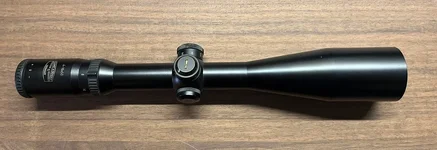
schmidt and bender disappointment

Phew, I made it right to the end. I still feel I dont know if expensive scopes are worth it. The rifle I expect to buy comes with a 4x so lets see how it goes.
 
It is getting the same amount of light, you are confusing this with magnifying the image.

But I'm not magnifying any image, at the minute I'm keeping it really simple and just building a garden wall. If one square inch of my wall has 3 units of light fall upon it and increasing the area does not increase the amount of light that falls upon the wall then this means that my 1000 square inch garden wall will also have 3 units of light fall upon it and so it will be very dim indeed. Nothing is being magnified, I'm just increasing the area of the object collecting the light.

However, while we are here, can you also explain how the light knows that only 3 units of light are allowed to fall on an object? I mean if you have a very large object, say the earth, how does the light know that as 3 units have already stuck it no more are allowed? On top of that if the 3 units are busy falling on my one square inch garden wall this is going to leave it pretty dark for everyone else. I looked out just before dinner time and it was dark, no wonder in view of the sudden changes in the laws of physics. If I don't get that one square inch garden wall knocked down pretty soon we are going to be in the dark for the rest of time.
 
These days there are a lot of scopes that are very close in low light conditions, and the gap between the bigger names and many other brands has well and truly closed.

My eyes tell me that my 6x42 Meopta is better than my S&B, but they also tell me that my Nikon Monarch is as well, and the Prostaff's aren't too far behind, in low light terms at least.

We are all different - a mate of mine swears that he can't see any benefit when peering through my scopes compared to his cheapie Hawke. That could be for other reasons or he might have squiffy eyesight.

I've not found a zoom scope that was as good as a fixed same size objective lens from the same manufacturer in low light.

Redfield are pretty decent overall IMHO.

For the record, I tested some of my scopes as the light failed recently and found a £250 Bushnell Legend Ultra HD left my Leupold VX2 and VX3 for dust in low light.

Leupold might have its brand name in its favour but, in pure low light performance, the much cheaper Bushnell Legend punched way above its weight. Loads of people wouldn't even look at one though, just because of the brand or country of origin.

Meh...

I think a lot of people overlook some serious performance bargains in favour of big brands on the assumption that they will always be better performers. Leupold in particular (just in my opinion of course) appears to be relying on a name made decades ago rather than producing scopes that drop any jaws, at east until you start spending thousands rather than hundreds.

Your mileage may vary - I hope you find a resolution.

Just put one of those on a rim fire; and side by side when dialled to the same magnification (6x) cannot for the life of me see the difference between that and the Duralyt on my .308; not for a moment saying that the Duralyt is not potentially better in other respects, only a shitty day in the hills, or various other scenarios would determine that, but thought provoking never the less! One is one third the price of the other, no prizes for guessing which way 'round!
 
Just put one of those on a rim fire; and side by side when dialled to the same magnification (6x) cannot for the life of me see the difference between that and the Duralyt on my .308; not for a moment saying that the Duralyt is not potentially better in other respects, only a shitty day in the hills, or various other scenarios would determine that, but thought provoking never the less! One is one third the price of the other, no prizes for guessing which way 'round!

I have literally just PM'd another member regarding that scope, on the basis of its outrageously good low light performance and its comparatively low asking price.

I would never claim that it is as good as certain other makes and models at all things but it is certainly better (or at least as good) at some things. When they were first introduced I seem to remember them winning awards for their low light performance. Mine is the side focus model and works brilliantly under the lamp and with NV.

Do you sacrifice a tiny bit of colour quality for superior low light performance ?

I can't answer for anyone else but all I am interested in is how well stuff works for me - that counts way more for what is written on the side of it.

Love my Leupold, Meopta and S&B but I openly admit that a much cheaper scope is at least as good as all of them and noticeably better than some in low light.

That probably just goes to show something...

I hear a lot of people mention resale value - that only factors into the argument if you intend selling. If not, would you rather lose X percentage of £1000 or any percentage of £250 ?

I'm just saying...

I'll get my coat.
 
Meh. It's a fair point to be honest. Chances are the leupold or whatever is better made and to finer tolerances, but optically, scopes are pretty simple and depend a lot on R&D and design as opposed to parts quality for their performance. Especially when you consider that a lot of the relatively high end bushnells have pretty good glass anyway and you don't see much difference most of the time. Thats not to say they are better, or even necessarily as good, but it is the law of diminishing returns. I could knock a tenth of a second of the laptime around stratsone in my car for £500, to do it in a ferrari would cost £10,000 and to do it in F1 it would cost millions. Besides, what do all these manufacturers spend on the production or sourcing of the lenses? £10? When you also factor in that the mark up for the top euro manufacturers is significantly higher, and that they don't benefit from the same economies of scale, that their employees will be more highly qualified and paid,plus the usually pretty awesome customer support and of course the time put in during manufacture, it's not surprising that there isn't usually much of a difference in image quality or low light performance despite the gulf in price. I would put money on the more expensive product lasting longer and being more durable though.
 
A larger objective lens does gather more light, however there is a limit to how much we can make use of it. What I think MARCBO was referring to was the amount of light reaching the eye.

In the 60's the Japanese introduced the 4x40 rifle scope. It was a marketing ploy that fooled many into thinking that a 4x40 scope would be brighter in low light than the common 4x32 USA scopes of the time.

At the end of the day or more correctly, at the setting of the sun, it's what our own individual eyes can see that counts. We can perceive optical characteristics differently from one another and therefore it's really a case of seeing for your self.
 
A larger objective lens does gather more light, however there is a limit to how much we can make use of it. What I think MARCBO was referring to was the amount of light reaching the eye.

In the 60's the Japanese introduced the 4x40 rifle scope. It was a marketing ploy that fooled many into thinking that a 4x40 scope would be brighter in low light than the common 4x32 USA scopes of the time.

At the end of the day or more correctly, at the setting of the sun, it's what our own individual eyes can see that counts. We can perceive optical characteristics differently from one another and therefore it's really a case of seeing for your self.

Precisely, The larger objective only increase the amount of magnification that can be used to deliver the same exit pupil. This will provide a perceived increase in light but is in reality just an increased magification with the same level of light transmission.

SS
 
Precisely, The larger objective only increase the amount of magnification that can be used to deliver the same exit pupil. This will provide a perceived increase in light but is in reality just an increased magification with the same level of light transmission.

Right, I see now. So no more light comes in the front end at all but the scope somehow manages to produce a brighter image of a smaller object?
 
I bought a Zeiss Duralyt scope (3-12x50IR) I thought the view through it was good but was expecting a little more based on what I had read...I am right handed and so look through my right eye when mounting the rifle.. Out of interest i mounted the rifle left handed and looked through my left eye... Jesus... what a difference! The view was excellent with a sharper image and brighter colours... I knew I had better vision from my left eye but didn't realise by how much.... I can alter the focus on the scope to get a pretty sharp image From my right eye but I am afraid my eye is the limiting factor with my scope.
 
Last edited:
Precisely, The larger objective only increase the amount of magnification that can be used to deliver the same exit pupil. This will provide a perceived increase in light but is in reality just an increased magification with the same level of light transmission.

SS

Of all the light that your eye receives a higher percentage will be of the target that you want to shoot if you use a larger objective and higher magnification....logic . Larger objective + higher mag means you see your target better, clearer and higher definition.....that's why they use large scopes to look at stars.
edi
 
Twilight factor versus exit pupil. Interesting subject and being a mathematical calculation dependent to a large degree on the quality of the optics in question.
 
Twilight factor versus exit pupil. Interesting subject and being a mathematical calculation dependent to a large degree on the quality of the optics in question.

The twilight factor and exit pupil are both simple maths and do not take into account the quality of the optics. In fact twilight factor is a "made up" measure of performance used by marketing departments when it suits them whereas exit pupil is just basic physics. Given that they are only really useful for comparing optics of the same quality and when you are capable of applying some analytical thinking to their meaning.
 
I think we have slightly gone off topic here with all the arguments about light transmission etc. Basically it comes down to what suits your own eyes.
Just to put in my tuppenceworth, I have two quite different scopes on two Tikka T3s.
The 22-250 has a Zeiss Duralyt 3-12x50 and the .308 has a Nikon Prostaff 3-9x50. I can find little difference in the light gathering properties as you would expect with both being 50mm but if any thing the Nikon is better. The big difference is in the price.
£600 for the Zeiss and £200 for the Nikon.
The quality of the Nikon did not surprise me too much because as a professional photographer, I know that Nikon has nothing to learn about optics from anyone. The more expensive Nikon Monarch range must be absolutely awesome.
 
The twilight factor and exit pupil are both simple maths and do not take into account the quality of the optics. In fact twilight factor is a "made up" measure of performance used by marketing departments when it suits them whereas exit pupil is just basic physics. Given that they are only really useful for comparing optics of the same quality and when you are capable of applying some analytical thinking to their meaning.

If you research a bit you'll find the twilight factor is not an invention of a marketing department.
edi
 
If you research a bit you'll find the twilight factor is not an invention of a marketing department.
edi

Is my recollection that it was invented by some "gun writer?" That's even worse if it's true, though my recollection is rarely right! It is, however, basically a made up number and certainly not a physical law and you know as well as I do that on cheap dodgy scopes they often crank up the magnification, and therefore the twilight factor, because it is cheap to do but adds a lot of marketing and selling points. In spite of that I do think it can be useful in some ways, and have argued for this usefulness in the past, as it allows for the positive effects of "getting closer" (i.e. higher magnification) to the object you are looking at as well as light gathering ability. As with most stuff discussed on this thread it is only a useful metric when comparing, say, two scopes from the same manufacturer but with slightly different specification.
 
Back
Top