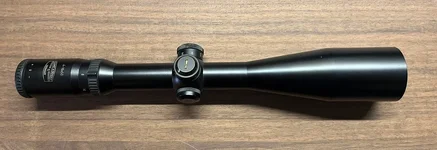
If only folks would pay half as much attention to the quality and aesthetic of what they clamp their tube with and then mount to.
K
K


It is getting the same amount of light, you are confusing this with magnifying the image.
These days there are a lot of scopes that are very close in low light conditions, and the gap between the bigger names and many other brands has well and truly closed.
My eyes tell me that my 6x42 Meopta is better than my S&B, but they also tell me that my Nikon Monarch is as well, and the Prostaff's aren't too far behind, in low light terms at least.
We are all different - a mate of mine swears that he can't see any benefit when peering through my scopes compared to his cheapie Hawke. That could be for other reasons or he might have squiffy eyesight.
I've not found a zoom scope that was as good as a fixed same size objective lens from the same manufacturer in low light.
Redfield are pretty decent overall IMHO.
For the record, I tested some of my scopes as the light failed recently and found a £250 Bushnell Legend Ultra HD left my Leupold VX2 and VX3 for dust in low light.
Leupold might have its brand name in its favour but, in pure low light performance, the much cheaper Bushnell Legend punched way above its weight. Loads of people wouldn't even look at one though, just because of the brand or country of origin.
Meh...
I think a lot of people overlook some serious performance bargains in favour of big brands on the assumption that they will always be better performers. Leupold in particular (just in my opinion of course) appears to be relying on a name made decades ago rather than producing scopes that drop any jaws, at east until you start spending thousands rather than hundreds.
Your mileage may vary - I hope you find a resolution.
Just put one of those on a rim fire; and side by side when dialled to the same magnification (6x) cannot for the life of me see the difference between that and the Duralyt on my .308; not for a moment saying that the Duralyt is not potentially better in other respects, only a shitty day in the hills, or various other scenarios would determine that, but thought provoking never the less! One is one third the price of the other, no prizes for guessing which way 'round!

A larger objective lens does gather more light, however there is a limit to how much we can make use of it. What I think MARCBO was referring to was the amount of light reaching the eye.
In the 60's the Japanese introduced the 4x40 rifle scope. It was a marketing ploy that fooled many into thinking that a 4x40 scope would be brighter in low light than the common 4x32 USA scopes of the time.
At the end of the day or more correctly, at the setting of the sun, it's what our own individual eyes can see that counts. We can perceive optical characteristics differently from one another and therefore it's really a case of seeing for your self.
Precisely, The larger objective only increase the amount of magnification that can be used to deliver the same exit pupil. This will provide a perceived increase in light but is in reality just an increased magification with the same level of light transmission.
Precisely, The larger objective only increase the amount of magnification that can be used to deliver the same exit pupil. This will provide a perceived increase in light but is in reality just an increased magification with the same level of light transmission.
SS
Twilight factor versus exit pupil. Interesting subject and being a mathematical calculation dependent to a large degree on the quality of the optics in question.


The twilight factor and exit pupil are both simple maths and do not take into account the quality of the optics. In fact twilight factor is a "made up" measure of performance used by marketing departments when it suits them whereas exit pupil is just basic physics. Given that they are only really useful for comparing optics of the same quality and when you are capable of applying some analytical thinking to their meaning.
If you research a bit you'll find the twilight factor is not an invention of a marketing department.
edi