Tumbling

Cleaning cases is for vanity, some 000 wool will clear the necks, the rest is what ever you feel need for...
 
As for “peened” necks I simply ask what possible disadvantage has this for bullet release
Possibly?

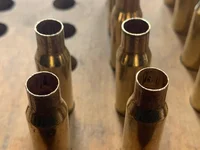
The displaced metal has to go somewhere...every dent in the end of the case mouth means a thickening of the edge and a distortion of the neck cylinder.

Unless there is sufficient force applied by the sizing die to crush the thickened "peened" bits back into the wall thickness, the dies are only acting on the "upset" edge and not directly on the internal and external surface of the case mouth.

Chamfering pre sizing will help, but as I found, was not 100% effective. You are trying to chamfer an irregular thickness and an irregular diameter cylinder distorted by the bruising.

My washing machine tumbling was an extreme case...I am sure a vibratory rumbler or a lapidary type tumbler would produce minimal bruising. However I could easily feel the lip thrown up by the bruising. Although I chamfered and decided to collet neck size to help overcome the potential problem, I could feel the difference in neck tension as I seated the bullets...

Mr. Occam's razor tells me that as tumbling in the washing machine and the consequent bruising of the end of the case mouth was the only thing that I did differently with those cases then that is the most likely reason that the neck tension varied.

Possibly.

Alan

Images are immediately post tumbling and before chamfering and sizing....and then after chamfering, sizing, trimming, chamfering, flaring, factory die crimping, and then after firing where the vestigial dimps are still visible.


IMG_9596.jpeg

IMG_9599.jpeg


IMG_9597.jpeg
 
Last edited:
I use an industrial grade ultrasonic cleaner. I have had ones made for jewelry, one from a dental office (very good but small capacity) and finally this one. The brass is clean but not shiny. You can tell when you have the right US cleaner as the instructions will tell you to not stick your hand in it while it's running. ~Muir
 
Alantoo thanks for the previous couple of posts, and Mirror's my thoughts. (If it makes any difference for hunting ammo is a question, but we always want the most accurate we can get.)👍
My vibratory tumbler with corn cob media in has had the same effect, even tried 5 cases in one cycle and it still did it.
Is the common thought it is case necks facing each other causing this?
I'm not to concerned with shiny brass, but would like it clean on the inside and necks.
 
Alantoo thanks for the previous couple of posts, and Mirror's my thoughts. (If it makes any difference for hunting ammo is a question, but we always want the most accurate we can get.)👍
My vibratory tumbler with corn cob media in has had the same effect, even tried 5 cases in one cycle and it still did it.
Is the common thought it is case necks facing each other causing this?
I'm not to concerned with shiny brass, but would like it clean on the inside and necks.
I am surprised you find it happen significantly with your vibratory tumbler.

It was a brainfart aberration on my part that I tried tumbling in the washing machine. Who in their right mind would change a tried and tested routine for an unknown one when making up ammunition for a shooting test? Stupid.

The ultrasonic cleaner does a great job of cleaning primer pockets and necks inside and out, with no physical abrasion at all. And does it in 10 minutes. I am always amazed to hear of the number of hours people leave their rumblers and tumblers going with their brass.

I can thoroughly recommend U/S...I use a teaspoon of citric acid and a drop or two of washing up liquid per Honey jar of hot water for 20+ cases. The U/S breaks up and bubbles off the powder residue and the citric acid acts as a pickle to remove the tarnish so the cases come out clean but not necessarily shiny. I do them in a honey jar so all the dirt comes out with the cases and I can just re-use the water in the main reservoir over and over without having to clean it.

When I am not taking leave of my senses, :rolleyes: and want the outside of the cases shiny I have given them a wipe with an Autosol cloth when they are spinning in the drill after trimming...it has the advantage at that stage after sizing of less subsequent handling and finger marking and leaves a bit of protection against tarnish, which tumbling doesn't.

Alan
 
Last edited:
Hello,
I've just made a rotary tumbler, it appears to be working very well.
On a 1 hour tumble using 1 pound of pins, cleaning 50 223 cases of various vintages.
They all came out quite shiny, some of the pockets on the newer cases were clean. on the others I believe that a lot of the crud has been reduced, most probably just a turn on my pocket cleaner and they should be ok.
I've found that a slower tumble seem to work better than too fast.
The inside of the cases are not shiny but very clean.
I had very little problem with retaining the pins, don't believe that I have lost any as yet.

Thus I'm encouraged to proceed but hoping for a few answers to queries that have been thrown up.

I've used a 1 : 1 weight ratio of pin weight to cases weight, i.e. 1 lb of pins to 1 lb of cases, is that correct?
Has any one been used the small ball bearing type s/steel media? , have you found it to be better than pins?
Does anyone mix pins and ball bearing type media, if yes? any better?
I've used just the pins, a few drops of lemon juice and a few spots of washing detergent, good result, but any better mixtures.
Thanks for any/all replies.
 
The issue with Ultrasonic (and wet tumbling) is the extra step/effort and time one must take for drying the brass.

There are many ways to skin a cat !

I put minimum effort in to cleaning brass , decap , U/S bath and then they're
left to airdry overnight in a warm place, before annealing . Nice clean primer pockets , none of that cleaning media from the primer pockets and flash holes or cleaning up the dust . Admittedly , you don't get shiny brass .
I've been using a £20 , Aldi U/S bath for the last 5 years and it's cheap .
 
I've used just the pins, a few drops of lemon juice and a few spots of washing detergent, good result, but any better mixtures.

Citric Acid Powder could give you a slightly more concentrated pickle than actual lemon juice, which may help remove the tarnish quicker.

Get in touch with one of the specialist commercial finishing companies like PDJ Vibro if you really want the best media and soap for the job.


The issue with Ultrasonic (and wet tumbling) is the extra step/effort and time one must take for drying the brass.

Not much of an issue and certainly no extra physical effort or labour time involved is it though? Merely a gap whilst drying between cleaning and loading which could be a delay the first time you do it maybe. Certainly there is less time and labour involved with just 10 minutes in the U/S, a few rinses, and then leaving them overnight on the night store heater to dry (whilst you load the ones that went through the cleaner the day, week or month before?) than dry rumbling and any subsequent handling separating / removing of media...

If you are really in rush to get some ammo made just use a primer pocket cleaner and load dirty cases.

But really, who is counting time? It is a hobby for most of us!

Dry/wet tumble, U/S they all get the brass clean. Just don't tumble them in the washing machine!

Alan
 
Brasso is supposed to leach out either copper or zinc forgot which from the brass somewhat and weaken it due to its ammonia content. Google it.

Even atmospheric levels of Ammonia can precipitate stress corrosion cracking in brass.

But an even better reason for not using Brasso on cartridge brass is that there are much better and more effective polishes available like the Autosol range which also happen to not contain ammonia.


"All copper alloys are rapidly attacked by ammonia in moist conditions, with the formation of a bright blue corrosion product, and contact should therefore obviously be avoided. Even in very low concentrations of ammonia, brass that is stressed by either residual or applied tension will spontaneously crack by ‘stress corrosion’, a phenomenon first observed many years ago and at that time called ‘season cracking’. For failure to occur in this way, two conditions must apply: that the brass is under stress, and that ammonia is present (Mercury and moist chlorine may also cause similar failure). Internal tensile stresses caused by cold working, as in the cold drawing of tubes or cold bending of pipework, are sufficient to make brass susceptible to stress corrosion cracking. Under such circumstances a stress-relief heat treatment is advisable before such items are put to use in aggressive environments. Test methods to ensure that the heat treatment has been effective are detailed in relevant Standards."

Alan
 
Wet tumble and use 1.5mm ball bearings, they do a much better job than the pins :)
How much media you would use to do 100 308 cases?
I use a 1kg of pins at the moment but thinking of tryaing ball bearings on their own but feel the mixture of the two would be good idea.
 
Back
Top