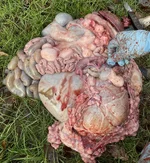
Two roe now with mesenteric issues

paulbshooting

Well-Known Member
Evening, had two roe does off different ground and both are fine carcasses. Normal behavior before culling, nothing externally to note, no ticks, full internal inspection of all lymph glands was fine except both had one 8-10mm diameter swelling in the mesenteric chain. These were hard lumps and wearing gloves I cut into it. No liquid just a "cottage cheese" texture. Never found an issue in the mesenteric before so looked at best practice guide to refresh myself and whilst isolated to that node, neither roe had any other issue.
Am I right to think the hard cheese swelling is the lymph chain doing its job, having dealt with the infection and the carcasses are fine? Sorry I didn't take pictures but wanted to focus on what was going on then dispose of gloves and clean up. Thank you.
 
I'm sure you've got this covered but for others maybe reading this thread

03000 200 301 - DEFRA. TB is notifiable and needs to be reported, etc

 
Evening, had two roe does off different ground and both are fine carcasses. Normal behavior before culling, nothing externally to note, no ticks, full internal inspection of all lymph glands was fine except both had one 8-10mm diameter swelling in the mesenteric chain. These were hard lumps and wearing gloves I cut into it. No liquid just a "cottage cheese" texture. Never found an issue in the mesenteric before so looked at best practice guide to refresh myself and whilst isolated to that node, neither roe had any other issue.
Am I right to think the hard cheese swelling is the lymph chain doing its job, having dealt with the infection and the carcasses are fine? Sorry I didn't take pictures but wanted to focus on what was going on then dispose of gloves and clean up. Thank you.


It is doing its job, but the hard cheese appearance - a caseous lesion - is typical of TB.
Sigh...
It has been accepted standard practice for ever that a single infected lymph node, with nothing else throughout the carcass or offal, meant that whatever infection was getting into the system had been arrested at that point - the lymph node was indeed doing it's job.
Mr Buchan at the end of a previous thread (here) said the advice now from other vets was to treat all infected single nodes in deer with suspicion re: bTB.

This doesn't mean the 2 roe discussed had TB!
Maybe you ditched the carcasses too soon? If testing could have been carried out within, say, 2 weeks and it came back negative you would have been good to go. Perhaps you are one of the many stalkers who only shoot a couple of roe per year, in that case disposing 2 fine carcasses (as you described them) unnecessarily would be a major blow to the venison you could have put in your freezer.
 
Just to clarify on one node v many. Oral infection with M bovis will usually settle in one of the mesenteric lymph nodes. The nature of M bovis is it invades and then the body tries to wall off the infection creating a granuloma. The caseous appearance is a result of this walling off, that the immune system can’t remove the bacteria.
Standard meat hygiene is one can be removed and the carcass is OK to eat, more than one is condemned (I’ll stand corrected on this, been a while since in an abattoir).
 
Sigh...
It has been accepted standard practice for ever that a single infected lymph node, with nothing else throughout the carcass or offal, meant that whatever infection was getting into the system had been arrested at that point - the lymph node was indeed doing it's job.
Mr Buchan at the end of a previous thread (here) said the advice now from other vets was to treat all infected single nodes in deer with suspicion re: bTB.

This doesn't mean the 2 roe discussed had TB!
Maybe you ditched the carcasses too soon? If testing could have been carried out within, say, 2 weeks and it came back negative you would have been good to go. Perhaps you are one of the many stalkers who only shoot a couple of roe per year, in that case disposing 2 fine carcasses (as you described them) unnecessarily would be a major blow to the venison you could have put in your freezer.
Yes that's why I asked as no TB or other indicators with either carcass hence why I asked the question on here to try to learn more. Fortunate to be taking between 4-8 deer a week off local ground so whilst I hate wasting any venison, wasnt prepared to risk the family and customers who buy our venison but always keen to learn more.
 
The lesions on the inside of the ribs are what I expect with tb
Not necessarily on the ribs at all.
The attached images from a pregnant doe showed nothing on the ribs, but abscesses all over the viscera. Didn't appear ill prior to the shot, either.
If a guy is unsure of the condition of any shot game, then surely the correct and safest descision for that person, is to not eat said game.
The OP said they were fine carcasses, only having a single small abscess each in the mesenterics, nothing else. Clear that with APHE and you have some great venison. What's so difficult?

IMG_2537.webpIMG_2529.webp
 
Not necessarily on the ribs at all.
The attached images from a pregnant doe showed nothing on the ribs, but abscesses all over the viscera. Didn't appear ill prior to the shot, either.

The OP said they were fine carcasses, only having a single small abscess each in the mesenterics, nothing else. Clear that with APHE and you have some great venison. What's so difficult?

View attachment 355999View attachment 356000
Clue being "Unsure of condition"
 
If unsure of something, why not increase your knowledge and find out, rather than carry on in ignorance?
So you would stick it in the chiller for two weeks?, I wouldn't be Rsd.
The guy is asking on here for opinions, weight of such is err on the side of caution .... unless of course having knowledge of abbatoir working.
 
Not necessarily on the ribs at all.
The attached images from a pregnant doe showed nothing on the ribs, but abscesses all over the viscera. Didn't appear ill prior to the shot, either.

The OP said they were fine carcasses, only having a single small abscess each in the mesenterics, nothing else. Clear that with APHE and you have some great venison. What's so difficult?

View attachment 355999View attachment 356000
thanks for posting the pics - it's useful to see examples of abnormalities
 
Back
Top