


Freeforester
Well-Known Member
As it's a bit snowy outside this evening, I thought I'd post this, a brief outline of the main design of high seat I use, which have stood me in good stead the past thirty years, so it's a bit of a long term review, if you like! When I got the first ones made by the local smith back in the early nineties, I was keen to have something that would stand the test of time, could be used with guests if needed, be freestanding or lean-to, and for free standing, be able to be erected on uneven ground without too much digging in legs to even things up, I'm sure this latter aspect has been noted by others when shifting a seat from place to place, and discovering that it sits a bit, well, wonky!
The basic design has a four foot wide top box for the seat and shooting rail, with a seat supporting spar, as can be seen here:
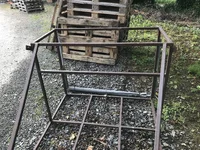
This one has an optional vari-height shooting rail fitted, as was recently discussed in a separate thread
Notice also the feet rests are slightly off set in comparison with the ladder portion; I found that having the foot rests some 15" below the seat level works well, but if you are shorter in stature than 6'+ you might want to figure this out for yourself, I think I arrived at the length simply by measuring the drop from comfortable height kitchen chair to the floor:
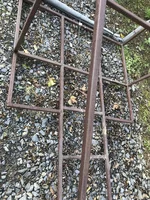
These were fitted after the ladder was made, back in the day; if making from new, it would be simple to adjust the position of the rung between to the same preferred drop from the seat; this measurement should be made to accommodate the end user!
Notice also, In the top picture, a couple of 3"X 1-1/2" brackets offset at 30/40 degree angle from the shooting box: these are where the back legs attach, along with two similar sized brackets located some 2 foot from the base of the ladder, as seen here:
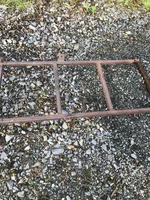
The rusty patina over thinned down (for ease of application) smooth finish green Hammerite paint has worked well enough to blend the seat in with the surroundings, whereas galvanising them would have been a costly way to make them significantly dearer, heavier and more visible; given this seat is still going strong after thirty winters, it proved to be the more cost effective decision.
The leg sets are 12' in length, and with a 14" base foot, which was made with box section offcuts, but could have just as easily have been made using flat bar, the main consideration being that they are set parallel to the ground when the legs are in situ, it's hard to convey this aspect in words, so I won't try, but since anyone making one of these will be able to arrange this as one of the last welds, it should not be a major stumbling block.
The rear cross brace is made from flat bar, and is attached to the welded lugs on the rear legs as shown in this pic; coupled with the side stays, this gives the seat a three-legged stability; the main 'trick'of this particular 'pony' however is the 'SVG - Sliding Variable Geometry' Tmk! brackets attaching the side stays to the back legs, which can be seen here below:
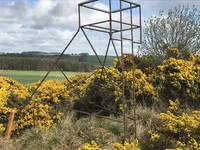
An inexpensive ground anchor is made by knocking in a fencepost alongside one of the legs (usually toward the prevailing wind is best) and secured either to another welded-on lug or by means of metal strapping and a screw or two, either being easily removed when the time to re-site the seat arises. Picture shows the seat 'skylined' close up, but from where the target deer emerge, this seat has a good background screen. Entry is by the inside of the ladder.
A close up of the all-important variable bracket:
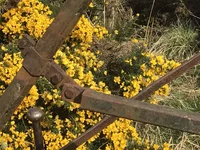
Patent pending! The joining bar is approx 4" long, but anyone fabricating their own can make to their own preferred length.
These give the seat great versatility in setting up on uneven ground, as with them the side stays can effectively be joined to the back legs according to wherever they best meet them, assuming your ladder is upright and leaning slightly backwards, adding stability.
Anyone sufficiently inspired to try making one or more of this type of seat would do well to consider the rung spacing they prefer (taking into consideration that you may not be so sprightly thirty years hence!), footrest drop as touched on above (you've got to be comfortable!) build the seat to their preferred design, adding the four brackets to the main body, and thereafter making up the leg sets and side stays according to the angle they feel they are confident that the seat won't be toppling over - I'd advise against making them six inches too short, width between the three terra firma contact points is a good thing! The cross stay at the back is very simple to make, again to the length of the final user's preference; mine are 101+1/2", my side stays are 89" long finished length, including a 2" X1" drilled lug either end. You'll know when the dimensions right for you. Measure thrice, think about it, make a cup of tea, consult a friend, then cut - if it's wrong, make it too long, If it's too short, blame the 'so called friend'! Seriously, it doesn't matter so much, I have some with added flat bar sections with drilled holes, just to knit the whole affair together, but I'm sure you can do better!
The seat can be dissembled and loaded/transported on a quad or vehicle trailer if access is good, if not it can be carried in the three main component sets by one man. When on site, the seat can be erected or taken down in approx 30-45 minutes, and as said, the spade work required is minimal. The back leg sub assembles can be pre assembled, then you're only talkng about nipping up half a dozen (greased, for easy dissembly some years hence!) bolts and nuts.
A couple lengths of pipe insulation held with not overly tightly done up cable ties, and an OSD or plywood seat finishes the job, camouflaged netting can be added to the front if you are trying to get among wary deer.
Hoping this is of possible interest to others.
The basic design has a four foot wide top box for the seat and shooting rail, with a seat supporting spar, as can be seen here:
This one has an optional vari-height shooting rail fitted, as was recently discussed in a separate thread
Notice also the feet rests are slightly off set in comparison with the ladder portion; I found that having the foot rests some 15" below the seat level works well, but if you are shorter in stature than 6'+ you might want to figure this out for yourself, I think I arrived at the length simply by measuring the drop from comfortable height kitchen chair to the floor:
These were fitted after the ladder was made, back in the day; if making from new, it would be simple to adjust the position of the rung between to the same preferred drop from the seat; this measurement should be made to accommodate the end user!
Notice also, In the top picture, a couple of 3"X 1-1/2" brackets offset at 30/40 degree angle from the shooting box: these are where the back legs attach, along with two similar sized brackets located some 2 foot from the base of the ladder, as seen here:
The rusty patina over thinned down (for ease of application) smooth finish green Hammerite paint has worked well enough to blend the seat in with the surroundings, whereas galvanising them would have been a costly way to make them significantly dearer, heavier and more visible; given this seat is still going strong after thirty winters, it proved to be the more cost effective decision.
The leg sets are 12' in length, and with a 14" base foot, which was made with box section offcuts, but could have just as easily have been made using flat bar, the main consideration being that they are set parallel to the ground when the legs are in situ, it's hard to convey this aspect in words, so I won't try, but since anyone making one of these will be able to arrange this as one of the last welds, it should not be a major stumbling block.
The rear cross brace is made from flat bar, and is attached to the welded lugs on the rear legs as shown in this pic; coupled with the side stays, this gives the seat a three-legged stability; the main 'trick'of this particular 'pony' however is the 'SVG - Sliding Variable Geometry' Tmk! brackets attaching the side stays to the back legs, which can be seen here below:
An inexpensive ground anchor is made by knocking in a fencepost alongside one of the legs (usually toward the prevailing wind is best) and secured either to another welded-on lug or by means of metal strapping and a screw or two, either being easily removed when the time to re-site the seat arises. Picture shows the seat 'skylined' close up, but from where the target deer emerge, this seat has a good background screen. Entry is by the inside of the ladder.
A close up of the all-important variable bracket:
Patent pending! The joining bar is approx 4" long, but anyone fabricating their own can make to their own preferred length.
These give the seat great versatility in setting up on uneven ground, as with them the side stays can effectively be joined to the back legs according to wherever they best meet them, assuming your ladder is upright and leaning slightly backwards, adding stability.
Anyone sufficiently inspired to try making one or more of this type of seat would do well to consider the rung spacing they prefer (taking into consideration that you may not be so sprightly thirty years hence!), footrest drop as touched on above (you've got to be comfortable!) build the seat to their preferred design, adding the four brackets to the main body, and thereafter making up the leg sets and side stays according to the angle they feel they are confident that the seat won't be toppling over - I'd advise against making them six inches too short, width between the three terra firma contact points is a good thing! The cross stay at the back is very simple to make, again to the length of the final user's preference; mine are 101+1/2", my side stays are 89" long finished length, including a 2" X1" drilled lug either end. You'll know when the dimensions right for you. Measure thrice, think about it, make a cup of tea, consult a friend, then cut - if it's wrong, make it too long, If it's too short, blame the 'so called friend'! Seriously, it doesn't matter so much, I have some with added flat bar sections with drilled holes, just to knit the whole affair together, but I'm sure you can do better!
The seat can be dissembled and loaded/transported on a quad or vehicle trailer if access is good, if not it can be carried in the three main component sets by one man. When on site, the seat can be erected or taken down in approx 30-45 minutes, and as said, the spade work required is minimal. The back leg sub assembles can be pre assembled, then you're only talkng about nipping up half a dozen (greased, for easy dissembly some years hence!) bolts and nuts.
A couple lengths of pipe insulation held with not overly tightly done up cable ties, and an OSD or plywood seat finishes the job, camouflaged netting can be added to the front if you are trying to get among wary deer.
Hoping this is of possible interest to others.

 I’ll have to stick to buying them for now.


