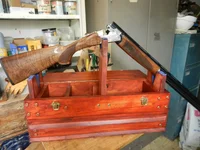
WD40 for cleaning, lubricating and protecting a rifle or shotgun.

Engine oil is pumped around at very high temperatures for hours on end , it comes in different viscosities as engine types vary and most is toxic,where as gun oil has to stick to surfaces often in wet and cold conditions ,not affect blueing or discolour wood ,non toxic and some loosens copper fouling and so on , its not 20w/50 in disguise, sure gun oil is comparatively expensive but then demand is much much less .

How is gun oil non-toxic? Engines rely on motor oil sticking to the working surfaces very well, otherwise much damage would be done on start-up.

"Gun oil" and copper solvent are two different things.

Lastly, a good grease works so much better for guns than oil.
 
my Swiss K31 has managed to get through 70+ years with just grease, its used to clean,lube and protect the metal and woodwork, the bore is pristine, and this is not unusual with Swiss rifles.
 

But what about……?

Everyone has their own little “secret”. If it works, is there anything wrong with it? Let’s find out…
Motor oils: Generally good boundary lubrication (particularly the Havoline formulations), but very poor corrosion resistance and poor resistance to open-air oxidation. The biggest problem is that their pour-point additives often contain benzene compounds, which aren’t a good thing to have next to your skin on a regular basis! I recommend staying away from motor oils; if you must use something from the auto parts store, ATF performs better for firearms use on every count, even if it is a tad more expensive. (ATF is still 1/10 to 1/100th the cost of a specialty “gun oil.”)

Gear oils: Too thick for the application. In addition, they contain tackifiers which gives them poor migration and lead to oxidization in open air, rendering them even more “sticky” – pretty much what we don’t want. (Some folks use it on their slide rails because it’s thicker and won’t migrate easily; a light grease is a far better choice.) If you really want a thicker oil with all the good characteristics we’ve covered, but is still cheap, mix ATF and STP Oil Treatment in a 40/60 ratio. Far better than gear oil on every count – but I’d still much rather have a good food grade NLGI #0 grease.
WD-40: WD-40 was never meant to be a lubricant – it was designed as a moisture displacer. It’s far too light for any load protection, has incredibly poor corrosion resistance, contains zero boundary lubricants, and rapidly oxidizes to form a sickly yellow varnish (hint: this is not good for delicate internal lockwork.) There are those who will defend this stuff vehemently, but then again you can still find people who think smokeless powder is a passing fad. Just. Don’t.

Automotive motor oil additives: Usually a boundary additive in some sort of light mineral oil carrier, they usually lack corrosion protection and often oxidize rapidly; some have poor migration characteristics and rely on the oil to which they’ll be added to provide those things. When mixed with an appropriate oil (such as ATF) these additives do have some merit (see above), but by themselves? No.

Silicone spray: Right up there with WD-40, but at least it’ll shed water while your parts grind themselves into little shavings!

Graphite: (sprays, powders) Graphite is a crystalline product which is actually very slightly abrasive. It offers no appreciable benefit other than being dry; a lube with a good boundary lubricant package can be wiped dry to the touch and still provide better lubrication and protection than graphite. Save it for your keys and padlocks.

Finally, note that the foregoing is a layman’s understanding of lubrication technology. I don’t pretend to be an expert, just a well-informed amateur hoping to disseminate some arcane knowledge. I have had the support, input, and feedback of a number of specialists and experts in the lubrication industry who have vetted what I say, but as always: use at your own risk!
– Grant
* – I have no affiliation with Lubriplate or Lubrikit other than as a customer,and I do not receive nor have I asked for any sort of consideration or discount for recommending their products.


I have 12 firearms and use them regularly , I maybe use two cans of either Browning Legia gun oil or Napier gun oil a year at around £15 all in , mess about with the above if you wish but I wont be :)
 
I personally don't like removing the residue that long term use of WD40 leaves
that **** sticks like glue when left in place for long periods

there are better things that clean
there are better things that lubricate
there are better things that protect
 
I personally don't like removing the residue that long term use of WD40 leaves
that **** sticks like glue when left in place for long periods

there are better things that clean
there are better things that lubricate
there are better things that protect

you are right however,
very few that do all, I found that wd40 removes old wd40 quite well.

who does not believe that WD40 lubricates should spray some on the kitchen floor and take a running step....

edi
 
you are right however,
very few that do all, I found that wd40 removes old wd40 quite well.

who does not believe that WD40 lubricates should spray some on the kitchen floor and take a running step....

edi
Maybe you could use banana skins to lubricate your rifle :roll:
 
Maybe you could use banana skins to lubricate your rifle :roll:
With certain materials water is a great lubricant. Banana skins might have solved some problems in it's time, short term I presume.
We had cases where two solid once off greased materials running against each other replaced greased needle bearings and had a much higher life span. We also asked for help at the best engineering universities in Germany about guessing if certain materials would run against each other only to be told try it run it and see. Not all is known. Materials used in Firearms vary quite a bit too.
With normal soft or hardened steel/stainless running against each other WD40 will lubricate much better than nothing. It was never intended to replace gear oil or engine oil or grease.
I know it is fashionable to knock WD40 as there is huge envy of this products success.

I think it has it's place in a workshop and got me out of trouble often enough.

edi
 
I'm not sure about the benefits or harm that can be caused by spraying WD40 into a reflex moderator but I can vouch for the fact that you can over do it. A fellow rifle club member recently purchased his first centrefire rifle and moderator. In hs eagerness to maintain his kit in a good state of repair he seems to have over done the WD40 because for weeks now after firing his first shot there is a huge cloud of smoke. No amount of blowing the WD40 out with an airline or allowing it to drain in a warm dry place seems to work. He can't shoot any more than two rounds at a time because he can't see the target due to the smoke.

Another reason why I am glad that I bought a moderator that can be stripped.

Get him to get it glowing that will burn her clean
 
Well I actually used some WD40 to clean the other day................................................................... I used it to clean off the outside of the polished stainless steel exhaust box on the car. The box was off to replace a faulty CAT so as it was grimey gave it a soak with WD40 then wiped it down and repeated. Shiney exhaust again and of course once hot any residue was burnt off. Used Plusgas to help undo the bolts on teh exhaust and CAT as WD40 is not much use really as a freeing agent.

This and use on electrical connections it the limit of my usage of WD40.
 
But what about……?

Everyone has their own little “secret”. If it works, is there anything wrong with it? Let’s find out…
Motor oils: Generally good boundary lubrication (particularly the Havoline formulations), but very poor corrosion resistance and poor resistance to open-air oxidation. The biggest problem is that their pour-point additives often contain benzene compounds, which aren’t a good thing to have next to your skin on a regular basis! I recommend staying away from motor oils; if you must use something from the auto parts store, ATF performs better for firearms use on every count, even if it is a tad more expensive. (ATF is still 1/10 to 1/100th the cost of a specialty “gun oil.”)

Gear oils: Too thick for the application. In addition, they contain tackifiers which gives them poor migration and lead to oxidization in open air, rendering them even more “sticky” – pretty much what we don’t want. (Some folks use it on their slide rails because it’s thicker and won’t migrate easily; a light grease is a far better choice.) If you really want a thicker oil with all the good characteristics we’ve covered, but is still cheap, mix ATF and STP Oil Treatment in a 40/60 ratio. Far better than gear oil on every count – but I’d still much rather have a good food grade NLGI #0 grease.
WD-40: WD-40 was never meant to be a lubricant – it was designed as a moisture displacer. It’s far too light for any load protection, has incredibly poor corrosion resistance, contains zero boundary lubricants, and rapidly oxidizes to form a sickly yellow varnish (hint: this is not good for delicate internal lockwork.) There are those who will defend this stuff vehemently, but then again you can still find people who think smokeless powder is a passing fad. Just. Don’t.

Automotive motor oil additives: Usually a boundary additive in some sort of light mineral oil carrier, they usually lack corrosion protection and often oxidize rapidly; some have poor migration characteristics and rely on the oil to which they’ll be added to provide those things. When mixed with an appropriate oil (such as ATF) these additives do have some merit (see above), but by themselves? No.

Silicone spray: Right up there with WD-40, but at least it’ll shed water while your parts grind themselves into little shavings!

Graphite: (sprays, powders) Graphite is a crystalline product which is actually very slightly abrasive. It offers no appreciable benefit other than being dry; a lube with a good boundary lubricant package can be wiped dry to the touch and still provide better lubrication and protection than graphite. Save it for your keys and padlocks.

Finally, note that the foregoing is a layman’s understanding of lubrication technology. I don’t pretend to be an expert, just a well-informed amateur hoping to disseminate some arcane knowledge. I have had the support, input, and feedback of a number of specialists and experts in the lubrication industry who have vetted what I say, but as always: use at your own risk!
– Grant
* – I have no affiliation with Lubriplate or Lubrikit other than as a customer,and I do not receive nor have I asked for any sort of consideration or discount for recommending their products.


I have 12 firearms and use them regularly , I maybe use two cans of either Browning Legia gun oil or Napier gun oil a year at around £15 all in , mess about with the above if you wish but I wont be :)

Good post.

It amuses me that many shooters wont baulk even slightly about spending £25 on a packet of 20 hunting bullets which might last a few outings, but hit the roof when offered a proper gun oil at a quarter that price which will last a year!

Personally, I use KG gun oils and for the bolt high shear areas and for corrosion protection I use a food processing industry standard white grease (food safe standard and wont do your skin any harm) which has excellent corrosion protection, far better than any gun oils or automotive type oils. The bolt and carrier surfaces get a wipe down after every outing and a very light coating, applied with the fingers, does the trick. For the barrels, a quick clean with a lightly oiled rag (SS barrels) is all that is needed. For muzzle threads, I apply some patch out and use a small nylon brush to get rid of fouling then wipe over with an oiled rag.

All I ever use is a combination of proprietary gun oil and white grease. It's cheap ehough and to my mind the best products for the job.
 
I used to use a black gun grease from Abby lubricants. It was bought originally for the sping powered air rifles but when i got my cartridge rifles it was used on them as well. A tiny smear on the bolt guides and rear of the bolt lugs was all it needed. A small pot of this lasted years as only a tiny amount was needed. Oil I used Parker-Hale Express oil in the red and black tins.
 
I used to use a black gun grease from Abby lubricants. It was bought originally for the sping powered air rifles but when i got my cartridge rifles it was used on them as well. A tiny smear on the bolt guides and rear of the bolt lugs was all it needed. A small pot of this lasted years as only a tiny amount was needed. Oil I used Parker-Hale Express oil in the red and black tins.


I remember that grease and think I even have a small amount left in the garage somewhere (bought years ago for my air rifle). Wasn't it a Molybdenum grease?
 
I remember that grease and think I even have a small amount left in the garage somewhere (bought years ago for my air rifle). Wasn't it a Molybdenum grease?


Your question compelled me to seek it out and take a look and yes I have a little left in the white tub still. LT2 Grease and yes it is a Molybdenum based grease.
 
Back
Top