Zeroing at 1” high question

That assumes that you'll be walking in a straight line towards the deer. In my experience, that's very rarely the case.
But close enough on realistic ranges? As would be counting your steps (and try to make them one meter or so), that I try to do both approaching the game and after the shot to pin down the area to look for blood, hair and so on.
 
But close enough on realistic ranges? As would be counting your steps (and try to make them one meter or so), that I try to do both approaching the game and after the shot to pin down the area to look for blood, hair and so on.
Not really close enough.
A deer may be 300 yards away, and you walk 300 yards at a tangent in order to get to a point 100 yards from the deer.
Ranging the deer and ranging the point you wished to shoot from would give you exactly the same distance, so no help at all and nowhere near close enough.
 
Not really close enough.
A deer may be 300 yards away, and you walk 300 yards at a tangent in order to get to a point 100 yards from the deer.
Ranging the deer and ranging the point you wished to shoot from would give you exactly the same distance, so no help at all and nowhere near close enough.
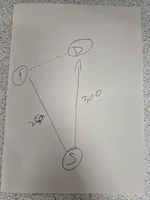
Starting at S, deer at D, if I range 250 to point F, presuming I'm at a sensible angle, it'll put me within my acceptabe range of 250y for the shot (dotted line).
 

Attachments

  • 17301587483134665033036426686480.webp
    17301587483134665033036426686480.webp
    220 KB · Views: 41
Starting at S, deer at D, if I range 250 to point F, presuming I'm at a sensible angle, it'll put me within my acceptabe range of 250y for the shot (dotted line).
I don't think you've gained anything by ranging the distance from S-F. Unless you're going to get your calculator out and do a spot of trigonometry, you are still only guessing the distance F-D.
Clearly you've already identified, by eye, that F is a suitable firing position. All you have to worry about is getting there as unobtrusively as possible. The distance is irrelevant. You can range F-D when you get to F, if you want to be certain before taking the shot.

I think triggernometry is preferable to trigonometry:
Does the deer look close enough? If yes, shoot it. If no, get closer and then shoot it.
 
Last edited:
Whilst this works for some and that’s ok, I personally prefer to have my centre fire calibres set up with a 100 yard zero. I have ran my ammunition through a chronograph and have a good ballistic app, I’ve learnt my drops and tested them at the range. This will prove useful not only for deer but for foxes also as the target is considerably smaller and the chances of missing are greater.

Happy shooting 😀
 
The poor Op, 😂 he asked such a simple question, got links to ballistic calculators, schooled on headshooting, a (bad!) example of trigonometry in the field and lots and lots of other advice.
@TST123 - Yes, 2 or 3 clicks up and you’ll be fine out to 200m. I bet 15 years ago this is how almost every scope on every deer rifle was set up. Corroborate on targets when you get a chance, but you’ll be fine to use your rifle 👍
 
The poor Op, 😂 he asked such a simple question, got links to ballistic calculators, schooled on headshooting, a (bad!) example of trigonometry in the field and lots and lots of other advice.
@TST123 - Yes, 2 or 3 clicks up and you’ll be fine out to 200m. I bet 15 years ago this is how almost every scope on every deer rifle was set up. Corroborate on targets when you get a chance, but you’ll be fine to use your rifle 👍
By zeroing 1 inch high, my bad trigonometry works.
 
Yes, 2 or 3 clicks up and you’ll be fine out to 200m.
@Acm


My .243 rifles wears a Swarovski Ballistic turret.

Unknown-4.jpeg

When I initially set it up, I went for Zero at 100 yards, Green 150 yards, Amber 200 yards and then Red at 250 yards.

The differences between Zero and Green was one click, Zero and Amber 3.

The turret was so 'cluttered' at these ranges that I changed them out to Zero 100, Green 200, Amber 300 and Red 400.

Why did I learn?

That for a Stalking rifle, a BT is not really necessary.:-|
 
For most ‘England large deer legal’ cartridges there is a very basic rule of thumb - zero at 100 yards - add 2moa for a 200 yard zero - add another 3moa for a 300 yard zero.

Personally I zero 2” high at 100 yards & that gives me point & shoot on fallow out to c.250 yards with my chosen load.
 
The poor Op, 😂 he asked such a simple question, got links to ballistic calculators, schooled on headshooting, a (bad!) example of trigonometry in the field and lots and lots of other advice.
@TST123 - Yes, 2 or 3 clicks up and you’ll be fine out to 200m. I bet 15 years ago this is how almost every scope on every deer rifle was set up. Corroborate on targets when you get a chance, but you’ll be fine to use your rifle 👍
😂😂, thank you! I got lots of advice 😂All I really wanted to know is if a couple of clicks up would give me a
The poor Op, 😂 he asked such a simple question, got links to ballistic calculators, schooled on headshooting, a (bad!) example of trigonometry in the field and lots and lots of other advice.
@TST123 - Yes, 2 or 3 clicks up and you’ll be fine out to 200m. I bet 15 years ago this is how almost every scope on every deer rifle was set up. Corroborate on targets when you get a chance, but you’ll be fine to use your rifle 👍
😂yep that’s all I wanted to check! Just to make sure I could give it a couple of clicks up for 1” high without needing to check zero again, as I don’t have regular access to a range
 
Maximum Point Blank Range is a foolish concept IMO- because it assumes that you get perfect grouping. And it ignores head shots.

With a large kill zone- say 6"- MPBR is large for many calibres- 400 yards or so.

Until you realise that at 400 yards your groups are probably 6-8" big anyway (depending on whether you're rested, sticks etc)- which when you include bullet drop- means you miss quite a few!

Also- zeroing high at 100 means you're far less accurate for head shots.

Chest Shooting reds on a Scottish Hill - I understand why you zero high at 100- knowing you're near enough flat out to 200. You aren't taking head shots, and you have time to range find anyway.

But if you shoot at closer ranges as well- zero at 100- and then check the impact point at 50 and 150 too.

If you're newish to stalking- you're better off shooting out to 150 yards anyway IMO- and any deer calibre zeroed at 100- will be flat enough out to 150 anyway.
 
personally I zero dead on at 30 yards, the target is easy to see and easy to get dead on, this gives a 2nd zero at abot 230 and a 6" mpbr of about 270 yards and not much hold over to 300ish, I dont shoot animals at these distances but it will give an easier back up shot should the need arise, (hopefully never but sooner or later it will), the distances are confirmed with testing not just app data
 
personally I zero dead on at 30 yards, the target is easy to see and easy to get dead on, this gives a 2nd zero at abot 230 and a 6" mpbr of about 270 yards and not much hold over to 300ish, I dont shoot animals at these distances but it will give an easier back up shot should the need arise, (hopefully never but sooner or later it will), the distances are confirmed with testing not just app data
How high is your scope above the bore?
 
It no more ignores 'head shots', that it does ignore 'arse' shots.

Then don't take them.

Please explain how I'm being ignorant?

I almost never take head shots 4% maybe. But I zero at 100 for that very reason that it makes my trajectory inside 100 flatter. Chest shots cause some distress. A perfectly placed head shot causes zero. There's certainly an ethical argument for head shots. But we are going OT.....
 
No it doesn't.

I have explained above how I think it does. Please explain where you disagree.

I will caviat that if you're disagreeing with the word "accurate" (which i agee isn't the right word).

Let me revise my statement-

Zeroing high at 100 means your trajectory is loopier making shot placement more difficult unless you know your trajectory inside out and the distance more precisely. In the moment- unless you're spot on with the above- it's easier to miss the kill zone on a head shot animal with a high far zero, vs a nearer one- all other factors being equal.
 
I have explained above how I think it does. Please explain where you disagree.

I will caviat that if you're disagreeing with the word "accurate" (which i agee isn't the right word).

Let me revise my statement-

Zeroing high at 100 means your trajectory is loopier making shot placement more difficult unless you know your trajectory inside out and the distance more precisely. In the moment- unless you're spot on with the above- it's easier to miss the kill zone on a head shot animal with a high far zero, vs a nearer one- all other factors being equal.
Yes, I was disagreeing with your use of the word "accurate".

What I think you're really trying to say is that a 1" high zero at 100 may not be so practical for taking head shots at the sort of distances that most people might be tempted to try it.

Someone's ability to shoot accurately isn't a factor of where they've zeroed. You could zero 6" left at 115 yards and still be incredibly accurate, or you could zero bang on at 100 and be a very inaccurate shooter.

Personally, I think that using the MPBR concept is very sensible.
 
Back
Top