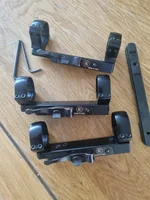
Claw mounts on rails

Southern

Well-Known Member
I was wondering if any of you use the integral rail mounts for scopes - particularly, the rail with claw feet.

And do you use them with what bases?
I am specifically interested in fitting a scope like that to an older German claw mount base, and figured this might be a better method than fitting a couple of rings with claw feet.
 
I have a drilling and this has a s&b scope with rail. The front of the scope has a ring around the front that has a claw mount and the rear has a claw mount attached to the rail. The bases come as standard with a drilling. I think claw mounts are expensive if you can avoid them but do return to zero every time when I take the scope off.
 
I already have the bases for the conventional, narrow claw mounts on my 1927 Sauer 20/7x57R.
I thought that I might find a used scope like yours, or straight tube, and find off-the-shelf claw feet to fit my bases.

I have the older claw mounts on a 7x64 Mauser with a Hensoldt scope and on a 1903 Springfield with a vintage Zeiss. They are strong and do return to zero. The same was true for the 16/
8x57JRS I had.

While I am at it, I must put in an endorsement for other QD systems which are quick and return to Zero:
Steyr pivot mount
EAW
Talley
Warne Premier QD
Paul Jaeger sidemount
Griffin & Howe side mount
HK G3 Claw mount
 
I like the hk made MP5/G3 mount works well and i still have one with the pic/weaver rail fitted onto it but sadly not rifle for it to go on .
 
Can you get the GSG MP5-alike in .22 LR over there? If so, snap it on that baby.

I have one HK with rail for a 10x mil dot or a red dot, and the other with the original Hensoldt 4x ranging scope.
The irons are dead on to 400 meters, then the scope comes on after that.
 
I have a Zeiss with rail mounts with claws that goes into a German claw mount. To my mind one of the best type of mounts you can get.
 
Heym,
Can you find ready-made claw feet to fit old bases?
Do they come from the scope manufacturer, or a second source?
How much honing and fitting do they require?

I feel comfortable doing this sort of metal work myself, up to a point. I file and hone dovetail rear sights, fit front sights, grip caps, butt plates, cartridge traps in stocks, etc.

If I have to machine a set of feet onto a raw ring on a block, then I will have to send my gun to Dietrich Apel and his German gunsmiths, who are 1,000 miles north of me, and wait a month or two. But they are very good at this.
 
Southern have a look at the Recknagel catalogue, they sell claw mounts. I'm not sure how much fitting is involved as most claw mounts were pretty much gunsmith made and not simply purchased stock items.
 
Yes, I have a Recknagel catalogue, that and some old Zeiss for sale, gave me this notion.

I have bought several rear sights from Recknagel and fitted them in the past, and will buy a folding leaf sight for a 1930s Mauser, and a set of front and rear for a 7x64 I am building ( all together and shooting in an old stock now without sights) while I build a new stock in classic style.

I know the older, conventional rings with claw feet take a good bit of hand fitting, and sometimes machining before that.

I think I will drop them an email with photos and measurements of my claw mount bases.

Thanks for all the input. This is a great site for information on drillings and combination guns from owners.
 
Southern - have been through this process and done the research as I have a1-4x20 I want to fit. Firstly measure up the slots on the bases:

Option 1: reknagel claws may fit - they make them to a few different widths and you are supplied with a blank that you can then fit. The front hooks will need honing to a tight fit, rear will need a slot cut for the rear latch. The feet may also need bevelling to fit. It will help if the rear is a two pice base with lateral adjustment. Reknagel quoted me a couple of years ago about £120 for blank rings that I could then fit to the bases on my gun.

Option 2 - get some ultra high Leupold double dovetail rings - or similar from really good steel. Then cut your own claws onto these.

Option 3 - start off with some bar stock, cut claws on one side, and then a longways dovetail to take a rail if on the scope, or cut a sideways dove tail on the upper side to take weaver type rings.
 
Thanks, Heym.

#1 is what I am trying to do. A set of fitted rings is about $800 US. If I could get some for the bases and just fit them with some careful filing and honing, I can do that. I have all the files and hones to get in tight corners.

#2 and #3 are good ideas. My gun is narrow, the bases are narrow. It is a small frame 20 gauge with 7x57R

A steel Weaver or Picatinny rail would take out most of the stress. A set of Burris Posi Line rings would complete that.

I am going to email Recknagel tonight, and Zeiss.
 
Thanks for those links, Heym.

I am really thinking of making something.
Here are two more ideas for 1 inch or 30mm tube scopes without integeral rails:

* two claw feet with flat bases and a one-piece Zeiss base screwed to them, with its integral rings in perfect alignment..
* STANAG 1913 rail attached to those two claw feet at each end, with some Burris rings.

Your Munch combi is handsome, clean as a pin, like a update of the older Merkel 12/8x57JRS I used to own. Do you own a 7x64, too?

If your rifle likes the Norma 156-gr and 158-gr ammo, have you tried the 154-gr Hornady bullets, or the 160-gr Sierras or Noslers? My 7x64 loves them. You have to throttle the loads back in a 7x65R to more than a maxed out 7x57mm would be, which is still a lot of rifle.

I had a 2.5x20mm Leupold on the 8x57JRS, and it was all it needed for every range I used it, from 25 to 200 yards.

The Leupold 4x33mm or a small Zeiss 4x would be great on a combi. My 6.5x54mm Mannlicher 1952 carbine wore a 4x Zeiss - a perfect rig.
As accurate as the combination guns can be, especially the 7x57R and 7x65R, something like a Burris 2-7x35 Ballistic Plex would let it reach out there
 
1Some form of rail screwed to flat to claws is an option and does give you an element of flexibility. Downside is that it starts setting the scope quite high. On mine I have made a strap on leather cheek piece to give good cheek alignment. Mine is labelled Heinrich Munch: Aachen which was I believe a top end retailer in Aachen. It was actually by Joseph Hambrusch in Ferlach in 1974, and was virtually unused when I got it.

re loads, have tried the 160gn Sierras - so so. Have though developed a 139gn Hornady Softpoint over 51.5gn of IMR 4831 that gives a book velocity of 2,500 fps that works well. If I shoot slowly it holds under an inch at 100 yds with just a mild shove. It shoots to the same as the RWS 173 gn ID Classic load which is a real thumper. Very happy at taking shots on Roe out to 120 yds, reds a bit further, but it's not really a long range prone rifle - much more comfortable shooting seated or standing shots. One thing you have to watch when prone is muzzle clearance as the scope is nearly three inches above the bore - last time I shot it prone there was a smoking hole in the ground 20 yds ahead rather than through the deer - quite embarrassing.

7x64 I like and have always done so. But being left handed most have bolts on wrong side - hence the combination gun. Also quite tricky in the uk to justify reason for having two rifles of similar calibre. You are pretty much kept to one each of 22rf for vermin, 22 cf for longer range vermin and fox, 243 for fox and small deer and a large 7mm / 270 / 308 / 30-06 for bigger deer.
 
A rail and rings atop two claw feet would fit very low with a straight tube scope. At some point, I will figure how to post photos here and put up a side view of my 8x57JRS with its 2.5x Leupold in low claw rings.

It is interesting that the 139-gr Hornady shoots that mild load so well. I am working up 139-gr RN and flat base spire points in my 7x57R now, and this time using 4831 or H100V, which had a slower, lower burning curve and low pressures. My 7x57 was built by Wilhelm Voss, on what appears to be a JP Sauer single cross bolt action. Like yours, it was sold through a larger name which catalogued firearms by many small builders. Mine was built for the American market, and imported by a large German firm in Pennsyslvania which built rifles, imported European firearms, and sold stock blanks and carved and inletted stocks for those who wanted to build their own Mauser or 1903 Sprinfield sporting rifle. It is checkered in a floral basket weave pattern, with an evident 1920s Art Nouveau motif. I just found another one, identical, about 300 miles from my home, but a doctor bought it and I am trying to track him down.

56.0 gr N-160 under the 160-gr bullets shoots 1/2 inch groups in the Mauser 7x64, and I am sure it will in the old Ruger I am building, and in my new Steyr Pro Hunter. You would have to back off that a few grains for your 7x65. If you run across some 154-gr Hornady RN bullets, grab them.

Since I now have a 7x64mm with which I can be less careful, I will probably built out my Ruger 77 with AAA wood and checkering. It is getting a set of Recknagel open sights and barrel band sling eye.
 
An update, Heym.

I talked with two very skilled gunsmiths who install claw mount bases, fit rings to existing bases, and sell drillings and Zeiss and Swaro scopes with rails.

The rail feet can be fitted to several different rifles. That is the whole idea.
The German scopes have gone to a new rail system, but there are feet to be fitted most bases.

Because they require some honing, and are hard to reach up under the scope, the lower cost of a pair of claw feet ( $150 US) is offset by labor, so they cost about the same as a full set of rings.

My idea of a Picatinny rail on claw feet or swing off pivot bases has already been done in Germany, and is really catching on, especially with those who switch optics between 6x42mm for day hunting, 3-12x56 for night stands, and red dot for driven boar.

More later, as I decide. I may buy and older Zeiss scope and try myself. Both these fellows will send me some claw feet, after I measure the existing bases and send them drawings and photos.
 
I have to agree with Heym's sentiment about a picatiny rail looking just plain wrong on a graceful double or drilling, but from a practical point of view they take some beating. That's mainly because I normaly associate a picatinny rail with the girders we often see bolted to the top of military weapons and that have become so popular on sporting guns in recent years.

However I think the Germans have recognised the versatility of the system and are now producing far more graceful picatinny rails of recent for mounting on such guns and these don't look so bad. The type that I am thinking of are similar to the Blaser and Mauser rails and not too different to the Recknagel rail I have fitted to my Sako 85. These are far more svelte and graceful than full blown military ironwork. I don't see why a good gunsmith can't produce something similar for your rifle Southern.
 
I like svelte vintage rifles and shotguns, and prefer to keep them look proper. The low one-piece cross-slot rails by Warne for some rifles, and for the current Steyr and Tikka T3 by Talley, actually look good. Recknagel has such a rail for the Sauer 200 and 202. A single rail is much better than two separate bases. I have the single low rail or separate Warne bases on Model 70s, Remington 700s, Steyr M and Pro Hunter, and BLR. On a rifle with no iron sights, a QD red dot like the Burris Fastfire is a very nice companion to the telescopic sight.

I could possibly abide them on a vintage combination gun for brief spells, as a platform for a red dot sight ( which really doesn't belong their, either), but what really belongs and would please me, is set of claw rings just like the original ones, holding a small black 4x scope. I like to tinker with all kinds of things, and will probably end up with both.
 
updating this very old thread,


And I have also fitted a new scope to my rifle using Recknagel blanks. I then cut the Claws. It's a slow job - hence the expense of having a gunsmith doing it - but if you are any good with small files and understand how claws work, it is certainly not beyond the wit of man.

Biggest challenge these days, is that the slim and svelt 1" tubed scopes are now getting few and far between, with very few offerings now in the market.
 
updating this very old thread,


And I have also fitted a new scope to my rifle using Recknagel blanks. I then cut the Claws. It's a slow job - hence the expense of having a gunsmith doing it - but if you are any good with small files and understand how claws work, it is certainly not beyond the wit of man.

Biggest challenge these days, is that the slim and svelt 1" tubed scopes are now getting few and far between, with very few offerings now in the market.
You could earn a good bit of money on the side if you are really capable of making reliably working claw mounts. 👍
 
Back
Top