
You are using an out of date browser. It may not display this or other websites correctly.
You should upgrade or use an alternative browser.
You should upgrade or use an alternative browser.
Proof and headspace
- Thread starter Greenmist
- Start date


Triggermortis
Well-Known Member
Whilst I understand a headspace gauge is used to accurately gain a measurement, is there a quick and easy way to assess if a rifle is Likely to be within acceptable tolerance ?

Heym SR20
Well-Known Member
A GO and NO GO gage is used. Difference in length is about 0.005 to 0.007 in length but will depend on cartridge etc. and a rifle should close on a GO gage and not on a NO GO. And a gage used to check an existing rifle will be a bit longer than one used in manufacWhilst I understand a headspace gauge is used to accurately gain a measurement, is there a quick and easy way to assess if a rifle is Likely to be within acceptable tolerance
Most A4 paper is about 4 to 5 thou thick, so disk of paper diameter of a cartridge head. Stick it on the head and see if it will chamber. Should be tight closing. Add two disks and it shouldn’t close.
But do note there is a variation in the length of factory cartridges- they are with spec, but some will give a slightly stiff bolt close.
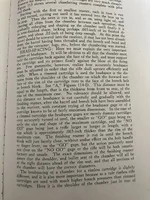
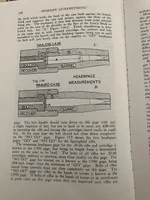
More details from Clyde Baker’s modern gunsmithing below.
In most sporting rifles in ordinary use, it’s something to be aware of, but not worried about per se. What changes headspace. Lots of wear on the bolt lugs, but we are talking hardened and tempered steel, so provided lugs are kept clean and not full of grit that then acts as grinding paste you should be fine. And too many way over pressure cartridges may set lugs back. But you have to be doing something stupid to do this.
Attachments

Last edited:
Printer paper does vary a lot in thickness. And is soft. A better thing to use is Scotch Magic Tape, which is very uniformly 2.5/1000" thick and much better as a shim material for this sort of measurement.Most A4 paper is about 4 to 5 thou thick, so disk of paper diameter of a cartridge head. Stick it on the head and see if it will chamber. Should be tight closing. Add two disks and it shouldn’t close.
Useful for checking e.g. headspace when setting up resizing dies for minimal shoulder bump. E.g. if going for say 2/1000", the bolt should no more than stiffen up slightly with one layer stuck on the head, and become hard with two layers. Comparators can only get you so close, the real test is chambering in your rifle.
Chambers may not conform absolutely precisely to specified shoulder dimensions (for bottlenecked chamberings). SAAMI specify the reference point in a simplistic way, CIP do it better, based on shoulder angle. Some comparators just use a plain drilled hole in soft aluminium. Others use a conical hole for the precise shoulder angle of the cartridge, made from stainless steel. Fortunately most body comparator inserts are made to a sort of industry standard, so are interchangeable between comparator bodies. The plain hole type are inexpensive and only a small set is needed to cover a wide range of chamberings. The conical shoulder angle type have to be matched to the shoulder angle of the specific chambering being measured. Swings and roundabouts, don't really cost much more if you only buy the ones you need, pay your money and make your choice.
Indeed, but factory cartridges are generally made to cartridge min./max. dimensions. Which are supposed to sit within chamber max./min. The tolerance band is quite large, and can even overlap slightly. You can learn something from this sort of test, but nothing near precisely enough to compare with the gauges used for proof testing, or making rifles in the first place.But do note there is a variation in the length of factory cartridges- they are with spec, but some will give a slightly stiff bolt close.
E.g a 308 Winchester chamber length can be from 1.630 to 1.640" Whereas the ammunition can be from 1.627 to 1.634" in length. So headspace of the combination could be anywhere from +0.013" to negative 0.004" The negative headspace possibility (delta L problem) would definitely result in tight bolt closure, even though everything is in spec. Quite a few common cartridges also have a delta L mismatch, which could account for some reports of some factory ammo being hard to chamber. I blame SAAMI for, basically, getting this wrong, but these SAAMI specs. are pretty much cast in stone, so have to be translated as-is by CIP so aren't going to be updated. Pure CIP chamberings are I think better done
Delta L problem - Wikipedia
I don't think you can really learn much from e.g. experimenting with bits of printer paper.
Well made modern rifles will probably be made with chambers close to minimum length. Sako and Tikka seem to do this. And shouldn't be expected to alter much in use, with sensible cleaning and lubrication of the critical interfaces.
Switch barrels introduce a whole extra layer of potential issues. None, AFAIK are made in the UK, so the interchangeable bits and pieces will be proofed according to the methods agreed by their proof authorities, and CIP committees. Relying on ultra precision manufacturing, in process gauging, statistical process control, the use of co-ordinate measuring technology etc. etc.
I understand that one US manufacturer, Savage, has had a go at making a straight pull switch barrel, still relying on the cost-effective barrel nut method of setting headspace rather than precision machining, or selective-fit recoil lugs (Remington method), which has not as yet been a success. I think you have to look to Europe to know how to do this well. Which is technically complex, and expensive.
It should not. And if detected at proof, the original proof marks should be struck out. It would need to be corrected then re-submitted. If suspecting that a rifle might not be correct best to get it checked first by someone with gauges. BTW you can do an approximate rudimentary test with only a go gauge, using the Scotch Magic Tape trick or proper engineering shim stock , to shim the go gauge into a no-go gauge. These gauges are not inexpensive.For whatever reason this question came up in the back of a beaters wagon yesterday, if a rifle has incorrect headspace, will/can it still pass proof?
The proof houses use precisely calibrated, and regularly re-calibrated ones.
For whatever reason this question came up in the back of a beaters wagon yesterday, if a rifle has incorrect headspace, will/can it still pass proof?
Yes.
Have bought two rifles which failed, one would no close on a 'Go' gauge, the other would close on a 'No Go'.
Both were (rubber) stamped at Birmingham Proof House.
Admittedly, neither were 'factory'. One had been converted from .222 to .223 and the other had a PTG bolt in it.
I recently bought a rifle and could not find any UK proof marks on it, much to my amusement!

levigsp
Well-Known Member
But did it have the relevant proof marks from europe?Yes.
Have bought two rifles which failed, one would no close on a 'Go' gauge, the other would close on a 'No Go'.
Both were (rubber) stamped at Birmingham Proof House.
Admittedly, neither were 'factory'. One had been converted from .222 to .223 and the other had a PTG bolt in it.
I recently bought a rifle and could not find any UK proof marks on it, much to my amusement!


Heym SR20
Well-Known Member
I would question whether the conversions had been done post being factory and they had never resubmitted for proof.Yes.
Have bought two rifles which failed, one would no close on a 'Go' gauge, the other would close on a 'No Go'.
Both were (rubber) stamped at Birmingham Proof House.
Admittedly, neither were 'factory'. One had been converted from .222 to .223 and the other had a PTG bolt in it.
I recently bought a rifle and could not find any UK proof marks on it, much to my amusement!
As for not having British Proof Marks on new rifles sold in the UK, the UK is a signatory to the CIP and all member countries recognise each others proof marks. Finland, Austria, Spain, Czech Republic, Slovakia, Germany, Italy, Chile, UAE and Russia are all signatories. So any Tikka, Sako, Steyr, Blaser, Heym, Merkel, Sauer, Chapuis, Berretta's Bergara's etc will have their own country proof marks, and not the UK's.
All American guns (Remington's, Rugers etc) Danish (Schultz and Larsen etc) and of course any British made guns will all feature either Birmingham or London proof marks.
I think this might be a basic flaw in the established proof methods. Chambers are gauged prior to the proof rounds being fired. After that they are inspected by, Mk1 eyeball, maybe also dye penetration or Magnaflux as is done as standard in some other CIP places, but not AFAIK in London or Birmingham. However they are not gauged again after the proof rounds are fired, AFAIK. So if something moved after the proof rounds, it might not be detected.My 280 ack passed proof charge loads but it was found later to be over 4tho off in head space .
Although the 280 Ackley Improved is homologated by SAAMI, it is not by CIP.
London and Birmingham being CIP places cannot be expected to have gauging, or proof ammunition, for anything not standardised by CIP. See here to do a search:
CIP - Homologation
Perhaps it was proofed as a wildcat. Or maybe just using a 280 Rem. proof load. And maybe gauged using 280 Rem. gauges. This is supposed to be just an "improved" chambering, interchangeable otherwise with the original, a P O Ackley concept. BTW, as far as I can see, the only "Ackley" that CIP recognise is the 30-06 Ackley Improved. Which I suspect is a rare thing, anywhere.
Is it a factory rifle, or something you had built for you ?
Not entirely correct. Any gun/rifle imported into a CIP country must be proofed in that country.All American guns (Remington's, Rugers etc) Danish (Schultz and Larsen etc) and of course any British made guns will all feature either Birmingham or London proof marks.
So, a Remington, Ruger ,anything American, something Dansk, Swedish, Norwegian, etc. etc. could first show up in a CIP country, be proofed there. People in other CIP countries do also buy such things. And, dare I say it, may have more sophisticated methods than ye olde Worshipful Company of Gunmakers, or even the new boys in Birmingham have quite got their heads around.
In places where rifles are mass manufactured usually the proofing is done in the factory, with someone from their proof authority in attendance to observe, if not participate, and sign it off.
Once proofed, in any CIP country, with their markings, then could turn up in the UK. Without London or Birmingham proof, or them knowing anything about it.
A competent RFD should be able to recognise CIP proof markings, as could you or I. They are shown in our proof regulations, 2006 being the latest I think.

However they are not gauged again after the proof rounds are fired, AFAIK. So if something moved after the proof rounds, it might not be detected.
London certainly do. I submitted an AR10 (straight pull) that had a barrel extension that wasn't hardened properly. Gauged fine before firing, but not after...
They probably detected that something wasn't quite right during shooting the proof rounds. They have a wide remit as to how to inspect afterwards and presumably gauged it again. Not usually done. Good call. You didn't want that duff barrel extension.London certainly do. I submitted an AR10 (straight pull) that had a barrel extension that wasn't hardened properly. Gauged fine before firing, but not after...
And dare I say, a credit to the inspector doing it. This is where some flexibility, interpretation and above all experienced inspectors can show their worth. A sort of British thing, also accompanied by average, mediocre or just useless, who are hopefully whittled out pretty soon, at least to the average level. It must be a mind-numbing task to spend your day/week/year just doing this, probably takes a certain sort of personality to do it.
levigsp
Well-Known Member
Brother had a gun re-barreled in 243 and it was passed in Birmingham . This was inv1985. When he tried to zerro it would not fire! Firing pin was 1/8 off an inch from the primer! Gunsmith! Tried to tell us that the proof house must have moved the barrel! It was handed back to.them with a few choice words.


Similar threads


- Replies
- 0
- Views
- 274


