
You are using an out of date browser. It may not display this or other websites correctly.
You should upgrade or use an alternative browser.
You should upgrade or use an alternative browser.
Frankford Arsenal and AMP Annealing in the morning...
- Thread starter Stalker62
- Start date

If that had been figured out by anyone other than AMP, you would have seen cheap copies of the AMP already
Some theories (all unproven) are:
a. A thermal sensor which detects the temperature of the case neck and determines the time taken for the case to reach some specified temperature. Given that thermal sensors usually have a pretty slow response time, this would account for the destruction of a case in obtaining the correct time
b. A visible light sensor that detects when the case neck begins to glow red hot
c.. Some sort of probe pressed against the case neck which detects the case neck softening. Look at the destroyed cases - it's not a stretch of the imagination to see some sort of spring loaded probe being pressed against the case at the point where the case is melted
d. Possibly a frequency change occurs in the coil when the case melts, so detecting this shift in frequency might do it.
I'm sure others will come up with their theories
Cheers
Bruce
Some theories (all unproven) are:
a. A thermal sensor which detects the temperature of the case neck and determines the time taken for the case to reach some specified temperature. Given that thermal sensors usually have a pretty slow response time, this would account for the destruction of a case in obtaining the correct time
b. A visible light sensor that detects when the case neck begins to glow red hot
c.. Some sort of probe pressed against the case neck which detects the case neck softening. Look at the destroyed cases - it's not a stretch of the imagination to see some sort of spring loaded probe being pressed against the case at the point where the case is melted
d. Possibly a frequency change occurs in the coil when the case melts, so detecting this shift in frequency might do it.
I'm sure others will come up with their theories
Cheers
Bruce

Foxyboy43
Well-Known Member
I didn’t like to say……Blimey what a rigmarole! I think I'll stick with tumbling using walnut media and the occasional ultrasonic clean followed by reloading cases numerous (often many) times and continue to achieve minute of angle/deer/fox/gong or better. However, each to their own.

Not sure about thate) possible change in electrical resistance of the brass as it heats up and then melts.
it's the eddy currents flowing around the neck of the case combined with the cross sectional area and resistivity of the brass at the neck of the case that produces the heat that does the annealing
My annealer monitors the current going into the ZVS circuit that drives the coil and although the current does increase very slightly as the brass heats up, I don't think it's enough of a change or a clear enough change to detect when the brass is correctly annealed or melts.
Cheers
Bruce
Somebody, maybe you, or me, needs to take a look inside an AMP to try to figure it out. I rather suspect that it is done by some magic looking at the drive to the induction coil rather than any other proximity sensors. Never mind a probe pressing on the neck.Not sure about that
it's the eddy currents flowing around the neck of the case combined with the cross sectional area and resistivity of the brass at the neck of the case that produces the heat that does the annealing
My annealer monitors the current going into the ZVS circuit that drives the coil and although the current does increase very slightly as the brass heats up, I don't think it's enough of a change or a clear enough change to detect when the brass is correctly annealed or melts.
Cheers
Bruce
I'm pretty sure that it triggers only once the brass starts to melt, or just before. If they could do it non-destructively, I expect they would. Prior to AZTEC being put into them, the procedure was to send AMP some cases for them to characterise, destructively, then give you a code.
It may also be that it does not use a simple ZVS circuit to drive the coil either, in self resonant mode. Other ways of powering induction coils are also available.
Which would require a volunteer with one to let someone have a look. Any volunteers, @Stalker1962
Last edited:

Stalker62
Well-Known Member
Sweet of you to ask, but no.Which would require a volunteer with one to let someone have a look. Any volunteers, @Stalker1962

Somebody, maybe you, or me, needs to take a look inside an AMP to try to figure it out. I rather suspect that it is done by some magic looking at the drive to the induction coil rather than any other proximity sensors. Never mind a probe pressing on the neck.
I'm pretty sure that it triggers only once the brass starts to melt, or just before. If they could do it non-destructively, I expect they would. Prior to AZTEC being put into them, the procedure was to send AMP some cases for them to characterise, destructively, then give you a code.
It may also be that it does not use a simple ZVS circuit to drive the coil either, in self resonant mode. Other ways of powering induction coils are also available.
Which would require a volunteer with one to let someone have a look. Any volunteers, @Stalker1962
I'm not sure posting publicly, on the internet, the intent to copy a patented technology, by reverse engineering it after viewing how it works, is a very good idea. If the UK product does go to market, this statement of intent, could be used to sue for patent infringement (if they, AMP, chose to pursue it).
Stalker62
Well-Known Member
I'm not sure posting publicly, on the internet, the intent to copy a patented technology, by reverse engineering it after viewing how it works, is a very good idea.
Would not be the first time, someone has regretted opening a box.
Have we learnt nothing from Pandora?



Here are the patents assigned to AMPI'm not sure posting publicly, on the internet, the intent to copy a patented technology, by reverse engineering it after viewing how it works, is a very good idea. If the UK product does go to market, this statement of intent, could be used to sue for patent infringement (if they, AMP, chose to pursue it).
Patents Assigned to AMP ANNEALING LIMITED - Justia Patents Search
Justia - Patents - Patents and Patent Application Resources
 patents.justia.com
"This disclosure relates to determining a material transition point such as a melt-point, and to determining an annealing parameter based on the determined material transition point. Changes in a parameter associated with an electromagnetic circuit coupled to an object subject to heating are monitored. A material transition point is determined upon detecting a predetermined change in the parameter. The annealing parameter is derived from the determined material transition point."
If the AMP method was discovered by examining a disassembled unit and that same method copied in the proposed device then IMHO, a copyright infringement will have occurred
Determining the material transition point is not copyrightable, but the method by which that transition point is determined may well be.
If the proposed device determines the transition point by a method different than that used by AMP, then no copyright infringement occurs
IMHO, even when a method using the same principle as the AMP machine is used to determine the transition point, no copyright is infringed unless the implementation of that principle is close or identical to the that used by AMP
Cheers
Bruce
Except when you state publicly that you're opening up an AMP to see how it works (which was my point). If you had done it without looking at the internals of an AMP, I'd say you were correct.Here are the patents assigned to AMP
I think this is the interesting bitPatents Assigned to AMP ANNEALING LIMITED - Justia Patents Search
Justia - Patents - Patents and Patent Application Resources
"This disclosure relates to determining a material transition point such as a melt-point, and to determining an annealing parameter based on the determined material transition point. Changes in a parameter associated with an electromagnetic circuit coupled to an object subject to heating are monitored. A material transition point is determined upon detecting a predetermined change in the parameter. The annealing parameter is derived from the determined material transition point."
If the AMP method was discovered by examining a disassembled unit and that same method copied in the proposed device then IMHO, a copyright infringement will have occurred
Determining the material transition point is not copyrightable, but the method by which that transition point is determined may well be.
If the proposed device determines the transition point by a method different than that used by AMP, then no copyright infringement occurs
IMHO, even when a method using the same principle as the AMP machine is used to determine the transition point, no copyright is infringed unless the implementation of that principle is close or identical to the that used by AMP
Cheers
Bruce
I am not convinced that the AMP AZTEC method actually determines a material transition point (whatever that might mean, seems an attempt to be all encompassing), or specifically a melting point, purely by parameters associated with an electromagnetic circuit. Seems to me that it probably works by the way the case is suspended, then once melted, bits start dropping off, or slumping, changing the focus of the induction coil, a "parameter change" then happening in the induction coil driver, which again is a very broad brush capture-all wording, then being monitored.Here are the patents assigned to AMP
I think this is the interesting bitPatents Assigned to AMP ANNEALING LIMITED - Justia Patents Search
Justia - Patents - Patents and Patent Application Resources
"This disclosure relates to determining a material transition point such as a melt-point, and to determining an annealing parameter based on the determined material transition point. Changes in a parameter associated with an electromagnetic circuit coupled to an object subject to heating are monitored. A material transition point is determined upon detecting a predetermined change in the parameter. The annealing parameter is derived from the determined material transition point."
If so this is nothing to do with determining a "material transition point" directly by looking at electromagnetic coupling.
Which is a well established method in industrial applications of induction heating, or melting. E.g. induction hardening of steels, when the transition from austenitic to martensitic can be deduced by changes in the induction circuit parameters. Held for a suitable time, then backed off to anneal. Likewise melting "furnaces", sophisticated ones which can tell when the contents have mostly changed from solid to liquid.
Brass, however, does not behave like steel, with any real sort of changes in "magnetic" properties as it passes through some sort of stress relieving, full annealing, or simply melting, transition. That is, basically, down to time and temperature.
The AMP AZTEC method, they will of course defend. If you do not defend a patent, say send some warning shots over the bow (Aka legal letters) then you might as well admit the patent was no good. If getting into a ding-dong, best to do some sort of a deal rather than getting involved in expensive and time consuming litigation. This is what patents are for. There is also a test as to whether such things were obvious and previously discussed openly, which I suspect this one would fail on, if challenged. Depending on where the patents were filed, locally or everywhere that IP is recognised (costly).
Copyright is something quite different, and of course anyone copying exact circuit designs, component selections, even PCB layouts, would be on a sticky wicket. Though stranger things have happened, where e.g. an audio mixer circuit was blatantly copied by another manufacturer. There was nothing particularly innovative in the design, but beautifully implemented in the original. And nicely copied. That case rested on copyright. And was lost.
As for software patents, that is whole other can of worms which I, fortunately, have not had to concern myself with. And regarded differently, in different legislations.
Ultimately, if you can make a better mousetrap, that works and customers appreciate, market it, make make it at a fair price, make some good profit, well done. Then consider licensing whatever is the unique aspect, providing you have been secretive about exactly how it works, ideally having some sort of patent that may or may not have any real worth. OK I am named on five patents, belonging to my then employers. I got bonuses for that which were nice, Employers made good kit, nobody tried to infringe, time has passed, better methods are now used.
I never proposed to "discover" the AMP method. I already have a hypothesis about how they are doing it. Just curious to take a look inside one and confirm that they have implemented it nicely. Which, by most accounts, they have.If the AMP method was discovered by examining a disassembled unit and that same method copied in the proposed device then IMHO, a copyright infringement will have occurred
Determining the material transition point is not copyrightable, but the method by which that transition point is determined may well be.
If the proposed device determines the transition point by a method different than that used by AMP, then no copyright infringement occurs
IMHO, even when a method using the same principle as the AMP machine is used to determine the transition point, no copyright is infringed unless the implementation of that principle is close or identical to the that used by AMP
Cheers
Bruce
I was not really being serious. Just try not to drop any more steel pins into it.Sweet of you to ask, but no.
Reverse engineering is ubiquitous in industry. Particularly in the automotive sector. To see how things have been done, then maybe try to do it better, or simply at lower price. In that sector there really is almost nothing new under the Sun, nor patentable, the competitive advantage is from doing it better than the others. It is allowed.Except when you state publicly that you're opening up an AMP to see how it works (which was my point). If you had done it without looking at the internals of an AMP, I'd say you were correct.
Elon Musk is an exemplar of this. He refuses to patent anything that he does. Even lets his companies explain in detail their developments. Thereby making them un-patentable by anyone else. Of course all the other competitors tear down something new from his companies, and try to figure out why they made changes. E.g. if you think you can make a better EV drivetrain, go for it, if you think you can implement it well enough. But then he is a leader, not a follower, with, perhaps, some inner moral compass.
Last edited:
Here is the detail of US patent 11209375Here are the patents assigned to AMP
I think this is the interesting bitPatents Assigned to AMP ANNEALING LIMITED - Justia Patents Search
Justia - Patents - Patents and Patent Application Resources
"This disclosure relates to determining a material transition point such as a melt-point, and to determining an annealing parameter based on the determined material transition point. Changes in a parameter associated with an electromagnetic circuit coupled to an object subject to heating are monitored. A material transition point is determined upon detecting a predetermined change in the parameter. The annealing parameter is derived from the determined material transition point."
If the AMP method was discovered by examining a disassembled unit and that same method copied in the proposed device then IMHO, a copyright infringement will have occurred
Determining the material transition point is not copyrightable, but the method by which that transition point is determined may well be.
If the proposed device determines the transition point by a method different than that used by AMP, then no copyright infringement occurs
IMHO, even when a method using the same principle as the AMP machine is used to determine the transition point, no copyright is infringed unless the implementation of that principle is close or identical to the that used by AMP
Cheers
Bruce
https://patentsgazette.uspto.gov/week52/OG/html/1493-4/US11209375-20211228.html
As I already speculated/theorised, they monitor the frequency of the induction circuit to detect the "material transition point" when the "sacrificial object" or "second object" i.e. brass, melts.
Then determine an "annealing parameter". To be applied to the "first object"s subsequently, to anneal them without melting them.
This is not novel, IMO. It is a technique long used for heat treatment of other things. Except that they are typically looking for a "material transition point from say austenite to martensite, in steels.
Probably this discussion could be of more use on the other thread, discussing some other method of determining how to induction anneal brass cartridge cases. I think that the way AMP do it is clear to me. The detail of how to then determine the annealing parameter is where they have done the difficult work, materials testing, and showed us in great detail on their website. This, I suggest, is the real cleverness, and not something anyone else could simply copy, without also doing that hard work themselves. Their other patent covering the implementation of the hardware is also interesting, and potentially shows how they might be considering further developments of the machine.
Altogether something rather good, without competition, streets ahead. And the price quite justifiable IMO. A niche product, for a niche market, I suspect primarily in the US. Hence the US patent filings. Rather than worldwide, AFAIK. If I haven't missed something, I suspect that someone selling some similar product anywhere else would be possible. But I am no IP specialist, in the class of e.g. Sir James Dyson..
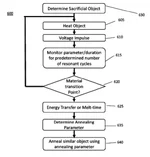
1. An apparatus for annealing a first object, the apparatus comprising:
an electric circuit comprising a coil and a capacitor;
a driver for delivering voltage to the electric circuit;
a sensor for repeatedly measuring an inductance parameter indicative of an inductance of the electric circuit, wherein the inductance parameter is selected from the group consisting of: an inductance of the coil; a resonant frequency of the electric circuit and a duration of a predetermined number of electrical cycles of a current in the electric circuit; and
a processor configured to:
activate the driver when the coil is magnetically coupled to a second object, wherein the second object responds to annealing in substantially the same way as the first object;
monitor repeated measurements of the inductance parameter by the sensor;
determine a melting point of the second object from a predetermined change in the measurements of the inductance parameter;
determine one or more annealing parameters for annealing the first object based on the determined melting point of the second object, wherein, when the driver is activated in accordance with the determined one or more annealing parameters when the coil is magnetically coupled to the first object to inductively heat the first object, a temperature of the first object is maintained below the melting point of the second object, and wherein the one or more annealing parameters are selected from the group consisting of: annealing time; power rating; and heat transfer amount; and
activate the driver in accordance with the determined one or more annealing parameters when the coil is magnetically coupled to the first object to inductively heat the first object.
So naive.<chuckle> I always find it curious when those that scream the loudest about following the rules, justify not following the intent of the rules when it suits their needs.
It's always interesting to watch...
Innovation can thrive outwith the patent, or design copyright system. Make a better mousetrap and, perhaps, you will prosper.
I did allude to Sir James Dyson, who indeed made a better mousetrap, after some false starts, In the UK, and other parts of the World, we don't Hoover the carpets anymore, we use a Dyson. Or a copycat. He is/was very keen on protecting his IP, though most of that has long since been busted.
There is a reason why patents expire, typically after 25 years. Ultimately they are stifling.
His R+D place is operated under conditions of absolute secrecy, though I haven't heard recently of anything interesting emerging. I well remember when mum bought one of his "ballbarow"s Nice idea, fell to bits after a few runs to the allotment with some light load in it. Under-developed.
He even had a fantasy project of developing a ridiculous EV, quite deluded, which soon enough was canned. But not before he had spaffed, some say $2 billion, in the attempt. Ouch. Should have stuck to vacuum cleaners, hand driers etc. not things he didn't properly understand.
Nevertheless he has done well. One of the richest men in the UK, and possibly the largest landowner in England. As well as a consummate tax dodger, sorry, highly respected contributor to our society. I admire him.

James Dyson - Wikipedia
Stalker62
Well-Known Member
Jesus H. Christ!
Five months ago, I post some utter drivel, on SD, about 'cleaning brass'.
How dull is that?
How can that deteriorate into anything more banal? It can't - it's about cleaning fing brass!

Well now. Fast forward some couple or three months - and we have an 'international' incident about fing copyright, with folk seeing how much 'cut and paste' from the tinternet they can drag up - to bolster their 'argument'.
Couple of questions.
Do you have access to a "Gentlemen's Club" (Ladies' Club, if that is your preference) ?
It's rhetorical. Go and find your local " Club". Spend some money. Buy some drinks. Spend time with real people. Get drunk. Get laid. Get arrested.
OK, maybe not arrested.
If that offends you (I don't care), go to your local Church/Temple/Synagog/Meeting House/'Fill in the gap" and chat to some real people.
Do not, for the love of God (insert your own divinity figure {P.S. - I still don't care}), get hung up, on the cleaning of brass for old cartridge rounds, on the shagging internet.
Do not sit up at midnight, trawling the tinternet ...

for 'shite' that 'supports' your argument - and then post it, purporting to be the...

NB
The irony of this post, is not lost on me...
Any hoo.
What do I care?
Off to Africa this weekend.

On another trip I can ill afford.
When my body, has never been so old and 'out of shape' - with my ego writing cheques, my body can't cash.
Which is much like at the end of the Safari, with me writing cheques, my Bank can't cash...
On the up side.
Whilst I am on the Dark Continent, I will not be posting stuff on here, (obtained from the "virtual world") about nothing that matters in the real world .
Which will be a blessing (I have no doubt) for you all.
Folks.
It's the internet. It's not real. It should be a place for chat and fun.
It should be that...it could be that...
Five months ago, I post some utter drivel, on SD, about 'cleaning brass'.
How dull is that?
How can that deteriorate into anything more banal? It can't - it's about cleaning fing brass!
Well now. Fast forward some couple or three months - and we have an 'international' incident about fing copyright, with folk seeing how much 'cut and paste' from the tinternet they can drag up - to bolster their 'argument'.
Couple of questions.
Do you have access to a "Gentlemen's Club" (Ladies' Club, if that is your preference) ?
It's rhetorical. Go and find your local " Club". Spend some money. Buy some drinks. Spend time with real people. Get drunk. Get laid. Get arrested.
OK, maybe not arrested.
If that offends you (I don't care), go to your local Church/Temple/Synagog/Meeting House/'Fill in the gap" and chat to some real people.
Do not, for the love of God (insert your own divinity figure {P.S. - I still don't care}), get hung up, on the cleaning of brass for old cartridge rounds, on the shagging internet.
Do not sit up at midnight, trawling the tinternet ...
for 'shite' that 'supports' your argument - and then post it, purporting to be the...
NB
The irony of this post, is not lost on me...
Any hoo.
What do I care?
Off to Africa this weekend.
On another trip I can ill afford.
When my body, has never been so old and 'out of shape' - with my ego writing cheques, my body can't cash.
Which is much like at the end of the Safari, with me writing cheques, my Bank can't cash...
On the up side.
Whilst I am on the Dark Continent, I will not be posting stuff on here, (obtained from the "virtual world") about nothing that matters in the real world .
Which will be a blessing (I have no doubt) for you all.
Folks.
It's the internet. It's not real. It should be a place for chat and fun.
It should be that...it could be that...
Last edited:
Actually no, you posted about how your wet tumbler actually worked. And your cock-up about retrieving the pins. How long had it been sitting around unused ? Quelle surprise. Then went on to tell us how you had finally, after two years, dared to try out AZTEC mode on your £1400 AMP. And, again, quelle surprise, it worked as advertised. In total having annealed all of 24 cases. In two years of ownership. Previously reporting how you had almost destroyed it by letting steel tumbler pins drop into it. Blow me down with a feather. BTW, you don't actually need to put steel pins, or any other sort of "media" into a wet tumbler for it to do quite a good job of getting the outside of the brass shiny, as well as dislodging the worst of the clag from the inside. Read the instructions, where this is made clear.Jesus H. Christ!
Five months ago, I post some utter drivel, on SD, about 'cleaning brass'.
How dull is that?
All terribly banal.
Not really. Enquiring minds like to know how their expensive bits of kit actually work. I had already figured it out, long ago. And come up with some alternative ideas, but too lazy to take them any further, or find out if they have any merit. Amongst other things, I am an electronic engineer. Also an applied physicist Sorry if that sometimes shows..Well now. Fast forward some couple or three months - and we have an 'international' incident about fing copyright, with folk seeing how much 'cut and paste' from the tinternet they can drag up - to bolster their 'argument'.
@mealiejimmy was still full of speculation in post #43. I hope I have now clarified that. Not by reverse engineering, but simply by reading their, rather poor, patent. Only yesterday.
That can be the danger of trying to patent something obvious, lets the cat out of the bag. Sometimes better to be silent and keep everyone guessing.
Indeed I do, a private members club, which does admit women also. But you'd have to dress appropriately and behave yourself, were I to invite you for a chinwag, were you to be somewhere near St. James. Actually extremely exclusive, royal patronage, only for people with military connections, officer class and above, though we do make exceptions, for the "right sort" if proposed by another two members. Inside there can be some rather louche and amusing company. Excellent food too, albeit very traditional.Couple of questions.
Do you have access to a "Gentlemen's Club" (Ladies' Club, if that is your preference) ?
I think you doth protest too much. But you can't take it with you when you are gone, so enjoy it while you still can
Actually, given your alias, I suspect that I am a few years ahead of you. And at least as creaky. And not so good at juggling the finances either.When my body, has never been so old and 'out of shape' - with my ego writing cheques, my body can't cash.
Which is much like at the end of the Safari, with me writing cheques, my Bank can't cash...
I do look forward to your report upon your return. I immensely enjoyed you last one from the Hebrides. Deeply envious.On the up side.
Whilst I am on the Dark Continent, I will not be posting stuff on here, (obtained from the "virtual world") about nothing that matters in the real world .
Which will be a blessing (I have no doubt) for you all.
Quite so. So here is a smiley just for you. Just to prove that I am not incapable (I very rarely do this)It's the internet. It's not real. It should be a place for chat and fun.
It should be that...it could be that...
 Peace, love and happiness.
Off to listen to Alfie Moor's latest "It's a fair cop" BBC Sounds - It's a Fair Cop - Available Episodes You might appreciate that.
Similar threads

- Replies
- 14
- Views
- 801

- Replies
- 34
- Views
- 1K


- Replies
- 31
- Views
- 2K


