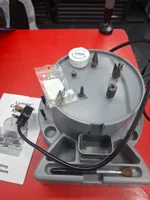
Case prep centre...notes on primer uniformers

ChesterP

Well-Known Member
For a while, I've been perplexed about why my primers are being gas blown (carbon rings on the perimeter of the case head between primer and case) resulting in the bolt face pitting, so I took the rifle to a local gunsmith and we tested headspace (check and ok), bolt and locking lugs (all ok) and examined the bolt face. There was a lot of scratching heads until the question was asked "do you uniform your primer pockets?" and thinking on this, I'd used the uniforming plug on the case prep centre when buying some once fired brass after FL resizing it all. Not with the intention of taking anything more than a slight skim, perhaps a thou, off the primer pockets when cleaning them all up but that wasn't the issue. The issue with uniforming plugs is that they remove the slight rounding fillet at the base of the primer and when you seat the primer, it sits a tiny bit deeper than intended and gets blow back hard against the bolt face on detonation which can result in gas cutting of the bolt face even though the primers aren't flattened or show no other signs of over pressure. This has happened a lot with the last few loaded batches and I just couldn't pin down why but now I know. It wasn't loads being over pressure, it was the sensitivity of the primer being seated a tiny bit too deep. End result is the bolt face has to be spark cut back to clean it up, re machined and to ensure there's no cracks in it and the barrel removed and chamber re-set for the corrected headspace. Lesson learned. Best place for the uniforming tool is the bin. It'll save you a considerable sum by throwing the thing away. I'll replace it and the primer pocket cleaning tool with a steel brush cleaner instead. Not ashamed to admit this old hand has been caught out. Every day is a new learning day.
 
For a while, I've been perplexed about why my primers are being gas blown (carbon rings on the perimeter of the case head between primer and case) resulting in the bolt face pitting, so I took the rifle to a local gunsmith and we tested headspace (check and ok), bolt and locking lugs (all ok) and examined the bolt face. There was a lot of scratching heads until the question was asked "do you uniform your primer pockets?" and thinking on this, I'd used the uniforming plug on the case prep centre when buying some once fired brass after FL resizing it all. Not with the intention of taking anything more than a slight skim, perhaps a thou, off the primer pockets when cleaning them all up but that wasn't the issue. The issue with uniforming plugs is that they remove the slight rounding fillet at the base of the primer and when you seat the primer, it sits a tiny bit deeper than intended and gets blow back hard against the bolt face on detonation which can result in gas cutting of the bolt face even though the primers aren't flattened or show no other signs of over pressure. This has happened a lot with the last few loaded batches and I just couldn't pin down why but now I know. It wasn't loads being over pressure, it was the sensitivity of the primer being seated a tiny bit too deep. End result is the bolt face has to be spark cut back to clean it up, re machined and to ensure there's no cracks in it and the barrel removed and chamber re-set for the corrected headspace. Lesson learned. Best place for the uniforming tool is the bin. It'll save you a considerable sum by throwing the thing away. I'll replace it and the primer pocket cleaning tool with a steel brush cleaner instead. Not ashamed to admit this old hand has been caught out. Every day is a new learning day.
As you very likely know, primers move rearward to the bolt face due to the pressure they alone produce (before any powder is ignited). The subsequent pressure from the powder charge then pushes the case head back against the bolt face effectively reseating the primer flush with the case head. The movement of the primer even in an un-uniformed primer pocket can be quite large given the tolerances on primer pocket depth (0.007” for a large rifle primer) & tolerances on primer height (0.013” for large rifle) & the cartridge headspace. Additionally the primer is seated below flush the case head - Sierra for example recommend seating primers 0.008” below flush - therefore all primers have to move out & in during firing quite a number of thou’ - without problems. Given that the radius of the fillet at the bottom of the pocket is only a couple of thou’ its removal has little net effect on how much a primer backs out when other far larger tolerances & normal seating depths are considered.

Are you sure this is the mechanism which is causing the primer cups not to seal properly?

I do have reservations about the removal of the tiny fillet but they aren’t related to gas blowing past the primer.
 
That's the theory of the gunsmith who recommends primers should only be seated a few thou under the case head. I won't be sure if it solves the issue but as we've checked for carbon rings, checked barrel, checked headspace and re-evaluated loads (all are well within safe max, at least a full grain under), tried new brass, then this leaves primer type and primer pocket. As it happens with standard CCI primers as well as with the KVB223M primers I've been using, that leaves only the primer pockets and bolt face. The bolt face has been gas cut and there is a very slight wear dish in the face so by spark eroding it, literally no more than 8 thou, and skimming it, then re-setting chamber for correct headspace, there's not much more we can think of doing. It's an unusual problem but he has seen this before when primer pocket uniformers are used which remove the fillet and also skin a little off the base making overall primer movement increase by anything up to 8 to 10 thou. Seat them well in and you can see that this can lead potentially to issues.
 
The bolt face has been gas cut and there is a very slight wear dish in the face so by spark eroding it, literally no more than 8 thou, and skimming it, then re-setting chamber for correct headspace, there's not much more we can think of doing.
images-39.webp

Have you got that bit in 'Janet & John'?
 
On reading this I went and checked close to 500 fired cases in 4 different calibres with their primers still in place awaiting prep for reloading with a Loupe and didn't find any signs of blow back, I also checked the bolts on the respective rifles and all I could was some very slight shiny marks from when the primer has rubbed against the bolt face when the bolt was rotated to extract the fired cases.
All of the cases have been reloaded several times and the cases have all had their primer pockets uniformed.
My standard routine on once fired cases in regard to the case head is de-prime, pocket uniform, de-burr and uniform flash holes, and if it's Norma Brass the pockets have also been swaged, as I have had a few batches where the pockets have been so tight that seating the primer has been very difficult, and in some cases, misfires have been an issue due to the primer not seating properly.
After that first prep I just clean the pockets with a small brush in the Dremel and U/S or tumble after resizing and trimming/deburring the case neck.
Is there not a possibility that you have another variable here, small flash holes, uniformer digging too deep or off centre or something else?
Seems strange that you are getting so much blow back that it is pitting the bolt face?
 
Sounds more like old brass with enlarged primer pockets allowing gas leakage. The pocket go first in my cases that is if I don’t loose them in the field first which I usually do lol
I have found that Fed brass was particularly prone to this when loading fairly stout loads in .270, 2, 3 or 4 reloads and it felt that it was too easy to seat a primer, I stopped reloading .270 in Fed brass.

Edit,
This prompted a memory and I checked a box of factory ammunition left in the safe.
It was as I remembered, .270 factory has a blue ring and stain around the primer pockets and a smudge of blue on the primers, Loctite? Penny pinching on tooling for the primer pockets, a smidge of loctite is cheaper than renewing the tools, so as they get worn it is used to cover manufacturing that is out of tolerance??
 
Last edited:
Ok, so to answer a few points raised. 1. No, it's not old brass. If peeps read the thread, it happened with a batch of new as well ; 2) No, it's not small flash holes or burrs or anything else like that. 3) uniforming pockets was a common factor in most but not all.

As I've already said, I've been trough every permutation I can think of and the gunsmith has gone through these with me too and is equally perplexed. It's never happened on any other rifle in years of shooting and reloading. It's a new one on me. All I can say is I bought the rifle used (well used) and bought it for the action, re-barrelled it and shot it. Never had this issue up until last year except once after rebarrelling when I went too hot on some 5 fired cases. I ditch my cases generally after 5 firings in 223 except Lap cases when I've had almost double that. Primer pockets are good and tight and it still happens. The bolt was a little gas cut when I bought it but now is much worse after just half a dozen shots where primers have been blown past. I think all we can do in these circumstances is think logically through what our reloading steps are, what components we use, how we prep cases and what loads we use and how they're loaded. That and check throat and barrel, bolt and headspace. Been there, done all that. The only reason I raised this is because the 'smith is pretty sure it's the uniformer contributing to the issue because he's seen this happen before and deals with way more rifles than I've had hot dinners so willing to follow his recommendations and try the rifle again when he's done with it. If it still happens, it'll be scrapped and I'll still be none the wiser so as my old man used to say "wait and see" which is an apt motto.
 
I have found that Fed brass was particularly prone to this when loading fairly stout loads in .270, 2, 3 or 4 reloads and it felt that it was too easy to seat a primer, I stopped reloading .270 in Fed brass.

Edit,
This prompted a memory and I checked a box of factory ammunition left in the safe.
It was as I remembered, .270 factory has a blue ring and stain around the primer pockets and a smudge of blue on the primers, Loctite? Penny pinching on tooling for the primer pockets, a smidge of loctite is cheaper than renewing the tools, so as they get worn it is used to cover manufacturing that is out of tolerance??
The blue is most definitely not Loctite. It is usually a lacquer which is used as a sealant to ensure no moisture can enter through the primer area. Some, particularly older milsurp, will have lacquer round primer and around the neck.
You can even lacquer seal your own reloads.
 
On reading this I went and checked close to 500 fired cases in 4 different calibres with their primers still in place awaiting prep for reloading with a Loupe and didn't find any signs of blow back, I also checked the bolts on the respective rifles and all I could was some very slight shiny marks from when the primer has rubbed against the bolt face when the bolt was rotated to extract the fired cases.
All of the cases have been reloaded several times and the cases have all had their primer pockets uniformed.
My standard routine on once fired cases in regard to the case head is de-prime, pocket uniform, de-burr and uniform flash holes, and if it's Norma Brass the pockets have also been swaged, as I have had a few batches where the pockets have been so tight that seating the primer has been very difficult, and in some cases, misfires have been an issue due to the primer not seating properly.
After that first prep I just clean the pockets with a small brush in the Dremel and U/S or tumble after resizing and trimming/deburring the case neck.
Is there not a possibility that you have another variable here, small flash holes, uniformer digging too deep or off centre or something else?
Seems strange that you are getting so much blow back that it is pitting the bolt face?
Pretty well mirrors my findings. Particularly the Norma pockets. Using a Sinclair Primer Uniformer on Norma is a pain in the a--e. And seating RWS primers almost breaks my thumb LoL.
 
@ChesterP

Have you compared the case lengths of fired , unfired and sized cases ?

I'm wondering if recutting the pockets , when combined with excessive relative headspace would allow the primer to back out so far as to fail to obdurate ? You stated that you had f/l sized the new cases but not the degree of shoulder set back you use on fired cases .

My Hornady .223 f/l die will set the shoulders back on fired cases a full 0.010" for example .

Pure conjecture on my part .
 
Last edited:
Good point Pip. Yes. I checked that too but cases were obturating or at least there was no obvious sooty marks on the case shoulder or body. I removed the bolt firing pin and tested some fire formed cases against resized and set my FL die to bump back no more than 1 thou.
 
I have used a Sinclair Primer Uniformer for 20 years, the case only needs triming once and it only cuts the base of the primer pocket, not the sides when used in a hand tool.
 
Good point Pip. Yes. I checked that too but cases were obturating or at least there was no obvious sooty marks on the case shoulder or body. I removed the bolt firing pin and tested some fire formed cases against resized and set my FL die to bump back no more than 1 thou.

I was only referring to primer obturation .

I have both large and small K&M rifle primer pocket uniformers , you're more than welcome to borrow . If it would help , dm me ?
 
Back
Top