Where are we up to with the lead ban for rifles?

Unless you’ve got a permission shooting for a deer cull, 20 rounds in a day starts adding up a bit!
Not with you here is this suggested scenario unpaid culling , in that case you shot 20 deer for free yet paid for the ammo ? Or paid for the rounds and paid for the beasts , which isn't really culling ?
Twenty deer in a day is work even with small deer , 20 large deer is full on grafting unless you told to leave them where they fall . Not sure i could do that unless they where all poor beasts even paid
 
I have not yet made the transistion to centrefire calibres. Could someone please briefly tell me what, if any, the implications are for the ballistic performance/accuracy of non-lead ammunition of a given calibre when used in barrels which have twist rates traditionally used for lead bullets? In short, is it going to matter much in practice if lead ammunition eventually becomes completely outlawed?
Plenty out there if you do a search, lots for and lots against, but as with lead some rifles will shoot a brand and weight good and another brand and similar weight crap.
 
Plenty lead in supposedly 'lead free' ammo... start at the primer and work your way up... trades description act anyone? :-| :fib: 🤑

'Non-toxic' won't fit the bill either, since any metal will be toxic to humans in sufficient quantities.
 
As Heym SR20 says.
I only went to non-lead because landowners/syndicates I was involved with stipulated their use instead of conventional bullets.
I wasn't overly keen to do so, but have got on ok with them since first using them.
Used correctly I have begun to think that most of the non-lead ammo I have tried actually surpasses the performance of a lot of the conventional ammo which I have used in the past
But
Still no actual legislation ordering the use of non-lead though
Likewise I am firmly of the opinion that the performance of the latest generation monolithic bullets out perform traditional cup and core bullets and any of the bonded, partition type bullets. Yes they are more expensive that cheap cup and core, but not a lot different to bonded or partition type bullets (especially RWS H-Mantle or ID Classic).

Personally I do not want lead in any of the food I eat, nor do I want other animals that eat the grallochs to die of lead poisoning.

On the range where bullets are captured then crack on with old lead.

But there are some pretty intersecting premium target monolithic bullets now being used on long range targets.
 
I have not yet made the transistion to centrefire calibres. Could someone please briefly tell me what, if any, the implications are for the ballistic performance/accuracy of non-lead ammunition of a given calibre when used in barrels which have twist rates traditionally used for lead bullets? In short, is it going to matter much in practice if lead ammunition eventually becomes completely outlawed?
Not really. There are now plenty of good solutions that will work in the vast majority of rifles in every day use.

There was whinging about 243 and 1 in 10” twist. There are 100gn Scottish deer legal solutions now available. But with the Scottish government no dropping min weight to 80gn, there are plenty of solutions that work.

I am sure there will be a few, pretty much obsolete cartridges that you will need to load your own.

As for price - superior terminal performance and less meat damage = more meat recovered, that outweighs the additional cost.
 
Copper doesn't kill quite as quickly IME. It's not as good as lead- but good enough.

It's more of a problem in the smaller calibres IMO. Small CFs and rimfires will struggle.

17 Hornet and 17 HMR won't have the range they used to. And 22lr will probably be redundant.
 
It's more of a problem in the smaller calibres IMO. Small CFs and rimfires will struggle.

17 Hornet and 17 HMR won't have the range they used to. And 22lr will probably be redundant.
Not in my experience at all. Mostly I have had drop on the spot kills. I have had a small percentage run a few yards.

And thats also the experience of those who have shot large numbers. I know others shooting deer to silly ranges with monolithic copper bullets.

Just like lead bullets, shot placement is everything.

As for small centrefires. I use a 223 with 51gn copper bullets. Everything I have shot from crows, foxes and small deer. Same result to well over 200m.

As for the 17 HMR - now being widely used with copper bullets for pest control by many estates and agencies. Range not an issue.

22 rf - you have a point. Its the old 1 in 16” twist that’s the problem. I believe new 22 are being made with faster twist which work well.

At moment though only really one rimfire solution on the market in UK.

But there are very large markets - eg California and public lands in other US States as well as much of Europe now stipulating lead free, and 22 rf is widely used, so solutions are being worked on.

There is a US company making copper 22 rf bullets for specialist competition use that are shooting a very long way with very good accuracy.

Here in the UK Horton & Sons have developed Hortonium, which is a patented alloy, with properties similar to lead. They have developed methods of producing shot, centrefire cored rifle bullets and yesterday announced they made a 40grain 22 long rifle ammo.

They are developing the technology and working with major ammo manufacturers who will licence to manufacture in bulk.
 
Not in my experience at all. Mostly I have had drop on the spot kills. I have had a small percentage run a few yards.

And thats also the experience of those who have shot large numbers. I know others shooting deer to silly ranges with monolithic copper bullets.

Just like lead bullets, shot placement is everything.

As for small centrefires. I use a 223 with 51gn copper bullets. Everything I have shot from crows, foxes and small deer. Same result to well over 200m.

As for the 17 HMR - now being widely used with copper bullets for pest control by many estates and agencies. Range not an issue.

22 rf - you have a point. Its the old 1 in 16” twist that’s the problem. I believe new 22 are being made with faster twist which work well.

At moment though only really one rimfire solution on the market in UK.

But there are very large markets - eg California and public lands in other US States as well as much of Europe now stipulating lead free, and 22 rf is widely used, so solutions are being worked on.

There is a US company making copper 22 rf bullets for specialist competition use that are shooting a very long way with very good accuracy.

Here in the UK Horton & Sons have developed Hortonium, which is a patented alloy, with properties similar to lead. They have developed methods of producing shot, centrefire cored rifle bullets and yesterday announced they made a 40grain 22 long rifle ammo.

They are developing the technology and working with major ammo manufacturers who will licence to manufacture in bulk.

Shot placement is indeed everything. But if you're putting fewer ft lbs into the animal, with more energy exiting- with everything else being equal it won't kill as quickly will it ?

I have used lead free for a couple of years on deer and its been ok. Not not as good as lead IME. The speed envelope in which lead free expands as well as lead is narrower. It needs more speed to begin with- but also has a narrower speed envelope IME. But sufficient for most situations.

Lead free in the smaller calibres is an interesting one. Inside the zero range- I agree it works well. HMR and .17 hornet. But stretching the range out- and the tiny bullet ballistics really drops off. The explosive bullets don't explode as well, and they drop off a cliff ballistically.

Compare the ballistics of a 150 yard .17 HMR and a 220 yard .17 hornet shot with and without lead and the differences really start showing up.
 
Shot placement is indeed everything. But if you're putting fewer ft lbs into the animal, with more energy exiting- with everything else being equal it won't kill as quickly will it ?

I have used lead free for a couple of years on deer and its been ok. Not not as good as lead IME. The speed envelope in which lead free expands as well as lead is narrower. It needs more speed to begin with- but also has a narrower speed envelope IME. But sufficient for most situations.

Lead free in the smaller calibres is an interesting one. Inside the zero range- I agree it works well. HMR and .17 hornet. But stretching the range out- and the tiny bullet ballistics really drops off. The explosive bullets don't explode as well, and they drop off a cliff ballistically.

Compare the ballistics of a 150 yard .17 HMR and a 220 yard .17 hornet shot with and without lead and the differences really start showing up.
As much as I was a sceptic I am finding lead free very good for deer. Shooting barnes 80 gr barnes in .257 from the 25-45 at 3150 fps, yew tree .264 114 gr at 2880 fps and the same 124/126 gr at 3100 fps. Roe and munties out to 200 in the 25, fallow often around or over 200 and a couple just over 300 with the .284. The 6.5 operated between the other 2.

All are working well and the deer are falling over from chest shots as quickly as they did with lead.

I’m not keen for smaller calibres for fox and vermin but for deer copper is good.
 
Lead will never be replaced due to the following reasons:

1. Density

2. Cost

3. Fragmentation- you can't get a monolithic bullet to expand/fragment the same way a copper jacketed, lead-cored bullet will.

These guys have done extensive tests:


Lets not forget the associated ricochet risks of a solid copper slug (which is what these bullets are, for the most part).

Designs with tin/copper powder in them are defeating the point of shooting a monolithic bullet.

If you are worried about stuff appearing in your food, wake up and realise that lead from a bullet is the least of your worries!
 
Lets not forget the associated ricochet risks of a solid copper slug (which is what these bullets are, for the most part).

Which is why such bullets were banned on MoD ranges (which includes the NSC Bisley being part of Pirbright Ranges for safety management).

They are now partially allowed, but on a limited number of ranges and restricted to 300M maximum distance. Note, too the high-BC ELR type target bullets (or any non-expanding copper bullet for that matter) remain banned.

Permitted bullets on NSC ranges ...............

b. Non lead-based ammunition (NLA) that is designed to expand is permitted on specified Bisley ranges, to a maximum distance of 300 yards. The ranges authorised for use are: Butt Zero, Century, Short Siberia, Winans Bay B and C (Zero Range), British Sporting Rifle Club (BSRC) Static and Running Deer ranges. A check zero must be conducted as the first activity of any range session:
 
Lead will never be replaced due to the following reasons:

1. Density

2. Cost

3. Fragmentation- you can't get a monolithic bullet to expand/fragment the same way a copper jacketed, lead-cored bullet will.

These guys have done extensive tests:


Lets not forget the associated ricochet risks of a solid copper slug (which is what these bullets are, for the most part).

Designs with tin/copper powder in them are defeating the point of shooting a monolithic bullet.

If you are worried about stuff appearing in your food, wake up and realise that lead from a bullet is the least of your worries!


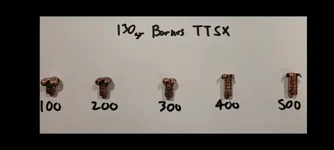
That's an excellent link but I must say I'm impressed by some of the results. Much of their tests are with pretty heavy for calibre bullets- but people have requested light for calibre bullets- and I'm impressed with the Barnes TTSX 130gr in .308


It's being launched quite quickly- 3150 fps or so. But it certainly seems valid out to 200-300 yards depending on how much expansion you consider acceptable.

Are water jugs a reasonably good replica of deer tissue ?

Do they more closely minimise skin and soft tissue or does the resistance of multiple layers of plastic more closely replicate above shot ?
 

Attachments

  • Screenshot_20230927_223216_Samsung Internet.webp
    Screenshot_20230927_223216_Samsung Internet.webp
    20.9 KB · Views: 9
Plenty out there if you do a search, lots for and lots against, but as with lead some rifles will shoot a brand and weight good and another brand and similar weight crap.
Thanks for the response. I would just stress that I wasn't being lazy in asking the question (I fully intend researching this topic further down the line, once I actually have my first centrefire rifle) but I was keen to get the views of some 'ordinary' shooters who already have some experience in making the 'lead to non-lead' transistion. Cheers.
 
Not really. There are now plenty of good solutions that will work in the vast majority of rifles in every day use.

There was whinging about 243 and 1 in 10” twist. There are 100gn Scottish deer legal solutions now available. But with the Scottish government no dropping min weight to 80gn, there are plenty of solutions that work.

I am sure there will be a few, pretty much obsolete cartridges that you will need to load your own.

As for price - superior terminal performance and less meat damage = more meat recovered, that outweighs the additional cost.
Many thanks for the response. My sole quarry will be Muntjac deer at fairly close range, so my intenfion is to use .222 Rem. ammunition, for which the established barrel twist rate for lead seems to be 1 in 12". I daresay many will scoff at this calibre in favour of .223 Rem. but as I intend learning how to load my own ammunition, I don't envisage it being a problem.
 
Many thanks for the response. My sole quarry will be Muntjac deer at fairly close range, so my intenfion is to use .222 Rem. ammunition, for which the established barrel twist rate for lead seems to be 1 in 12". I daresay many will scoff at this calibre in favour of .223 Rem. but as I intend learning how to load my own ammunition, I don't envisage it being a problem.
Ah - God’s very own calibre, obviously a man of taste and distinction!
For me 55gns Sierra Gamekings over a decent charge of Viht N120 for Munties and Hornady 50gns Vmax for foxes do nicely - do not try Vmax 52gns in the triple deuce - they won’t stabilise!
Should you need any advice when you go over to the dark side this is the place to get it.
🦊🦊
 
Plenty lead in supposedly 'lead free' ammo... start at the primer and work your way up... trades description act anyone? :-| :fib: 🤑

'Non-toxic' won't fit the bill either, since any metal will be toxic to humans in sufficient quantities.
You have got to stop eating bits of your primers. Has no one told you it's bad for you
 
Many thanks for the response. My sole quarry will be Muntjac deer at fairly close range, so my intenfion is to use .222 Rem. ammunition, for which the established barrel twist rate for lead seems to be 1 in 12". I daresay many will scoff at this calibre in favour of .223 Rem. but as I intend learning how to load my own ammunition, I don't envisage it being a problem.
You may want to check the twist in your barrel, 1:12 is 'traditional' for .223Rem whereas 1:14 is 'traditional' for .222Rem. Whilst I have found some factory ammo with 55gn bullets (Federal fmj that was 'surplus to requirement' after the foot and mouth culls from memory) would work OK in my .222 it wasn't that accurate & the reality is that 52/53gn are the heaviest it will shoot well.
 
Many thanks for the response. My sole quarry will be Muntjac deer at fairly close range, so my intenfion is to use .222 Rem. ammunition, for which the established barrel twist rate for lead seems to be 1 in 12". I daresay many will scoff at this calibre in favour of .223 Rem. but as I intend learning how to load my own ammunition, I don't envisage it being a problem.
No - 222 is a lovely cartridge. Only reason I use a 223 is that I couldn’t find a left handed .222.
 
Shot placement is indeed everything. But if you're putting fewer ft lbs into the animal, with more energy exiting- with everything else being equal it won't kill as quickly will it ?

I have used lead free for a couple of years on deer and its been ok. Not not as good as lead IME. The speed envelope in which lead free expands as well as lead is narrower. It needs more speed to begin with- but also has a narrower speed envelope IME. But sufficient for most situations.

Lead free in the smaller calibres is an interesting one. Inside the zero range- I agree it works well. HMR and .17 hornet. But stretching the range out- and the tiny bullet ballistics really drops off. The explosive bullets don't explode as well, and they drop off a cliff ballistically.

Compare the ballistics of a 150 yard .17 HMR and a 220 yard .17 hornet shot with and without lead and the differences really start showing up.
The logic that kinetic energy kills is fundamentally flawed. It was the concensus of thinking in the 1800’s when 12 bore rifle was a small cartridge and 8 and 4 bores were all the rage. But with the introduction of small smokeless powder fueled high velocity rifles this soon fell by the wayside.

With the kinetic energy logic we use 1,000 ft lb min on small deer such as muntjac and roe which have a live weight of 25 to perhaps 50kg.

Yet the likes of the 416 Rigby, 458 Lott are only producing 5,000 ft lbs, yet are perfectly capable of killing buffalo (1,000kg plus) and elephants (5000 kg plus).

Plenty of elephants fell to little rifles such as the 6.5 Mannlicher and 7x57, but using non expanding solid military type bullets. Even today the AK47 with 7.62 x39 is used by poachers to kill plenty.

And bow hunters using arrows kill just as well - albeit much closer range yet a bow produces similar energy to an FAC air rifle.

What actually kills an animal is the projectile severing major arteries and nerves within the body. If you sever major arteries it will need in a moment of two. Impact the Central Nervous System it will collapse on the spot. However a CNS shot will stun but might not kill. You need blood loss to kill.

What is required is sufficient energy to send the projectile right through the body severing all those vitals.

An arrow works by having a very sharp blade which cut as it goes in. But you have to be very careful not to hit shoulder but slip the arrow in behind.

With a bullet, how it penetrates is a function of its design.

A traditional cup and core bullet expands quickly on impact loosing lots of material with small lead fragments blasting into the lungs. The remaining slug - weighing about 50% of its original mass, may or may not penetrate right the way through.

Energy is Mass times Velocity Squared, and as the bullet sheds weight it looses energy, and as it penetrates it looses speed rapidly - hence sheds energy and momentum very quickly.

With a traditional bullet on bigger tougher animals you need to be careful on shot placement as a smaller bullet (eg 243) can easily expand completely within the nearside shoulder of a bigger deer and fail to cause catastrophic damage and a kill. I have had this happen to me. With bigger animals you need to go to bigger tougher constructed bullets that are long for calibre, so you have enough retained mass for penetration.

With a monolithic bullet, the bullet does not usually fragment. It expands into a spinning cutter that cuts right through. It doesn’t shed weight so maintains its energy as it cuts through the body.

All bullets also set up a bow wave - think of a boat - that causes a temporary wound cavity. Ballistic gel tests show a traditional cup and core has large initial wound cavity but quickly tapers off. A monolithic might not have as wide an intertial cavity, but it has a bigger cavity all the way through.

As to bullet density. Copper is 80% density of lead. But traditional lead core bullets are not pure lead. They are a lead core with a copper jacket.

If you take bullets such as the bonded cores and partition bullets the copper content is perhaps 40% weight of the bullet.

So if you look at ballistics you will not a huge level of difference between the energies and trajectories of a traditional lead and a copper monolithic bullets.

Because a monolithic bullet doesn’t break up on impact you can use a lighter bullet going faster which negates need for a heavier for calibre bullet.

We need a different way of thinking - you always do when new technologies arrive. And old thinkings don’t necessarily read across.

But I will admit plenty still think the earth is flat, and the moon is made of cheese, and that lead is not harmful to human health.
 
Last edited:
You may want to check the twist in your barrel, 1:12 is 'traditional' for .223Rem whereas 1:14 is 'traditional' for .222Rem. Whilst I have found some factory ammo with 55gn bullets (Federal fmj that was 'surplus to requirement' after the foot and mouth culls from memory) would work OK in my .222 it wasn't that accurate & the reality is that 52/53gn are the heaviest it will shoot well.
Thanks for pointing that out. I don't yet have a centrefire rifle, as I'm still awaiting for my FAC Variation to (hopefully!) come through but I'm looking forward to the .222Rem being my first intoduction to the 'dark side'!
 
Back
Top