Shot placement is indeed everything. But if you're putting fewer ft lbs into the animal, with more energy exiting- with everything else being equal it won't kill as quickly will it ?
I have used lead free for a couple of years on deer and its been ok. Not not as good as lead IME. The speed envelope in which lead free expands as well as lead is narrower. It needs more speed to begin with- but also has a narrower speed envelope IME. But sufficient for most situations.
Lead free in the smaller calibres is an interesting one. Inside the zero range- I agree it works well. HMR and .17 hornet. But stretching the range out- and the tiny bullet ballistics really drops off. The explosive bullets don't explode as well, and they drop off a cliff ballistically.
Compare the ballistics of a 150 yard .17 HMR and a 220 yard .17 hornet shot with and without lead and the differences really start showing up.
The logic that kinetic energy kills is fundamentally flawed. It was the concensus of thinking in the 1800’s when 12 bore rifle was a small cartridge and 8 and 4 bores were all the rage. But with the introduction of small smokeless powder fueled high velocity rifles this soon fell by the wayside.
With the kinetic energy logic we use 1,000 ft lb min on small deer such as muntjac and roe which have a live weight of 25 to perhaps 50kg.
Yet the likes of the 416 Rigby, 458 Lott are only producing 5,000 ft lbs, yet are perfectly capable of killing buffalo (1,000kg plus) and elephants (5000 kg plus).
Plenty of elephants fell to little rifles such as the 6.5 Mannlicher and 7x57, but using non expanding solid military type bullets. Even today the AK47 with 7.62 x39 is used by poachers to kill plenty.
And bow hunters using arrows kill just as well - albeit much closer range yet a bow produces similar energy to an FAC air rifle.
What actually kills an animal is the projectile severing major arteries and nerves within the body. If you sever major arteries it will need in a moment of two. Impact the Central Nervous System it will collapse on the spot. However a CNS shot will stun but might not kill. You need blood loss to kill.
What is required is sufficient energy to send the projectile right through the body severing all those vitals.
An arrow works by having a very sharp blade which cut as it goes in. But you have to be very careful not to hit shoulder but slip the arrow in behind.
With a bullet, how it penetrates is a function of its design.
A traditional cup and core bullet expands quickly on impact loosing lots of material with small lead fragments blasting into the lungs. The remaining slug - weighing about 50% of its original mass, may or may not penetrate right the way through.
Energy is Mass times Velocity Squared, and as the bullet sheds weight it looses energy, and as it penetrates it looses speed rapidly - hence sheds energy and momentum very quickly.
With a traditional bullet on bigger tougher animals you need to be careful on shot placement as a smaller bullet (eg 243) can easily expand completely within the nearside shoulder of a bigger deer and fail to cause catastrophic damage and a kill. I have had this happen to me. With bigger animals you need to go to bigger tougher constructed bullets that are long for calibre, so you have enough retained mass for penetration.
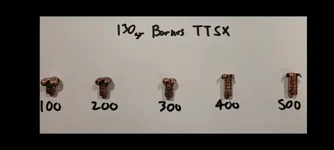
With a monolithic bullet, the bullet does not usually fragment. It expands into a spinning cutter that cuts right through. It doesn’t shed weight so maintains its energy as it cuts through the body.
All bullets also set up a bow wave - think of a boat - that causes a temporary wound cavity. Ballistic gel tests show a traditional cup and core has large initial wound cavity but quickly tapers off. A monolithic might not have as wide an intertial cavity, but it has a bigger cavity all the way through.
As to bullet density. Copper is 80% density of lead. But traditional lead core bullets are not pure lead. They are a lead core with a copper jacket.
If you take bullets such as the bonded cores and partition bullets the copper content is perhaps 40% weight of the bullet.
So if you look at ballistics you will not a huge level of difference between the energies and trajectories of a traditional lead and a copper monolithic bullets.
Because a monolithic bullet doesn’t break up on impact you can use a lighter bullet going faster which negates need for a heavier for calibre bullet.
We need a different way of thinking - you always do when new technologies arrive. And old thinkings don’t necessarily read across.
But I will admit plenty still think the earth is flat, and the moon is made of cheese, and that lead is not harmful to human health.