

You have the dominant Stag/Buck in males so it would be to have a lead hind/doe.Is it actually certain there is such a thing as a lead doe or matriarch in deer?


You have the dominant Stag/Buck in males so it would be to have a lead hind/doe.Is it actually certain there is such a thing as a lead doe or matriarch in deer?

Just as an aside to this discussion, does everyone believe that they're capable of identifying the "lead" doe in a herd of fallow, without alerting the herd and causing them to run?
Having my own contained herd of fallow has enabled me to spend far more time in close observation of their behaviour than would normally be the case, and one thing I've noticed is that the true lead hind often isn't the one that you would think it is.

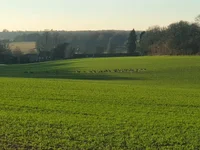
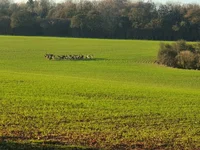
Perhaps you could offer some advice on how to deal with taking the does out of this little group? Ignoring the house in the background, their location in the middle of a large field is typical of how they tend to behave. Assuming a safe shot can be secured the outcome is very likely to be the rest of the herd disappearing into the distance at a rapid rate of knots.Agreed- it was what taught by old fashioned stalkers in the Highlands and Game Wardens in Africa.
Seems that current generation have no regard for deer - just shoot as many as possible and to hell with long term consequences. I expect future generations will be reading stories about the wonderful conservationists reintroducing very rare deer back to the British Isles.
Never happen?? Well have a read of

‘They could disappear overnight’: rare Italian deer make long journey to survival
Under an ambitious conservation plan, 60 Mesola red deer are being moved from northern Italy to Calabria, where it is hoped they will thrive and multiplywww.theguardian.com

Not necessarily - or at least not in as clear cut a way as you might think.You have the dominant Stag/Buck in males so it would be to have a lead hind/doe.
We are not shooting those, your question was about a lead doe. We might have to call up Sir David Attenborough to sort out this one lol...Not necessarily - or at least not in as clear cut a way as you might think.
There are a fair number of species with clear linear hierarchies in one sex but not in the other. There are also plenty of species where it’s not really possible to identify linear hierarchies in either sex - or at least not consistently.
And even where hierarchies exist, it’s not always (or even often) the dominant that leads during group movements.

A frustrating and difficult situation. There's no other way I can describe it..Perhaps you could offer some advice on how to deal with taking the does out of this little group? Ignoring the house in the background, their location in the middle of a large field is typical of how they tend to behave. Assuming a safe shot can be secured the outcome is very likely to be the rest of the herd disappearing into the distance at a rapid rate of knots.
View attachment 400354View attachment 400355

I don’t have that problem but collaborative culls are one obvious answer using people who know what they are doing and can shoot straight under all circumstances.@Heym SR20
In England, in areas of high numbers & densities of fallow (100+/sqkm), covering large areas (20000ha+) with a sex ratio of 80% female, with fragmented landownership (& therefore many safe sanctuary sites), what would be your alternative tactics to try to contribute to the wider task of reducing the population?
Please read post #28I don’t have that problem but collaborative culls are one obvious answer using people who know what they are doing and can shoot straight under all circumstances.
What to do with the mountain of venison is another problem but one that’s already created another problem.
A mass cull in such areas should maybe take place with all the venison given away or if necessary destroyed, I guess no alternative?
Haven’t thought about it much maybe I’m missing something obvious for which you’ll have to excuse me. Of course a glut of venison will be available, so next to nothing for carcasses for others who’ve done a good job of keeping numbers reasonable, but hopefully when the immediate problem and venison glut is in order and over, maybe people can get back to proper sustainable deer stalking rather than just killing deer because numbers are too high, or not shooting any at all because there’s no market value?
Took 2 hours to write this on and off between a load of other chores so as previous, maybe I’ve not considered it enough and have not taken implications into account?
- I posted originally to ask for input from people who’d maybe experienced what I experienced the other day. It wasn’t a post about ethics, destroying surplus carcasses, but one aimed at getting feedback from others who regularly shoot animals from groups of fallow in woodland. Please if you want to discuss others issues start a new thread…
It's difficult to control the narrative of a thread. I made my suggestion ref shooting lead doe or hind...... leave it as although it may help to get a second or third in the short term, I try to leave them so there's not too much distruption to their habits giving more reliable opportunities another day.Please read post #28

So there in lies the fault in your and many others logic in deer management. Don’t worry, you are not alone, many of the conservation agencies spin the same nonsense.@Heym SR20
In England, in areas of high numbers & densities of fallow (100+/sqkm), covering large areas (20000ha+) with a sex ratio of 80% female, with fragmented landownership (& therefore many safe sanctuary sites), what would be your alternative tactics to try to contribute to the wider task of reducing the population?
When it comes to the wider strategy, collaborative culls are an option that are used to some success but, even where fallow numbers are high, trying to get enough landowners and stalkers to agree on objectives is not easy.I don’t have that problem but collaborative culls are one obvious answer using people who know what they are doing and can shoot straight under all circumstances.
What to do with the mountain of venison is another problem but one that’s already created another problem.
A mass cull in such areas should maybe take place with all the venison given away or if necessary destroyed, I guess no alternative?
Haven’t thought about it much maybe I’m missing something obvious for which you’ll have to excuse me. Of course a glut of venison will be available, so next to nothing for carcasses for others who’ve done a good job of keeping numbers reasonable, but hopefully when the immediate problem and venison glut is in order and over, maybe people can get back to proper sustainable deer stalking rather than just killing deer because numbers are too high, or not shooting any at all because there’s no market value?
Took 2 hours to write this on and off between a load of other chores so as previous, maybe I’ve not considered it enough and have not taken implications into account?
You make it clear in many of your posts there areas in which you have a lot of knowledge and experience. It would be polite to acknowledge those areas in which you have less experience: the topic of parts of England with a fallow problem really does seem to be one such area.So there in lies the fault in your and many others logic in deer management. Don’t worry, you are not alone, many of the conservation agencies spin the same nonsense.
Are you really saying that over a 20,000 ha range, which is 200 square kilometres, you have a total population of 100 x 200 =20,000 deer in your local area.
20,000 ha is a reasonably large Scottish Estate, so your figure of 20,000 deer is nonsense, that would equate to 1 deer per ha.
Or if I am reading you correctly you have a herd of about 100 breeding females which tend to keep in one herd so when seen in a 100 ha field you equate to a population or stocking density of 100 deer per sq km. Yes it is, but only for that one sq km.
In fact if you take that herd of 100 over the total 200 sq km you actually have a stocking density of 2 per sq km.
When you claim sex rations of 80% female you are probably correct - females of herd species tend to go around in large herds with young afoot, and a few young males yet to be kicked out of the herd, and a few mature males keeping them herded. Depends though on time of year.
Males will mostly be off in other batchelor groups. You need to take these into account as well when looking at population densities.
And in this discussion is any consideration being given to the young deer which still rely on their mothers input and education. Or is the consensus just to shoot what you can and leave all the young to fend for themselves?

2 things are needed.
A Hughes 500, (or a Robbie 44) and a good shooter with an AR15 - although nowadays there are several guys making shotguns work well if carcase recovery isn't part of the plan.
Might not look too good in the Guardian though.
Got to love the strop hanger in the second video.
Apologies for the music.

Thanks @Hazlett once again you’ve beaten me to it & again probably said it in a much calmer way than I would have doneYou make it clear in many of your posts there areas in which you have a lot of knowledge and experience. It would be polite to acknowledge those areas in which you have less experience: the topic of parts of England with a fallow problem really does seem to be one such area.
In the south of England, 20000ha might have 10s-100s of landowners and include residential/built areas. My figure of 100/sqkm was to give you an scenario to think about specific stalking tactics in relation to your comment of not shooting the lead doe. In the 20000ha I have in mind, the overall number of fallow would be in excess of 10000 and, I very much hope, not as many as 15000. Densities would vary from nil to hotspots of several sqkm with a density over 200/sqkm.
There aren't many who pipe up on SD about the work involved on trying to deal with fallow numbers but with the fragmented ownership and the unshot land creating safe zones it becomes very hard work on the ground where you are trying to make the difference. We owe it to the deer not just to throw our hands in the air and give up - we have to do what we can and doesn't provide much scope for being selective. Have a look at posts #24 & #28, realistically what sensible choices are there other than to go for older adult does?
I am sorry @Donkey Basher , I don't have any experience of the situation described in your original post and so I wasn't originally planning on contributing but when you're in one of these problem fallow zones, others need to know that it's extremely hard work and just being told that you're doing it wrong isn't helpful.


I do agree that finding people who "know what they are doing and can shoot straight", are not so easy to find, but organisers can assign the the more demanding areas, safety wise, to those they deem the most trustworthy or known, and the safer areas to those guys they do not know so well? Post #24 shows a few animals that could be taken in the second photo, assuming the woodland behind does not contain unknown safety issues. The areas where safety and exiting bullets are of concern, which includes photo 2, those rifles should use highly fragmenting rounds used sensibly.When it comes to the wider strategy, collaborative culls are an option that are used to some success but, even where fallow numbers are high, trying to get enough landowners and stalkers to agree on objectives is not easy.
As to the original post and the comments re shooting the lead doe, take a look at the photos posted in #24. What are you going to do? We know that to reduce numbers we have to get the does, preferably pregnant. There are unsexable fawns in there and difficult to sex yearlings, the females of which may or may not be pregnant, - or there are 'lead' does which almost certainly will be. (Re other posts above, I am not convinced in my area that there is often one single lead doe but rather older generations and herd hierarchy.) Realistically, in this situation, there is no choice but to go for as many adult does as present themselves. This isn't just killing deer, it is a very specific approach.
unless you'll be taking what you shoot. . And of course I wouldn't like to see large collaborative culls in my area, but there again, I don't have 100/km2.


