Satellite flyers, soooo frustrating!

In the last few years I’ve completely changed my reloading load development process. Basically I think about what speed i need to get for terminal performance at whatever range and try to find a load with an acceptable sd at that speed, perhaps using different powders or primers. I don’t look for velocity nodes (a myth?) or test different COAL also largely a waste of time in my view. as far as groups go I rely on good components which nearly alway provide acceptable accuracy.
Then I spend the time and bullets I’ve saved on development on getting good drop data and good zeros. All in all cheaper and quicker than the old “traditional” way
 
The thing is, statistics on fired groups is a bit like statistics on a broken wheel bearing, so many factors. So many things that might or might not repeat. Not even knowing what one is trying to "statistic"... the rifle? the hold? the shooter? shooter fatigue? the weather? the ammo? primer/bullet etc.
On the new rifle we tested this weekend we had alone over 100fps difference between the first and ~tenth shot. That will probably increase for a while, then settle, then drop again after x. One thing was consistent though, the ammo that my friend has been using for two world championships PRS and the one that I have been using for hunting in the last three years has shot the same group size as in every other rifle we used it in. There are ways of making rifles more consistent as well as bullets just easier to group. I don't see the PRS guys doing much 100m grouping or statistics. Just zero then see what she dose down range. Trying to not shoot out the barrel before you know if or if not she shoots well enough.
edi
I totally get one has to be practical and I don’t think anyone is suggesting insane amount of testing but it is still worth at least being aware of the mathematical issues. Then you can make informed decisions. I don’t think the odd 10 shot zero will kill your barrel and as I mentioned I actually shoot more bullets in anger now and less in load development so for me it’s a win win 👍
 
  • Like
Reactions: ejg
Possibly when phrased the way he did ('if you shoot a 2 inch group, you don't have a 1MOA gun'), he has a point.

If you take the parameters I've used above (95% of shots taken across a lifetime fall within a 1" circle), then a 2" group is very unlikely (p<0.00001).

I agree with you in terms of the rifle but you have made some assumptions in the sense that you've decided upon a rifle that shoots to 1 inch and you've also decided that it produces a normal distribution. Now, I agree that it almost certainly does produce a normal distribution and that you have to make some assumptions about its accuracy so 1 inch is as good as any other. However, in the real world you can't be completely sure this is exactly the case, there's nothing to stop a 2 inch rifle shooting a 1 inch group, or a 3 inch group.

However, the bigger problem is that the person doing the shooting will probably not produce a normal distribution as various factors will act upon them. In the first instance we have the tendency to see what we want to see - how often do you see pictures of tiny groups that someone says they can shoot all the time but you know that this is one target out of maybe hundreds? Or how often do people discount the occasional wild shot on the basis that it doesn't count? Also people don't shoot the same all the time and I think what I believe the outcome will be can have an impact upon the actual outcome - I don't know why that is but I think it fair to say that mental state, confidence, and expectation plays a role in almost everything else in life so I have to suggest that it could skew the outcome and this will be superimposed upon the normal distribution that you see from the actual rifle.

There is a thing called multivariate analysis that can, basically, untangle multiple factors and help quantify the impact of each upon the outcome. I've no idea how you'd do this and only the most vague concept of what it actually is but I suspect that some very complex stats analysis like this would be required before we could come close to getting any clear idea of what is important in rifle shooting. One example of this that I've seen, and relevant to us, was some MVA analysis that was carried out on the effects of shooting on sika populations which found that shooting mature hinds reduced numbers in the long term much more markedly than you might imagine - I appreciate that everyone knows that shooting hinds is the only way to reduce numbers but you might imagine that half of calves you shoot are going to be female and so shooting calves would be of some value, I might even consider that a young calf may have the potential to produce more calves than an older hind, but this wasn't the case. Pretty much the reduction achieved by shooting mature hinds made shooting anything else a waste of time. Things aren't always as they seem.
 
I agree with you in terms of the rifle but you have made some assumptions in the sense that you've decided upon a rifle that shoots to 1 inch and you've also decided that it produces a normal distribution. Now, I agree that it almost certainly does produce a normal distribution and that you have to make some assumptions about its accuracy so 1 inch is as good as any other. However, in the real world you can't be completely sure this is exactly the case, there's nothing to stop a 2 inch rifle shooting a 1 inch group, or a 3 inch group.

However, the bigger problem is that the person doing the shooting will probably not produce a normal distribution as various factors will act upon them. In the first instance we have the tendency to see what we want to see - how often do you see pictures of tiny groups that someone says they can shoot all the time but you know that this is one target out of maybe hundreds? Or how often do people discount the occasional wild shot on the basis that it doesn't count? Also people don't shoot the same all the time and I think what I believe the outcome will be can have an impact upon the actual outcome - I don't know why that is but I think it fair to say that mental state, confidence, and expectation plays a role in almost everything else in life so I have to suggest that it could skew the outcome and this will be superimposed upon the normal distribution that you see from the actual rifle.

There is a thing called multivariate analysis that can, basically, untangle multiple factors and help quantify the impact of each upon the outcome. I've no idea how you'd do this and only the most vague concept of what it actually is but I suspect that some very complex stats analysis like this would be required before we could come close to getting any clear idea of what is important in rifle shooting. One example of this that I've seen, and relevant to us, was some MVA analysis that was carried out on the effects of shooting on sika populations which found that shooting mature hinds reduced numbers in the long term much more markedly than you might imagine - I appreciate that everyone knows that shooting hinds is the only way to reduce numbers but you might imagine that half of calves you shoot are going to be female and so shooting calves would be of some value, I might even consider that a young calf may have the potential to produce more calves than an older hind, but this wasn't the case. Pretty much the reduction achieved by shooting mature hinds made shooting anything else a waste of time. Things aren't always as they seem.
I do (and teach) various forms of multivariate analysis. You could indeed work out the variance in accuracy accounted for by each variable, if your sample size was big enough. It would require hundreds (if not thousands) of shots under controlled conditions!

The simulations I’ve been presenting here are very simple and assume no more than that the error in the x and y components of accuracy is normally distributed. The beauty of this is that it makes no assumption about WHAT causes that error: as everyone points out, there are any number of things that cause variation in accuracy. None of that matters when you’re just looking at the group itself and working out if it is telling you anything informative.

Going back to the OP: he asked ‘is there a problem because I keep getting two together and one off’. Answer: no. This is what happens with 3 shot groups and normally distributed error. It doesn’t matter what the source of the error is - it’s enough to know that it’s there.

So Edi’s point is valid: a rifle that is shot under optimal conditions that produces a 2” group is extremely unlikely to be a 1MOA gun - a true 1MOA gun will not shoot a 2” group in thousands of rounds, if those are shot under optimal conditions. That’s if we use a definition of 1MOA gun to mean ‘95% of all shots across a working lifetime of 2000 shots fall in a 1” circle’.

Of course all bets are off when you start throwing in inconsistent shooting under sub-optimal conditions. Though even here, the error should follow a normal distribution - all that happens is the SD increases markedly. I think this where your point is absolutely correct: if the shooter is inconsistent (and we are), and conditions are not optimal, then a ‘true’ 1MOA gun could easily be entirely undetectable because groups are all over the place.
 
One example of this that I've seen, and relevant to us, was some MVA analysis that was carried out on the effects of shooting on sika populations which found that shooting mature hinds reduced numbers in the long term much more markedly than you might imagine - I appreciate that everyone knows that shooting hinds is the only way to reduce numbers but you might imagine that half of calves you shoot are going to be female and so shooting calves would be of some value, I might even consider that a young calf may have the potential to produce more calves than an older hind, but this wasn't the case. Pretty much the reduction achieved by shooting mature hinds made shooting anything else a waste of time. Things aren't always as they seem.

Is it possible for you to provide a link to further information on that please? I would be very interested in reading into this since one of the areas that I help manage contains Sika. In the meantime I'll do some research and see what comes up.

Thanks, Mick
 
The info is in this book:
unfortunately I don't have my copy here or I could provide the exact numbers etc. so all I can state is that I found the results surprising.

Thanks for that, I've found a few, more recent papers, by other authors based on research in Japan.
Happy to PM details to you rather than clogging this thread.

Cheers, Mick
 
I do (and teach) various forms of multivariate analysis. You could indeed work out the variance in accuracy accounted for by each variable, if your sample size was big enough. It would require hundreds (if not thousands) of shots under controlled conditions!

The simulations I’ve been presenting here are very simple and assume no more than that the error in the x and y components of accuracy is normally distributed. The beauty of this is that it makes no assumption about WHAT causes that error: as everyone points out, there are any number of things that cause variation in accuracy. None of that matters when you’re just looking at the group itself and working out if it is telling you anything informative.

Going back to the OP: he asked ‘is there a problem because I keep getting two together and one off’. Answer: no. This is what happens with 3 shot groups and normally distributed error. It doesn’t matter what the source of the error is - it’s enough to know that it’s there.

So Edi’s point is valid: a rifle that is shot under optimal conditions that produces a 2” group is extremely unlikely to be a 1MOA gun - a true 1MOA gun will not shoot a 2” group in thousands of rounds, if those are shot under optimal conditions. That’s if we use a definition of 1MOA gun to mean ‘95% of all shots across a working lifetime of 2000 shots fall in a 1” circle’.

Of course all bets are off when you start throwing in inconsistent shooting under sub-optimal conditions. Though even here, the error should follow a normal distribution - all that happens is the SD increases markedly. I think this where your point is absolutely correct: if the shooter is inconsistent (and we are), and conditions are not optimal, then a ‘true’ 1MOA gun could easily be entirely undetectable because groups are all over the place.

I know nothing at all about MVA other than that it exists but I was giving consideration to how many shots you'd need to see fired by different people to have enough data to account for all the variables. I was wondering if you would need to include people who were tired, or dehydrated, or had a sore toe? :-)

I see what you are saying about the 2 inch group and I get that now especially if we only consider the rifle.

My situation is that I've reached the conclusion that I'm the biggest factor in my shooting and that any time I blame something else the chances are that it was me and that is why I've stopped with all the various reloading black magic etc. as I simply can not find evidence to support it plus the amount of data you'd need to gather before you'd generate any information seems completely overwhelming.
 
Blimey not exactly cheap £286

I managed to get it on some sort of sale and didn't pay anything near that for it, it was still expensive enough to make the eyes water but there is a lot of useful info in it. If your local library has it or can get it then it might be a worthwhile read. Some parts of it were a bit beyond me, as it is basically a collection of scientific papers or a review of the science, but a lot of it is understandable without specialist knowledge should you be put off by the rather academic appearance.
 
I know nothing at all about MVA other than that it exists but I was giving consideration to how many shots you'd need to see fired by different people to have enough data to account for all the variables. I was wondering if you would need to include people who were tired, or dehydrated, or had a sore toe? :-)

I see what you are saying about the 2 inch group and I get that now especially if we only consider the rifle.

My situation is that I've reached the conclusion that I'm the biggest factor in my shooting and that any time I blame something else the chances are that it was me and that is why I've stopped with all the various reloading black magic etc. as I simply can not find evidence to support it plus the amount of data you'd need to gather before you'd generate any information seems completely overwhelming.
Absolutely. The shooter is always the largest source of error, and the size of that error completely dwarfs everything else.
 
Some we really need a machine based load testing service at ranges, allowing firearms to be bolted down and automated trigger arms used, and even that leaves error unless its Swiss made to bank vault or watch standards
 
I do (and teach) various forms of multivariate analysis. You could indeed work out the variance in accuracy accounted for by each variable, if your sample size was big enough.

So Edi’s point is valid: a rifle that is shot under optimal conditions that produces a 2” group is extremely unlikely to be a 1MOA gun - a true 1MOA gun will not shoot a 2” group in thousands of rounds, if those are shot under optimal conditions. That’s if we use a definition of 1MOA gun to mean ‘95% of all shots across a working lifetime of 2000 shots fall in a 1” circle’.
Would I be correct that part of our problem with fliers is that these are at the far end of the normal distribution curve - the 2.25% beyond +2 standard deviations? The other end - the 2.25% at - 2 SD we are quite happy with as they are within our desired circle.
 
Some we really need a machine based load testing service at ranges, allowing firearms to be bolted down and automated trigger arms used, and even that leaves error unless its Swiss made to bank vault or watch standards
Pointless, given the whole point is how a rifle - be it for deerstalking and/or F Class - groups in the Owner's shoulder?

K
 
Some we really need a machine based load testing service at ranges, allowing firearms to be bolted down and automated trigger arms used, and even that leaves error unless its Swiss made to bank vault or watch standards
Or just accept that for stalking purposes, there’s no point worrying about all the things like COL, primer, neck tension etc etc. Probably not really worth worrying about the load either - you’re very unlikely to be able to detect any real effect of varying the load without firing hundreds of rounds.

Instead, far better to spend the time practicing and improving your shooting.
 
Is it possible for you to provide a link to further information on that please? I would be very interested in reading into this since one of the areas that I help manage contains Sika. In the meantime I'll do some research and see what comes up.

Thanks, Mick
I'd think part of this is calf mortality - they may well die before they breed. The adult hinds are already breeding
 
Would I be correct that part of our problem with fliers is that these are at the far end of the normal distribution curve - the 2.25% beyond +2 standard deviations? The other end - the 2.25% at - 2 SD we are quite happy with as they are within our desired circle.

A lot of this hinges on what you mean by 'flier'.

Many people use it to mean any shot that appears not to be grouped with the rest. So with 3 shot groups, where the 'two together and one apart' pattern is very common, people often describe the one apart as a flier. As my simulations should show, it's not - it's a common outcome of random sampling from a normal distribution.

As you suggest, another (and probably far more rigorous) definition of a flier is one that sits >2SD from the point of aim. Though remember we're dealing with a distribution where the mean is 0, with a symmetrical error either side of that. In very simple terms, assuming we're only thinking about error in the vertical component, our -2.25% goes low and your +2.25% goes high.

The reason we over estimate accuracy by being more willing to accept 'good' groups as evidence of an accurate rifle is this: with any normal distribution, you do still get a 'lump' in the middle: you are more likely to see a shot close to the mean than one away from the mean. So a while a true 1MOA gun is very unlikely to produce a 2MOA group, a true 2MOA gun can still produce 1MOA groups.

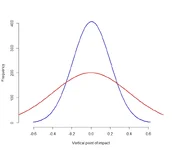
The plots below should illustrate this. They show how often a shot falls a given distance above or below the point of aim. Blue is from a 1MOA gun, red from a 2MOA gun. As you can see, for the 1MOA gun, the likelihood of seeing a shot more than 0.5" above of below the target is vanishingly small. By contrast, the 2MOA gun still gets a fair number of shots within 0.5" above or below the target.

different sds.png
I think this means that when deciding if a rifle is accurate, the question should not be 'can it shoot a 1MOA group'. It should be 'what is the largest group it shoots, over n shots under optimal conditions'. You then decide what n you're happy with. For most of us, that seems to be 3! I reckon for stalking purposes, 20 is probably enough. At least you'll get some practice while doing it.
 
Last edited:
A lot of this hinges on what you mean by 'flier'.

Many people use it to mean any shot that appears not to be grouped with the rest. So with 3 shot groups, where the 'two together and one apart' pattern is very common, people often describe the one apart as a flier. As my simulations should show, it's not - it's a common outcome of random sampling from a normal distribution.

As you suggest, another (and probably far more rigorous) definition of a flier is one that sits >2SD from the point of aim. Though remember we're dealing with a distribution where the mean is 0, with a symmetrical error either side of that. In very simple terms, assuming we're only thinking about error in the vertical component, our -2.25% goes low and your +2.25% goes high.

The reason we over estimate accuracy by being more willing to accept 'good' groups as evidence of an accurate rifle is this: with any normal distribution, you do still get a 'lump' in the middle: you are more likely to see a shot close to the mean than one away from the mean. So a while a true 1MOA gun is very unlikely to produce a 2MOA group, a true 2MOA gun can still produce 1MOA groups.

The plots below should illustrate this. They show how often a shot falls a given distance above or below the point of aim. Blue is from a 1MOA gun, red from a 2MOA gun. As you can see, for the 1MOA gun, the likelihood of seeing a shot more than 0.5" above of below the target is vanishingly small. By contrast, the 2MOA gun still gets a fair number of shots within 0.5" above or below the target.

View attachment 401510
I think this means that when deciding if a rifle is accurate, the question should not be 'can it shoot a 1MOA group'. It should be 'what is the largest group it shoots, over n shots under optimal conditions'. You then decide what n you're happy with. For most of us, that seems to be 3! I reckon for stalking purposes, 20 is probably enough. At least you'll get some practice while doing it.

Also most helpful and informative. I started with a 2moa shot out .308 and it used to drive me mad as it would shoot 1” groups occasionally and I thought it was me till I bought a new rifle !!
 
Also most helpful and informative. I started with a 2moa shot out .308 and it used to drive me mad as it would shoot 1” groups occasionally and I thought it was me till I bought a new rifle !!
Yup.

My long descent down the statistical rabbit hole started exactly like that: a .308 that could shoot 1Moa groups. But often didn’t.

Eventually I realised that there was nothing wrong with me, or the ammo. It was just a 2moa gun, at best.

I now have a Creedmoor that, regardless of what I shoot through or how badly I’m shooting, has never shot a group bigger than 1.2”. I strongly suspect that if someone competent was behind the trigger, it would never shoot more than 0.75”.
 
Back
Top