

You express my thoughts for novices exactlyKit. The more complex, the more room for mistakes. Especially for novices IMHO the simpler the better.
Scopes and optics - these days endless sources of error. Parallax adjustment - usually on a dial or ring that can easily be moved. And often forgotten about. Yes good cheek weld and position mitigates, but wrong parallax and poor position can easily put the impact off several inches. Ditto dialling turrets. Flip up scope covers catching your hat / cap etc
God alone knows about all the electronic optics - running through menus etc etc.
Bipods - work great on nice flat ground. But when used in anger the ground is never flat and you are messing about trying to get the legs level. The mounting always seems to go loose when you need to use it. Its why I prefer shooting off my pack or a rolled up slip, etc.
Sticks. I was playing a few hundred pound set of quad sticks last week end. Little lever catches on the legs to adjust length - knocked open and leg looses its ability to hold up a rifle. Had telescoping sticks collapse on me more than once. A pair, three or four hazel wands with bungee joints cost nothing and can’t fail.
For a novice I would always encourage simplicity. Add complexity if you really need to.
You are using an out of date browser. It may not display this or other websites correctly.
You should upgrade or use an alternative browser.
You should upgrade or use an alternative browser.
'When' you mess up. Not 'if'
- Thread starter User00056
- Start date


The bigger factors can beAdrenaline rush doesn't work like that.
It takes something like 5-10 seconds for the rush. So if you're completely calm at the shot and have tendency to get excited afterwards -> only the seconds immediately after the shot are "safe".
Another option is to try'n'control the rush, this seldom works 100% but takes away majority of symptoms (loss of fine motor control and exaggerated major control). Breathing control and so on.
I guess most seasoned stalkers won't get the adrenaline rush (in a way that it really affects their actions). But there are other, more conscious symptoms that may lead to bad judgement after a botched shot.
Limited outings in the year (booking stalking) see it many times in scuba diving with forgotten skills.
Fitness where you are puffed out.
Lack of sleep I would say the biggest problem especially meeting a guide for Roe stalking at 3am to get on the ground in the summer!
We changed going to Lincoln for 1 1/2 days so only one nights poor sleep instead of 3 as leaving very early 2.30am you were half dead then lol
For me a miss will be increased with being tired shooting foxes say 4 then going way back for the fifth only to miss it.
The other factor is you just simply miss.

Heym SR20
Well-Known Member
Thanks. I have been mentoring a friend from afar. Against my suggestion he got an all singing and dancing scope. He has been constantly frustrated at zero keeps moving, especially when he changes position.You express my thoughts for novices exactly
Finally after several months he rang me all excited as he has worked out that setting parralax correctly removes all the error. And he has found that dropping from 14x down to 6x makes shooting so much easier.
He had also realised you don’t need to dial for range inside 200m - and on his ground there is only spot that you get a 200m shot.
He finally understood why I had suggested a simple 6x42 in the first place.
He has the best part of £1500 sitting on top of his rifle along with probably 1lb of un needed weight.

Could you redraw the lines aiming for the top of the heart and at 30 degrees? Which is the shot in question (assumed aim point).I think that the consensus is that in ballistic terms, the effect of the downhill angle is not worth considering but the trajectory of the bullet through the body of the deer is significant, as pointed out in post #17, as per this sketch:
View attachment 405912
If you take the same point of aim on the downhill shot as for a horizontal shot, there is the risk of missing the heart/vitals altogether, so in order to go through the heart, the aim needs to be higher.
Then you would see that at that range and angle, you’d still hit the heart. The picture is exaggerated to make the point.
To put it into perspective, for your bullet to hit the deer at 45 degrees as the diagram, say from a high seat rail height of 3.6 metres, on flat ground the deer would have to be around 3-4 metres in front of you…..

maximus otter
Well-Known Member
A very honest account. I'd probably be more inclined to think the rifle was off myself, rather than a 30 degrees 110yrds making much difference.
For my rifle - 6.5 x 55mm with 120 grain bullets - the difference between 96 and 110 yards is only ~ 0.15"
maximus otter

@theroedeerguy
Well-Known Member
Chest shot slightly far back, compounded by an unsympathetic angle required a tidy up to remove an exit wound contaminated with fragmented liver.
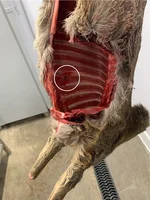
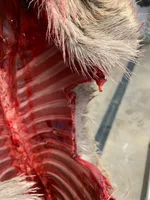


Damoeire33
Well-Known Member
Honest account & it's happens to the very best shooters.

Pine Marten
Well-Known Member
I the view that I want as few moving parts and variables on everything as possible. That's why I specified fixed chokes on my shotgun too. There is now no question as to why I miss things: it's because I shot badly. I'm the only variable. Well that and the birds not playing nicely.Thanks. I have been mentoring a friend from afar. Against my suggestion he got an all singing and dancing scope. He has been constantly frustrated at zero keeps moving, especially when he changes position.
Finally after several months he rang me all excited as he has worked out that setting parralax correctly removes all the error. And he has found that dropping from 14x down to 6x makes shooting so much easier.
He had also realised you don’t need to dial for range inside 200m - and on his ground there is only spot that you get a 200m shot.
He finally understood why I had suggested a simple 6x42 in the first place.
He has the best part of £1500 sitting on top of his rifle along with probably 1lb of un needed weight.
Regarding how to adjust point of aim when shooting on a slope, my friend in Alsace told me a little rhyme in German:
"Ob hoch oder 'runter
halt immer etwas d'runter"
(Whether high or beneath
Always hold a little lower)

Thanks to the OP for getting this ball rolling and starting a thread full of good advice.
If I may add an observation, it is this.
I wouldn't be without quad sticks, but can trace more than one bad shot to having them imperfectly set up. Especially shooting downhill, I find a greater tendency to rock, usually downwards, on the shot. Another issue is their feet sinking in mud under pressure or getting tangled in summer weeds. Ignoring these issues through an exclusive focus on the rifle and the deer has been "educational".
Get the sticks right and it's a lot harder to get the rest wrong.
If I may add an observation, it is this.
I wouldn't be without quad sticks, but can trace more than one bad shot to having them imperfectly set up. Especially shooting downhill, I find a greater tendency to rock, usually downwards, on the shot. Another issue is their feet sinking in mud under pressure or getting tangled in summer weeds. Ignoring these issues through an exclusive focus on the rifle and the deer has been "educational".
Get the sticks right and it's a lot harder to get the rest wrong.
Absolutely spot on.Especially shooting downhill, I find a greater tendency to rock, usually downwards
I carry a length of dog rose with my sticks, one particular shot with a young cwd at 195mts at the end of a long cold stalk with 2 in the bag. On the sticks, "not feeling the calm" I needed! jammed the stick in the mud in front of the sticks, 2 fingers grip on the stick nice and steady no rock bang flop.Thanks to the OP for getting this ball rolling and starting a thread full of good advice.
If I may add an observation, it is this.
I wouldn't be without quad sticks, but can trace more than one bad shot to having them imperfectly set up. Especially shooting downhill, I find a greater tendency to rock, usually downwards, on the shot. Another issue is their feet sinking in mud under pressure or getting tangled in summer weeds. Ignoring these issues through an exclusive focus on the rifle and the deer has been "educational".
Get the sticks right and it's a lot harder to get the rest wrong.
Local just the quad-sticks but on the ground where it is open so a longer shot might be on the cards then it comes along.

kenbro
Well-Known Member
Bullets hit high when shooting down hill.It’s surprising how much the bullet drops going down hill we all zero on level ish ground never downhill to see what happens , a good lesson learnt
Kb
kenbro
Well-Known Member
I may be wrong, but something doesn’t sound right with those figures!Im going out after muntjac later this week and typically they are likely to be at much shorter ranges then I normally shoot. My 6.5 Creed is zeroed at 150 yards so I checked it on paper at 50 yards and 100 yards. Shot about 1.5 inches high at 50 and about an inch at 100 so 1/4'' that you mention sounds about right.
Ken.

Not by enough to worry aboutBullets hit high when shooting down hill.
Kb
Saving myself half an hour on the keyboard I'll say just this.I was out on Saturday afternoon on a guided stalk. I knew the place well as I used to live on the ground, but had never stalked it before. Approaching last light, we stalked into a mixed group, and I selected a doe at around 110 yards for a shot off sticks. What I completely failed to consider was that the shot was downhill at around a 30-degree slope. I made the rookie error of shooting to my usual point of aim and made a bad shot. To compound matters, the doe ran, then lay down around 100 yards from cover. Embarrassingly (‘cringe-inducing humiliation’ would be a more accurate description) I then missed with my next two shots due to being flustered, and then finally brought the incident to an end from about 60 yards.
The takeaways? I hadn’t been out for a while, I was slightly out of breath, I wasn’t stable enough, I hadn’t considered adjusting my aim for the slope, and I was rushing due to losing the light.
In retrospect, it was a shot I should’ve declined. I made it right very quickly, but it isn’t a stalk I shall look back on with anything other than a healthy dose of shame and embarrassment.
I guess the lesson is that it will go wrong at some point, and that almost certainly it’ll be your own fault
Respect to you first because you are dealing with it in the best possible way . We've all done it or are prone to at some point, there is no perfect human. That's a very good lesson for every single one of us.

That's where the bullets struck so definitely rightI may be wrong, but something doesn’t sound right with those figures!
Ken.
 Smack on at 150 then 4 clicks up at 200 and hitting the centre of the 3 inch gong every time
kenbro
Well-Known Member
I would have thought the bullets would hit lower at 50 yards than at 100 yards!That's where the bullets struck so definitely right
If it’s 1.5 high at 50 and 1.0 at 100, the bullet is already in a downward trajectory, so how can it get back up to zero at 150?
Ken.
kenbro
Well-Known Member
Not by enough to worry about
Roedeer said bullets drop when shooting low, I just pointed out it was the opposite.Not by enough to worry about
Similar threads

- Replies
- 48
- Views
- 3K


- Replies
- 53
- Views
- 4K
