How do you not get fed up

So we are starting to disregard the principles of good deer management on the basis of fellow stalker competition and not having the balls to educate landowners on what is best to leave and best to shoot…and laziness due to extraction.

Quality

Totally depends on what your (or the landowner’s) objective is.

Traditional deer management was all about maintaining the sport and maximising two things: (a) the chances that every guest/client saw deer and at least had a chance of a shot (and a memorable day); (b) the number of good representative stags that came off the ground (not least because that was linked to the resale value of the property). Built into the model were several assumptions: (a) that forestry and/or agriculture were not a primary concern; (b) that the overall population density was quite low (or at least low enough that modest culls kept it from entering a rapid exponential phase). It was a model largely influenced by the Highland estates during the century between 1850 and 1950. Critically, deer density was low (or absent) across the rest of the UK, so it largely worked.

Modern deer management is much more diverse, and faces completely different conditions. The biggest challenge to the traditional model is the simple fact that across much of the UK, deer density is much, much greater than it has been in hundreds of years. Deer are not just much more common and widespread, they are also often present in densities that mean a modest, selective cull does nothing at all to numbers - they are well into the rapid exponential phase of demography. To illustrate: I recently did some modelling for cluster of Perthshire estates. They were worried they were shooting too many. And yet despite shooting 74% of the deer they were counting, their population was still going up year on year. Which meant that they were part of a much larger population that was growing so fast that their efforts made no difference at all to local numbers.

Many people really don’t understand exponential growth. Once it gets going, you have lost the luxury of being selective if you have any interest in forestry or agriculture. Or indeed animal size and welfare!

Roe are the absolute worst here. The population really can double in a year. The maths then becomes relentless. Say you have a bit of ground that has a ‘carrying capacity’ of 100 animals. You’re at 50 animals. How many years til you hit the limit? Answer: 1 year. So you need to shoot 50 this year. Almost no one is willing to do that. They are still thinking that it’s possible to ‘overshoot’ and are trying to be selective.

For many, many areas, we are way past the point where it’s possible or desirable to be selective. You need to be aggressive and shoot what you see until you bring numbers well down.
 
Another illustration of the exponential growth problem: across a lot of southern England/Home Counties, there are major problems with very large numbers of fallow, and people are really struggling to get on top of them. There are serious agricultural consequences.

A common consensus is that the current problem emerged during COVID, when we lost a year (in some cases 2) of culling effort. That meant that the population had 2 years of uncontrolled recruitment. Which means that the annual increment now far exceeds the shooting capacity in those areas. They have lost any ability to influence the population using traditional approaches and cull numbers based on pre-Covid effort. Added to which fallow are just enormously difficult to cull effectively once they’re nervous and in big numbers.
 
Unfortunately, the "principles of good deer management" that you refer to seem largely based on preserving animals with "good heads", which is actually not particularly good deer management at all.
I don’t refer to that in exclusivity whatsoever. Good weight, condition, head, breeding genes - population density for the land, objectives for the land whilst not eradicating the species clearly.

Tim - do you harvest your best rams or pick the ones going to slaughter indiscriminately? Would farmers go and shoot their best breeding bull?

Similarly, the best quality deer should be left until they start going back, it will also keep a lot of fraying young and yearling bucks out of their territory. It will keep good older does with good genes.
You might have a couple of quality deer in a plantation, rather than 6-7 or 10 younger ones.

In my book, that’s deer management. It’s nothing to do with shooting the numbers down to suit a landowner or investor, that’s deer removal.
 
I suppose it depends on the drivers behind yours or others decisions.

Are you there to shoot as many deer legally possible

Does the landowner want to see large stags, bucks on his ground for what ever reason

Are you there to just get trophy heeds.

At the moment I regularly see a 4 point roe buck which I could take but I don't as he is a really good animal which hopefully will develop a good head as he ages.
 
Having a very small population of Roe, I've just been shooting one buck and a couple of does a year. However they did increase a few years back.but as soon as they crossed our boundary they were shot by the neighbours. I now just shoot them when in season and I get a chance. The same with Fallow, I always left the big mature and fit bucks just shooting young or scrubby animals. My frustration was getting to me as our neighbours were shooting the big healthy ones all season. We were and still will be shooting mainly does as the population has expanded rapidly. However as numbers are increasing I will just take anything that I see but still taking does before bucks. Luckily we've just got next door on one side which will really help us with the does.
 
I don’t refer to that in exclusivity whatsoever. Good weight, condition, head, breeding genes - population density for the land, objectives for the land whilst not eradicating the species clearly.

Tim - do you harvest your best rams or pick the ones going to slaughter indiscriminately? Would farmers go and shoot their best breeding bull?

Similarly, the best quality deer should be left until they start going back, it will also keep a lot of fraying young and yearling bucks out of their territory. It will keep good older does with good genes.
You might have a couple of quality deer in a plantation, rather than 6-7 or 10 younger ones.

In my book, that’s deer management. It’s nothing to do with shooting the numbers down to suit a landowner or investor, that’s deer removal.
While on the face of it the comparison seems reasonable, in fact it's not.
No, of course I don't send my best ram lambs to slaughter. That's because I'm a ram breeder. However, the vast majority of livestock farmers rear all of their male lambs (and calves) for eventual slaughter. There is no selection taking place whatsoever. When they need a new stock sire they buy one from a specialist breeder, such as myself.

As a breeder, I have tools available to me that other farmers do not have access to:
I can use ultrasound and CT scanning to assess the meat-to-bone ratio and conformation of the live animals, to ensure that only the best are kept;
I can weigh all my lambs at specific ages to assess growth rates;
I can DNA test all my lambs to ensure that parentage information is accurately recorded;
And I can use genomics to increase the accuracy of my breeding predictions. (We were the first sheep breeding project in the UK to have this capability).

Without these "tools", the only methods available (which are also available to managers of wild deer) are phenotypical selection (very difficult when you're 100+ yards away from the animal you're trying to evaluate) or assessment of the carcass post-mortem (which is pointless unless you know the exact parentage of the animal, and are able to identify the parents).

In addition, I can manipulate the "habitat" in which my sheep live. I can use fencing to stop them straying. I can move them to another field if they're short of grass, I can ensure that the best grazing is reserved for times of year that their nutritional requirements are higher, I can buy in extra feed, etc etc. All of these things help ensure that the genetic potential of the animals is fully expressed. Deer managers cannot do this, which further contributes to the inaccuracy of phenotypical selection. Yes, you can selectively retain the ones that appear to "do" better under the circumstances in which they're existing, but without knowing the genetics it is just a shot in the dark. (For example, a fallow buck in excellent condition in the spring may be considered worthy of retaining based on appearance, whereas in reality his good condition may be as a result of having been unsuccessful during the rut, which means as a breeder he should be culled).

A few things I have picked up on as a livestock breeder, which are overlooked by deer managers are:
Success lies in ruthless selection of females. This is far more important than concentrating on the male side of things;
Where females have access to more than one sire (as is the case with wild deer, or in sheep flocks that run multiple sire mating groups), the male that you have identified as the "best" or most "dominant", and therefore assume is the sire of the majority of the offspring, often isn't;
Appearance (phenotype) and performance (genetics) and often poles apart;
About 20% of sets of twins consist of offspring by two different sires. (Twins are very common in roe, I believe?)
Environmental factors mask genetics, as does overstocking.

Something else of interest, that I read about in a study on the genetics of wild red deer, is that the vast majority of stags do not sire any offspring in their lives, regardless of how smart they look.

Also, as the owner of two herds of enclosed fallow deer, I've observed how much influence nutrition has on antler growth and development. Good genetics is not expressed without good nutrition.
Also, whereas a poor deer is unlikely to grow a good head, a good deer may well grow a poor head.

So, my "take home" messages to deer managers from all of the above are:
A lot of traditional selection based on phenotype is merely ****ing in the wind, because it's often not giving you the result that you think you're going to get;
Traditional selection methods are very slow to produce any kind of meaningful difference;
Using antlers as the principal selection criteria isn't particularly helpful;
If you want to improve the quality of the stock on your ground, concentrate on your selection of the females;
Do not assume that the "good" male that you retained will sire "good" offspring, or even any offspring at all;
First and foremost, reduce the population to a level that the habitat can sustain;
Monitor your results. (Carcass weights is the only realistic way to do this with any degree of consistency).
 
Last edited:
I’ve been trying to manage the ground I have the best I can. How do you guys not get annoyed or just fed up when you see stags you want to leave to breed just get hammered by someone else once they leave your grounds ? Not me crying or complaining, fully on board with once someone shoots an animal on ground they’ve permission it’s fair game, just saying it can still be frustrating.
Nice to have that luxury!
 
Something I learnt many years ago, there is a lot to be said for shooing the humble muntjac and roe and even fallow!

Smaller, easier to handle and better eating 😬

Bollocks to shooting reds, now I only shooting them if I really, really and I mean really have to!

Fortunately I have 2 friends that are much keener than me to shoot the bloody things, I let them get on with it.
Agree totally ! Not long ago I had a 150m drag across a dry crop field with a large fallow hind. Although it was March, the temp was up and I was sweating like a bas…d by the time I’d got it to a tree to gralloch.
The next muntjac I shot caused me to ‘think on’ about those bigger deer.
And I can get three muntjac into a plastic crate easy without doing my back in ….
 
Agree totally ! Not long ago I had a 150m drag across a dry crop field with a large fallow hind. Although it was March, the temp was up and I was sweating like a bas…d by the time I’d got it to a tree to gralloch.
The next muntjac I shot caused me to ‘think on’ about those bigger deer.
And I can get three muntjac into a plastic crate easy without doing my back in ….
Agreed with the bigger deer. I shot a big fallow buck and a doe on a farm where I borrow the mule to move them. Phoned the farmer...mule wont start...I ll come down with the telehandler...but cant get into the field as its wet...2 of us with a big buck and a 300m drag...farmer says to me "cant you shoot them somewhere sensible next time" 😅 I have the utmost respect for people who shoot reds...I would think twice ...but suppose if you do it you either have all the gear or are built to be able to lift them...I would much prefer roe or muntjac from a handling perspective 👍
 
Agree totally ! Not long ago I had a 150m drag across a dry crop field with a large fallow hind. Although it was March, the temp was up and I was sweating like a bas…d by the time I’d got it to a tree to gralloch.
The next muntjac I shot caused me to ‘think on’ about those bigger deer.
And I can get three muntjac into a plastic crate easy without doing my back in ….
You poor boy I can just imagine the struggle you had..🤣
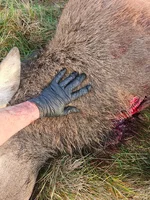
Decent stalkers should be capable of shifting the biggest down to the smallest.20241206_084800.webp
 
And further to my previous post - a shot on a muntjac (which don’t stay still for long - ever) at distances over 125m is a rewarding shot. At 200m it’s a very good shot - and if you’re not accurate and drop it on the spot I guarantee it will run to the nearest heavy cover and you’ll have a job retrieving it. Don’t ask me how I know this.
 
You poor boy I can just imagine the struggle you had..🤣
Decent stalkers should be capable of shifting the biggest down to the smallest.View attachment 428369
Good luck to you ! I’d be completely trousered if I had to recover that any distance without help. My respect to those that can and do.
I’d like to think that age and experience means I look at the deer before I shoot it and work out exactly how I’m going to recover it before I squeeze the trigger.
 
You poor boy I can just imagine the struggle you had..🤣
Decent stalkers should be capable of shifting the biggest down to the smallest.View attachment 428369
I'm glad you pitched in on that mate and thanks for your sympathy lol

Fair play to you mate...thats al I can say..though if someone offered me ground with a load of reds I would get all the kit as I dont think going down the gym would change me from being a skinny little sod...but I sit in an office most of the time
 
And further to my previous post - a shot on a muntjac (which don’t stay still for long - ever) at distances over 125m is a rewarding shot. At 200m it’s a very good shot - and if you’re not accurate and drop it on the spot I guarantee it will run to the nearest heavy cover and you’ll have a job retrieving it. Don’t ask me how I know this.
:) I should have mentioned that I dropped the doe in a willow thicket and had to drag her over a ditch on an old wooden plank as well.....shooting the buggers is the easy part.
 
I'm glad you pitched in on that mate and thanks for your sympathy lol

Fair play to you mate...thats al I can say..though if someone offered me ground with a load of reds I would get all the kit as I dont think going down the gym would change me from being a skinny little sod...but I sit in an office most of the time
Most stalkers will struggle with the first few larger Deer Mike.
Then it's either they jack in or get on with it. I'm pretty sure the majority of guys choose the latter.
The management plan i work with is simple.. Everything gets it..
 
Most stalkers will struggle with the first few larger Deer Mike.
Then it's either they jack in or get on with it. I'm pretty sure the majority of guys choose the latter.
The management plan i work with is simple.. Everything gets it..
👍I saw some footage from someone who shot a 300kg ish red stag in Romania...it was like a bullock with antlers..4 guys trying to get it into a pickup was some sight :lol:

Keep up the good work mate :)👍
 
When it comes to herd species the only thing that matters are the wishes at the landowner!

When you’re talking crops, the only thing that matters to the land owners are dead deer they want them shot they are causing damage therefore they want the problem solved that’s why they get you to do it.

The principles and the what if and what maybe are no longer a concern in today’s deer management world, numbers on the deck.

End of subject.

Because if you don’t do it, they will soon get someone who will and we are now in a world and age that there are 1000 people willing to take your place at the drop of a hat.

The principles of ethical deer management no longer exist and the sooner that people get that into their head the easier life will be for them
 
I can understand why people chose too not shoot red deer I think people are quick to forget It is dangerous not to mention not everyone
A: Wishes to be In debilitating pain in there 60s.
B: Has the physical capability too deal with them.

Obviously dont take on ground if you cant manage it but If the deer arent causing problems and there isn't massive amounts there's no need to be silly with it shooting everything, reds also move so much again neighbors are also probably shooting them (just dont be that one neighbor that provides a safe oasis for deer!)

Red deer might of been one of my favorite animals but after hunting roe they quickly became my favorite and I put reds on the back burner after shooting two a few years back, my mate Is incredibly keen on getting me a more mature stag this year a nice proper one we've already spied up a 16 pointer, he shot a small little 6 point out the herd last week for meat the "small" stag ended up weighing 28 stone I think any adult man would struggle moving those things.

Not something I'd want to shoot unless you've got proper equipment for them.
 
I can understand why people chose too not shoot red deer I think people are quick to forget It is dangerous not to mention not everyone
A: Wishes to be In debilitating pain in there 60s.
B: Has the physical capability too deal with them.

Obviously dont take on ground if you cant manage it but If the deer arent causing problems and there isn't massive amounts there's no need to be silly with it shooting everything, reds also move so much again neighbors are also probably shooting them (just dont be that one neighbor that provides a safe oasis for deer!)

Red deer might of been one of my favorite animals but after hunting roe they quickly became my favorite and I put reds on the back burner after shooting two a few years back, my mate Is incredibly keen on getting me a more mature stag this year a nice proper one we've already spied up a 16 pointer, he shot a small little 6 point out the herd last week for meat the "small" stag ended up weighing 28 stone I think any adult man would struggle moving those things.

Not something I'd want to shoot unless you've got proper equipment for them.
I’ve got a permanent back injury from 15 years ago, dragging an spiker out of a ditch thinking I was superhuman!

I now pay for that big time.

I am now of the opinion that if it is not standing on a track where I can drive up to it, it doesn’t get shot end of subject
 
Back
Top