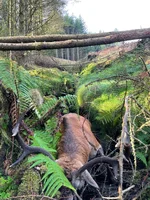
Would you leave him ?

Whether it's a red deer, a Highland bull or a Suffolk ram makes bugger all difference when it comes to selecting good animal genetics.
But I should think that genetics is probably something you know bugger all about.
I know one thing about genetics and that is those three won't be passing there DNA genes on 🤗
Watch your fingers when doing those two muntys 😂
 
If you want "good genetics", stop looking at the antlers and instead consider conformation and body condition for the time of year.
Whilst I agree to a certain extent with this Tim, and cognisant that I only have limited experience of "managing" such animals, I was struck by the comments of the experienced FLS Ranger up on Arran who commended my colleague for shooting pre-rut what turned out to be the biggest stag shot that entire season (23 and a half stone), as he was a poor 8-pointer. In a managed park herd he would I suggest been a "keeper" but as far as he was concerned, he was a good one to take out.

IMG_2023.webpIMG_2049.webpIMG_2047.webp
 
Last edited:
Whilst I agree to a certain extent with this Tim, and cognisant that I only have limited experience of "managing" such animals, I was struck by the comments of the experienced FLS Ranger up on Arran who commended my colleague for shooting pre-rut what turned out to be the biggest stag shot that entire season (23 and a half stone), as he was a poor 8-pointer. In a managed park herd he would I suggest been a "keeper" but as far as he was concerned, he was a good one to take out.

View attachment 463079View attachment 463080View attachment 463082
That just goes to show why it's a mistake to use antlers as the primary culling criteria.
 
Another tangent to this discussion is the question.....are you culling to keep the numbers down or trophy hunting for a nice head?
Me - I'll just take whichever animal the stalker I'm out with tells me is a suitable animal, if it has a nice head and worth keeping, all well and good.
 
I know one thing about genetics and that is those three won't be passing there DNA genes on 🤗
Watch your fingers when doing those two muntys 😂
Instead of always making facetious remarks, why not put your grown-up hat on, and try to have a sensible discussion about genetic improvement in wild deer through phenotypical selection?
I may not know anything much about red deer specifically, but I do know about selecting for genetic improvement in large ruminant animals. It's a subject that interests me a lot, and if, as you claim, you have some knowledge and experience in this field I'd be glad to hear about it.

Unfortunately, phenotypical selection is the only option available to us in wild deer, and it's not particularly reliable as an animal's appearance can be significantly affected by environmental pressures. We also have no control over their breeding, so there is no guarantee that the male that you retained as a "good one" will actually sire any offspring. Selection of the females will generally give better results and a more sustained gain than selection of the males.

I think you claim to have "improved" the quality of your local red deer through your selection process, and I'd be interested to know by what metric you're measuring that improvement? Can you provide the data to substantiate your claim? For example, can you demonstrate that there's been a sustained gain in lean meat yield as a percentage of carcass weight, or that the ratio of high value to low value cuts has improved over time? These are the sort of things that can be measured and recorded, and will clearly show if the selection criteria you're applying are actually resulting in genetic improvement.

The more characteristics you try to alter at the same time, the slower the rate of gain will be, so it's best to pick a few important traits and concentrate on them.
Aside from antlers (which are purely cosmetic), possibly one of the best traits to evaluate in the field in the live animal is body length. An extra 4 inches on the loin of a fallow doe equals an extra £15 income from the loin alone, so selecting for longer animals by culling the shorter ones makes economical sense.
Winter body condition is also another trait worth selecting for, and again it can relatively easily be assessed in the live animal. Need to take care though not to overselect for this and end up with carcasses that are too fat, as they're wasteful to butcher. In an ideal world we would be selecting for loin muscle depth as well as length, but in wild animals we can only assess this once they're dead.
Another worthwhile trait to select for would be early sexual activity. So keep the males that come into rutting condition ahead of their herd mates. This should result in them siring daughters that come into breeding condition early, with a result that, over a period of years, the birthing date of the herd gradually moves forward. This will give a higher survival rate of the offspring through their first winter, and enable you to maintain an economical cull from a reduced breeding herd size.

Selecting for antlers is great if your income comes from trophy stalking, but not if it inadvertently results in you selecting animals that are less suited to their environment. Otherwise, after a brief improvement, antler quality will decline due to environmental pressure. So characteristics such as body condition etc should take priority over antlers.
 
Last edited:
Instead of always making facetious remarks, why not put your grown-up hat on, and try to have a sensible discussion about genetic improvement in wild deer through phenotypical selection?
I may not know anything much about red deer specifically, but I do know about selecting for genetic improvement in large ruminant animals. It's a subject that interests me a lot, and if, as you claim, you have some knowledge and experience in this field I'd be glad to hear about it.

Unfortunately, phenotypical selection is the only option available to us in wild deer, and it's not particularly reliable as an animal's appearance can be significantly affected by environmental pressures. We also have no control over their breeding, so there is no guarantee that the male that you retained as a "good one" will actually sire any offspring. Selection of the females will generally give better results and a more sustained gain than selection of the males.

I think you claim to have "improved" the quality of your local red deer through your selection process, and I'd be interested to know by what metric you're measuring that improvement? Can you provide the data to substantiate your claim? For example, can you demonstrate that there's been a sustained gain in lean meat yield as a percentage of carcass weight, or that the ratio of high value to low value cuts has improved over time? These are the sort of things that can be measured and recorded, and will clearly show if the selection criteria you're applying are actually resulting in genetic improvement.

The more characteristics you try to alter at the same time, the slower the rate of gain will be, so it's best to pick a few important traits and concentrate on them.
Aside from antlers (which are purely cosmetic), possibly one of the best traits to evaluate in the field in the live animal is body length. An extra 4 inches on the loin of a fallow doe equals an extra £15 income from the loin alone, so selecting for longer animals by culling the shorter ones makes economical sense.
Winter body condition is also another trait worth selecting for, and again it can relatively easily be assessed in the live animal. Need to take care though not to overselect for this and end up with carcasses that are too fat, as they're wasteful to butcher. In an ideal world we would be selecting for loin muscle depth as well as length, but in wild animals we can only assess this once they're dead.
Another worthwhile trait to select for would be early sexual activity. So keep the males that come into rutting condition ahead of their herd mates. This should result in them siring daughters that come into breeding condition early, with a result that, over a period of years, the birthing date of the herd gradually moves forward. This will give a higher survival rate of the offspring through their first winter, and enable you to maintain an economical cull from a reduced breeding herd size.

Selecting for antlers is great if your income comes from trophy stalking, but not if it inadvertently results in you selecting animals that are less suited to their environment. Otherwise, after a brief improvement, antler quality will decline due to environmental pressure. So characteristics such as body condition etc should take priority over antlers.
I'm not even bothering to read one word of your long winded rambling..
Just out of interest are you in your lucky high seat again 🤣
 
Instead of always making facetious remarks, why not put your grown-up hat on, and try to have a sensible discussion about genetic improvement in wild deer through phenotypical selection?
I may not know anything much about red deer specifically, but I do know about selecting for genetic improvement in large ruminant animals. It's a subject that interests me a lot, and if, as you claim, you have some knowledge and experience in this field I'd be glad to hear about it.

Unfortunately, phenotypical selection is the only option available to us in wild deer, and it's not particularly reliable as an animal's appearance can be significantly affected by environmental pressures. We also have no control over their breeding, so there is no guarantee that the male that you retained as a "good one" will actually sire any offspring. Selection of the females will generally give better results and a more sustained gain than selection of the males.

I think you claim to have "improved" the quality of your local red deer through your selection process, and I'd be interested to know by what metric you're measuring that improvement? Can you provide the data to substantiate your claim? For example, can you demonstrate that there's been a sustained gain in lean meat yield as a percentage of carcass weight, or that the ratio of high value to low value cuts has improved over time? These are the sort of things that can be measured and recorded, and will clearly show if the selection criteria you're applying are actually resulting in genetic improvement.

The more characteristics you try to alter at the same time, the slower the rate of gain will be, so it's best to pick a few important traits and concentrate on them.
Aside from antlers (which are purely cosmetic), possibly one of the best traits to evaluate in the field in the live animal is body length. An extra 4 inches on the loin of a fallow doe equals an extra £15 income from the loin alone, so selecting for longer animals by culling the shorter ones makes economical sense.
Winter body condition is also another trait worth selecting for, and again it can relatively easily be assessed in the live animal. Need to take care though not to overselect for this and end up with carcasses that are too fat, as they're wasteful to butcher. In an ideal world we would be selecting for loin muscle depth as well as length, but in wild animals we can only assess this once they're dead.
Another worthwhile trait to select for would be early sexual activity. So keep the males that come into rutting condition ahead of their herd mates. This should result in them siring daughters that come into breeding condition early, with a result that, over a period of years, the birthing date of the herd gradually moves forward. This will give a higher survival rate of the offspring through their first winter, and enable you to maintain an economical cull from a reduced breeding herd size.

Selecting for antlers is great if your income comes from trophy stalking, but not if it inadvertently results in you selecting animals that are less suited to their environment. Otherwise, after a brief improvement, antler quality will decline due to environmental pressure. So characteristics such as body condition etc should take priority over antlers.
I definitely agree with you that selecting females is the way to go and when looking at males body condition is better than antler shape. I think Id go further than that, just shooting enough females (in that it reduces the deer population and browsing competition) makes a difference. Anyone can shot males over the long summer days, but shooting enough females is difficult. I know, I have never managed to get my cull % above about 65% females.
 
Dog chews and bottle openers, roll him over!

But I will say from experience to make sure he is about 150 yards from the truck maximum, preferably within 100 yards of the truck, close enough to shoot out of the window even better🙈😂

That speaking from experience and a bad back thats permanently damaged through being or evil Knievel on dragging red deer.
 
Dog chews and bottle openers, roll him over!

But I will say from experience to make sure he is about 150 yards from the truck maximum, preferably within 100 yards of the truck, close enough to shoot out of the window even better🙈😂

That speaking from experience and a bad back thats permanently damaged through being or evil Knievel on dragging red deer.
I wondered if you had died?
 
I think the key is not to cull based on any single criteria. Selection on single factors is where intensive farming went wrong.

Antlers are both visual and physical tools for dominance. Fighting is the last stage in a gradual escalation of behaviour which is used by deer to assess fitness, if they can avoid fighting they will as it is a risky behaviour. Scent, roaring, posturing (appearance, so combination of factors such as antlers, condition and stature) and finally fighting are all used for deer to assess who is the dominant male. Big antlers may help with posturing but doesn't guarantee a male is 'fitter'. Us selecting solely on antlers shows a complete ignorance of deer biology and behaviour.

A deer which is old and strong but past his prime will potentially have a poorer head than a younger one of poorer genetics but in his prime, even if the older stag is physically bigger and in good condition. However, the DNA of the older stag is largely the same as it ever was and the DNA of the younger one is largely as good as it will ever be. The older stag's semen will still pass on his good genes if he is able to mate. So the real question is how to assess stags such that fair comparison can be made between older and younger stags, how to discern when to let new genetics through and when it is appropriate to cull the younger better antlered males in order to allow the better genes of an older, better genetics male persist for another year or two. The most natural method would be to wait for the rut and then shoot the older losers, although it's more complex than that and obviously irrelevant where populations need to be hammered.
 
Dog chews and bottle openers, roll him over!

But I will say from experience to make sure he is about 150 yards from the truck maximum, preferably within 100 yards of the truck, close enough to shoot out of the window even better🙈😂

That speaking from experience and a bad back thats permanently damaged through being or evil Knievel on dragging red deer.
I’ve learned the hard way and I’m not shooting any I can’t get a strap to or drive up to within 100m.

I was out 3 weeks ago with someone starting out and we saw two nice young stags fighting on the edge of a wood, about 700m from the nearest road and not far off that again where we could get a jeep or tractor. He asked me which one I was going to take, told him neither **** that. The stags walked about 70m broadside from us and walked up the wood. Said we’d hold out for a calf or young hind. No point in ruining a day dragging one of those beasts out
 
I’ve learned the hard way and I’m not shooting any I can’t get a strap to or drive up to within 100m.

I was out 3 weeks ago with someone starting out and we saw two nice young stags fighting on the edge of a wood, about 700m from the nearest road and not far off that again where we could get a jeep or tractor. He asked me which one I was going to take, told him neither **** that. The stags walked about 70m broadside from us and walked up the wood. Said we’d hold out for a calf or young hind. No point in ruining a day dragging one of those beasts out
Completely agree, although a knife, some meat bags, and a large rucksack sorts it out too and leaves some goodies for the natural predators
 
Dog chews and bottle openers, roll him over!

But I will say from experience to make sure he is about 150 yards from the truck maximum, preferably within 100 yards of the truck, close enough to shoot out of the window even better🙈😂

That speaking from experience and a bad back thats permanently damaged through being or evil Knievel on dragging red deer.
52D611AE-5CB2-4D5E-9E59-3523A67A6526.webp

Stalking out across a field last weekend and after seeing a number of different stags over the previous few weeks floating in and out, he was grazing the farmers rape with a much bigger stag, so that sealed his faith.

Rolled him over and met the farmer who thought he was impressive, so I’ve boiled him out and the farmers delighted with him as some wall art.
 
I'm not even bothering to read one word of your long winded rambling..
Just out of interest are you in your lucky high seat again 🤣
Well, a bloke with a few Red deer, probably descended from the Beaudessert herd adjacent to the Chace is the World expert n them. WOW!!!! He doesn't even have to listen to genetic speak, he knows it all. Amazing folk on here.
 
  • Haha
Reactions: VSS
Thanks and duly noted. I thought his body condition was good given the time of year. Taken a few spikers recently and all in similar condition, still good fat reserves.


View attachment 463016
I would leave him. Good body. Antlers fill a rectangle shape rather than a triangle.

Real question is how does he compare to others on the ground. IMHO he is the sort of beast to leave.

I took a stag a couple of weeks ago. 10 points and a decent rack but body was quite thin and absolutely no fat on him at all so took him out as there are plenty of better ones around.
 
Back
Top