16 Bore

I have a Webley & Scott 701, single trigger, in 16 bore with 30" barrels and 2 3/4 chambers. Full and half choke. It was made in 1972 and I had Brady's make a case for it. I love its sweet lines, but other than the odd pheasant I can't hit a thing with it.
 
I have a Webley & Scott 701, single trigger, in 16 bore with 30" barrels and 2 3/4 chambers. Full and half choke. It was made in 1972 and I had Brady's make a case for it. I love its sweet lines, but other than the odd pheasant I can't hit a thing with it.
I confess to never having seen a Webley with a single trigger. You would probably be doing yourself a great favour if you got the chokes opened out.
I think it’s worth sharing a photograph of it with us.
 
I have a Webley & Scott 701, single trigger, in 16 bore with 30" barrels and 2 3/4 chambers. Full and half choke. It was made in 1972 and I had Brady's make a case for it. I love its sweet lines, but other than the odd pheasant I can't hit a thing with it.
That's very possibly not your fault that's the fault of the gun.

First off shooting is like billiards (so said another - not me - I've just appropriated the quote) it is the easy shots that make up the bag. Therefore IMHO the gun is choked too tightly and would be better at 1/4 and 1/4 or IMP and 1/4. I've never been a fan of 1/4 and 1/2.

Some say that open choke won't make up for poor shooting. That's only partly true. At close range....the easy shot thus the billiards analogy...tight choke will mean that you do "miss" (or more correctly don't put any shot into) a bird that with an open choke you would have put shot in to.

Next I'd suggest that the stock needs looking at to see if it fits you. For if you can hit everything else with other guns that you use then it is the gun that doesn't fit you. Use a good competent fitter not a bloke in a gun shop who sells air rifles and the odd shotgun. A good fitter will tell you what "fit" you need and how near to that the gun in its present measurements is.

So my advice? Have a gun fit and have the gun measured to see how near that fit it measures up to.
 
I have a Webley & Scott 701, single trigger, in 16 bore with 30" barrels and 2 3/4 chambers. Full and half choke. It was made in 1972 and I had Brady's make a case for it. I love its sweet lines, but other than the odd pheasant I can't hit a thing with it.
Harrington and Richardson imported Webley & Scott SxS’s back in the 70’s models 720 and 728 they were cased straight grip double trigger guns . I wanted a 728 some kinda bad and fondled several at a semi local shop . But at the time I was in the 8th or 9th grade and they were if my memory serves about $1200 and I certainly didn’t have that then . That little 728 28 gauge felt like a magic wand .
 
An update.

The 16 been out for some walks. I missed a couple of easy ducks. But early in the new year went for a walk. One shot fired, one snipe in the bag. I like this little gun. It carries beautifully.

Took it down to Braidwood. Constantly missing to the right. Going away birds where I can concentrate, getting the line right. Fast low incoming grouse where in effect snap shooting - off to the right. I shoot left handed, it was cast slightly to the right. And its tightly choked. Even tall clays were utterly smoked by the right barrel and left utterly obliterated them.

Look at a target, close your eyes and mount. Open eyes. Gun pointing well to the right. Work needed

So a wee trip through to Graham Mckinlay’s fine emporium in Dunbarton. If you have any sort of fetish about fine British made guns, especially Scottish ones a visit should definitely be on your bucket list.

He has a good look at the gun. Measured the chokes. Half and Full. Had a look at my mounting, and the gun. Then wife a left handed gun.

Leave with me.

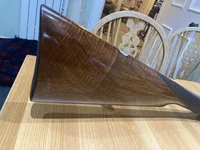
Picked it up a couple of weeks. Ago. It now fits well and points where I look. Graham also opened up the chokes to improved cylinder and 1/4. Have now given the stock a gentle clean up. Took it back a bit with fine sandpaper, just enough to take off the surface finish. There is some good grain below. A couple of coats of red oil, followed by several just plain boiled linseed oil and its looking really good.

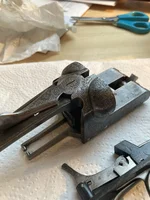
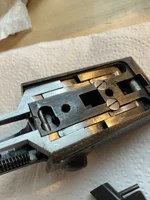
Spent sometime filling up a couple of screwdrivers to fit the pins. Took off the floor plate, trigger plate and action. Have expecting to find bits of rust and lots of gunk inside. Very little. A good blast with carb cleaner, let in dry and liberal application of 3 in 1 followed by a good blow out with compressed air and put back together.

The 16 is not in first flush of youth. The stock and the barrels definitely have some stories to tell. Having good open chokes makes it usable with steel and much better walked up type shooting. It now fits me and will be good for another 80 odd years.

Hound is a gun dog, but she is unimpressed at being used as gun supporting dog!
 

Attachments

  • IMG_8140.webp
    IMG_8140.webp
    219.9 KB · Views: 25
  • IMG_8141.webp
    IMG_8141.webp
    202.6 KB · Views: 23
  • IMG_8130.webp
    IMG_8130.webp
    232.2 KB · Views: 23
  • IMG_8143.webp
    IMG_8143.webp
    175 KB · Views: 23
Last edited:
Now here's a weird German phrase...Nullachtfunfzehn!

Which means it'll do but it's not very good at best.

But literally is zero, eight, fifteen.

Any clues why?
 
Now here's a weird German phrase...Nullachtfunfzehn!

Which means it'll do but it's not very good at best.

But literally is zero, eight, fifteen.

Any clues why?
Wiki, Es gibt mehrere Erklärungsansätze zur Entstehung der Redewendung, die im Zusammenhang mit dem Maschinengewehr 08/15 stehen. 08/15 steht für das Einführungsjahr des Ursprungsmodells MG 08, 1908, und für 1915, das Jahr der Weiterentwicklung. Diese Zahlen wurden in die Waffen eingeschlagen.

  1. Der erste Ansatz[1] führt die Redewendung darauf zurück, dass im Ersten Weltkrieg die deutschen Soldaten täglich mit diesem Maschinengewehr ein langwieriges und eintöniges Training zu absolvieren hatten. So habe die Bezeichnung 08/15 bei den Soldaten irgendwann für langweilige Routine gestanden, derer sie schon lange überdrüssig geworden waren.
  2. Eine andere Erklärung geht auf die Länge des Ersten Weltkrieges zurück und hängt mit der Qualität der Waffen zusammen. Ab dem Zeitpunkt der Einführung des MG 08/15 nahm die Materialqualität ab und die Fehlerhäufigkeit zu. Mit Äußerungen wie „Die Waffe ist 08/15!“ hätten die Soldaten demnach die Bedeutung „von geringer Qualität“ geprägt.
  3. Durch fortschreitende Standardisierung war es möglich, Einzelteile des einschlägig bekannten Maschinengewehrs auch in Fahrrad- oder Schreibmaschinenfabriken herzustellen. Auch die Munition war zu diesem Zeitpunkt schon zwischen verschiedenen Modellen problemlos austauschbar. Der Ausspruch „das ist 08/15“ lässt sich also auch auf einen (durchschnittlichen) Standard beziehen.[2] Translation There are several explanations for the origin of the phrase, which are related to the 08/15 machine gun. 08/15 stands for the year of introduction of the original model MG 08, 1908, and for 1915, the year of further development. These numbers were stamped into the weapons.
    The first approach attributes the idiom to the fact that during the First World War, German soldiers had to complete lengthy and monotonous training with this machine gun every day. At some point, the soldiers used the term 08/15 to mean a boring routine that they had long since grown tired of.
    Another explanation goes back to the length of the First World War and is related to the quality of the weapons. From the time the MG 08/15 was introduced, the material quality decreased and the frequency of errors increased. With statements like “The weapon is run of the mill!” the soldiers would have coined the meaning “of low quality”.
    As standardization progressed, it was possible to produce individual parts of the well-known machine gun in bicycle or typewriter factories. At this point, the ammunition could also be easily interchanged between different models. The saying “that’s run of the mill” can also be referred to an (average) standard.

I know it in todays usage here as "its ok, it will do the job but it is not special".
 
Wiki, Es gibt mehrere Erklärungsansätze zur Entstehung der Redewendung, die im Zusammenhang mit dem Maschinengewehr 08/15 stehen. 08/15 steht für das Einführungsjahr des Ursprungsmodells MG 08, 1908, und für 1915, das Jahr der Weiterentwicklung. Diese Zahlen wurden in die Waffen eingeschlagen.

  1. Der erste Ansatz[1] führt die Redewendung darauf zurück, dass im Ersten Weltkrieg die deutschen Soldaten täglich mit diesem Maschinengewehr ein langwieriges und eintöniges Training zu absolvieren hatten. So habe die Bezeichnung 08/15 bei den Soldaten irgendwann für langweilige Routine gestanden, derer sie schon lange überdrüssig geworden waren.
  2. Eine andere Erklärung geht auf die Länge des Ersten Weltkrieges zurück und hängt mit der Qualität der Waffen zusammen. Ab dem Zeitpunkt der Einführung des MG 08/15 nahm die Materialqualität ab und die Fehlerhäufigkeit zu. Mit Äußerungen wie „Die Waffe ist 08/15!“ hätten die Soldaten demnach die Bedeutung „von geringer Qualität“ geprägt.
  3. Durch fortschreitende Standardisierung war es möglich, Einzelteile des einschlägig bekannten Maschinengewehrs auch in Fahrrad- oder Schreibmaschinenfabriken herzustellen. Auch die Munition war zu diesem Zeitpunkt schon zwischen verschiedenen Modellen problemlos austauschbar. Der Ausspruch „das ist 08/15“ lässt sich also auch auf einen (durchschnittlichen) Standard beziehen.[2] Translation There are several explanations for the origin of the phrase, which are related to the 08/15 machine gun. 08/15 stands for the year of introduction of the original model MG 08, 1908, and for 1915, the year of further development. These numbers were stamped into the weapons.
    The first approach attributes the idiom to the fact that during the First World War, German soldiers had to complete lengthy and monotonous training with this machine gun every day. At some point, the soldiers used the term 08/15 to mean a boring routine that they had long since grown tired of.
    Another explanation goes back to the length of the First World War and is related to the quality of the weapons. From the time the MG 08/15 was introduced, the material quality decreased and the frequency of errors increased. With statements like “The weapon is run of the mill!” the soldiers would have coined the meaning “of low quality”.
    As standardization progressed, it was possible to produce individual parts of the well-known machine gun in bicycle or typewriter factories. At this point, the ammunition could also be easily interchanged between different models. The saying “that’s run of the mill” can also be referred to an (average) standard.
I know it in todays usage here as "its ok, it will do the job but it is not special".
IMG_7178.webp

Here’s the best gun. Alex Martin Sidelock built in 1921 with ribless barrels. It’s used on good fine days. The 16 is the sort of gun I will carry when working to dogs through reed beds and bogs etc. Its a gun to carry and use and not be precious about. The Alex is lovely but it the sort of gun you carry in a slip between drives and you don’t want to drop it.
 
There are several explanations for the origin of the phrase, which are related to the 08/15 machine gun. 08/15 stands for the year of introduction of the original model MG 08, 1908, and for 1915, the year of further development. These numbers were stamped into the weapons.
The first approach attributes the idiom to the fact that during the First World War, German soldiers had to complete lengthy and monotonous training with this machine gun every day. At some point, the soldiers used the term 08/15 to mean a boring routine that they had long since grown tired of.
Another explanation goes back to the length of the First World War and is related to the quality of the weapons. From the time the MG 08/15 was introduced, the material quality decreased and the frequency of errors increased. With statements like “The weapon is run of the mill!” the soldiers would have coined the meaning “of low quality”.
As standardization progressed, it was possible to produce individual parts of the well-known machine gun in bicycle or typewriter factories. At this point, the ammunition could also be easily interchanged between different models. The saying “that’s run of the mill” can also be referred to an (average) standard.
No. I don't think that's actually really why. German weapons quality remained good. So I the internet explanation quoted is wrong.

It's true origin is that compared to the Allies' Lewis Machine Gun or even the Chauchat it was actually a poor, supposed, LIGHT Machine Gun.

So it'd do, at a pinch, as an LMG, but it wasn't really anywhere at all near ideal, still had a water jacket, weighed 40lbs compared to the 30lbs or so of the Lewis and but 20 lbs of the Chauchat and so wasn't the best solution. And certainly not light! It's an explanation that is the correct one. It'll do but it's not very good at best. A read of Wikipedia about the MG 08/15 expresses well why.

 
This is such a cool gun. Totally steam punk and of British design and patent. Pity it needs to be on an FAC.


When I made the earlier post I forgot the pair of Browning Citori 16’s I had thirty years ago . The first was a 28” Lightening I used that gun almost exclusively at that time for dove and sporting clays . Also had a Citori Upland Special 24” straight grip gun , it was my go to Ruffed Grouse gun at the time .
 
Back
Top