.223 For CWD, Muntjac and Scottish Roe / Non Lead Options

UpNorthMI

Well-Known Member
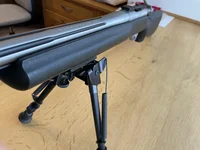
As I'm in the process of a new .223 rifle for foxing, I started to think about using it for smaller deer and if it would be effective with new non lead bullets. All of my prior stalking with lead ammo involved a minimum of .243 for roe and red hinds, lot's of .308 for everything and .338 WM for the big beasts. I've started to shoot non lead where forced to do so and have that sorted for my .308 and bigger calibers. I have not ventured in the .243 or smaller non lead bullets until now.

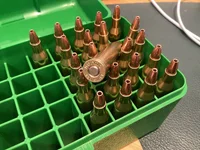
My prior .223 deer shooting experience is very limited and goes back 30 or so years when I got to use my friends .223 on roe one afternoon in Scotland. I was very unimpressed after shooting 2 roe deer out at about 150 yards, and decided stalking with a .223 would never be an option for me. A lot has changed since then, most newer .223 rifles have tighter twists like 1 in 8" allowing heavier bullet use and of course the non lead requirement seems to be fast becoming a standard requirement. I'm currently loading heavier lead bullets in .223 like the 60 grain Nosler BT and some Sierra 63 grain semi pointed rounds, my newer .223 (CZ 527 has 1 in 9" twist) seems to be shooting these well but both of these bullets are more varmint based. I just loaded some Maker T-Rex non lead bullets but have yet to shoot them or test them on any live quarry.

Looking to hear what other people are using on CWD and Muntjac in England. Those using .223 for deer what lead bullets have they found that worked well and has anyone found any good non lead bullets that are performing well on smaller deer up to and including roe?

Trying to work out if I'm wasting my time thinking about .223 for smaller deer or if I should just keep using a .308 with 130gn non lead for everything. I'm not a fan of being under gunned, I appreciate that hitting the right spot is important but I do like a little margin of safety in that a reasonable shot will knock them down!
 
As I'm in the process of a new .223 rifle for foxing, I started to think about using it for smaller deer and if it would be effective with new non lead bullets. All of my prior stalking with lead ammo involved a minimum of .243 for roe and red hinds, lot's of .308 for everything and .338 WM for the big beasts. I've started to shoot non lead where forced to do so and have that sorted for my .308 and bigger calibers. I have not ventured in the .243 or smaller non lead bullets until now.

My prior .223 deer shooting experience is very limited and goes back 30 or so years when I got to use my friends .223 on roe one afternoon in Scotland. I was very unimpressed after shooting 2 roe deer out at about 150 yards, and decided stalking with a .223 would never be an option for me. A lot has changed since then, most newer .223 rifles have tighter twists like 1 in 8" allowing heavier bullet use and of course the non lead requirement seems to be fast becoming a standard requirement. I'm currently loading heavier lead bullets in .223 like the 60 grain Nosler BT and some Sierra 63 grain semi pointed rounds, my newer .223 (CZ 527 has 1 in 9" twist) seems to be shooting these well but both of these bullets are more varmint based. I just loaded some Maker T-Rex non lead bullets but have yet to shoot them or test them on any live quarry.

Looking to hear what other people are using on CWD and Muntjac in England. Those using .223 for deer what lead bullets have they found that worked well and has anyone found any good non lead bullets that are performing well on smaller deer up to and including roe?

Trying to work out if I'm wasting my time thinking about .223 for smaller deer or if I should just keep using a .308 with 130gn non lead for everything. I'm not a fan of being under gunned, I appreciate that hitting the right spot is important but I do like a little margin of safety in that a reasonable shot will knock them down!
For lead bullets the lapua & Norma soft point are about as good as you’ll get I think.
The 50grn Barnes ttsx is awesome on deer & fox 🦊
 
.223 will be grand with the ttsx! I like the .22.250 more than the .223 though, harder hitting and bucks the wind better than the .223 with the added fps advantage
 
For lead bullets the lapua & Norma soft point are about as good as you’ll get I think.
The 50grn Barnes ttsx is awesome on deer & fox 🦊

The Norma soft points you are referring to are these the Norma Oryx bullets, I just picked up a couple of boxes in 50gn to try them. I normally use these type of bonded bullets in my .375 H&H or .300 WM for heavy or dangerous game. Not really sure what to expect with a bonded bullet in .223 for smaller deer!
 
The Norma soft points you are referring to are these the Norma Oryx bullets, I just picked up a couple of boxes in 50gn to try them. I normally use these type of bonded bullets in my .375 H&H or .300 WM for heavy or dangerous game. Not really sure what to expect with a bonded bullet in .223 for smaller deer!
I’ve never used the small oryx bullets, just the standard soft points. Unless they are the same thing?
I’m sure they will be excellent!
 
Thanks for the input on this, I have decided that it's not going to be a .223, I'm just not feeling it is enough gun at times and have decided to move forward with a .243 barrel for the R8, I can share my .30 cal moderator, can use my thermal that already is fitted to a quick release Blaser mount and have the ability to use a range of ammunition that will cover from fox to Red deer in both lead and non lead ammo.
 
I use the 51 grain Peregrine bullet in my 223. Fox, Crows and Roe deer all fall over dead and have taken shots out to about 150 metres so far.

Not much mess. Roe have either dropped on the spot or taken a few steps. I have had one where bullet went a bit far back and shot it again at longer range it dropped dead. That was operator error rather than bullet.

I pretty much always use the 223 on Roe these days.
 
I would have shot hundreds of roe with the 223 and don’t feel like it wasn’t enough gun. I’ve not tried any non-lead but used 55gr Sako factory soft points and 55gr Sierra spbt. Put the bullet in the right place and it does its job without much damage.
 
I use the 51 grain Peregrine bullet in my 223. Fox, Crows and Roe deer all fall over dead and have taken shots out to about 150 metres so far.

Not much mess. Roe have either dropped on the spot or taken a few steps. I have had one where bullet went a bit far back and shot it again at longer range it dropped dead. That was operator error rather than bullet.

I pretty much always use the 223 on Roe these days.
I've just started playing with the 58gn, accuracy is good enough. Not chrono'd it yet, but QL seems reassuring.
 
We go to war arming our super troopers with 5.56/.223 to kill another human.. but it's only good for Munties & Chinks in England :scared:

I use 60grain Vmax on Muntjac & Chinks out to 250 yards neck and it's superb.
 
.223 kills them all just fine with no dramas!

I’m convinced it would kill other larger species just as well also 🤔

I’m sure there are people around the world are using the .223 on larger species than Roe with good results? 🤷‍♂️
They use 223 vs feral pigs in the USA. Seems to work well when put in the right place.
 
I have had some issues with copper in 223 . Failing to expand to any real degree with Barnes Ttsx on CWD ( a bullet i very much favour in the 260rem 100 grain / 120 grain out to maximum ranges ). I put 4 shots in only one was poor accuracy / placement effected , the last one put it down instantly , its the most bullets i have ever put into a single deer .
 
I'm one to believe, it's best to take a calibre knowing its more than capable to get the job done.
If out after Fallow or larger, 308 is the go to, knowing it will take anything, even down to muntjac, using 165gr copper rounds.
No it doesn't destroy muntjac unless it hits hard bone or taken when not side on, it tends to punch a hole cleanly through otherwise.
The 243 goes out if after Roe, muntjac and CWD but will take fallow if one unexpectedly comes along, using 85gr copper rounds.
These do seem to make a bit more of a mess on muntjac but not greatly.
223 if on the foxes, knowing it will take muntjac and CWD if required, 55gr Norma non copper rounds work best out of my tikka t3 varmint so head and neck shots if going into food chain.
Everyone will have a different opinion from their own results but generally I find its angle of the shot that affects the amount of meat damage but that's my thoughts.
 
I have shot Muntjac and CWD with Hornady 50 grain copper and also CWD. I have also shot CWD with the Hornady. With my 223
TBF I Am now using an Alpex on the 223 rifle and that makes it the same weight as my 260 rem ( both the Sako ) . So i am thinking the 223 will be almost entirely a vermin gun when i can shoot into dark but we shall see . The 260rem has also dome enough of the small deer with the 100 grain tTSX . For a lighter option on vermin i will just take the .22 hornet if i want a lighter .22 cf ( though it cannot do copper ) ,as it has not feed or shoot anything longer than the 45 grain lead and will not reach the 1000 ft Lb required by law
 
Nothing wrong with a .22CF for small deer
You could kill roe deer with ball bearings and frozen peas at the appropriate terminal velocity and placement!

If is isn't working effectively one of two things are failing:
1) Wrong bullet choice, no such thing as a "copper bullet that doesn't work". Whatever you chose may not work for your specific application/terminal velocity etc, as with many lead bullet choices, its a bullet design choice issue not a component metal issue. Running a decent design at sensible velocities with an appropriate shot placement and the .224 is perfect for roe

2) Operator error
 
Standard factory 14 twist sends 50gr TTSX ‘swiftly’
Very effective non-toxic combo.
Expand well and terminal effect is very effective on roe.
Tips need pulling to stabilise them, takes less than 5 minutes to do a box.
I think most 22CF would be similar. Swift is just swifter 😁

IMG_1204.webp

image.webp
 
Back
Top