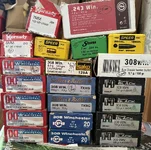
243 legal??

When ever I had suspect stability issues I just tipped more powder in if pressure sign was still good. What with reloading data being tamed over the decades rpm has been unwittingly dropping.
An often overlooked aspect to ballistic calculations is time! Revs per second, minute or nano second play an important role.
Takes some figuring out but it's true. It's not just bullet length, diameter and weight that determines a rate of twist, it is also the expected velocity of the cartridge too.

With hindsight 243 should of been 1:9". Then all the sissy's to scared to make the rifle sing could still get stabilized. Remington made the same mistake with the rem 244 express!
 
Remington and Savage sped twist up a wee bit. Remingtons are 9 and one eighth inch, Savage 9 and a quarter.

I’ve just not had this “stability” problem with the 1:10”. I’ve had a couple of slightly fussy .243 rifles, but nothing remotely like the problems with 100gr bullets the interweb would have you believe. And neither have countless other fairly serious .243 shooters I’ve come across, here in NZ, the US, the UK. There’s a couple of professionals on this forum that use the .243 exclusively with 100gr bullets, and its not like they’ve had a problem either. And one reason for this I believe is we all use the shorter and potentially most common 100gr bullet, the Sierra ProHunter (1540).

There are two reasons likely to underpin the issue of 100gr bullets. One is that there is definitely a bunch of bullets made by the main manufacturers that are longer than the stability calculator would like. Some by just a fraction, others by a fair bit, the boat tails in particular. But these bullets are almost all made by American manufacturers, and guess what, Americans buy Remington’s and Savages.

The other I think is powder. I had a long break from reloading .243 because for a few years (shock horror) I used bulk factory ammo. When I returned to NZ I bought a new rifle, couldn’t get the same bulk ammo, so reloading it was. I made a classic mistake. I tried to use too fast a powder, with too low a case fill ratio. This problem has come up time and time again, these faster powders are all listed in the reloading manual and as you might expect, guys want to economise and use something they already have. There are posts on here every week it seems about using powders that are just not right for the .243 Winchester case. My previous Tikka and current Howa hated Varget and H4895, but they are both listed as options.

In recent months I’ve had my eyes opened by a reloader I know who is using properly slow magnum powders for this cartridge in a 1:10” Tikka, with compressed low pressure loads, and man do they shoot. He’s not getting any problems with the 100gr boat-tails, just tiny wee groups.

So yeah, maybe internal ballistics are up there near the top of the list for those reloaders struggling with 10 twist barrels.

Regarding the issue of velocity, I don’t push my 100 grain loads that fast, 2820 ft/sec in my current 20 inch barrel. It’s a relatively upper middle range load, and I could confidently push the case to around 2950 ft/sec if I chose. So with the 1:10” Howa, velocity doesn’t seem to be a factor. Case fill ratio is around 92% with H4350 from memory.

My gut feel is that there’s more the 100gr bullet problems than just twist rate.
 
Remington and Savage sped twist up a wee bit. Remingtons are 9 and one eighth inch, Savage 9 and a quarter.

I’ve just not had this “stability” problem with the 1:10”. I’ve had a couple of slightly fussy .243 rifles, but nothing remotely like the problems with 100gr bullets the interweb would have you believe. And neither have countless other fairly serious .243 shooters I’ve come across, here in NZ, the US, the UK. There’s a couple of professionals on this forum that use the .243 exclusively with 100gr bullets, and its not like they’ve had a problem either. And one reason for this I believe is we all use the shorter and potentially most common 100gr bullet, the Sierra ProHunter (1540).

There are two reasons likely to underpin the issue of 100gr bullets. One is that there is definitely a bunch of bullets made by the main manufacturers that are longer than the stability calculator would like. Some by just a fraction, others by a fair bit, the boat tails in particular. But these bullets are almost all made by American manufacturers, and guess what, Americans buy Remington’s and Savages.

The other I think is powder. I had a long break from reloading .243 because for a few years (shock horror) I used bulk factory ammo. When I returned to NZ I bought a new rifle, couldn’t get the same bulk ammo, so reloading it was. I made a classic mistake. I tried to use too fast a powder, with too low a case fill ratio. This problem has come up time and time again, these faster powders are all listed in the reloading manual and as you might expect, guys want to economise and use something they already have. There are posts on here every week it seems about using powders that are just not right for the .243 Winchester case. My previous Tikka and current Howa hated Varget and H4895, but they are both listed as options.

In recent months I’ve had my eyes opened by a reloader I know who is using properly slow magnum powders for this cartridge in a 1:10” Tikka, with compressed low pressure loads, and man do they shoot. He’s not getting any problems with the 100gr boat-tails, just tiny wee groups.

So yeah, maybe internal ballistics are up there near the top of the list for those reloaders struggling with 10 twist barrels.

Regarding the issue of velocity, I don’t push my 100 grain loads that fast, 2820 ft/sec in my current 20 inch barrel. It’s a relatively upper middle range load, and I could confidently push the case to around 2950 ft/sec if I chose. So with the 1:10” Howa, velocity doesn’t seem to be a factor. Case fill ratio is around 92% with H4350 from memory.

My gut feel is that there’s more the 100gr bullet problems than just twist rate.
Perfect post.
Yes slow powders in 243. H4350 was my fave. Tried H414, pants so I stuck with H4350.
 
I feel that this has become and argument about the wrong thing. I am sure there are a lot of people who can shoot a lead core flat base 100grain bullet fine. But that isn't the potential problem, the potential problem is non-lead bullets are going to be longer, perhaps even longer than the marginally stable boat-tail bullets used now and then there might be a problem. Saying "I currently shoot 100grainers fine at the moment" doesn't address the possible future problems. To future proof perhaps advising newcomers to the sport to get something that handles longer bullets far better wouldn't be a bad plan as it future proofs them to a certain extent.

David.
 
I feel that this has become and argument about the wrong thing. I am sure there are a lot of people who can shoot a lead core flat base 100grain bullet fine. But that isn't the potential problem, the potential problem is non-lead bullets are going to be longer, perhaps even longer than the marginally stable boat-tail bullets used now and then there might be a problem. Saying "I currently shoot 100grainers fine at the moment" doesn't address the possible future problems. To future proof perhaps advising newcomers to the sport to get something that handles longer bullets far better wouldn't be a bad plan as it future proofs them to a certain extent.

David.
Agree. Buy any 6.5 that's has factory ammunition readily available, eg 6.5 x 55 or 6.5 Creedmoor or another larger mainstream calibre (270 Win or 308 Win).
Best regards
JCS
 
I feel that this has become and argument about the wrong thing. I am sure there are a lot of people who can shoot a lead core flat base 100grain bullet fine. But that isn't the potential problem, the potential problem is non-lead bullets are going to be longer, perhaps even longer than the marginally stable boat-tail bullets used now and then there might be a problem. Saying "I currently shoot 100grainers fine at the moment" doesn't address the possible future problems. To future proof perhaps advising newcomers to the sport to get something that handles longer bullets far better wouldn't be a bad plan as it future proofs them to a certain extent.

David.
One of the reasons I gave to justify changing my smaller “deer” rifle from 243 to 6.5x55 was. The ability to fire a larger deer legal non toxic bullet for use in Scotland. The FEO was quite happy with my reason.
If someone intended to shoot larger deer north of the boarder I would advise something that would be capable of using a non toxic bullet
 
Get the bit about non-lead bullets but for an old git like me it is a bit academic outlawing of lead is five years away
maybe even a bit longer so I guess I will more than likely be done with shooting by that time.
However as far as lead goes my 1in 10 twist shoots just just fine it shoots 100gr and 105gr without any fuss it also shoots
boat tails without any fuss.
I will admit I'm no ballistics expert but I have never really understood why everyone seems to load to the max when I
have found in my case at least a mid range load is much more accurate than a max load.
Nor is my loading what would be described as a usual load for .243 but I simply worked up a load with what was
available at the time and more or less stuck to have been loading the same load for thirty years the only thing thats
changed in that time is that I have substituted the Hornady boat tails for pro hunters
100gr pro hunters 37 gr H380 magnum primers that 37 gr is a mid range load ,still have a couple of lbs of H380 but will
need to look for an alternative when its gone.
works for me.
 
I feel that this has become and argument about the wrong thing. I am sure there are a lot of people who can shoot a lead core flat base 100grain bullet fine. But that isn't the potential problem, the potential problem is non-lead bullets are going to be longer, perhaps even longer than the marginally stable boat-tail bullets used now and then there might be a problem. Saying "I currently shoot 100grainers fine at the moment" doesn't address the possible future problems. To future proof perhaps advising newcomers to the sport to get something that handles longer bullets far better wouldn't be a bad plan as it future proofs them to a certain extent.

It’s called thread drift. Happens all the time.

And this thread’s original question was answered on page 1. Nothing more to see!

And we’re not arguing either, for once. I’m sure it can be arranged though.
 
Interesting debate.

I live in a Scotland and have always had a .243 and always bought 100g factory ammo. I have never been to a shop where I cannot buy 100g soft point .243 ammo. Indeed I would suggest it’s one of the most common rounds?

It’s perfect for me on mixed arable and woodland land. I mainly shoot roe, and it does the job perfectly. Mr fox doesn’t complain and if I choose to take a red I can. When it was my only rifle I shot plenty of clean hill stags and many hinds with this round without issue.

I suppose I feel it’s a good all rounder (in my situation).

I then added a .30-06 to the cabinet which I now use solely for red deer.

I haven’t yet done my research but given I mainly shoot Roe I assume I could get a suitable non lead round? Therefore perfectly suitable for the main use, but it wouldn’t tick the legal box for reds?

I do agree if you were buying a red deer rifle one wouldn’t pick the .243.

Indeed, if I could have only one calibre for both my everyday stalking and suitable for the hill I would probably get a .25-06 or .270 (amongst others)..... BUT I don’t yet know if my choice would change if applying none lead loads. Thoughts?
 
Interesting debate.

I live in a Scotland and have always had a .243 and always bought 100g factory ammo. I have never been to a shop where I cannot buy 100g soft point .243 ammo. Indeed I would suggest it’s one of the most common rounds?

It’s perfect for me on mixed arable and woodland land. I mainly shoot roe, and it does the job perfectly. Mr fox doesn’t complain and if I choose to take a red I can. When it was my only rifle I shot plenty of clean hill stags and many hinds with this round without issue.

I suppose I feel it’s a good all rounder (in my situation).

I then added a .30-06 to the cabinet which I now use solely for red deer.

I haven’t yet done my research but given I mainly shoot Roe I assume I could get a suitable non lead round? Therefore perfectly suitable for the main use, but it wouldn’t tick the legal box for reds?

I do agree if you were buying a red deer rifle one wouldn’t pick the .243.

Indeed, if I could have only one calibre for both my everyday stalking and suitable for the hill I would probably get a .25-06 or .270 (amongst others)..... BUT I don’t yet know if my choice would change if applying none lead loads. Thoughts?
I think you've summed it up perfectly.

If we had the same law as England then a .243 would be all that I needed.
 
Interesting debate.

I live in a Scotland and have always had a .243 and always bought 100g factory ammo. I have never been to a shop where I cannot buy 100g soft point .243 ammo. Indeed I would suggest it’s one of the most common rounds?

It’s perfect for me on mixed arable and woodland land. I mainly shoot roe, and it does the job perfectly. Mr fox doesn’t complain and if I choose to take a red I can. When it was my only rifle I shot plenty of clean hill stags and many hinds with this round without issue.

I suppose I feel it’s a good all rounder (in my situation).

I then added a .30-06 to the cabinet which I now use solely for red deer.

I haven’t yet done my research but given I mainly shoot Roe I assume I could get a suitable non lead round? Therefore perfectly suitable for the main use, but it wouldn’t tick the legal box for reds?

I do agree if you were buying a red deer rifle one wouldn’t pick the .243.

Indeed, if I could have only one calibre for both my everyday stalking and suitable for the hill I would probably get a .25-06 or .270 (amongst others)..... BUT I don’t yet know if my choice would change if applying none lead loads. Thoughts?
If it came to it you could use the 80 grain TTSX (to name one) for instance. I am sure that there will be more choice as time goes on.
Your current 30-06 would have no problem with non lead bullets.
I have no experience with 25-06 but 270 would work fine. For many years it was my friends go to rifle he shot all over the UK and Ireland (partly why he had the 270 in the first place).
I now have the choice of 6.5x55 or 270 either one I can feed non toxic.
I was set up with rifles I liked that were very accurate and covered everything I was likely to shoot. However a rifle I really like in a calibre that preempts any restrictions on lead.
I would advise a new stalker to choose a 6.5 of some description rather than 243, not because it isn’t a capable round. But because it won’t fit the Law and would limit the opportunities for stalking anything bigger than Roe in Scotland. Let’s face it you would potentially be missing out on some cracking stalking.
 
My 243 SM prohunter will group 5 rounds touching ( in ideal conditions) with 100gn norma, sako and 105gn geco. I am going down in price with each brand but the 100/105s group well. I also use 80gn copper sako Power head for DI/WT areas. These group satisfactorily for hunting but probably 1.5 inch 5 rnd grouping.

The 100/105s are all flat bottomed bullets but the copper 80gn looks like it has a wee bit of a boat tail, but not as much as others I’ve seen. When I started with the rifle I bought 100gn federal, HorAndy and Remington and it didn’t group any of them better than 2”. I wonder of they were boat tailed.

i hadn’t realised until reading this thread that the shape made any difference. But what dodgyknees says is interesting, that longer boat tails loaded differently might be key.

im hoping manufacturers design something that means I can keep using 243 accurately if/when lead ban arrives.
 

Attachments

  • 8761E172-E98E-4C22-995A-E9E7543EE0BF.webp
    8761E172-E98E-4C22-995A-E9E7543EE0BF.webp
    125.7 KB · Views: 14
It is more complicated than just lead vs. copper, and whether a boat tail improves BC whilst pushing the length forward for the same mass, or a compromise. Whilst having to engineer the thing and machine it to deliver good terminal performance for hunting across a wide range of use cases. Not easy, somewhat subjective, and still very much early days I think.

Or simplified theoretical stability calculation that knows nothing about the mass distribution of the material of the bullet, nor the aerodynamic instabilities of it's shape. Nor the precision with which it has been manufactured, no bullet will be perfectly in balance for spin stability, they will all have some degree of nutation.

Poorer ones might just diverge until they even end up flying sideways. Good ones might manage to converge. Sometimes giving better results at longer ranges ("going to sleep" theory. Target shooters have known this for years, trying to push lead cored stuff to the ragged edge. Whilst using the slowest twist rate that works, over-"stabilisation" with fast twists being noticeably detrimental to accuracy too.

Hence the received wisdom to go light for calibre, push velocity (for stability and possibly terminal ballistics, depending how "hard" the construction is), etc.

That seems to still be the thing with Barnes, but now it seems there are many others having a go at this, with their own ideas, some may be very good indeed, others less so, 'twas ever thus.

Then there is the alloy composition. Copper is not necessarily pure copper, I doubt that that would work very well at all, at least only for a few shots until the barrel was copper fouled.

Indeed with things like Fox I think they only claim to be some sort of brass, which is a substantially less dense material, being alloyed primarily with zinc.

So I'd say it is early days before non toxic materials are as well understood and proven as the old lead stuff, but it does seem that already we have some very good options.

However, I think it is pretty clear that a .243, originally designed to shoot say an explosive lead varmint bullet in the 70 grain class fast and flat, maybe nowadays with a faster twist taking it up to be usable with 100 grains, is becoming borderline for non toxic, unless say the Scots see sense and change their regulations to make more sense for what I'm sure could still be a very effective calibre, but with slightly lighter bullets.

It's all very odd. I can, and have legally shot Fallow and Red in England with .243 70 grain bullets (not very suitable explosive ones, estate rifle, normally used for park culling, headshots). Illegal in Scotland.

Yet I may not shoot a Roe with say a .223 or smaller. Whereas that is deemed a very suitable calibre in Scotland.

However I can shoot muntjac with such things, which In my limited experience are far far tougher than roe, which are delicate things by comparison it seems to me Even a classic boiler room shot with a 30-06 resulted in one runner, at least 150 yards, heart destroyed, one shoulder literally blown off (precise raking shot from the left side, unbelievable, only stopped when it had basically bled out. Adrenalin, reflexes, unshockability, determination I'm sure. Respect.

Of course, officially the are as yet no Muntjac in Scotland, and long may that continue, seriously, despite being great sport and very tasty. So their people might not have an opinion about what to shoot them with, and hopefully won't need to learn.

So we do have some inconsistencies in legislation which I think need to be addressed in anticipation of lead free, possibly changed, brought into line, or at least properly researched, because, I have no doubt that this is coming. Meanwhile .270, .308 etc. are safe bets and known to work.

So I am told.

Never having yet shot a "copper" bullet.
 
Last edited:
Missed out a vital few words, as in "maybe nowadays with a faster twist taking it up to be usable with 100 grains using non toxic"

Of course it will shoot 100 grains of lead, but that's not necessarily it's best feature, certainly of three experienced guides I've been out with we used .243 only for small deer, and a couple of times when we came across fallow and one red, loaded with 70 grain Accutips, which were for the park culling (headshots), small deer, foxing etc. When we went out intentionally looking for large deer it was 270, 308 or 30-06 every time. With which I understand there is no difficulty stabilising suitable non toxic bullets for anywhere in the UK. Unlike the .243.

Anyway I have no great experience, nor any of none toxic, but do listen to what my guides have told me.

I don't want to chew over the endless debate about whether it is an appropriate calibre for larger deer, but the OP was questioning whether there were any 100 grain non toxics that would work well in the usual sort of .243 rifle. Presumably thinking from a Scottish context.

Which I think is pertinent going forward. To which, my thinking is, probably not. So either change the Scottish law to bring it in line with say English law, where sub 100 grain bullets are considered effective (but maybe not ideal) on large deer, or redesign the rifle with a faster twist rate, which is hardly practical
 
No.

The bit you got woefully wrong was “However, I think it is pretty clear that a .243, originally designed to shoot say an explosive lead varmint bullet in the 70 grain class fast and flat...”

This is complete bollocks. Time to do your research. Haven’t we already been through all this, you and I?
 
No.

The bit you got woefully wrong was “However, I think it is pretty clear that a .243, originally designed to shoot say an explosive lead varmint bullet in the 70 grain class fast and flat...”

This is complete bollocks. Time to do your research. Haven’t we already been through all this, you and I?
I get the feeling that many people choose to “forget” that they designed the 243 as a dual purpose rifle.
 
Back
Top