5.56×45 NATO - .223 Remington. Same but different?

User00044

Well-Known Member
This is a follow on to a discussion that occurred in another thread .

I prophered that it should be safe to shoot 5.56 NATO in a rifle chambered in .223 Remington that is built to comply CIP specs' as both are rated to the same Pmax . There are however very slight differences in the chamber dimensions but not the cartridge dimensions , I should add that 5.56 ammo uses thicker brass and crimped primers .

@Bowland blades took the opposite stance .

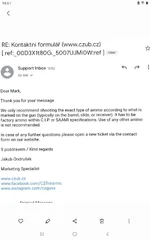
In an attempt to add weight to my argument , I posted a post from another forum which contained a reply from CZ .Screenshot_20230921-202559_Chrome.jpg
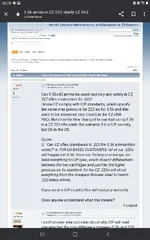
That was then and this is now ,
Screenshot_20230927-180736_Gallery.jpg
1 step forward and 1 back .

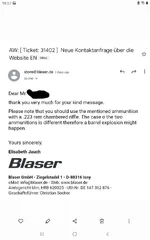
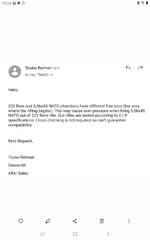
I emailed four other manufacturers , so far only Sako have failed to replied. They were all asked the same question, "Could they confirm as to whether it is safe to use 5.56×45NATO ammo in one of their rifles chambered in .223 Remington?"

Here are the replies,
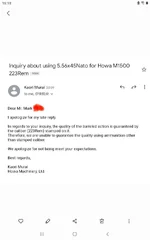
IMG_2388.webp

Screenshot_20230927-182305_Gallery.jpg
Screenshot_20230927-182709_Gallery.jpg

The only conclusion I've reached is that before using 5.56 ammo in your own rifle , for your own safety you should email the manufacturer and ask the question as to whether they regard it safe beforehand, regardless of the email replies I've posted, If only to safeguard the warranty.
If Sako reply I shall post that as well .
I shall endeavour to find and read the CIP information on the matter , when time allows .
For now I'll let you all draw your own conclusion .😉
 
Last edited by a moderator:
This is a follow on to a discussion that occurred in another thread .

I prophered that it should be safe to shoot 5.56 NATO in a rifle chambered in .223 Remington that is built to comply CIP specs' as both are rated to the same Pmax . There are however very slight differences in the chamber dimensions but not the cartridge dimensions , I should add that 5.56 ammo uses thicker brass and crimped primers .

@Bowland blades took the opposite stance .

In an attempt to add weight to my argument , I posted a post from another forum which contained a reply from CZ .View attachment 330406
That was then and this is now ,
View attachment 330407
1 step forward and 1 back .

I emailed four other manufacturers , so far only Sako have failed to replied. They were all asked the same question, "Could they confirm as to whether it is safe to use 5.56×45NATO ammo in one of their rifles chambered in .223 Remington?"

Here are the replies,
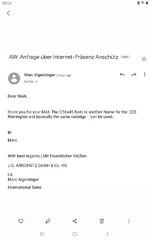
View attachment 330408
View attachment 330414
View attachment 330415

The only conclusion I've reached is that before using 5.56 ammo in your own rifle you should email the manufacturer and ask the question as to whether they regard it safe beforehand, regardless of the email replies I've posted, If only to safeguard the warranty.
If Sako reply I shall post that as well .
I shall endeavour to find and read the CIP information on the matter , when time allows .
For now I'll let you all draw your own conclusion .😉
Remember you have two replies saying dont do it , the confusion is if a company chambers the Nato version its OK to shoot 223 !
if the company chambers as 223 rem its NOT ok to shoot the Nato !
The 223 rem came out just prior to Nato acceptance and differences exist
Remember though that getting away with doing something you might get away with it until the time you dont .
 
Wonder how these rifles that supposedly won't safely shoot 5.56 ever pass proof.....
Seen a 22-250 brand new go through UK proof with a barrel that was basically spun on by hand ! Do you think it was ever fired ? But proof do not fire the Nato spec to proof a 223 rem . As stated you should only shoot the nato round in a gun which has a chamber cut to do that and the two are different just look up the drawings .
 
Remember you have two replies saying dont do it , the confusion is if a company chambers the Nato version its OK to shoot 223 !
if the company chambers as 223 rem its NOT ok to shoot the Nato !
The 223 rem came out just prior to Nato acceptance and differences exist
Remember though that getting away with doing something you might get away with it until the time you dont .

There's three manufacturers saying don't do it and one that says it's okay !

The whole point of my emailing the manufacturers was to get their stance on the matter as a reference and point of interest and to share that information on the forum , not to add weight to any argument . Had the latter been the case I'd have just posted the Anschutz reply or not bothered .
 
It may be naive but if a 223/5.6 etc is proofed in a CIP country it will have the longer chamber dimensions forward of the cartridge case and should therefore be fine with a NATO round, they are operated at the same proof pressure and the longer leade should kep the pressures in check. I know that when @scrumbag of this parish bought a CZ527 in Switzerland and he could get Swiss Army ammunition for very competitive prices at his club he checked with CZ and they said it was fine.

David.
 
Last edited:
but if a 223/5.6 etc is proofed in a CIP country it will have the longer chamber dimensions forward of the cartridge case and should therefore be fine with a NATO round,

Why should a 223 Rem rifle have that chamber if proofed in a CIP country? 5.56x45mm NATO is a military cartridge whose rifles are chambered as per the dimensions and tolerances laid out in the relevant NATO STANAG. There is no civilian 5.66 standard either in CIP or SAAMI. As the military chamber has a longer freebore, any CIP spec 223 proof round can be used in it for test purposes.

The question in this topic - as others have pointed out - isn't about 223 CIP or SAAMI spec ammunition being safe when fired in a 5.56 chamber, but the reverse.


In a similar vein, I have put .308 and 7.62x51 through the same rifle.

Yes. ............. and so? 308 Win and 7.62 NATO are one case preceding the other by some 30 years which has no commonality with or relevance to 223/5.56 other than there again being slightly different military and civilian chamber specifications. What is different is that no rifle manufacturers print warnings about firing 7.62 in their 308 rifles.
 
The often quoted differences in chamber pressures between the two rounds does not take into account the different methods of measuring the pressures.
See video below starting at time 4:20

 
Perfectly safe, 308win chamber is rated at a higher pressure than 7.62

It's not actually, or not enough to make a real difference. NATO measures and calibrates chamber pressures in a different way to SAAMI, so the headline figures aren't comparable. On the face of it, 308 has an MAP 12,000 psi higher than 7.62, but the actual difference is 2,000 psi in 308's favour, but only for SAAMI 308 Win at 62,000 psi vs 60,000 psi for 7.62. CIP on the other hand rates 308 Win at the same 60,000 psi. Internal ballistics tells you anyway that the standard NATO 1950s era ball round load of a 144-150gn bullet at a nominal 2,800 fps MV from a 21-inch barrel employs similar pressures to those used in comparable .308 Win sporting cartridges.

When there are occasional problems, it's usually the other way round with 308 Win ammunition over-pressure in some 7.62 rifles, a particular issue in 'TR' rifles and military conversions. Because our NRA (likewise Australian, Canadian, and New Zealand) used off the shelf military specification 7.62mm ball rounds for several decades with their undersize bullets in 'Target Rifle', most such rifles were built with non-SAAMI compliant 'tight' barrels, ie undersize bore and groove dimensions to suit the 'skinny' bullets. When military ammo was finally dropped and the NRA began purchasing commercial match ammunition, originally from RUAG (RWS brand) with 0.3080"-dia. Sierra 155gn MatchKings, there were two fall-outs. First the cartridges had to be downloaded slightly to suit TR barrels, which remain 'undersize' albeit nothing like as much as in the early days after the changeover. This led to problems in the final year of the RUAG contract where that year's supply of cartridges proved to be over-pressure in hot weather conditions in that year's 'Imperial' meeting at Bisley in many rifles. (Ironically, the NRA rejected the remaining cartridges and returned them to RWS who tested them and found them within allowed pressures in a CIP-spec test barrel, and who put them back on general sale as 308 Win Match in different cartons.)

Secondly, the 'tightest' of the 'tight' barrel TR rifles were the Number 4 service rifles rebuilt as 7.62s in the early days of 7.62 adoption especially when fitted with the heavy-profile match/sniper barrel produced by RSAF Enfield Lock in its final years. Allied to the relatively weak Enfield No.4 action, full-pressure 308 Win ammo was potentially dangerous, and users were warned about this at the time.
 
More correct, although of less relevance today to us since the Tory handgun ban is the very real difference between 9mm Luger as loaded in the USA and 9mm Parabellum as loaded in the UK and more especially British 9mm 2Z. But that's water under the bridge in 2023.
 
Why should a 223 Rem rifle have that chamber if proofed in a CIP country? 5.56x45mm NATO is a military cartridge whose rifles are chambered as per the dimensions and tolerances laid out in the relevant NATO STANAG. There is no civilian 5.66 standard either in CIP or SAAMI. As the military chamber has a longer freebore, any CIP spec 223 proof round can be used in it for test purposes.

The question in this topic - as others have pointed out - isn't about 223 CIP or SAAMI spec ammunition being safe when fired in a 5.56 chamber, but the reverse.


Yes. ............. and so? 308 Win and 7.62 NATO are one case preceding the other by some 30 years which has no commonality with or relevance to 223/5.56 other than there again being slightly different military and civilian chamber specifications. What is different is that no rifle manufacturers print warnings about firing 7.62 in their 308 rifles.
Basically you can put a small thing in a big hole but you cant ( or rather pertaining to the actual subject " should not ") put the big thing in a small hole principle
 
Back
Top