
You are using an out of date browser. It may not display this or other websites correctly.
You should upgrade or use an alternative browser.
You should upgrade or use an alternative browser.
6.5x55 Case Length
- Thread starter purdey24
- Start date


Foxyboy43
Well-Known Member
On the Viht site it’s 2.157” but whats a couple of thou…and defo a better Vernier required - measuring to 3 decimal places. As if this isn’t confusing enough just wait until you try to find the right COAL for your rifle! The 6.5 is the Linda Lovelace of the reloading world (younger members - don’t ask your father for god’s sake!).Recommended trim to length is 2.155 - your measurements look like they need another decimal place added to them.


purdey24
Well-Known Member
So I take it that you recon you can stick anything down its throat.On the Viht site it’s 2.157” but whats a couple of thou…and defo a better Vernier required - measuring to 3 decimal places. As if this isn’t confusing enough just wait until you try to find the right COAL for your rifle! The 6.5 is the Linda Lovelace of the reloading world (younger members - don’t ask your father for god’s sake!).
purdey24
Well-Known Member
Don't know, that is why I asked.Apply some critical thinking: What do you think would be the outcome of using them? ~Muir
You need to know maximum case length and the trim to length spec. 2.165 - .010 . Assuming you left a digit out 2.155 is fine if you did not that neck is rather short. Did you measure after sizing? Has the brass been trimmed before sizing? Another problem is the cases may have been short from PPU. So we have 2.14 what? The final digit is needed.I am about to start reloading 6.5x55.
I have once fired PPU cases which I used for zeroing but when I mike the cases they come out at 2.14. the recommended length is 2.15. is this ok to use?

A Guy Out West
Well-Known Member
I have heard rumor that it is acceptable for factory new brass to come as much as 20 thousands under the max length. I have found that the Nosler super duper turn key premium brass comes close to that number. Muir answered this a couple of weeks ago in a question about crimping. Trim to the shortest case length, as long as it within reason, load and crimp. Within reason is 20 thousands under max case length. If our op is not going to crimp, the minuscule difference in the lengths provided makes no difference at all. Good shooting to our Comrad. Max length is paramount. I’ve got a library of loading manuals, Nosler, Western Rivers, Hornady all your questions answered with a little reading time. Most are on line for free.
Last edited:

Foxyboy43
Well-Known Member
Your call my friend. I have found the chamber to be sooooo long that if you bother to chase the lands the bullet will fall out of the case! That said they do like it long….So I take it that you recon you can stick anything down its throat.
Their is no "trim to length" specification. Though by convention a number halfway between the specified min. and max. case length is usually suggested.
It's pointless to measure the once fired brass until you first have resized it. It will become longer with every resizing. Until eventually it's getting close to the max. limit, which is the point at which you definitely need to trim it back.
To wherever you choose to do so. If you don't have an adjustable trimmer, say you use a Lee Cutter and case length gauge, then your trim length will be that of the tool, as Lee made it. Which will probably be close to the halfway point.
This is the only trim tool that I use.
If you want to trim a little shorter than that, you can grind down the tip of the length gauge by the extra amount. Measuring to a suitable level of precision of course.
If you are not crimping, then variations within this tolerance band will have little effect, unless you are into extreme precision. If you are crimping, then they all need to be the same length, otherwise the crimp may be inconsistent from one to another.
But to do that properly, as @Muir does, you have to be trimming your cases every time, which is more effort than I like. Besides I only crimp two chamberings, for use in Lever action rifles with a tube magazine.
TBH there is something to be said for beginning by trimming them all close to the minimum length, then reloading them for as many times, without trimming each time, until one or more are beginning to approach the max. length. Then trim the whole lot back again. Saving a lot of work. Do measure them though, but don't necessarily think that you have to trim them every time. If you keep notes, you will soon get a feel for how much the cases grow with each resizing, and so have an idea how many times you might be able to reload without trimming. Then set yourself a method, such as e.g. trim every 3, or 5, or whatever, resizings, whether they need it or not.
Study the actual specification:
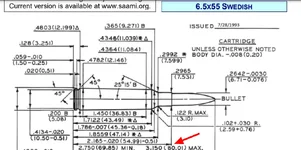
It's pointless to measure the once fired brass until you first have resized it. It will become longer with every resizing. Until eventually it's getting close to the max. limit, which is the point at which you definitely need to trim it back.
To wherever you choose to do so. If you don't have an adjustable trimmer, say you use a Lee Cutter and case length gauge, then your trim length will be that of the tool, as Lee made it. Which will probably be close to the halfway point.
This is the only trim tool that I use.
If you want to trim a little shorter than that, you can grind down the tip of the length gauge by the extra amount. Measuring to a suitable level of precision of course.
If you are not crimping, then variations within this tolerance band will have little effect, unless you are into extreme precision. If you are crimping, then they all need to be the same length, otherwise the crimp may be inconsistent from one to another.
But to do that properly, as @Muir does, you have to be trimming your cases every time, which is more effort than I like. Besides I only crimp two chamberings, for use in Lever action rifles with a tube magazine.
TBH there is something to be said for beginning by trimming them all close to the minimum length, then reloading them for as many times, without trimming each time, until one or more are beginning to approach the max. length. Then trim the whole lot back again. Saving a lot of work. Do measure them though, but don't necessarily think that you have to trim them every time. If you keep notes, you will soon get a feel for how much the cases grow with each resizing, and so have an idea how many times you might be able to reload without trimming. Then set yourself a method, such as e.g. trim every 3, or 5, or whatever, resizings, whether they need it or not.
Study the actual specification:
Which would be incorrect.Considering it is the 6.5x55mm there is a strong possibility that the maximum case length is 55mm. Trim to 54.75mm when required.
Technically, of course, you might describe the chambering as 6.71 x 54.991 mm. Or maybe 6.71 x 80.01
No trim to length spec? All of my hard bound load manuals list .010 from max case length. For example, 22-250 max case length 1.912 with a case trim length of 1.902 listed in Hornady Manual tenth edition. Could that be described as a spec? Describing the .010 trim as spec maybe be nothing more than semantics as this is a common amount to trim. Does Saami really care about what we as handloaders do to our brass I rather think not.
Simplistic.No trim to length spec? All of my hard bound load manuals list .010 from max case length. For example, 22-250 max case length 1.912 with a case trim length of 1.902 listed in Hornady Manual tenth edition. Could that be described as a spec? Describing the .010 trim as spec maybe be nothing more than semantics as this is a common amount to trim. Does Saami really care about what we as handloaders do to our brass I rather think not.
That's just SAAMI's sort of rule of thumb, (i.e. difference between min. and max. of 20/1000"), to give their clientele (ammunition manufacturers, not reloaders), something to aim for, in a voluntary way. Probably not based on any analysis or testing, but rather a practical round number that is readily achievable in mass production. Anywhere in that ballpark will do.
That's when they aren't trying to draw up, retrospectively, chamberings that they played no part in the standardisation of, many of which existed long before SAAMI existed. And others were defined outside of the US, but nonetheless SAAMI attempt to take them over.
E.g. study the 338 Lapua Magnum. Not invented there. Nevertheless they have drawn it up, hedged about with yellow, and red, warnings. OMG, we aren't prepared to just translate the CIP spec, oh no, we will make up our own ideas, disregard others, and add a few (the ones in yellow). What a dogs breakfast they made of that.
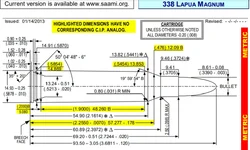
Yet again we see the same old rule of thumb "- 0.020" tolerance on case length. Plucked from the air.
Together with their shoulder position (Junction Cone) measurement approach, unchanged since they first began. As in, drill a hole specified to 0.001" (0.476") and then try to measure the distance between where it's knife edge might touch upon some point on there, yet specify that "headspace" to within 0.0001" (2.2550"), even though the shoulder angle will further multiply any such imprecision. Farcical.
If you use a Hornady case comparator, that's what you get, a cylindrical hole drilled into aluminium. Fair does, that's how SAAMI specify it. Whereas if you buy a Sinclair bushing it is conical, cut to the precise shoulder angle of the case for which it is to be used. Both do the job, as comparators. But as an engineer I know which is the superior approach for actually measuring something.
It's details like this that seem nonsensical to me, and of no useful applicability to reloaders.
Contrast that with the proper original CIP drawing. Finland being a CIP nation.
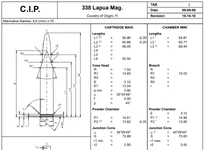
L3 applies. Only the max. specified. No minimum. No arbitrary 20/1000". And, for the interested, L3 for the chamber (minimum, no max.). With the tightest combination allowing 0.25mm clearance.
Again, CIP specify the shoulder position in a way that can actually be measured, using conical bush cut to the precise shoulder angle of the case. alpha. 40 degrees + 45 minutes, minus 11 minutes.
I do have a pet gripe about SAAMI's habit of sometimes converting to inches with rounding error, then reverse calculating back again into into mm and putting the mm figures in brackets. It is quite the other way around. Since the 1950s the inch has been defined as exactly 25.4mm.
Even in the US, in precision industries, things are usually drawn up and measured in SI units, have been for many years. Since the standardisation of the "metric yard". 0.9144 m. And the precision machinery usually calibrated that way.
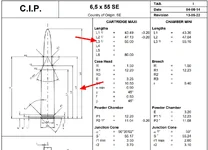
BTW, here is the pukka drawing for the 6.5 x 55 SE. NB. L3 is 55.00mm. Maximum. Not 54.991mm (doh, they got it wrong by nine microns) as SAAMI would have you believe. minus 0.51mm (AKA 20/1000") I think they just made that bit up, because it's expected, what they always have done..
Similar threads
- Replies
- 6
- Views
- 465


- Replies
- 16
- Views
- 1K

- Replies
- 13
- Views
- 889

- Replies
- 13
- Views
- 530

